Finnish Internet Forum 2024 — In-Depth Report: Minutes Digest & 3-Line Summary
The 3-Line Summary
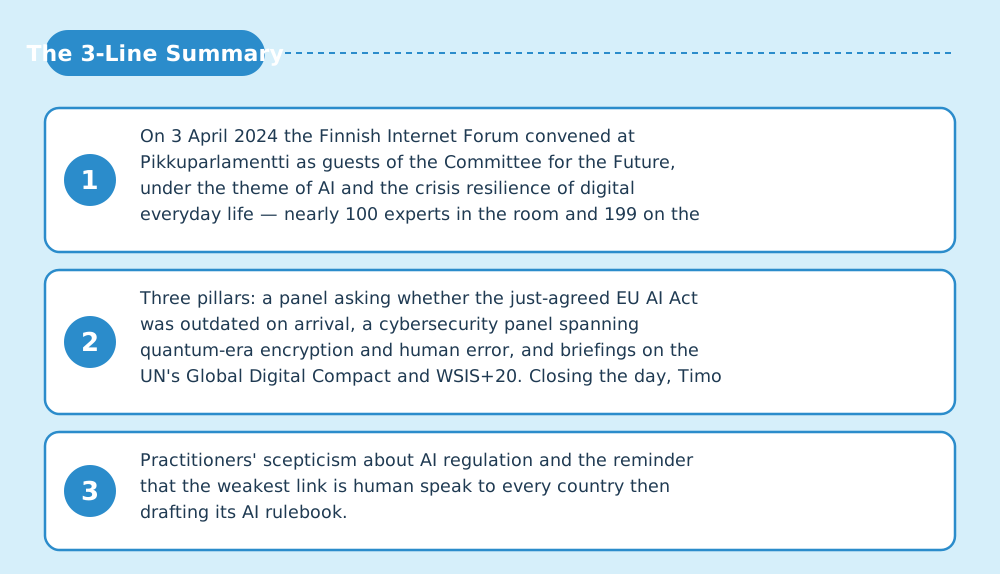
- On 3 April 2024 the Finnish Internet Forum convened at Pikkuparlamentti as guests of the Committee for the Future, under the theme of AI and the crisis resilience of digital everyday life — nearly 100 experts in the room and 199 on the webcast.
- Three pillars: a panel asking whether the just-agreed EU AI Act was outdated on arrival, a cybersecurity panel spanning quantum-era encryption and human error, and briefings on the UN's Global Digital Compact and WSIS+20. Closing the day, Timo Harakka called AI 'the most important political question of our time'.
- Practitioners' scepticism about AI regulation and the reminder that the weakest link is human speak to every country then drafting its AI rulebook.
Welcome — this is the Japan IGF Support Organization. This in-depth report on Finnish Internet Forum 2024 draws on official outputs, session records and on-site reporting. In a hurry? The three lines above and the diagrams carry the gist.
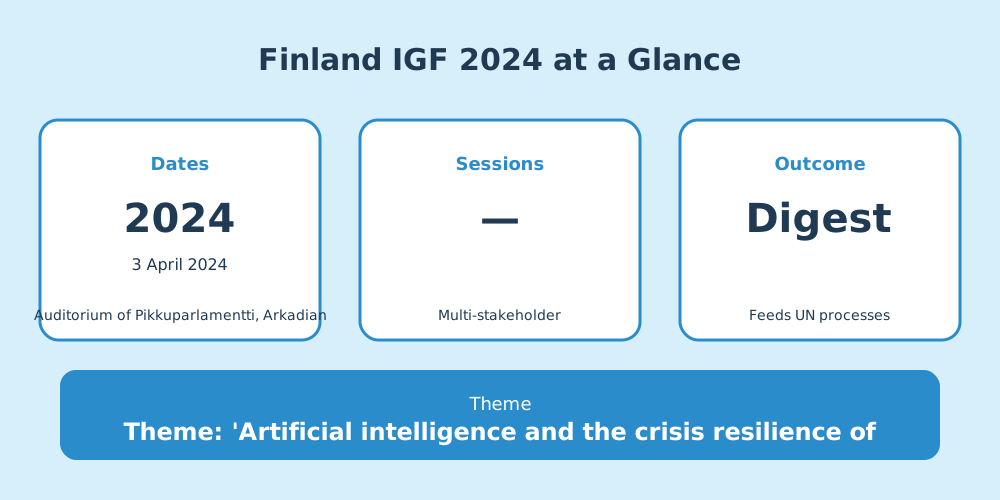
Conference at a Glance (from official records)
| Item | Detail |
|---|---|
| Official name | Finnish Internet Forum 2024 |
| Dates | 3 April 2024 |
| Venue | Auditorium of Pikkuparlamentti, Arkadiankatu 3, Helsinki |
| Theme | Theme: 'Artificial intelligence and the crisis resilience of the internet-enabled digital everyday' |
| Host | Hosted by Parliament's Committee for the Future (opened by chair Aino-Kaisa Pekonen MP, closed by vice-chair Timo Harakka MP); organised by a group including the MFA, the Ministry of Transport and Communications, ISOC Finland, TIVIA and EFFI |
(See the source list at the end of this article.)
Discussion Digest — from the Session Records
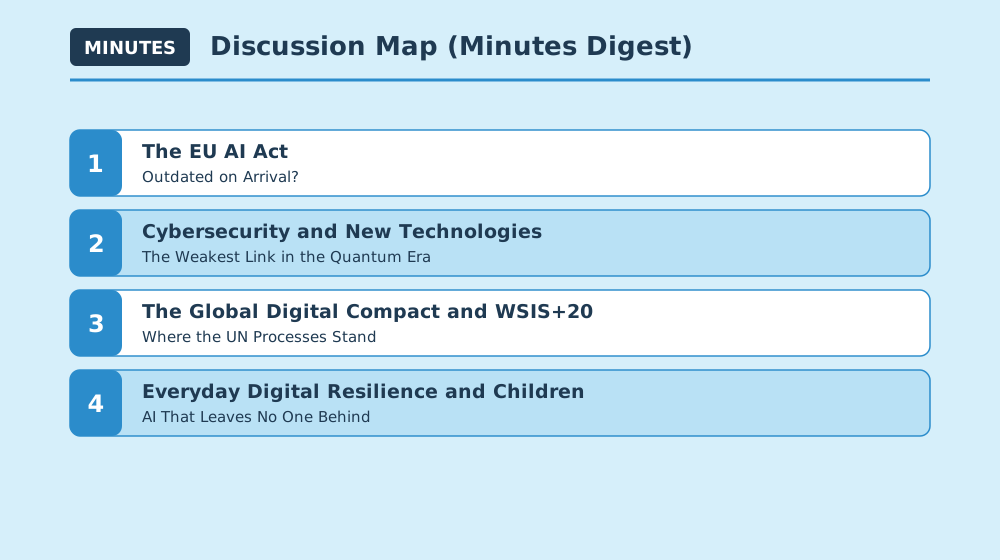
Key exchanges extracted from session records and transcripts.
1. The EU AI Act — Outdated on Arrival?
Sessions: Panel I 'The EU AI Act — obsolete before completion?' (moderated by Tommi Karttaavi, with Prof. Petri Myllymäki, MP Aura Salla, Save the Children's Anna-Maija Ohlsson and EFFI's Tapani Tarvainen; comments by Technology Industries' Joonas Mikkilä and MEP Miapetra Kumpula-Natri remotely)
"Metaverse business has been done for years in Silicon Valley-type places. Realism has been forgotten — there is a huge amount of regulation, overlapping lengthwise, crosswise and diagonally (translated from Finnish)"
— Aura Salla, MP [1][2]
"(AI) is the most important political question of our time (translated from Finnish)"
— Timo Harakka, vice-chair of the Committee for the Future, in his closing summary [1][2]
- Most panellists felt the AI Act was already passé; EFFI's Tarvainen argued it 'was written for the technologies of the past — systems and models keep evolving' [1][2]
- The burden of continuous reporting and administration was criticised, along with the paradox that big companies with compliance resources benefit most, and doubts about officials' expertise [1][2]
- Technology Industries Finland announced a EUR 10 million investment to accelerate AI adoption and a EUR 3.2 million foundation donation towards Aalto University's new AI research centre [1][2]
2. Cybersecurity and New Technologies — The Weakest Link in the Quantum Era
Sessions: Panel II 'Cybersecurity and new technologies' (moderated by Deputy National Cybersecurity Director Stefan Lee, with VTT's Petri Puhakainen, Women4Cyber Finland founder Noora Hammar and WithSecure Chief Research Officer Mikko Hyppönen)
- WithSecure's Hyppönen argued the danger of the AI era is excessive trust rather than lost trust — scams keep multiplying, with 'CEO fraud' a growing corporate threat [1][2]
- All agreed the weakest link is human; the risk horizon ran from the targeting of experts themselves to China's massive quantum investments and networks spreading to 6G and space [1][2]
- Training teachers and professionals, and strengthening media literacy and critical thinking at every level, were named the pillars of preparedness — with the caveat that coming generations are not automatically digital natives [1][2]
3. The Global Digital Compact and WSIS+20 — Where the UN Processes Stand
Sessions: Briefing session (Prof. David Souter remotely and MFA development-policy adviser Aki Enkenberg; convened by ISOC Finland's Yrjö Länsipuro)
- Souter — lead consultant of the WSIS 10-year review — explained WSIS+20 and the GDC, concluding that WSIS's human-centred, inclusive, development-oriented principles survived even as optimism gave way to risk-awareness [1][2][3]
- On the GDC's first draft, published the day before, Souter's first impression was that it was more substantive than many, himself included, had expected [1][2][3]
- The MFA's Enkenberg stressed finding the UN's natural role while regulation is also built regionally, notably in the EU — with Finland an active WSIS participant from the start [1][2][3]
4. Everyday Digital Resilience and Children — AI That Leaves No One Behind
Sessions: Opening briefing by Traficom's Kirsi Karlamaa and the child-safety and literacy strand of Panel I
- Traficom's Karlamaa reported rising DDoS attacks testing security, naming cooperation and skills as the priorities ahead [1]
- Save the Children's Ohlsson urged that children be included in decision-making, citing massive online harms, violence, bullying and growing device dependency [1]
- Families who think AI does not concern them are already on the wrong side of a new inequality, the discussion warned — putting mainstream media, media-literacy education and teacher training at the centre of the response [1]
Three-Minute Short Talk — Your Questions Answered
Q. What did this meeting decide?
A. Nothing binding — it was the 2024 edition of the revived FIF, hosted by Parliament's Committee for the Future, with ~100 experts in the room and 199 online.
Q. What was the most contentious topic?
A. The EU AI Act: most panellists called it outdated on arrival, citing overlapping rules and a big-company advantage — while the closing summary countered that AI is 'the most important political question of our time'.
Q. Why should I care?
A. The AI Act reaches companies far beyond Europe, and the 'weakest link is human' warning about CEO fraud and AI-assisted scams applies to every workplace and family.
What Is Finland IGF? (for first-time readers)
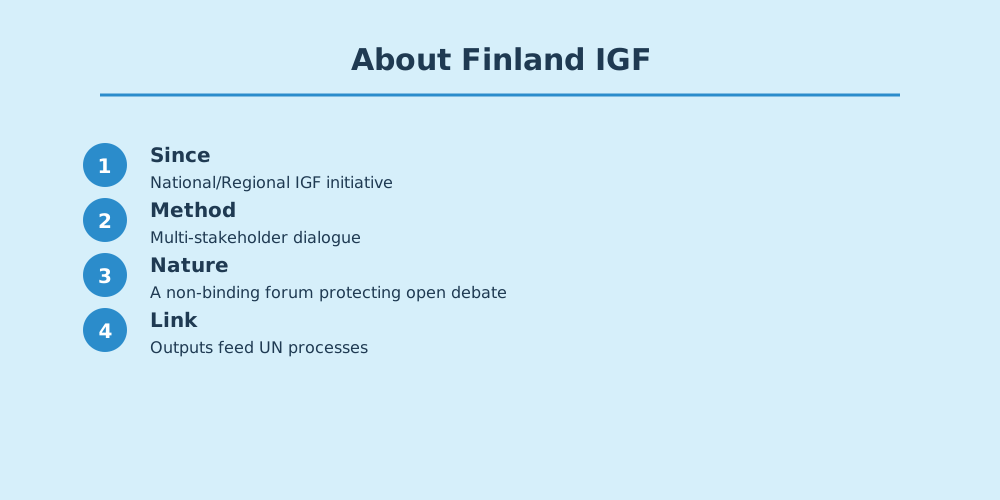
Finland IGF is a National or Regional IGF Initiative (NRI), aligning local internet governance discussion with global IGF principles.
Why It Matters to You
What was discussed here becomes the baseline for national digital policy, platform rules and AI regulation worldwide within a few years. The principles confirmed at the 2024 meeting are the foundation of the "next rules" for the phones, social platforms and AI services you use every day.
Sources & References
- Finnish Internet Forum 2024(TIVIAニナ・フロムによる公式事後報告・参加者数と各パネルの発言記録) — Finnish Internet Forum(internetforum.fi) (accessed 2026-07-23)
- Tekoälyn haasteet ja digiarjen resilienssi vuoden 2024 aiheet(公式事後報告・GDC/WSIS+20セッション詳細) — Finnish Internet Forum(internetforum.fi) (accessed 2026-07-23)
- Finnish Internet Forum 2024 huhtikuun alussa(公式開催告知・2024年3月9日、プログラムと登壇者) — Finnish Internet Forum(internetforum.fi) (accessed 2026-07-23)
- Aiemmat foorumit(公式過去大会一覧・2024年録画リンク掲載) — Finnish Internet Forum(internetforum.fi) (accessed 2026-07-23)
- National IGF Initiatives – WEOGグループ詳細(フィンランドNRI記録・年次会合=2024年4月3日ヘルシンキ) — 国連IGF事務局 (UN IGF Secretariat)(Wayback 2025-06-09) (accessed 2026-07-23)
Quotes are translated or condensed from the records listed above. Bracketed numbers [n] refer to the source list.
Related links
- IGF official (NRI list): https://www.intgovforum.org/en/content/national-and-regional-igf-initiatives
- Japan IGF: https://japanigf.jp/
- Yuki Nakazawa's blog: https://nkzw.jp/category/igf/
更新履歴
第1稿投稿 2026年8月5日 14時55分(記事コンテンツアップ)
— 中澤祐樹