


This essay applies the framework of Organizational Learning — most prominently associated with Peter Senge — to analyze the ASEAN IGF 2017 Jakarta conference from a management perspective. Target audience: executives, MBA students, management researchers, consultants, and policy analysts.
Executive Summary
Senge's The Fifth Discipline presented five disciplines: personal mastery, mental models, shared vision, team learning, systems thinking. ASEAN IGF is a global-scale learning system.
For firms operating in Indonesia and adjacent ASEAN協調, データ越境, プライバシー domains, this essay maps how to incorporate the conference debate into strategic decision-making through the lens of Five disciplines.
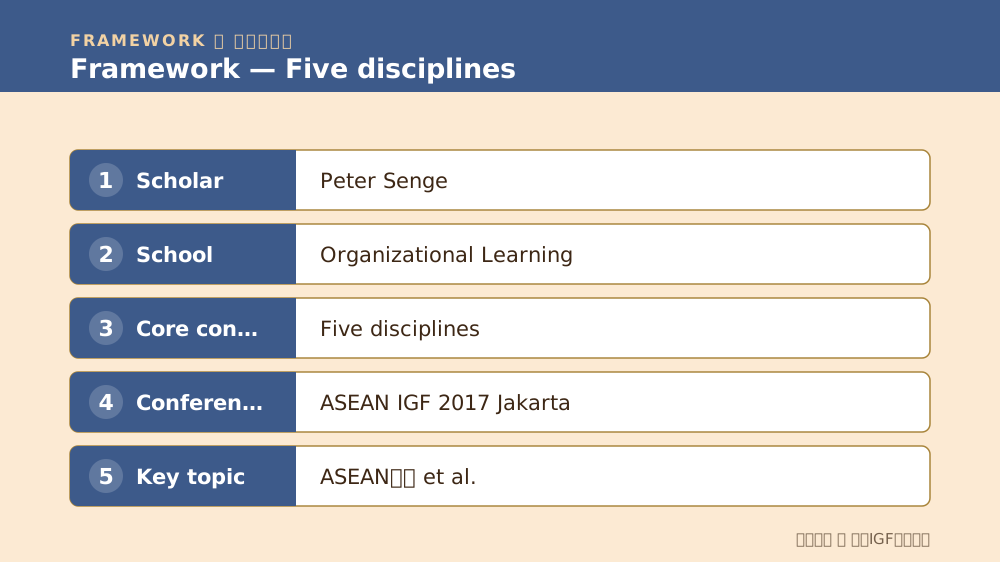
IGF as a learning system
For Indonesia's participating organizations to maximize learning outcomes from 2017, the five disciplines from individual personal mastery to organizational systems thinking must be honed simultaneously.
The theoretical framework of Peter Senge provides a lens to read the 2017 debate not as mere "industry trends" but as a precursor of structural change. The fact that this is a regional-level discussion has direct strategic implications for the geographic scope of the target market.
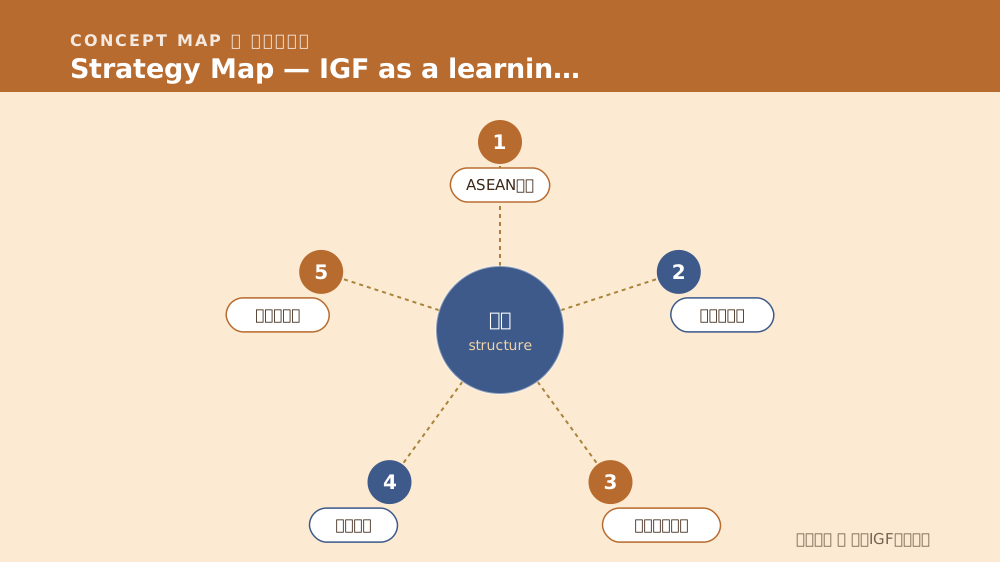
Applying systems thinking
For practical application, we map the applicability of Five disciplines to each topic at the conference.
1. Application to "ASEAN協調"
The discussion on "ASEAN協調" can be located, in Peter Senge's framework, as a primary strategic variable.
Concrete managerial implications include:
- Implications for Indonesia's market: early identification of regulatory trends and preemptive business-model adjustment
- Impact on competitive advantage: monitoring competitors' moves and reviewing one's differentiation strategy
- Investment decisions: allocation of R&D investment and reconfiguration of the portfolio
2. Application to "データ越境"
The discussion on "データ越境" can be located, in Peter Senge's framework, as an important constraint.
Concrete managerial implications include:
- Implications for Indonesia's market: early identification of regulatory trends and preemptive business-model adjustment
- Impact on competitive advantage: monitoring competitors' moves and reviewing one's differentiation strategy
- Investment decisions: allocation of R&D investment and reconfiguration of the portfolio
3. Application to "プライバシー"
The discussion on "プライバシー" can be located, in Peter Senge's framework, as an auxiliary topic.
Concrete managerial implications include:
- Implications for Indonesia's market: early identification of regulatory trends and preemptive business-model adjustment
- Impact on competitive advantage: monitoring competitors' moves and reviewing one's differentiation strategy
- Investment decisions: allocation of R&D investment and reconfiguration of the portfolio
4. Application to "地域協調"
The discussion on "地域協調" can be located, in Peter Senge's framework, as an auxiliary topic.
Concrete managerial implications include:
- Implications for Indonesia's market: early identification of regulatory trends and preemptive business-model adjustment
- Impact on competitive advantage: monitoring competitors' moves and reviewing one's differentiation strategy
- Investment decisions: allocation of R&D investment and reconfiguration of the portfolio
5. Application to "越境データ"
The discussion on "越境データ" can be located, in Peter Senge's framework, as an auxiliary topic.
Concrete managerial implications include:
- Implications for Indonesia's market: early identification of regulatory trends and preemptive business-model adjustment
- Impact on competitive advantage: monitoring competitors' moves and reviewing one's differentiation strategy
- Investment decisions: allocation of R&D investment and reconfiguration of the portfolio
Strategic Actions for Firms Operating in Indonesia
We translate the management analysis above into concrete actions for firms operating in Indonesia.
Short-term (within 6 months)
- Intelligence gathering: closely read the ASEAN IGF 2017 minutes and reports; share with the corporate strategy function
- Stakeholder mapping: identify relevant regulators, industry associations, and civil society organizations
- Risk assessment: quantify potential impacts of the regulatory directions under discussion
Medium-term (1–3 years)
- Capability building: close the capability gaps identified through the Five disciplines framework
- Alliance strategy: cultivate relationships with the international IGF community
- Regulatory dialogue: shift from reactive compliance to proactive agenda-setting
Long-term (3–10 years)
- Business model reconstruction: structural transformation informed by Peter Senge's framework
- Contribution to international standard-setting: sustained participation in venues like ASEAN IGF
- Norm formation from Indonesia: accumulation of soft power through distinctive contributions to international debate
ROI Analysis Perspective
In Peter Senge's framework, ROI of investment in ASEAN IGF participation is evaluated not as a single-year financial metric but as multi-year option value. This aligns with the "real options" approach to decision-making under uncertainty.
| Dimension | Short-term ROI | Long-term option value |
|---|---|---|
| Direct financial | Limited | Medium–Large |
| Network capital | Medium | Large |
| Brand / legitimacy | Medium | Large |
| Policy intelligence | Large | Medium–Large |
| Talent development | Medium | Large |
Conclusion: A Question to Executives
Reading ASEAN IGF 2017 through the auxiliary line of Peter Senge's framework, the conference emerges not as a mere international gathering but as a site of contemporary implementation of Five disciplines. Executives in Indonesia face a strategic choice: passive observer or active participant.
This essay argues that the latter choice is indispensable for building long-term competitive advantage. Peter Senge's theoretical insight provides the intellectual foundation for that strategic choice.
Primary Sources
- IGF Secretariat. Annual Reports of ASEAN IGF.
- ASEAN IGF 2017 Jakarta Conference Materials.
- Japan IGF Support Organization. https://japanigf.jp/
- Nakazawa Yuki Blog. https://nkzw.jp/category/igf/
Secondary Sources (Management)
- Works of Peter Senge (representative texts of Organizational Learning)
*This piece belongs to the academic essays (management series). Strategic proposals are illustrative applications of general analytical frameworks; specific business judgments require individual due diligence.*
更新履歴
第1稿投稿 2026年6月10日 18時40分(記事コンテンツアップ)
— 中澤祐樹