

This essay applies the conceptual framework of the Communitarianism — most prominently associated with Charles Taylor — to re-read the Arab IGF 2018 Beirut conference. Target audience: researchers, doctoral students, policy analysts, and executives.
Introduction: The Problem
In "The Politics of Recognition", Taylor argues that contemporary identity depends on recognition by others. Arab IGF can be read as a site of recognition for each country, culture, and stakeholder.
This essay argues that the multistakeholder process of Arab IGF becomes intelligible in its specificity only through the concept of Recognition and authenticity, and that the concept itself undergoes transformation under the new material of digital space. Describing this mutual transformation is the task of this essay.
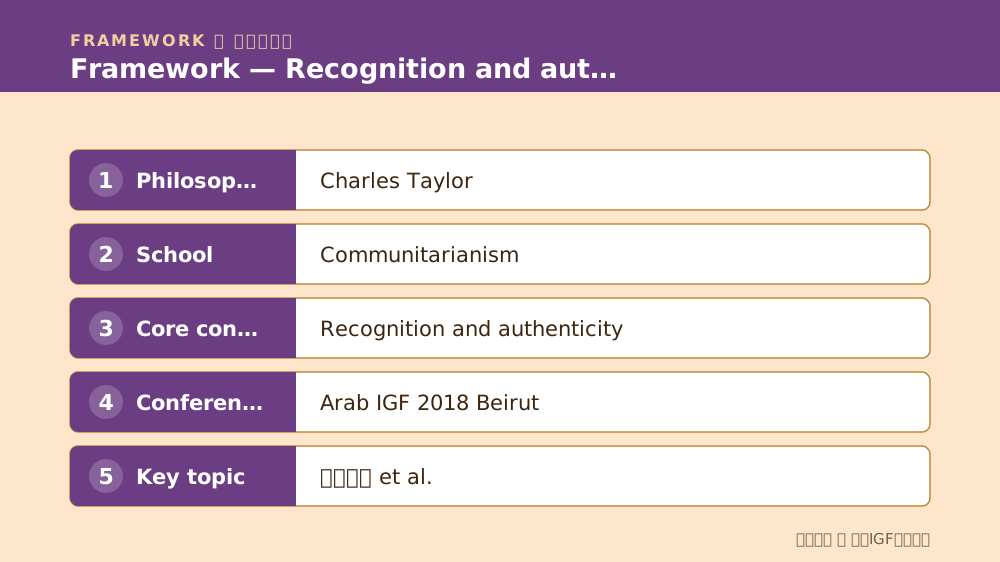
IGF as a site of cultural recognition
Lebanon's experience of being recognized in international space carries constitutive significance beyond mere procedural participation. Regional-level discussion in particular cannot stand without recognition of cultural diversity.
Each session's agenda-setting can be read as a contemporary restaging of the Charles Taylor-type problematic.
The regional IGF (Arab IGF) holds a philosophically distinct position as the intermediate category mediating global universality and national particularity.
Minority authenticity
Charles Taylor's concepts are not confined to abstract philosophical discussion; they apply to the concrete agenda items debated at the 2018 conference. We examine that application below.
1. Application to "電子政府"
Discussion of "電子政府" can be positioned, from the perspective of Charles Taylor's Recognition and authenticity, as a central problematic. In Lebanon's context, the three layers of regulatory design, social implementation, and citizen participation around 電子政府 are particularly at stake.
2. Application to "起業"
Discussion of "起業" can be positioned, from the perspective of Charles Taylor's Recognition and authenticity, as a derivative problematic. In Lebanon's context, the three layers of regulatory design, social implementation, and citizen participation around 起業 are particularly at stake.
3. Application to "AI"
Discussion of "AI" can be positioned, from the perspective of Charles Taylor's Recognition and authenticity, as a peripheral yet important problematic. In Lebanon's context, the three layers of regulatory design, social implementation, and citizen participation around AI are particularly at stake.
4. Application to "地域協調"
Discussion of "地域協調" can be positioned, from the perspective of Charles Taylor's Recognition and authenticity, as a peripheral yet important problematic. In Lebanon's context, the three layers of regulatory design, social implementation, and citizen participation around 地域協調 are particularly at stake.
5. Application to "越境データ"
Discussion of "越境データ" can be positioned, from the perspective of Charles Taylor's Recognition and authenticity, as a peripheral yet important problematic. In Lebanon's context, the three layers of regulatory design, social implementation, and citizen participation around 越境データ are particularly at stake.
Implications for Executives and Practitioners
The philosophical reflection of this essay is not merely academic. The Charles Taylor perspective carries three practical implications for executives operating in Lebanon.
First, it raises the reflexive question of how the firm's business model connects to the logic of Recognition and authenticity. Second, in dialogue with regulators and civil society, it suggests dimensions of consensus formation that purely technical arguments cannot reach. Third, it indicates that the long-term ground of business legitimacy lies not so much in technical advantage or market share as in participation in such philosophical-normative debates.
Academic Positioning and Future Research
The argument of this essay attempts to graft a philosophical perspective onto the mainstream political-science and legal approaches to internet governance research. Three future research questions follow.
- Verification of the applicability of Charles Taylor's framework to other IGF conferences
- Comparative contrast between Communitarianism and other theoretical traditions
- Exploration of dialogue possibilities with the indigenous intellectual traditions of Lebanon
In particular, the third point has the potential to liberate IGF research from West-centric debate and open a more multi-layered discursive space.
Primary Sources
- IGF Secretariat. Annual Reports of Arab IGF.
- Arab IGF 2018 Beirut Conference Materials.
- Japan IGF Support Organization. https://japanigf.jp/
- Nakazawa Yuki Blog. https://nkzw.jp/category/igf/
Secondary Sources (Philosophy)
- Works of Charles Taylor (representative texts of Communitarianism)
*This piece belongs to the academic essays (philosophy series). The author's views do not necessarily represent those of any institutional affiliation. Feedback and critique are welcome.*
更新履歴
第1稿投稿 2026年6月21日 11時23分(記事コンテンツアップ)
— 中澤祐樹