


The 3-Line Summary
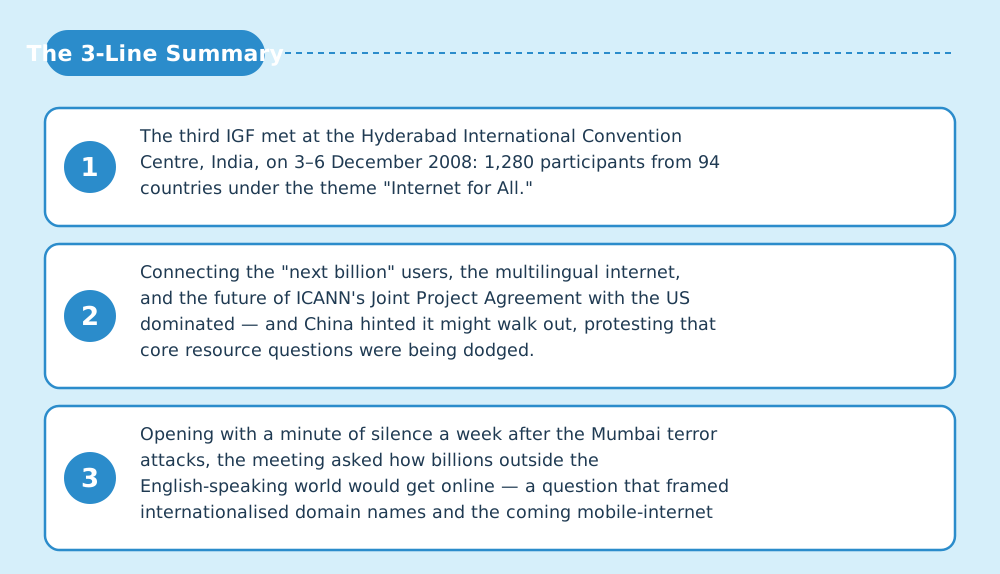
- The third IGF met at the Hyderabad International Convention Centre, India, on 3–6 December 2008: 1,280 participants from 94 countries under the theme "Internet for All."
- Connecting the "next billion" users, the multilingual internet, and the future of ICANN's Joint Project Agreement with the US dominated — and China hinted it might walk out, protesting that core resource questions were being dodged.
- Opening with a minute of silence a week after the Mumbai terror attacks, the meeting asked how billions outside the English-speaking world would get online — a question that framed internationalised domain names and the coming mobile-internet era.
Welcome — this is the Japan IGF Support Organization. This in-depth report on Global IGF 2008 in Hyderabad draws on official outputs, session records and on-site reporting. In a hurry? The three lines above and the diagrams carry the gist.
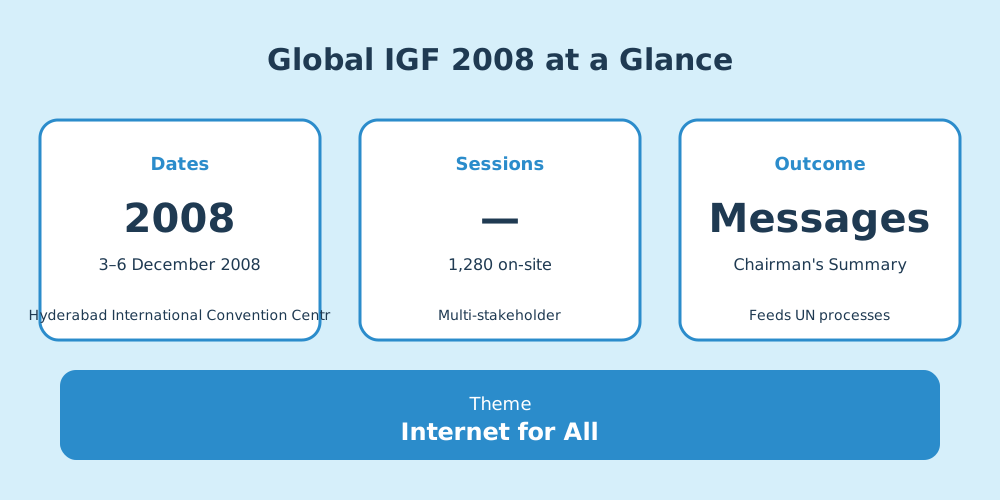
Conference at a Glance (from official records)
| Item | Detail |
|---|---|
| Edition | Third annual IGF meeting |
| Dates | 3–6 December 2008 |
| Venue | Hyderabad International Convention Centre (HICC), Hyderabad, India |
| Theme | Internet for All |
| Participants | 1,280 |
| Countries | 94 |
| Main sessions | Reaching the Next Billion, Promoting Cyber-security and Trust, Managing Critical Internet Resources, Emerging Issues — the Internet of Tomorrow, Taking Stock and the Way Forward |
| Host | Government of India and the United Nations |
| Outcome | Chairman's Summary |
| Context | Held days after the November 2008 Mumbai terror attacks; the meeting opened with a minute of silence, and registrations fell to 1,273 from the 1,500 originally expected |
(See the source list at the end of this article.)
Discussion Digest — from the Session Records
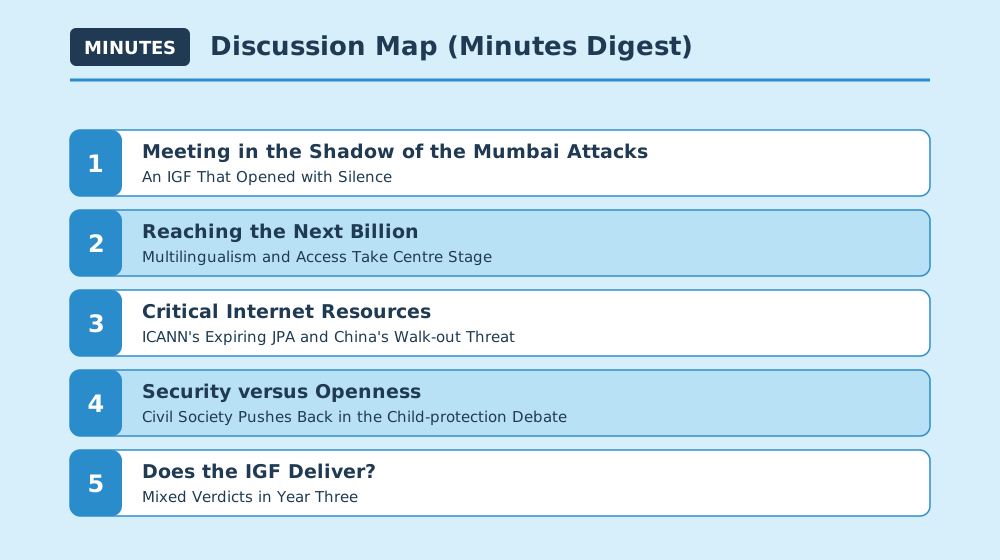
Key exchanges extracted from session records and transcripts.
1. Meeting in the Shadow of the Mumbai Attacks — An IGF That Opened with Silence
Sessions: Opening Ceremony (3 December)
- The Mumbai terror attacks struck about a week before the meeting; participants stood for a minute of silence and expressed sympathy to the victims' families and to the government and people of India [1][2][4][8]
- Security fears prompted cancelled trips — registrations fell to 1,273 from the 1,500 expected — yet 1,280 participants from 94 countries still attended and the meeting went ahead [1][2][4][8]
- Continuing a multistakeholder dialogue on an open internet in India days after the attacks became the meeting's defining symbolic statement [1][2][4][8]
2. Reaching the Next Billion — Multilingualism and Access Take Centre Stage
Sessions: Main session "Internet for All: Reaching the Next Billion" (3 December, in two panels: "Realizing a Multilingual Internet" and "Access")
- Panellists confirmed that most software, hardware and content remained rooted in English, and that internationalising the internet — including internationalised domain names (IDNs) — was still a work in progress [1][3][8]
- The multilingualism panel, moderated by UNESCO's Myriam Nisbet, framed linguistic diversity as a precondition for connecting the next billion users [1][3][8]
- Hosting the meeting in Hyderabad, an emerging IT hub, itself embodied the "Internet for All" theme: the next wave of growth would come from the developing world [1][3][8]
3. Critical Internet Resources — ICANN's Expiring JPA and China's Walk-out Threat
Sessions: Main session "Managing Critical Internet Resources" and workshop "The Future of ICANN: After the JPA, What?" (4 December)
"The focal point of IGF is to discuss whether we need one government to manage critical internet resources or whether we need something else"
— Chinese government delegate (unnamed in source) [5][6]
"It is hard to convince other national governments… when the USG itself has not yet done the same"
— Michael Palage (private-sector consultant) [5][6]
"It is more important to get this right than to do it fast"
— Len St-Aubin (Industry Canada) [5][6]
- With ICANN's Joint Project Agreement (JPA) with the US government due to expire in September 2009, defenders of the status quo clashed with advocates of internationalisation; a workshop straw poll favoured letting the JPA lapse by roughly 35 votes to 10 [5][6]
- China's delegate protested that substantive debate was being deliberately avoided, warning the issue could be taken to the UN General Assembly and hinting China might leave the IGF — putting the Tunis Agenda's "enhanced cooperation" squarely in dispute [5][6]
- US involvement in DNS oversight, the flashpoint inherited from WSIS 2005, was confirmed as still the sharpest divide at the third meeting [5][6]
4. Security versus Openness — Civil Society Pushes Back in the Child-protection Debate
Sessions: Main session "Fostering Security, Privacy and Openness" (4 December)
"Women are often prevented from accessing important content on health and reproductive and sexual rights because of the content regulation policies being promoted"
— Jac sm Kee (APC Women's Rights Programme) [1][7]
- Against calls for aggressive content regulation in the name of child protection, civil society warned of collateral damage to free expression and access to legitimate information; APC's Jac sm Kee's plenary intervention is credited with shifting the debate toward a more balanced approach [1][7]
- More than 40 workshops on child protection, privacy and free expression ran in parallel, making the line between "protection" and "openness" a running theme of the meeting [1][7]
5. Does the IGF Deliver? — Mixed Verdicts in Year Three
Sessions: Main session "Taking Stock and the Way Forward" (6 December) and throughout
"The IGF does things that intergovernmental structures cannot do"
— Lynn St. Amour (President and CEO, Internet Society) [4]
"I believe the IGF was not on track to meet the expectations of many countries"
— Hamadoun Touré (Secretary-General, ITU) [4]
- UN Assistant Secretary-General Jomo Kwame Sundaram called the IGF "a space, a platform, for frank and enlightened debate," defending the value of a non-binding dialogue venue [4]
- US Ambassador David Gross called the third IGF "the best" yet, noting unexpected "vigorous agreement" on net neutrality, while ITU chief Touré complained it was failing many countries' expectations — a split verdict [4]
- With the IGF's five-year mandate up for review in 2010, how to measure the worth of a forum that decides nothing was left as the open question for the years ahead [4]
Three-Minute Short Talk — Your Questions Answered
Q. So what did the conference actually decide?
A. Nothing binding — the IGF is the UN's forum where governments, business and civil society talk as equals. The Hyderabad discussions were distilled into a Chairman's Summary and fed the looming 2010 decision on whether the IGF should continue at all.
Q. What was the most contentious topic?
A. Who controls the internet's core — the domain name system. With ICANN's agreement with the US government expiring the following year, positions collided, and China even hinted it might quit the IGF, saying the real debate was being dodged.
Q. Why should I care?
A. The 'next billion' debate that took off here — how people outside the English-speaking world get online, in their own languages, increasingly via mobile phones — set the stage for the multilingual, smartphone-era internet. And the decision to keep talking days after the Mumbai attacks still defines the IGF's spirit.
What Is Global IGF? (for first-time readers)
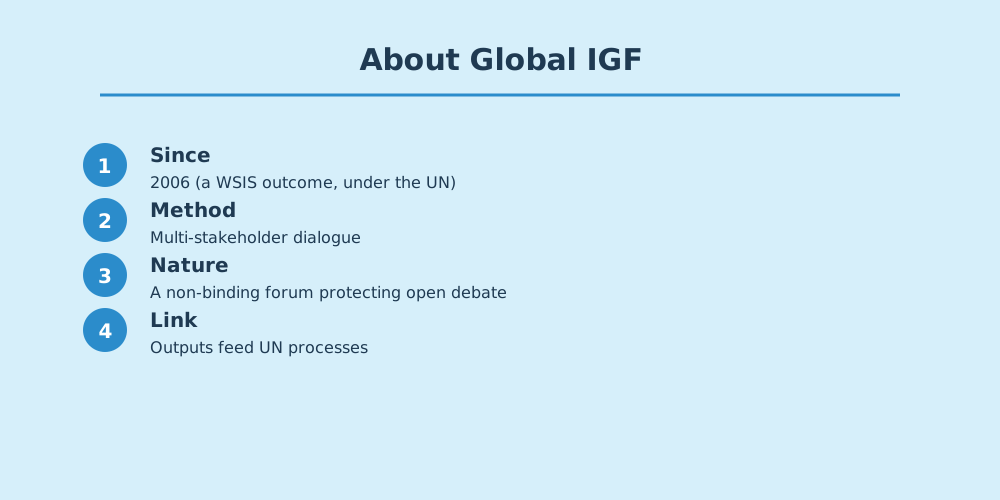
Global IGF has met annually under UN auspices since 2006 — the one global conference where governments, business, civil society, the technical community and youth debate internet governance as equals (the multistakeholder model).
Why It Matters to You
What was discussed here becomes the baseline for national digital policy, platform rules and AI regulation worldwide within a few years. The principles confirmed at the 2008 meeting are the foundation of the "next rules" for the phones, social platforms and AI services you use every day.
Sources & References
- The IGF 2008 Meeting — UN IGF Secretariat (accessed 2026-07-10)
- Internet Governance Forum — IGF III, Hyderabad 2008 — en (accessed 2026-07-10)
- INTERNET GOVERNANCE FORUM OPENS IN HYDERABAD, INDIA (PI/1869) — UN Meetings Coverage and Press Releases (accessed 2026-07-10)
- UN Internet Governance Forum 2008: Friends And Foes, But More Friends — Intellectual Property Watch (accessed 2026-07-10)
- China threatens to leave IGF — 米シラキュース大学 (accessed 2026-07-10)
- IGF Workshop Report: "The Future of ICANN: After the JPA, What?" — Internet Governance Project (accessed 2026-07-10)
- Ensuring the internet is run with rights at the fore: APC and the Internet Governance Forum 2004-8 — APC (accessed 2026-07-10)
- Internet Governance Forum in Hyderabad, India, December 2008 — Elon University — Imagining the Internet (accessed 2026-07-10)
Quotes are translated or condensed from the records listed above. Bracketed numbers [n] refer to the source list.
Related links
- IGF official (NRI list): https://www.intgovforum.org/en/content/national-and-regional-igf-initiatives
- Japan IGF: https://japanigf.jp/
- Yuki Nakazawa's blog: https://nkzw.jp/category/igf/
Revision History
Rev. 1 — published 3 December 2008, 12:30 (Article published)
Rev. 2 — updated 10 July 2026, 14:28 (Fully revised into the in-depth edition: added the 3-line summary, minutes digest, short talk, source list and diagrams (all quotes verified against the listed sources))
— 中澤祐樹

