


The 3-Line Summary
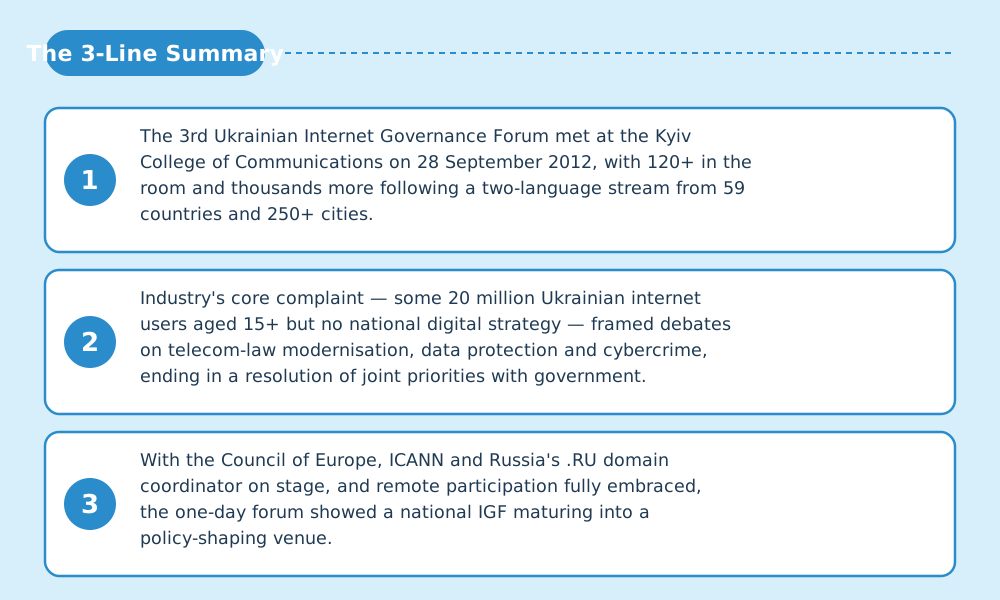
- The 3rd Ukrainian Internet Governance Forum met at the Kyiv College of Communications on 28 September 2012, with 120+ in the room and thousands more following a two-language stream from 59 countries and 250+ cities.
- Industry's core complaint — some 20 million Ukrainian internet users aged 15+ but no national digital strategy — framed debates on telecom-law modernisation, data protection and cybercrime, ending in a resolution of joint priorities with government.
- With the Council of Europe, ICANN and Russia's .RU domain coordinator on stage, and remote participation fully embraced, the one-day forum showed a national IGF maturing into a policy-shaping venue.
Welcome — this is the Japan IGF Support Organization. This in-depth report on 3rd Ukrainian Internet Governance Forum (IGF-UA 2012) draws on official outputs, session records and on-site reporting. In a hurry? The three lines above and the diagrams carry the gist.
Conference at a Glance (from official records)
| Item | Detail |
|---|---|
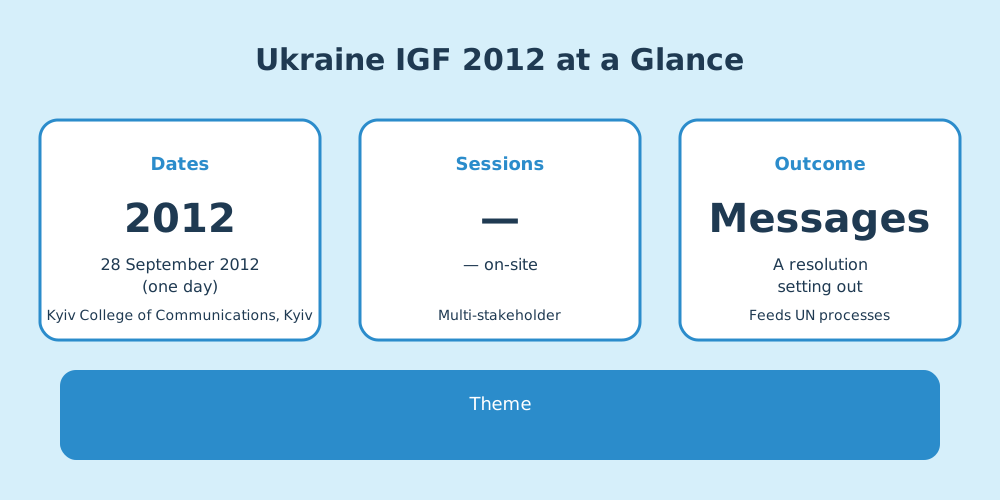
| Official name | 3rd Ukrainian Internet Governance Forum (IGF-UA 2012) |
| Dates | 28 September 2012 (one day) |
| Venue | Kyiv College of Communications, Kyiv |
| Theme | Regional governance themes |
| On-site participants | Over 120 on-site participants |
| Outcome | A resolution setting out collaborative priorities for the ICT community and government representatives |
(See the source list at the end of this article.)
Discussion Digest — from the Session Records
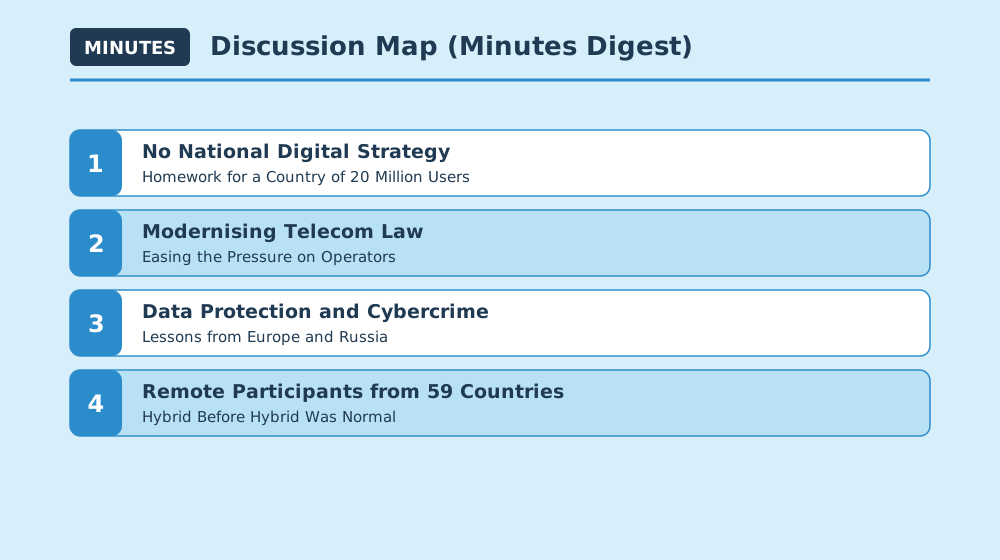
Key exchanges extracted from session records and transcripts.
1. No National Digital Strategy — Homework for a Country of 20 Million Users
Sessions: Opening session and plenary debate (28 September)
- Ivan Petukhov (vice-president, Ukrainian Union of Industrialists and Entrepreneurs) reported roughly 20 million Ukrainian internet users aged 15+ — and named the absence of a national digital strategy as the biggest gap [2]
- Opening the forum, presidential adviser Anatolii Kinakh stressed the importance of an information-society development strategy [2]
- Mykola Sokirko of regulator NKRZI presented the 'Digital District' national project for universal internet access [2]
2. Modernising Telecom Law — Easing the Pressure on Operators
Sessions: Sessions on telecom legislation and the ICT market (28 September)
- InAU board chair Sergii Boiko proposed rebalancing regulation and reducing administrative pressure on telecom providers [2]
- Anatolii Dovhyi of mobile operator MTS argued for legislative changes to spur infrastructure build-out, while UA-IX's Vadim Harbuz outlined how backbone modernisation would expand services over three to five years [2]
3. Data Protection and Cybercrime — Lessons from Europe and Russia
Sessions: Sessions on personal data protection and cybersecurity (28 September)
- Volodymyr Kozak, deputy head of the data-protection service, recommended that providers inform users of privacy risks and let them use pseudonyms [2]
- The Council of Europe's Kyiv office head Vladimir Ristovski stressed human rights and internet freedom, CoE expert Marie George shared European cybersecurity experience, and the Interior Ministry's cybercrime chief Maksym Litvinov discussed providers' role in investigations [2]
- Leonid Todorov of Russia's .RU domain coordination presented Russia's cybersecurity concept, adding a comparative angle from next door [2]
4. Remote Participants from 59 Countries — Hybrid Before Hybrid Was Normal
Sessions: Overall forum operations (28 September)
- A real-time stream in two languages drew thousands of remote participants from 59 countries and 250+ cities, with 69,000+ total visits (organisers' figures) — an ambitious remote-participation experiment for 2012 [2][3]
- The forum closed by adopting a resolution of joint priorities for the ICT community and government, establishing the pattern of turning dialogue into a written outcome [2][3]
Three-Minute Short Talk — Your Questions Answered
Q. What did this meeting decide?
A. A resolution listing the priorities the ICT community and government would tackle together — not binding, but a formal channel for handing industry's asks to the state.
Q. What was the most contentious topic?
A. How heavy regulation should be. Industry demanded less administrative pressure on operators, while government pushed access projects and investigative cooperation; user protections like pseudonym use cut across both.
Q. Why should I care?
A. The 2012 dilemma — millions of users, no national strategy — is one most countries have faced. And the forum's full-scale remote participation anticipated hybrid conferencing a decade before the pandemic made it standard.
What Is Ukraine IGF? (for first-time readers)
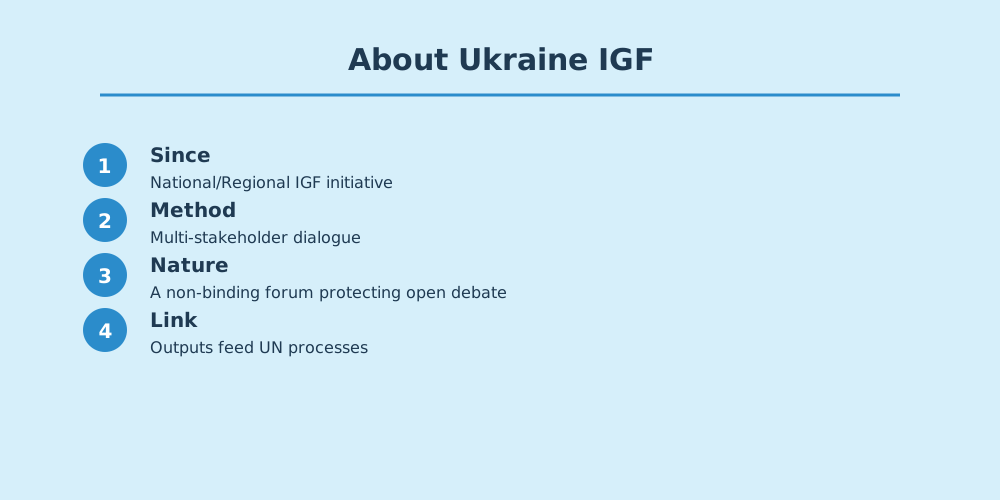
Ukraine IGF is a National or Regional IGF Initiative (NRI), aligning local internet governance discussion with global IGF principles.
Why It Matters to You
What was discussed here becomes the baseline for national digital policy, platform rules and AI regulation worldwide within a few years. The principles confirmed at the 2012 meeting are the foundation of the "next rules" for the phones, social platforms and AI services you use every day.
Sources & References
- IGF-UA 2012 公式アーカイブ(ヘッダに第3回・2012年9月28日・キーウ) — IGF-UA組織委員会 (accessed 2026-07-11)
- Підсумки IGF-UA 2012(IGF-UA 2012総括・登壇者の報告と決議採択を記録) — IGF-UA公式サイト (accessed 2026-07-11)
- Відбувся Третій український форум по управлінню Інтернетом IGF-UA(第3回開催報告・参加規模と遠隔参加) — IGF-UA公式サイト (accessed 2026-07-11)
- VII Ukrainian Internet Governance Forum IGF-UA — Annual report(2010年初回からの毎年開催を明記・系列の継続性) — IGF-UA組織委員会(国連IGF事務局提出年次報告書) (accessed 2026-07-11)
Quotes are translated or condensed from the records listed above. Bracketed numbers [n] refer to the source list.
Related links
- IGF official (NRI list): https://www.intgovforum.org/en/content/national-and-regional-igf-initiatives
- Japan IGF: https://japanigf.jp/
- Yuki Nakazawa's blog: https://nkzw.jp/category/igf/
更新履歴
第1稿投稿 2026年7月14日 20時17分(記事コンテンツアップ)
— 中澤祐樹

