


The 3-Line Summary
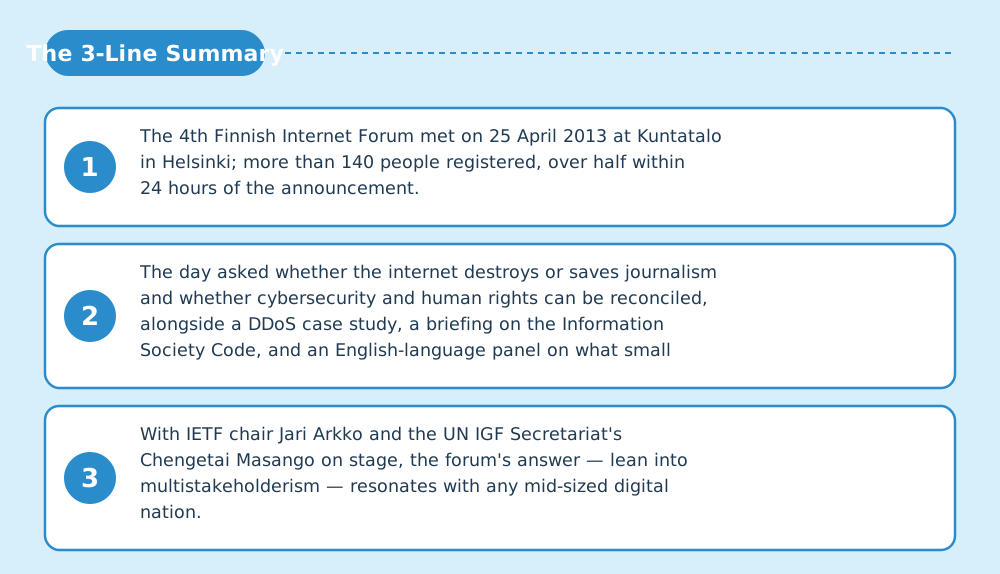
- The 4th Finnish Internet Forum met on 25 April 2013 at Kuntatalo in Helsinki; more than 140 people registered, over half within 24 hours of the announcement.
- The day asked whether the internet destroys or saves journalism and whether cybersecurity and human rights can be reconciled, alongside a DDoS case study, a briefing on the Information Society Code, and an English-language panel on what small countries can do in the governance of the big internet.
- With IETF chair Jari Arkko and the UN IGF Secretariat's Chengetai Masango on stage, the forum's answer — lean into multistakeholderism — resonates with any mid-sized digital nation.
Welcome — this is the Japan IGF Support Organization. This in-depth report on Finnish Internet Forum 2013 (4th edition) draws on official outputs, session records and on-site reporting. In a hurry? The three lines above and the diagrams carry the gist.
Conference at a Glance (from official records)
| Item | Detail |
|---|---|
| Official name | Finnish Internet Forum 2013 (4th edition) |
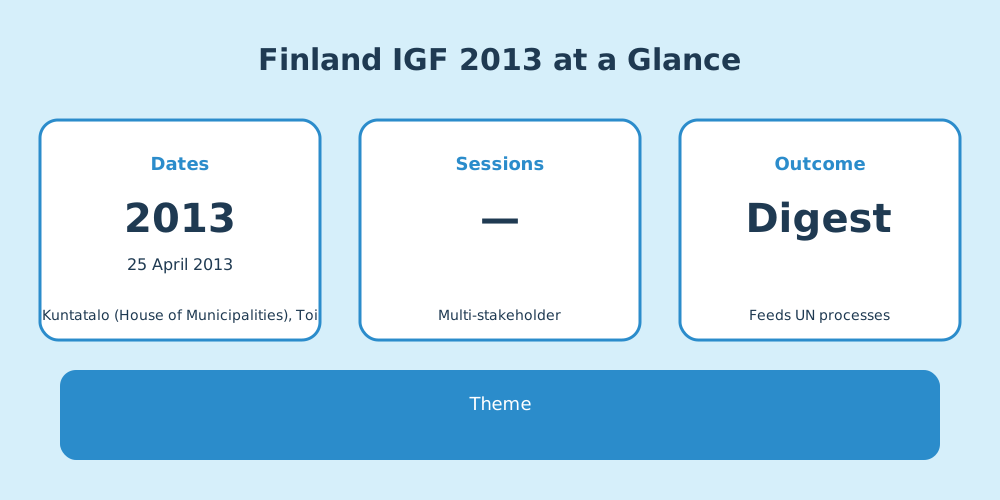
| Dates | 25 April 2013 |
| Venue | Kuntatalo (House of Municipalities), Toinen linja 14, Helsinki |
| Theme | Regional governance themes |
| Registrations | Over 140 registered (more than half within 24 hours of the announcement); attendance varied between 50 and 90; a steady ~20 followed the ISOC-sponsored webcast (per the official report) |
| Format | Bilingual (Finnish/English); the second consecutive spring edition |
| Host | Prepared by the multistakeholder WSIS follow-up group chaired by the Ministry for Foreign Affairs; sessions organised by ISOC Finland, Electronic Frontier Finland, the Ministry of Transport and Communications and the MFA, with administrative support from the Finnish Information Processing Association (per the official report) |
(See the source list at the end of this article.)
Discussion Digest — from the Session Records
Key exchanges extracted from session records and transcripts.
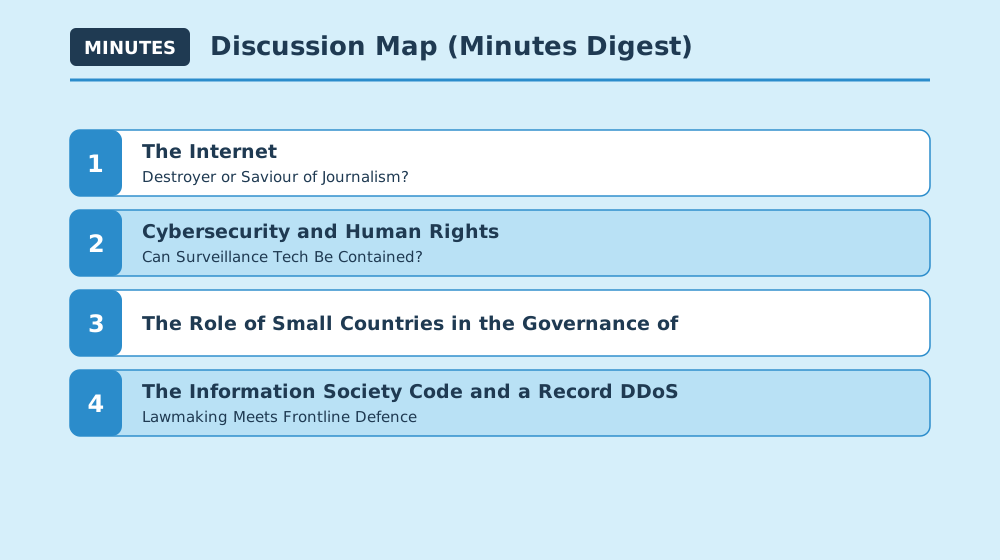
1. The Internet — Destroyer or Saviour of Journalism?
Sessions: Panel 'The Internet — the Destruction or Salvation of Journalism?' (9:05; moderated by Yrjö Länsipuro, ISOC Finland, with Long Play co-founder Hanna Nikkanen, Uusi Suomi's Jarmo Koponen, newspapermen's association chair Jyrki Vesikansa and Tampere University's Esa Sirkkunen)
- Practitioners of old and new media debated whether professional journalism can survive when anyone can publish 'their own paper' without gatekeepers; Finland's legacy media still led on trust, but monetisation loomed as the existential problem [1]
- The moderator's recorded conclusion: journalism probably will not be destroyed — like the telegraph, once feared as the newspapers' killer, the internet may end up saving it [1]
- Concrete signs of change were tabled: politicians' blogs and Twitter replacing speeches, automated sports and stock-market news, and readers supplying thousands of accident photos a month [1]
2. Cybersecurity and Human Rights — Can Surveillance Tech Be Contained?
Sessions: EFFI's panel 'Cybersecurity and Human Rights' (11:00; moderated by Tapani Tarvainen, with MP Päivi Lipponen, CERT-FI head Erka Koivunen, author Petteri Järvinen and Stonesoft's Timo Soikkeli)
- Panellists broadly agreed that surveillance tools built by democracies for law enforcement end up oppressing dissidents under dictatorships — and that once standardised, such tools can hardly be kept from autocrats' hands [1]
- A message from Development Minister Heidi Hautala noted Finland's membership of the Freedom Online Coalition and its decision to join the Digital Defenders Partnership [1]
- Speakers criticised well-meaning authorities' 'just in case' data hoarding, from centralised passport-fingerprint registries to ever-growing health databases [1]
3. The Role of Small Countries in the Governance of the Big Internet
Sessions: English panel 'The role of small countries in the governance of the big internet' (14:30; moderated by Mervi Kultamaa, MFA, with MP Sinuhe Wallinheimo, US Embassy's Dan Daley, IETF chair Jari Arkko and Chengetai Masango of the UN IGF Secretariat)
- Ahead of the WSIS 10-year review, panellists reaffirmed multistakeholder cooperation as the only legitimate working method in internet governance [1]
- Small countries' low bureaucracy and easy convening power can give them technical relevance beyond their size — Finland was advised to 'abandon the idea of being a small country and keep doing what it is doing' [1]
- There is no single governance model: the IGF as a discussion forum, the IETF as a standards body and regulatory processes each mature in their own way [1]
4. The Information Society Code and a Record DDoS — Lawmaking Meets Frontline Defence
Sessions: 'The Information Society Code' (13:30, Sanna Helopuro, Ministry of Transport and Communications) and 'Fending off a DDoS — the Kavkaz-Center case study' (10:30, Mikael Storsjö)
- The ministry presented the Information Society Code, a single statute consolidating Finland's electronic-communications rules, then at the consultation stage — a thread continued at the next year's FIF [1]
- The operator of servers hosting Kavkaz-Center shared how publication survived the autumn 2012 DDoS — described as among the largest attacks on a single domain in Europe to date — at moderate cost [1]
Three-Minute Short Talk — Your Questions Answered
Q. What did this meeting decide?
A. Nothing binding — it was the fourth edition of Finland's annual multistakeholder forum, and one of the best-documented early ones thanks to its official English report.
Q. What was the most contentious topic?
A. Cybersecurity versus human rights: the panel concluded that surveillance tools, once built and standardised, can hardly be kept from dictators — and quipped that Helsinki spends more on chasing rabbits than the state does on cybersecurity.
Q. Why should I care?
A. The journalism-survival debate mirrors every country's media crisis, and the 'small countries punch above their weight through multistakeholderism' conclusion speaks to any mid-sized nation navigating global internet rulemaking.
What Is Finland IGF? (for first-time readers)
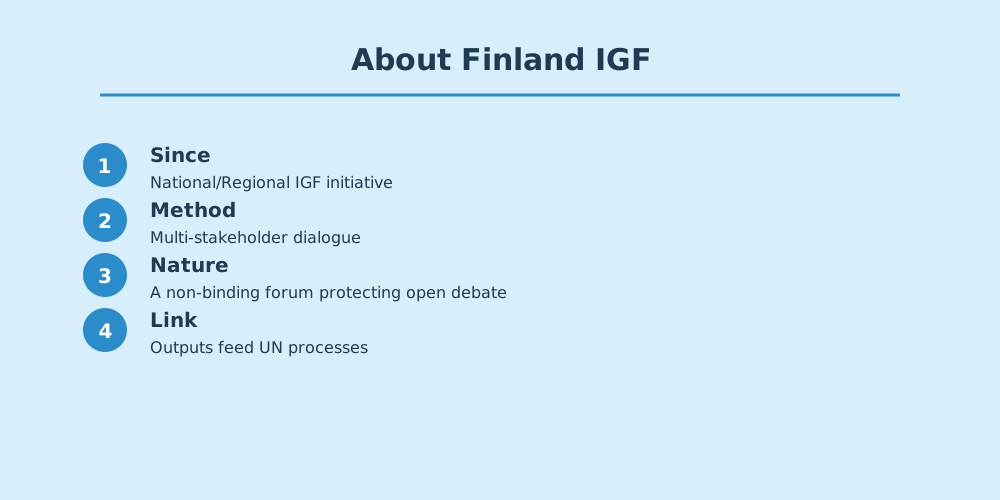
Finland IGF is a National or Regional IGF Initiative (NRI), aligning local internet governance discussion with global IGF principles.
Why It Matters to You
What was discussed here becomes the baseline for national digital policy, platform rules and AI regulation worldwide within a few years. The principles confirmed at the 2013 meeting are the foundation of the "next rules" for the phones, social platforms and AI services you use every day.
Sources & References
- Finnish Internet Forum 25.4.2013(公式アーカイブ・プログラムと英語公式報告書) — Finnish Internet Forum(internetforum.fi) (accessed 2026-07-23)
- Finnish Internet Forumin lyhyt historia(公式短史・2013年の項) — Finnish Internet Forum(internetforum.fi) (accessed 2026-07-23)
- Aiemmat foorumit(公式過去大会一覧) — Finnish Internet Forum(internetforum.fi) (accessed 2026-07-23)
- National IGF Initiatives – WEOGグループ詳細(フィンランドNRI記録) — 国連IGF事務局 (UN IGF Secretariat)(Wayback 2025-06-09) (accessed 2026-07-23)
Quotes are translated or condensed from the records listed above. Bracketed numbers [n] refer to the source list.
Related links
- IGF official (NRI list): https://www.intgovforum.org/en/content/national-and-regional-igf-initiatives
- Japan IGF: https://japanigf.jp/
- Yuki Nakazawa's blog: https://nkzw.jp/category/igf/
更新履歴
第1稿投稿 2026年8月1日 12時13分(記事コンテンツアップ)
— 中澤祐樹

