


The 3-Line Summary
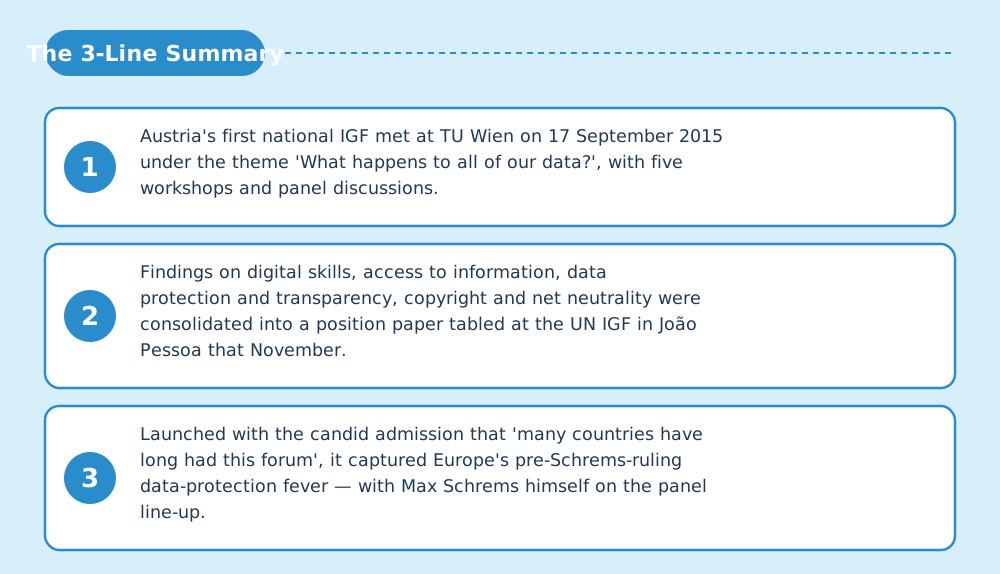
- Austria's first national IGF met at TU Wien on 17 September 2015 under the theme 'What happens to all of our data?', with five workshops and panel discussions.
- Findings on digital skills, access to information, data protection and transparency, copyright and net neutrality were consolidated into a position paper tabled at the UN IGF in João Pessoa that November.
- Launched with the candid admission that 'many countries have long had this forum', it captured Europe's pre-Schrems-ruling data-protection fever — with Max Schrems himself on the panel line-up.
Welcome — this is the Japan IGF Support Organization. This in-depth report on IGF Austria 2015 (1st Internet Governance Forum Austria) draws on official outputs, session records and on-site reporting. In a hurry? The three lines above and the diagrams carry the gist.
Conference at a Glance (from official records)
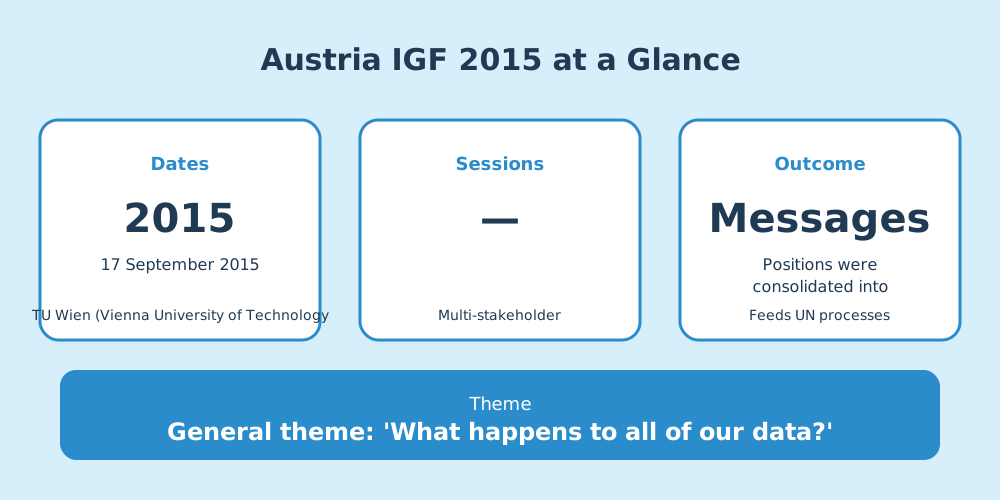
| Item | Detail |
|---|---|
| Official name | IGF Austria 2015 (1st Internet Governance Forum Austria) |
| Dates | 17 September 2015 |
| Venue | TU Wien (Vienna University of Technology), Vienna |
| Theme | General theme: 'What happens to all of our data?' |
| Host | A multistakeholder organising team of government, business, civil society, academia and the technical community; opened by State Secretary Sonja Steßl |
| Outcome | Positions were consolidated into the IGF Austria position paper, tabled at the 10th UN IGF in João Pessoa, Brazil (November 2015) |
| Note | Austria's first national IGF, following a 2014 kick-off event |
(See the source list at the end of this article.)
Discussion Digest — from the Session Records
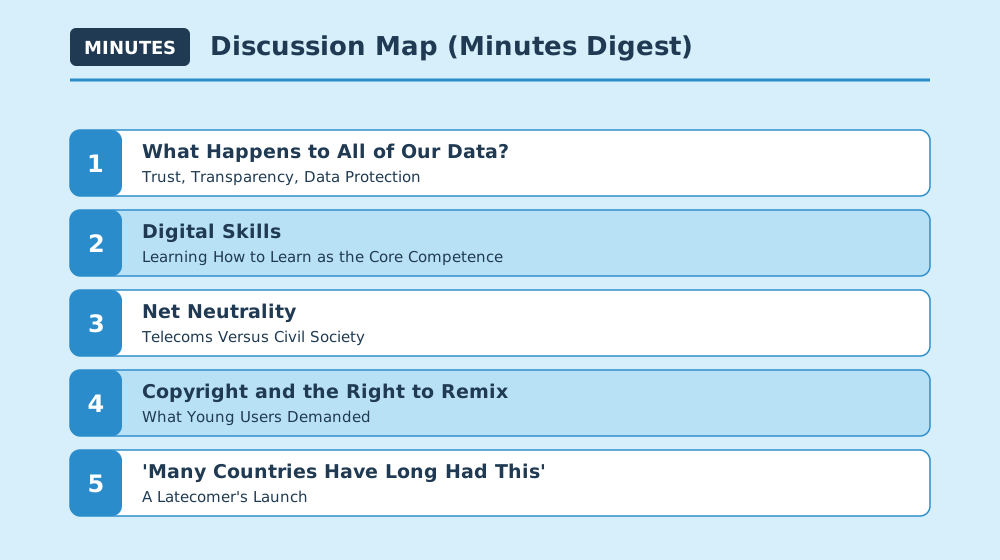
Key exchanges extracted from session records and transcripts.
1. What Happens to All of Our Data? — Trust, Transparency, Data Protection
Sessions: Panel 'Was geschieht mit unseren Daten?' and Workshops I ('Data as a business model') and IV ('Digital user rights and commercial surveillance')
- The position paper affirmed every individual's right to decide whether and how their personal data is used; governments should support users in making informed decisions independently [2][1]
- Everyone must be able to report suspected data-protection violations to an agency offering advice even on minor incidents, plus affordable legal protection [2][1]
- Consumer advocates demanded transparency of commercial data collection using profiles and algorithms, consumer choice over non-essential data use, and preference in public procurement for privacy-compliant products [2][1]
2. Digital Skills — Learning How to Learn as the Core Competence
Sessions: Workshop III 'Digital skills for all'
- The pace of development demands new education models; the crucial ability is learning how to learn properly — the key to acquiring all other competencies [2]
- Media competencies taught in schools should not be linked solely to economic requirements but also to social issues such as democracy and critical thinking, with e-skills and coding included [2]
- Comprehensive media-competence training is needed for the entire population — from kindergartens to adult education — supported by periodic studies and self-evaluation tools for teachers and students [2]
3. Net Neutrality — Telecoms Versus Civil Society
Sessions: Workshop II 'Net neutrality'
- Safeguarding Europe's open internet was undisputed — how open it should be was not [2]
- Telecom companies saw no need for new net-neutrality rules, arguing European competition is sufficiently strong and specialised services diversify the market without threatening the open internet [2]
- Civil society came out clearly for strict net-neutrality regulation, holding that best-effort internet guarantees continued innovation; ISPs conceded the scope and definition of special services needed debate [2]
4. Copyright and the Right to Remix — What Young Users Demanded
Sessions: Workshop V 'Copyright and data protection' and the 16 September side event
- To eliminate grey areas, representatives of young users stressed that non-commercial distribution and modification of existing cultural property — the right to remix — should be legal, as it benefits society [2][1]
- Repositories of public knowledge — archives, libraries, media libraries, museums — sought legal certainty for modern presentation of cultural property, especially out-of-print and orphaned works [2][1]
- Rights holders underlined that creativity requires appropriate rewards and adequate IP protection; collective licensing and compensative measures were proposed to modernise access to knowledge [2][1]
5. 'Many Countries Have Long Had This' — A Latecomer's Launch
Sessions: Founding context (2014 kick-off) and stakeholder video statements published on the official site
"It is five to twelve — high time to discuss internet governance together in Austria. Many countries have long had this forum. Internet administration faces major upheavals, and regardless of Austria's size, our voice counts and should be heard"
— Richard Wein (Managing Director, nic.at) — official video statement, translated from German [1][3]
"We are very critical of control by states. We call for a free, global internet and unrestricted access. The internet is a fundamental right, and human rights must also be guaranteed online"
— Maximilian Schubert (Secretary General, ISPA Austria) — official video statement, translated from German [1][3]
- After a 2014 kick-off (with a keynote by Wolfgang Kleinwächter), the first annual meeting materialised in 2015 — opened by State Secretary Steßl, with keynotes by Sarah Spiekermann ('The Ethical Machine') and Raphael Schneeberger ('No apps without data') [1][3]
- The panel 'What happens to our data?' listed Max Schrems — whose case against Facebook was weeks from judgment — alongside ISPA's Schubert and Research Institute's Christof Tschohl, capturing Europe's pre-Schrems-ruling mood [1][3]
- A transparency report on funds and sponsors was announced for after the event — transparency built in from the founding [1][3]
Three-Minute Short Talk — Your Questions Answered
Q. What did it decide?
A. Nothing binding — but five fields of debate were distilled into a position paper tabled at the UN IGF in Brazil two months later.
Q. Highlight?
A. The speaker list: Max Schrems, three weeks before the ruling that struck down Safe Harbour, debating 'what happens to our data'.
Q. Why care?
A. Young users' demand to legalise non-commercial remixing prefigured fan-culture copyright debates in many countries.
What Is Austria IGF? (for first-time readers)
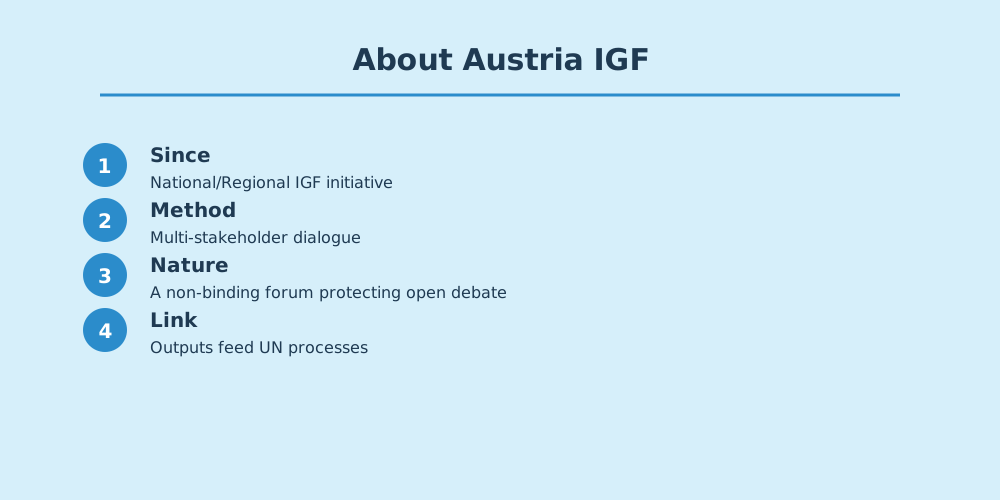
Austria IGF is a National or Regional IGF Initiative (NRI), aligning local internet governance discussion with global IGF principles.
Why It Matters to You
What was discussed here becomes the baseline for national digital policy, platform rules and AI regulation worldwide within a few years. The principles confirmed at the 2015 meeting are the foundation of the "next rules" for the phones, social platforms and AI services you use every day.
Sources & References
- Teilnahme am IGF 2015(プログラム・独語) — IGF Austria(Waybackアーカイブ) (accessed 2026-07-23)
- IGF Austria position paper for discussion at the 10th IGF in Joao Pessoa, Brazil — IGF Austria (accessed 2026-07-23)
- Die Stimmen der österreichischen Stakeholder(2015年大会の映像声明・基調講演記録) — igf-austria.at (accessed 2026-07-23)
- National IGFs — WEOG(Austria IGF「established in 2015」の記録) — 国連IGF事務局(Waybackアーカイブ) (accessed 2026-07-23)
Quotes are translated or condensed from the records listed above. Bracketed numbers [n] refer to the source list.
Related links
- IGF official (NRI list): https://www.intgovforum.org/en/content/national-and-regional-igf-initiatives
- Japan IGF: https://japanigf.jp/
- Yuki Nakazawa's blog: https://nkzw.jp/category/igf/
更新履歴
第1稿投稿 2026年8月4日 8時25分(記事コンテンツアップ)
— 中澤祐樹

