

The 3-Line Summary
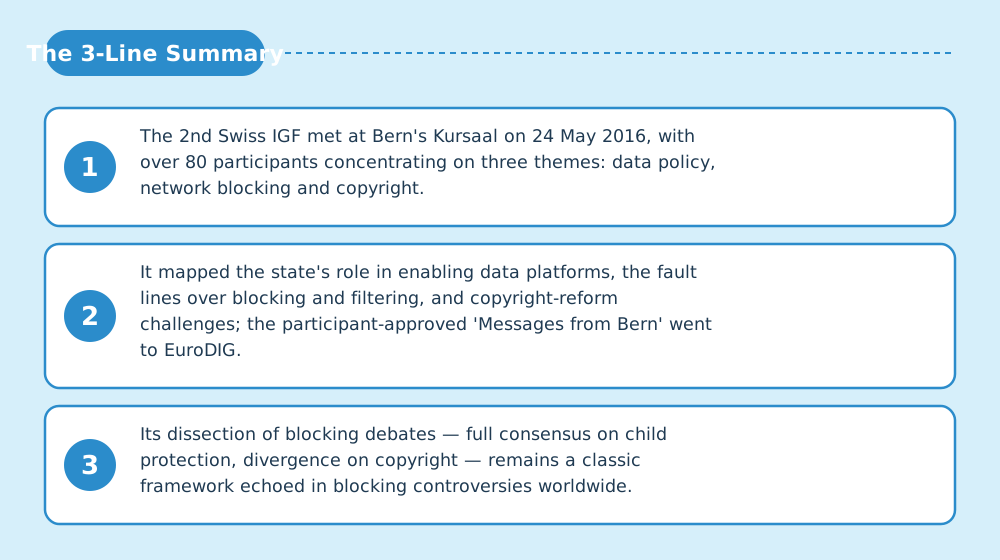
- The 2nd Swiss IGF met at Bern's Kursaal on 24 May 2016, with over 80 participants concentrating on three themes: data policy, network blocking and copyright.
- It mapped the state's role in enabling data platforms, the fault lines over blocking and filtering, and copyright-reform challenges; the participant-approved 'Messages from Bern' went to EuroDIG.
- Its dissection of blocking debates — full consensus on child protection, divergence on copyright — remains a classic framework echoed in blocking controversies worldwide.
Welcome — this is the Japan IGF Support Organization. This in-depth report on Swiss IGF 2016 (2nd Swiss Internet Governance Forum) draws on official outputs, session records and on-site reporting. In a hurry? The three lines above and the diagrams carry the gist.
Conference at a Glance (from official records)
| Item | Detail |
|---|---|
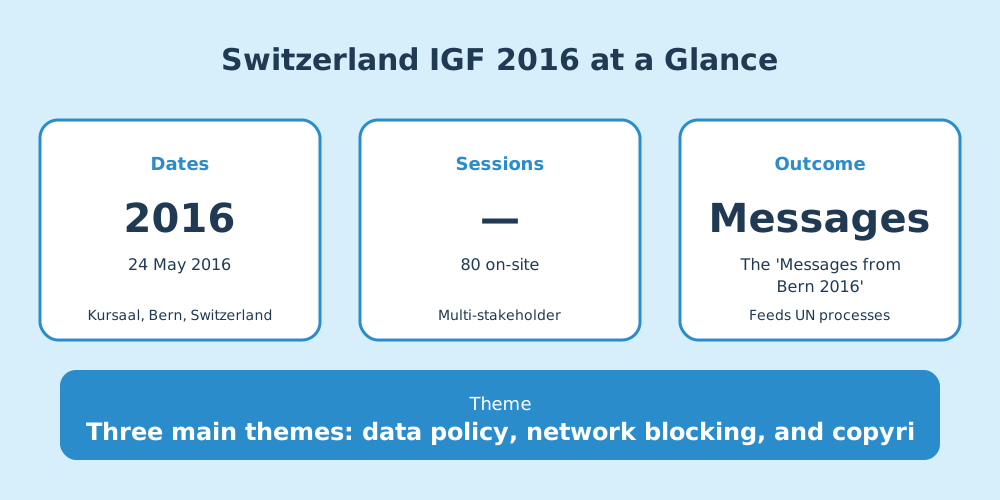
| Official name | Swiss IGF 2016 (2nd Swiss Internet Governance Forum) |
| Dates | 24 May 2016 |
| Venue | Kursaal, Bern, Switzerland |
| Theme | Three main themes: data policy, network blocking, and copyright |
| Participants | 80 (The official report records 'over 80 participants' from all parts of society) |
| Host | A multistakeholder steering group; held under the patronage of Federal Councillor Doris Leuthard |
| Outcome | The 'Messages from Bern 2016', approved by participants in the wrap-up and submitted to EuroDIG |
(See the source list at the end of this article.)
Discussion Digest — from the Session Records
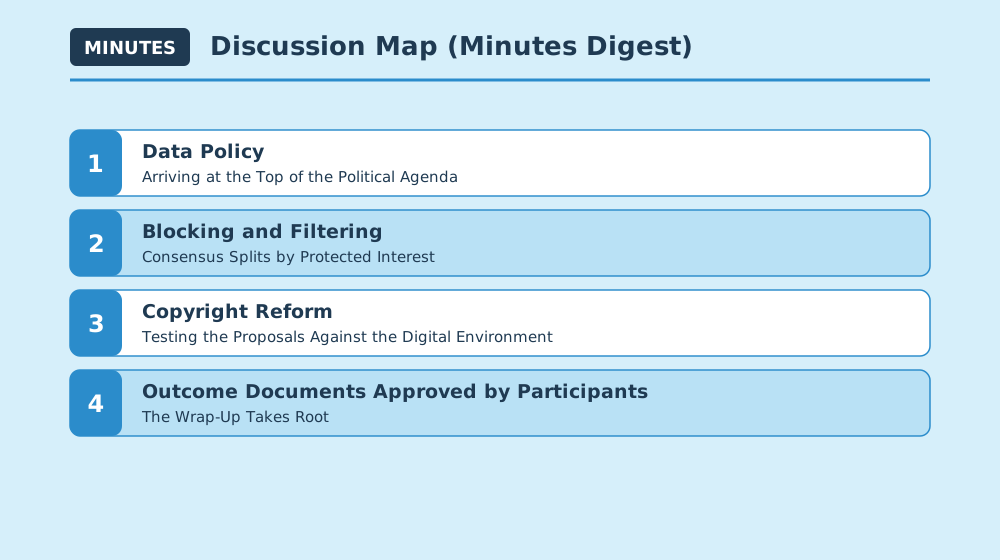
Key exchanges extracted from session records and transcripts.
1. Data Policy — Arriving at the Top of the Political Agenda
Sessions: Plenary 1
- Broad consensus emerged that states have a role in establishing an enabling environment for innovative data platforms, whose governance and trustworthiness are key to societal acceptance [1]
- Questions of individual data ownership were addressed, with focus on the potential of data use while remaining mindful of misuse, especially of sensitive data [1]
- With data policy 'now arriving at the top of the political agenda', participants called for public awareness raising and a shared, understandable vision for a holistic data policy [1]
2. Blocking and Filtering — Consensus Splits by Protected Interest
Sessions: Plenary 2
- The tension between concerns over unlawful/harmful content and freedom of information was dissected: absolute consensus exists on protecting children from sexual exploitation, while views diverge on copyright [1]
- Camps split between source-removal, education and follow-the-money approaches versus proportionate, transparent blocking with appeal rights where removal fails; overblocking and circumvention risks were widely debated [1]
- Beyond calls for international instruments, states were reminded of their role in securing spaces of freedom — a role that must not be delegated to private platforms [1]
3. Copyright Reform — Testing the Proposals Against the Digital Environment
Sessions: Plenary 3
- General agreement: balance the interests of society — including libraries and cultural institutions — with those of creators, preserving copyright's original intent to maximise access and promote creation [1]
- Collective licensing gained traction as a partial answer, while the digital adaptation of collecting societies was questioned and global players' market power over access conditions criticised [1]
- Anti-piracy tools drew concerns — chilling effects of notice-and-takedown, dangers to public-domain access — and alternative legal-access business models, including lending rights, were deemed necessary [1]
4. Outcome Documents Approved by Participants — The Wrap-Up Takes Root
Sessions: Wrap-up (adoption of the Messages from Bern)
- The 'Messages from Bern' were approved by the participants themselves in the closing wrap-up — an owned-by-the-room mechanism, entrenched in year two, before submission to EuroDIG [1][2]
- Patronage by Federal Councillor Doris Leuthard exemplified the Swiss balance: government endorsement without government control of the debate [1][2]
Three-Minute Short Talk — Your Questions Answered
Q. What did it decide?
A. Nothing binding — but 80+ participants themselves approved the 'Messages from Bern' at the wrap-up and sent them to EuroDIG, covering data policy, blocking and copyright.
Q. Most contentious point?
A. Network blocking. Unanimity on blocking child sexual exploitation content; a clean split on blocking for copyright. What you protect determines how much consensus you get.
Q. Why care?
A. The same questions — overblocking, circumvention, transparency — resurface in every country's site-blocking debate; this was an early, systematic mapping.
What Is Switzerland IGF? (for first-time readers)
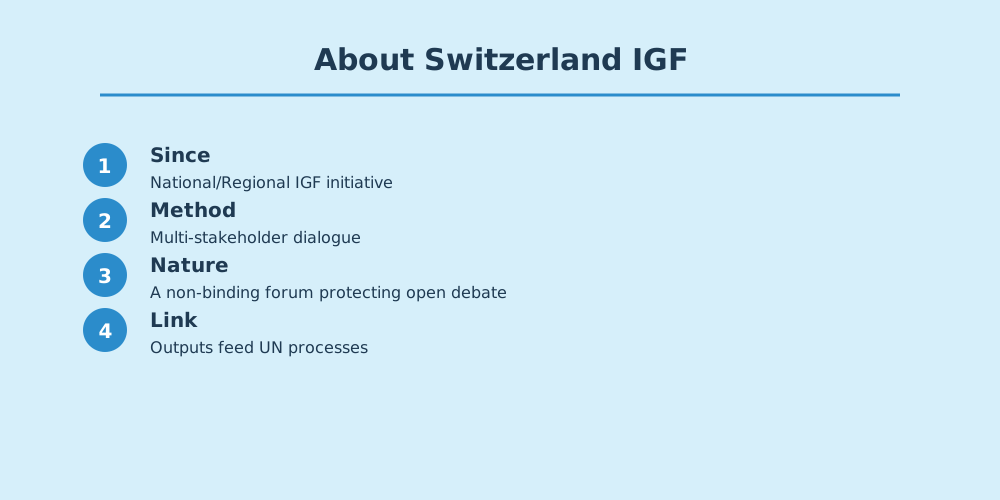
Switzerland IGF is a National or Regional IGF Initiative (NRI), aligning local internet governance discussion with global IGF principles.
Why It Matters to You
What was discussed here becomes the baseline for national digital policy, platform rules and AI regulation worldwide within a few years. The principles confirmed at the 2016 meeting are the foundation of the "next rules" for the phones, social platforms and AI services you use every day.
Sources & References
- Messages from Bern 2016 / Bericht aus Bern 2016 — Swiss Internet Governance Forum(旧swiss-igf.ch、Waybackアーカイブ) (accessed 2026-07-23)
- Swiss-IGF 2015: Bericht aus Bern(2016年大会のロイトハルト後援を記載) — Swiss Internet Governance Forum(Waybackアーカイブ) (accessed 2026-07-23)
- About the Swiss IGF — igf.swiss (accessed 2026-07-23)
- National IGFs — Western European and Others Regional Group (WEOG) — 国連IGF事務局(Waybackアーカイブ) (accessed 2026-07-23)
Quotes are translated or condensed from the records listed above. Bracketed numbers [n] refer to the source list.
Related links
- IGF official (NRI list): https://www.intgovforum.org/en/content/national-and-regional-igf-initiatives
- Japan IGF: https://japanigf.jp/
- Yuki Nakazawa's blog: https://nkzw.jp/category/igf/
更新履歴
第1稿投稿 2026年8月3日 19時36分(記事コンテンツアップ)
— 中澤祐樹