


The 3-Line Summary
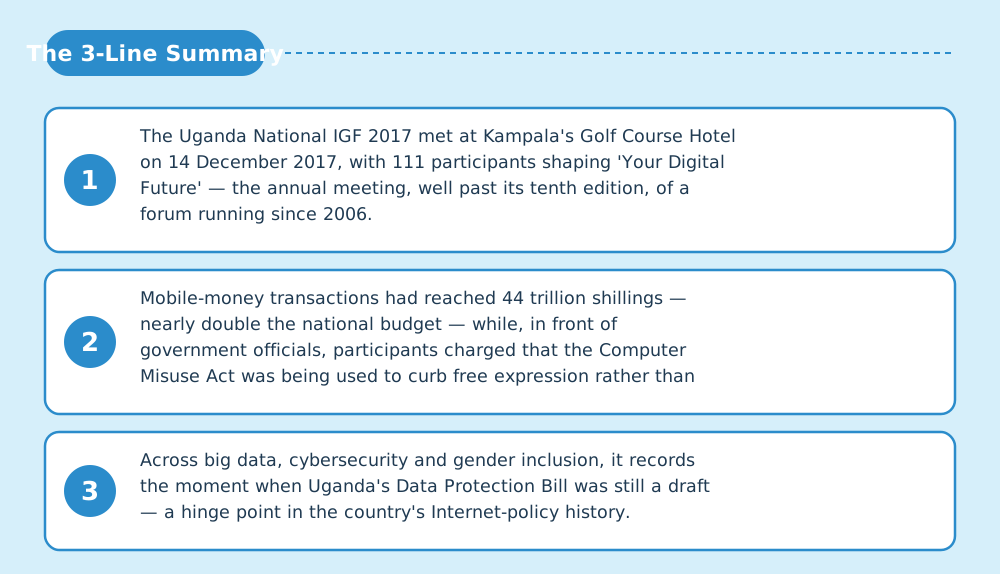
- The Uganda National IGF 2017 met at Kampala's Golf Course Hotel on 14 December 2017, with 111 participants shaping 'Your Digital Future' — the annual meeting, well past its tenth edition, of a forum running since 2006.
- Mobile-money transactions had reached 44 trillion shillings — nearly double the national budget — while, in front of government officials, participants charged that the Computer Misuse Act was being used to curb free expression rather than fight cybercrime.
- Across big data, cybersecurity and gender inclusion, it records the moment when Uganda's Data Protection Bill was still a draft — a hinge point in the country's Internet-policy history.
Welcome — this is the Japan IGF Support Organization. This in-depth report on Uganda National Internet Governance Forum 2017 draws on official outputs, session records and on-site reporting. In a hurry? The three lines above and the diagrams carry the gist.
Conference at a Glance (from official records)
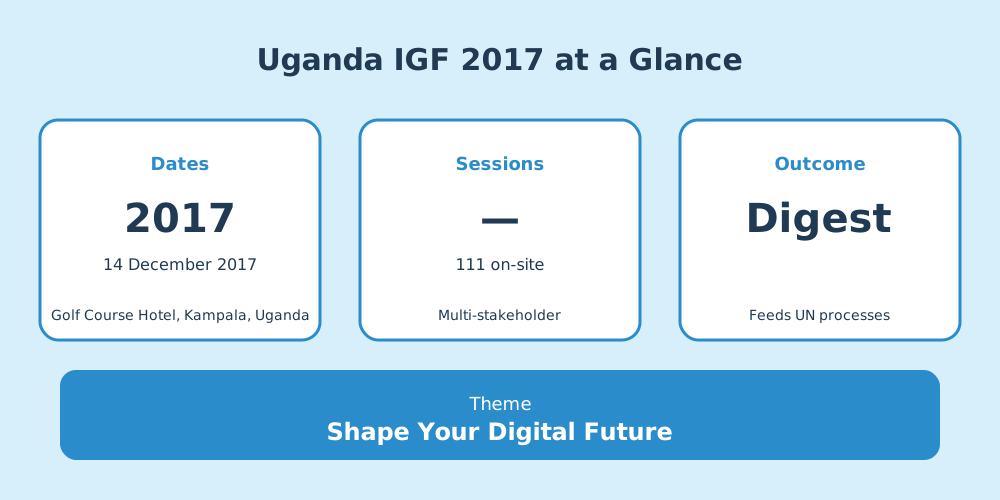
| Item | Detail |
|---|---|
| Official name | Uganda National Internet Governance Forum 2017 |
| Dates | 14 December 2017 |
| Venue | Golf Course Hotel, Kampala, Uganda |
| Theme | Shape Your Digital Future |
| Participants | 111 |
| Keynote | Keynote by Vivian Dambya, Director Technical Services at NITA-U, on behalf of ICT Minister Frank Tumwebaze |
| Host | Convened by the multistakeholder UIGF process led by the Internet Society Uganda Chapter (chair Lillian Nalwoga) |
(See the source list at the end of this article.)
Discussion Digest — from the Session Records
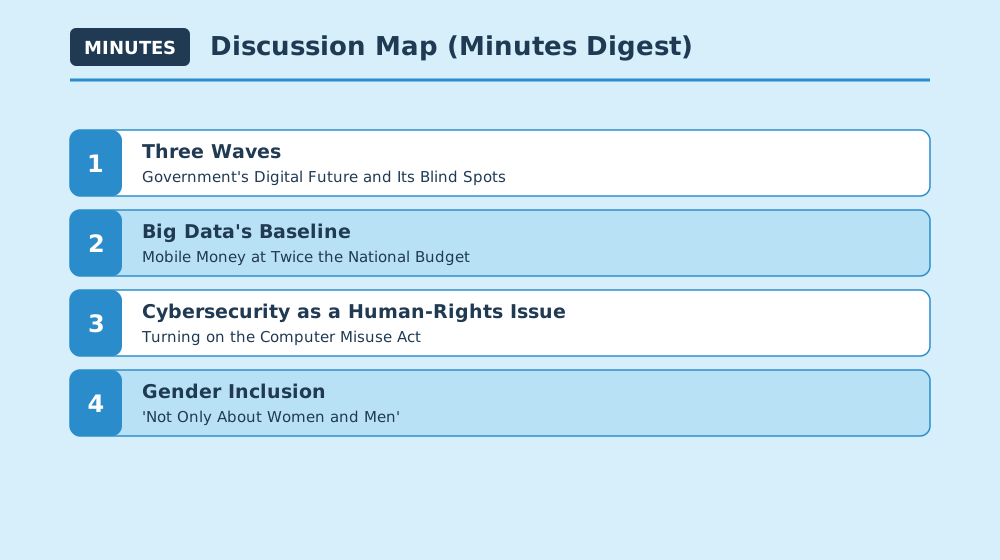
Key exchanges extracted from session records and transcripts.
1. Three Waves — Government's Digital Future and Its Blind Spots
Sessions: Keynote by Vivian Dambya (NITA-U Director Technical Services) on behalf of the ICT minister
- Dambya framed Uganda's Internet history as three waves — telco/email era, liberalisation opening access to universities and individuals, and today's innovation and disruption — citing the innovation fund and free or subsidised connectivity for hubs in major towns [1]
- Government itself acknowledged low uptake and scarce local content, positioning the ecitizen.go.ug e-government portal as a local-content play, alongside the National Information Security Infrastructure, the Computer Misuse Act 2011 and a Data Protection and Privacy Bill still in draft [1]
- The floor pressed back: how is citizens' privacy handled without a legal framework, what about children learning to code, and why are short-code licence fees unaffordable for young innovators? [1]
2. Big Data's Baseline — Mobile Money at Twice the National Budget
Sessions: Session on the future of innovation, big data and analytics
- Mobile-money transactions of 44 trillion shillings — nearly double the national budget — set the baseline for how data-driven services were transforming the economy [1]
- Challenges listed: fast-moving technology, skills gaps, unstandardised innovations, weak user-innovator linkages and a lack of design-thinking spaces, with mentoring innovators into viable businesses as the prescription [1]
3. Cybersecurity as a Human-Rights Issue — Turning on the Computer Misuse Act
Sessions: Session on cybersecurity and the future of the Internet in Uganda
- Cybersecurity was defined as a human-rights issue touching privacy and free expression — 'beyond financial loss because it can lead to loss of lives' — with weak inter-agency coordination and poor reporting culture flagged [1]
- Concern was recorded explicitly that the Computer Misuse Act 'has been mostly used to curtail freedom of expression and not to fight cybercrime', with calls for progressive laws protecting citizens rather than favouring one party [1]
- Prescriptions: personal cyber hygiene, a security-conscious society, regional security blocs at government level and digital forensics laboratories [1]
4. Gender Inclusion — 'Not Only About Women and Men'
Sessions: Session on gender inclusion and the future of the Internet in Uganda
- Despite efforts to bring women into science and technology, the gap had not closed, with few women at tech innovation events; education and the Internet were framed as the game changers [1]
- Strategies included safe spaces for women and girls, gender-aware policy change and role models — and, since 'gender is not only about women and men', the ISOC Uganda Chapter was urged to include youth and refugee groups [1]
Three-Minute Short Talk — Your Questions Answered
Q. What did the meeting decide?
A. It was an annual policy dialogue, not a decision body — but demands that cyber laws protect citizens' rights and that youth and refugees be included were recorded in front of government officials, feeding the pressure that produced the 2019 Data Protection Act.
Q. What was most contentious?
A. How the Computer Misuse Act was being used. The official record preserves the charge that it curbed free expression more than cybercrime — while government conceded the Data Protection Bill was still only a draft.
Q. Why should I care?
A. Mobile money at 44 trillion shillings — nearly twice the national budget — is the textbook leapfrog economy, and the debate over cyber laws drifting into speech control is a cautionary comparator for computer-misuse statutes anywhere.
What Is Uganda IGF? (for first-time readers)
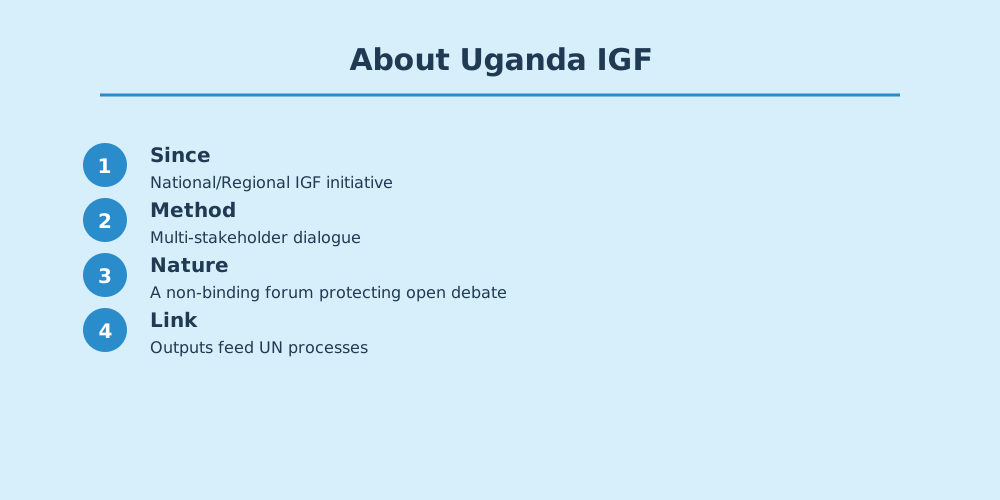
Uganda IGF is a National or Regional IGF Initiative (NRI), aligning local internet governance discussion with global IGF principles.
Why It Matters to You
What was discussed here becomes the baseline for national digital policy, platform rules and AI regulation worldwide within a few years. The principles confirmed at the 2017 meeting are the foundation of the "next rules" for the phones, social platforms and AI services you use every day.
Sources & References
- Shaping Your Digital Future: Uganda National Internet Governance Forum 2017(公式報告書: 111名・4セッションの記録。バナーに December 14, Golf Course Hotel, Kampala) — Internet Society Uganda Chapter (accessed 2026-07-23)
- NRIs Annual Meetings 2017(公式一覧: Uganda IGF — 27 October, Kampala と記載。実開催12/14との相違はフェーズA検証および本報告書で確認) — 国連IGF事務局 (accessed 2026-07-23)
- Uganda Internet Governance Forums(系列公式ページ: 「since 2006」・年次報告書一覧に2017年掲載) — Internet Society Uganda Chapter (accessed 2026-07-23)
- Uganda IGF(UIGF公式サイト: 2006年以来のマルチステークホルダー・プロセスの概要) — Uganda Internet Governance Forum(uigf.ug) (accessed 2026-07-23)
Quotes are translated or condensed from the records listed above. Bracketed numbers [n] refer to the source list.
Related links
- IGF official (NRI list): https://www.intgovforum.org/en/content/national-and-regional-igf-initiatives
- Japan IGF: https://japanigf.jp/
- Yuki Nakazawa's blog: https://nkzw.jp/category/igf/
更新履歴
第1稿投稿 2026年8月1日 8時38分(記事コンテンツアップ)
— 中澤祐樹

