


The 3-Line Summary
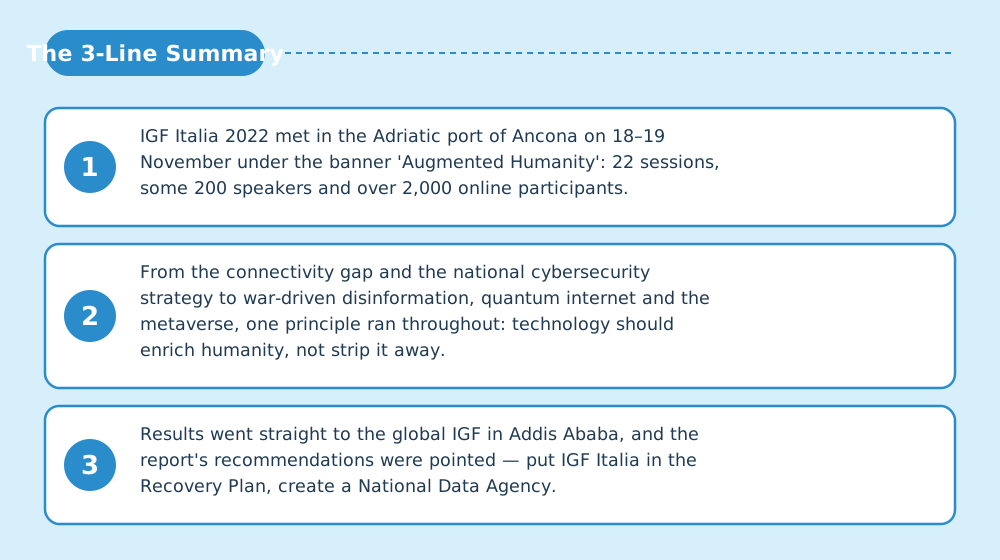
- IGF Italia 2022 met in the Adriatic port of Ancona on 18–19 November under the banner 'Augmented Humanity': 22 sessions, some 200 speakers and over 2,000 online participants.
- From the connectivity gap and the national cybersecurity strategy to war-driven disinformation, quantum internet and the metaverse, one principle ran throughout: technology should enrich humanity, not strip it away.
- Results went straight to the global IGF in Addis Ababa, and the report's recommendations were pointed — put IGF Italia in the Recovery Plan, create a National Data Agency.
Welcome — this is the Japan IGF Support Organization. This in-depth report on IGF Italia 2022 draws on official outputs, session records and on-site reporting. In a hurry? The three lines above and the diagrams carry the gist.
Conference at a Glance (from official records)
| Item | Detail |
|---|---|
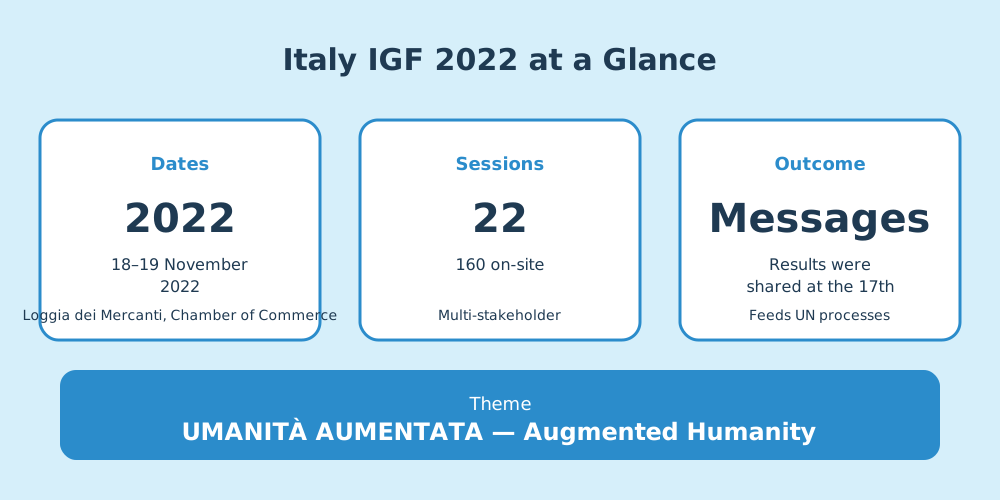
| Official name | IGF Italia 2022 |
| Dates | 18–19 November 2022 |
| Venue | Loggia dei Mercanti, Chamber of Commerce of the Marche, Ancona — the first edition in the Marche region |
| Theme | UMANITÀ AUMENTATA — Augmented Humanity |
| Participants | 160 (Over 160 onsite attendances and 1,108 registrations; 1,126 plenary streaming links and 2,069 parallel-session connections, with online participation estimated above 2,000 (official report)) |
| Sessions | 22 (22 sessions over two days (8 in parallel, 2 in English) with roughly 200 speakers) |
| Host | Chamber of Commerce of the Marche, the Polytechnic University of the Marche and AgID; hybrid format |
| Outcome | Results were shared at the 17th global IGF in Addis Ababa (28 November–2 December 2022) and across the NRI network; the official report lists recommendations for government, the UN, the European Commission, business, civil society and universities |
(See the source list at the end of this article.)
Discussion Digest — from the Session Records
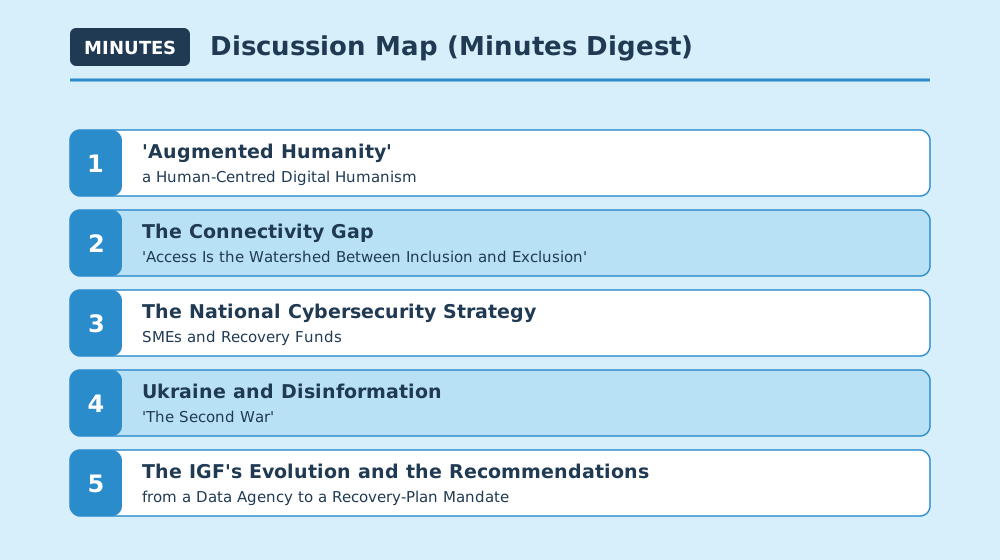
Key exchanges extracted from session records and transcripts.
1. 'Augmented Humanity' — a Human-Centred Digital Humanism
Sessions: Opening ceremony and the cross-cutting theme (18 November, 9:00)
"Digital will shape the future of us all — of businesses, families and our young people (translated from Italian)"
— Gino Sabatini (President, Chamber of Commerce of the Marche) [3][1]
"Our mission is to make the internet a democratic, safe place that helps us grow (translated from Italian)"
— Mattia Fantinati (President, IGF Italia Association) [3][1]
- Under the credo that technology must enrich rather than diminish humanity, the agenda ran on four pillars: human rights, data and privacy, security and accountability, and advanced technologies [3][1]
- Marche president Francesco Acquaroli, Unioncamere president Andrea Prete, EC DG-Connect chief Roberto Viola and UN MAG chair Paul Mitchell joined the opening [3][1]
- The official report records 'the centrality of the human being in technological and digital development' as the theme cutting across nearly every session [3][1]
2. The Connectivity Gap — 'Access Is the Watershed Between Inclusion and Exclusion'
Sessions: 'The State of Connectivity in Italy' (18 November, 12:00) and related sessions
"Internet access is the watershed between social inclusion and social exclusion (translated from Italian)"
— Gino Sabatini (President, Chamber of Commerce of the Marche) [1][3]
- The forum confronted Italy's near-bottom DESI connectivity ranking: fibre, FWA and 5G are growing, but patchily and metro-first [1][3]
- Experts from AGCOM, Rome IXP operator Namex and research network GARR called for stronger carrier networks and IXPs and for symmetric connections with adequate upload speeds [1][3]
- With more than half of Italians lacking basic digital skills, the national 'Repubblica Digitale' initiative was debated as the remedy [1][3]
3. The National Cybersecurity Strategy — SMEs and Recovery Funds
Sessions: 'The National Strategy on Cybersecurity and Competitiveness' (18 November, 14:00) and related sessions
- Built around the new National Cybersecurity Agency's support measures, the debate weighed security against competitiveness — big firms invest, but micro and small businesses need awareness campaigns first [1]
- From security-by-design to skills, the forum mapped how security loads costs onto firms, and appealed for Recovery Plan funds and public-private partnerships [1]
- On disinformation, fact-checking alone was judged insufficient; media literacy and co-regulatory tools like the EU Code of Practice were endorsed [1]
4. Ukraine and Disinformation — 'The Second War'
Sessions: Parallel session 'Disinformation: the Second War Fighting in Ukraine' (18 November, 14:00)
- EDMO secretary general Paula Gori, the European Commission, AGCOM and IDMO dissected invasion-related disinformation as 'the second war' being fought over Ukraine [1]
- Enforcement is hampered because platforms sit outside member states, panellists noted, holding up Europe's regulatory framework as best practice [1]
- Framing wartime information manipulation this way tied directly into that year's global IGF debate in Addis Ababa [1]
5. The IGF's Evolution and the Recommendations — from a Data Agency to a Recovery-Plan Mandate
Sessions: English session 'The Evolution of IGF' (18 November, 16:40), closing and official recommendations
- UN MAG chair Paul Mitchell, the EC's Pearse O'Donohue and NRIs coordinator Anja Gengo used the English session to argue for a stronger IGF role in the Global Digital Compact and WSIS+20 — and for 'constructive self-criticism' [1][2]
- The report's recommendations to the Italian government were concrete: promote access as a citizens' right, establish a National Data Agency, invest in carrier networks and IXPs, and write an IGF Italia chapter into the Recovery Plan [1][2]
- It urged the European Commission to back the IGF mandate renewal and fold the Code of Practice into the DSA, and universities to teach internet governance [1][2]
Three-Minute Short Talk — Your Questions Answered
Q. What did the meeting decide?
A. Nothing binding, but the official report lists concrete recommendations — a National Data Agency, an IGF Italia chapter in the Recovery Plan — and fed them into the global IGF in Addis Ababa days later.
Q. What does 'Augmented Humanity' mean?
A. That as AI and the metaverse extend human capabilities, technology should enrich our humanity rather than strip it away. It was the thread running through nearly every session.
Q. Why should I care?
A. Regional connectivity gaps, SME cyber-defence, wartime disinformation — the 2022 agenda is every country's agenda, with Europe's policy answers on display.
What Is Italy IGF? (for first-time readers)
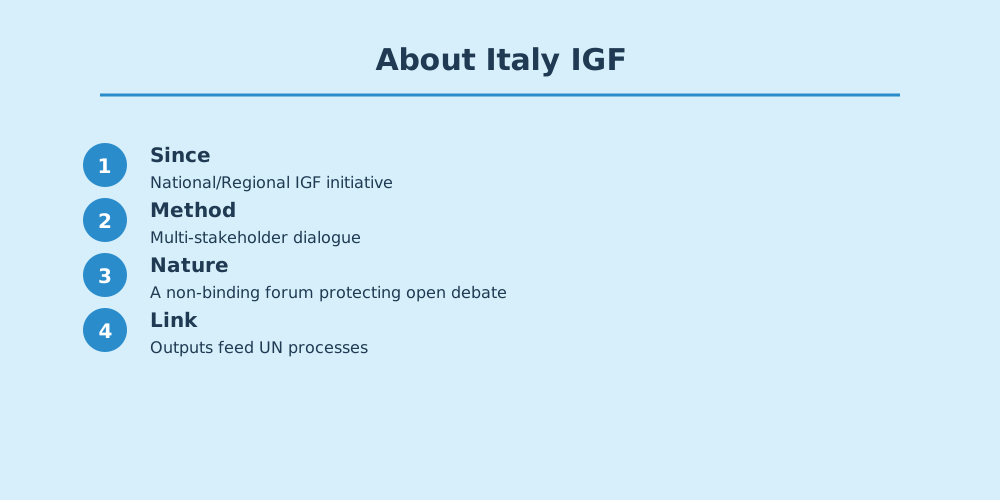
Italy IGF is a National or Regional IGF Initiative (NRI), aligning local internet governance discussion with global IGF principles.
Why It Matters to You
What was discussed here becomes the baseline for national digital policy, platform rules and AI regulation worldwide within a few years. The principles confirmed at the 2022 meeting are the foundation of the "next rules" for the phones, social platforms and AI services you use every day.
Sources & References
- Report Italy IGF 2022, Ancona(公式英文報告書PDF) — AgID(Concettina Cassa編) (accessed 2026-07-11)
- IGF Italia 2022: UMANITÀ AUMENTATA — IGF Italia(igf-italia.org 公式サイト) (accessed 2026-07-11)
- Ad Ancona, l'Internet Governance Forum Italia 2022. Sabatini: «Accesso spartiacque fra inclusione e esclusione sociale» — CentroPagina(マルケ州のニュースサイト) (accessed 2026-07-11)
- Internet Governance Forum Italia 2022: l'evento annuale ad Ancona il 18 e il 19 novembre — AgID(デジタル・イタリア庁) (accessed 2026-07-11)
- Umanità aumentata – IGF Italia, edizione 2022, Sessione Plenaria (18.11.2022) — Radio Radicale(プレナリー録画) (accessed 2026-07-11)
Quotes are translated or condensed from the records listed above. Bracketed numbers [n] refer to the source list.
Related links
- IGF official (NRI list): https://www.intgovforum.org/en/content/national-and-regional-igf-initiatives
- Japan IGF: https://japanigf.jp/
- Yuki Nakazawa's blog: https://nkzw.jp/category/igf/
更新履歴
第1稿投稿 2026年7月21日 17時26分(記事コンテンツアップ)
— 中澤祐樹

