


The 3-Line Summary
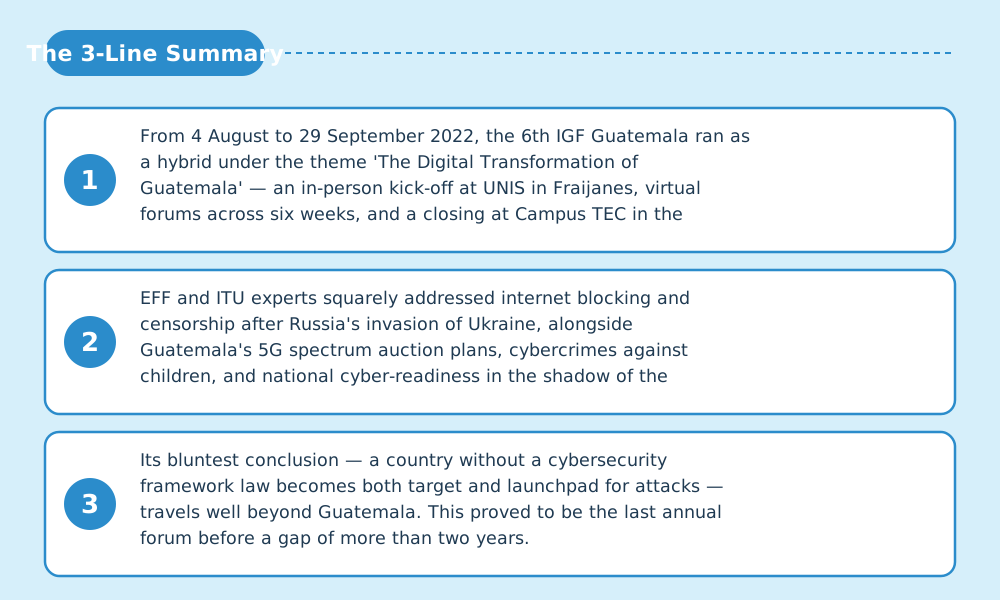
- From 4 August to 29 September 2022, the 6th IGF Guatemala ran as a hybrid under the theme 'The Digital Transformation of Guatemala' — an in-person kick-off at UNIS in Fraijanes, virtual forums across six weeks, and a closing at Campus TEC in the capital: twelve forums, 31 speakers, over 18 hours of dialogue.
- EFF and ITU experts squarely addressed internet blocking and censorship after Russia's invasion of Ukraine, alongside Guatemala's 5G spectrum auction plans, cybercrimes against children, and national cyber-readiness in the shadow of the massive attack on Costa Rica.
- Its bluntest conclusion — a country without a cybersecurity framework law becomes both target and launchpad for attacks — travels well beyond Guatemala. This proved to be the last annual forum before a gap of more than two years.
Welcome — this is the Japan IGF Support Organization. This in-depth report on IGF Guatemala 2022 (VI Guatemala Internet Governance Forum) draws on official outputs, session records and on-site reporting. In a hurry? The three lines above and the diagrams carry the gist.
📍 Not a simple Guatemala City event: the kick-off — the first in-person activity since 2019 — took place at UNIS in Fraijanes, and only the (itself hybrid) closing was held at Campus TEC in the capital
Conference at a Glance (from official records)
| Item | Detail |
|---|---|
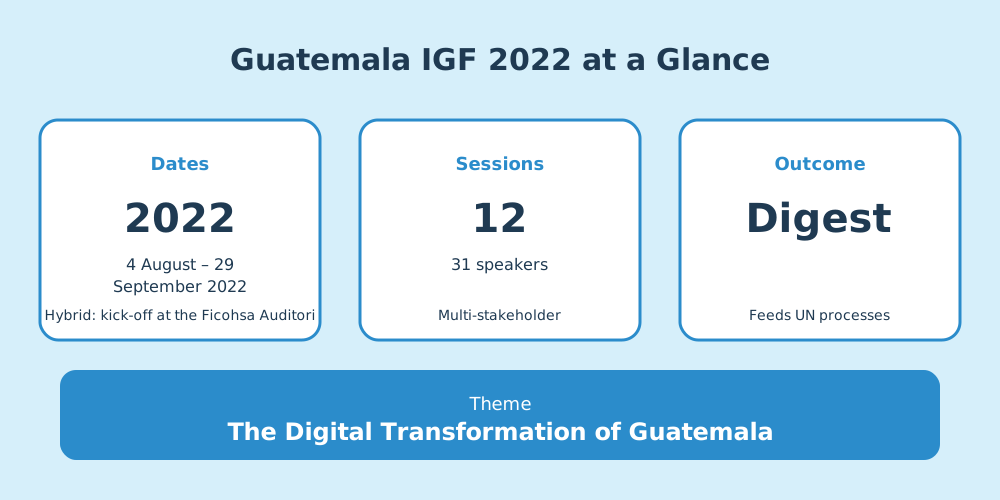
| Official name | IGF Guatemala 2022 (VI Guatemala Internet Governance Forum) |
| Dates | 4 August – 29 September 2022 |
| Venue | Hybrid: kick-off at the Ficohsa Auditorium, Universidad del Istmo (UNIS), Fraijanes on 4 August; virtual forums through the cycle; closing at a Campus TEC auditorium, Zone 4, Guatemala City on 29 September |
| Theme | The Digital Transformation of Guatemala |
| Sessions | 12 (The report counts 'a total of twelve forums in six weeks' from 5 August (5 public policy, 3 net neutrality, 1 cybersecurity, 1 education, 2 digital transformation); elsewhere the same report says 15 were planned and 11 carried out. Two education and two blockchain talks were cancelled for speaker availability) |
| Speakers | 31 (Thirty-one speakers plus four moderators, eight of the speakers women; experts joined from Brazil, Colombia, El Salvador, Peru, Panama, Paraguay and the Dominican Republic, producing over 18 hours of content) |
| Host | A multistakeholder committee (ISOC Guatemala Chapter, UNIS, Ministry of National Defense, Public Ministry, Ministry of the Interior, Campus TEC, the private schools association, SVET, Fundación Sobrevivientes, ES Consulting and others; national coordinator Fred Clark) |
(See the source list at the end of this article.)
Discussion Digest — from the Session Records
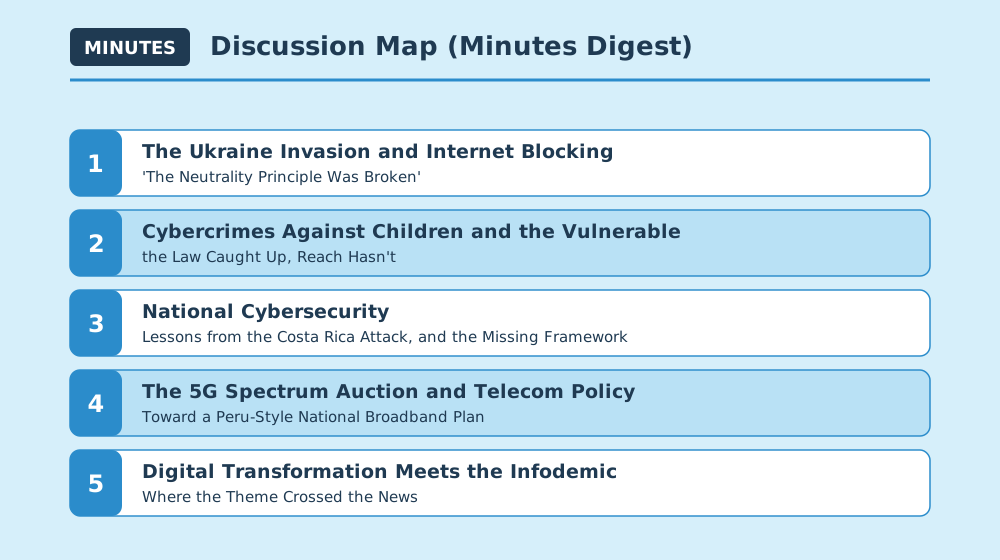
Key exchanges extracted from session records and transcripts.
1. The Ukraine Invasion and Internet Blocking — 'The Neutrality Principle Was Broken'
Sessions: Net-neutrality forum 'Blocking of the Internet and changes since February 2022' (24 August; Veridiana Alimonti, EFF Associate Director of Latin American Policy; Miguel Ángel Alcaine, head of the ITU Regional Office for Central America; José Luis Chávez, Haru Security; Joel Ariel Robinson, ICT consultant in Panama)
- Since Russia's February 2022 invasion of Ukraine, Russian authorities had blocked access, disconnected IXPs and restricted social platforms — breaking the principle that traffic be treated equally regardless of origin or type, the panel concluded [1]
- The four main blocking techniques — by IP address, URL, DNS and deep packet inspection — were laid out for the audience [1]
- Recommendations included vigilant reporting of blocking, regulation ensuring providers do not censor, and a joint agenda between the SIT regulator and the consumer-protection agency [1]
2. Cybercrimes Against Children and the Vulnerable — the Law Caught Up, Reach Hasn't
Sessions: Net-neutrality forum 'Protection of children, teens, and vulnerable people on the Internet' (31 August; all four expert speakers were women, including practitioners from SVET — the Secretariat against Sexual Violence, Exploitation and Trafficking — and the Public Ministry)
- Speakers reported that grooming via ICT, violating minors' sexual privacy, and the sale, distribution and possession of child sexual abuse material are now punishable under the Criminal Code — real movement since the 2018 forum's finding that no such law existed [1]
- Predators run multiple fake profiles and make first contact on legitimate platforms like LinkedIn before steering victims to personal channels such as WhatsApp, panellists showed with real cases [1]
- Cyber-violence cases have risen every year since the pandemic began, and the digital divide keeps SVET and the Public Ministry from reaching every community — a mobile unit partly fills the gap [1]
3. National Cybersecurity — Lessons from the Costa Rica Attack, and the Missing Framework Law
Sessions: The Cybersecurity Forum (22 September; chaired by Dr Román Estuardo Cancinos, Fourth Vice-Minister for Technology at the Ministry of the Interior, with experts from the Ministry of Defense, CONCIBER, SISAP and IDS — among the largest audiences)
- The forum concluded bluntly that Guatemala 'is not ready to face a cyberattack threat like the one that occurred in Costa Rica this year', and that without a framework law it risks being both attacked and used as a launchpad against other countries [1]
- The Ministry of Defense has run a CSIRT since 2009 — recognised by the OAS among the Americas' CSIRTs — and in 2019 formed an Information and Technology Command with ICT and cyber-defense battalions [1]
- Recommendations: a national cybersecurity and cyberdefense plan, a new cybercrime bill drafted with public, private, academic and civil-society participation, and a national reference CSIRT [1]
4. The 5G Spectrum Auction and Telecom Policy — Toward a Peru-Style National Broadband Plan
Sessions: Public-policy forum 'Telecommunications in Guatemala' (8 September; Vice-Minister Rodolfo Letona, Superintendent Marco Antonio Baten, former superintendent José Raúl Solares, and Wilmer Azurza of Peru's regulator OSIPTEL)
- SIT announced it had begun identifying frequency bands for 5G mobile service ahead of an auction — the session's headline news [1]
- Drawing on Peru's experience, the panel recommended a national broadband plan built on all stakeholders' input, plus a 'coverage map' identifying unconnected communities [1]
- Community networks are already being deployed in Guatemala and could scale with credits and non-reimbursable funds from international organisations, speakers noted [1]
5. Digital Transformation Meets the Infodemic — Where the Theme Crossed the News
Sessions: The digital-transformation forums (14 September with Irina Cisneros, Director of Regulation at Digicel El Salvador; 22 September on the ITU plan) and the net-neutrality forum 'Infodemic: the cancer of misinformation and fake news' (7 September)
- From her pandemic-era client research, Cisneros quantified firms' digital capabilities: 35% could work from home, 22% had advanced cybersecurity, 18% advanced analytics, 19% advanced cloud infrastructure and 14% mobile technology [1]
- The ITU's digital-transformation plan was judged an adoptable methodology for Guatemala, with mass e-signature use, a cybercrime law and data protection listed among the regulatory changes states should enact [1]
- The infodemic was defined as an overabundance of content feeding disinformation campaigns that manipulate opinion, discredit opponents, silence dissent and polarise — with source-checking and refusing to forward chain messages the first line of defence [1]
Three-Minute Short Talk — Your Questions Answered
Q. What was the format?
A. A six-week hybrid: the first in-person kick-off since 2019 at UNIS in Fraijanes on 4 August, twelve virtual forums at roughly two a week, and a closing at Campus TEC in the capital on 29 September — 31 speakers, eight of them women.
Q. What was the timeliest debate?
A. Internet blocking after the invasion of Ukraine. EFF and ITU experts framed Russia's IXP disconnections and platform restrictions as a breaking of the net-neutrality principle, and walked through the blocking techniques — IP, URL, DNS and deep packet inspection.
Q. Why should I care?
A. The conclusion that a country without a cybersecurity framework law becomes both target and launchpad applies everywhere, and watching a neighbour turn Costa Rica's massive breach into policy lessons is a case study in regional learning.
What Is Guatemala IGF? (for first-time readers)
Guatemala IGF is a National or Regional IGF Initiative (NRI), aligning local internet governance discussion with global IGF principles.
Why It Matters to You
What was discussed here becomes the baseline for national digital policy, platform rules and AI regulation worldwide within a few years. The principles confirmed at the 2022 meeting are the foundation of the "next rules" for the phones, social platforms and AI services you use every day.
Sources & References
- IV Annual, 2022 Guatemala Internet Governance Forum Final Report(第6回最終報告書・UN提出。表紙の「IV Annual」は誌面表記で、本文は「VI Guatemala IGF」「6年連続」と明記) — intgovforum.org (accessed 2026-07-17)
- Latin American and Caribbean Regional Group (GRULAC) — Guatemala IGF(2022年報告書リンク) — intgovforum.org (accessed 2026-07-17)
- Guatemala IGF(NRIミーティングページ) — intgovforum.org (accessed 2026-07-17)
- #IGF #Guatemala 2026 el 5 de noviembre – Convocatoria(組織委員会関係者ブログ。「正式・連続の開催は計6回、直近の年次フォーラムは2022年末」と2026年時点で確認) — Maria Mercedes Zaghi(IGF Guatemala 組織委員会関係者) (accessed 2026-07-17)
- IGF Guatemala 公式サイト — IGF Guatemala / ISOC Guatemala (accessed 2026-07-17)
Quotes are translated or condensed from the records listed above. Bracketed numbers [n] refer to the source list.
Related links
- IGF official (NRI list): https://www.intgovforum.org/en/content/national-and-regional-igf-initiatives
- Japan IGF: https://japanigf.jp/
- Yuki Nakazawa's blog: https://nkzw.jp/category/igf/
更新履歴
第1稿投稿 2026年7月9日 19時36分(記事コンテンツアップ)
— 中澤祐樹

