
The 3-Line Summary
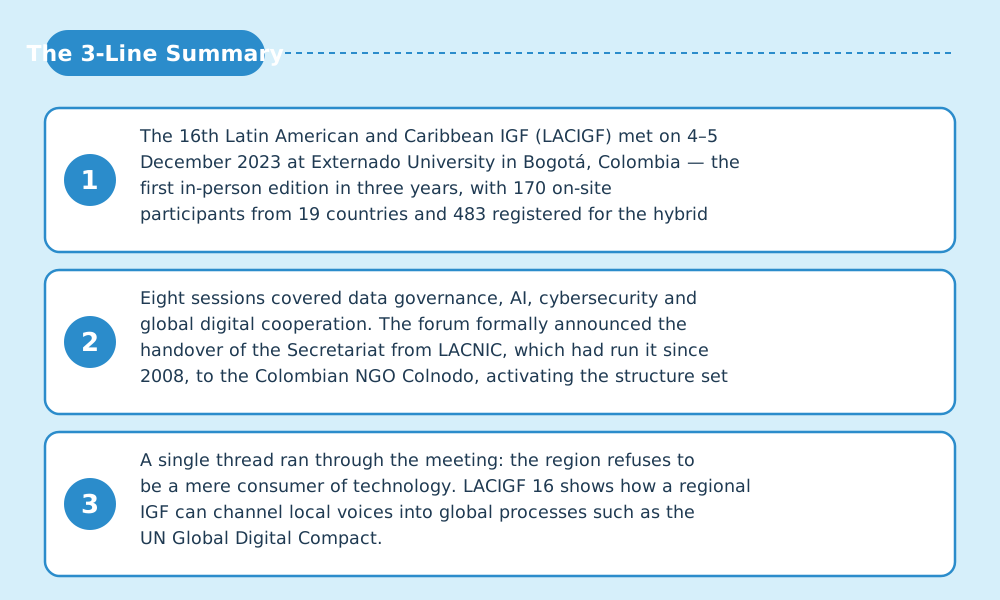
- The 16th Latin American and Caribbean IGF (LACIGF) met on 4–5 December 2023 at Externado University in Bogotá, Colombia — the first in-person edition in three years, with 170 on-site participants from 19 countries and 483 registered for the hybrid event.
- Eight sessions covered data governance, AI, cybersecurity and global digital cooperation. The forum formally announced the handover of the Secretariat from LACNIC, which had run it since 2008, to the Colombian NGO Colnodo, activating the structure set out in the 2021 bylaws.
- A single thread ran through the meeting: the region refuses to be a mere consumer of technology. LACIGF 16 shows how a regional IGF can channel local voices into global processes such as the UN Global Digital Compact.
Welcome — this is the Japan IGF Support Organization. This in-depth report on LACIGF 2023 in Bogotá draws on official outputs, session records and on-site reporting. In a hurry? The three lines above and the diagrams carry the gist.
📍 The catalogue lists 'Santiago, Chile, 2023', but official records show the 16th LACIGF (2023) was held in Bogotá, Colombia. Santiago hosted the 17th edition in 2024; no LACIGF took place in Santiago in 2023.
Conference at a Glance (from official records)
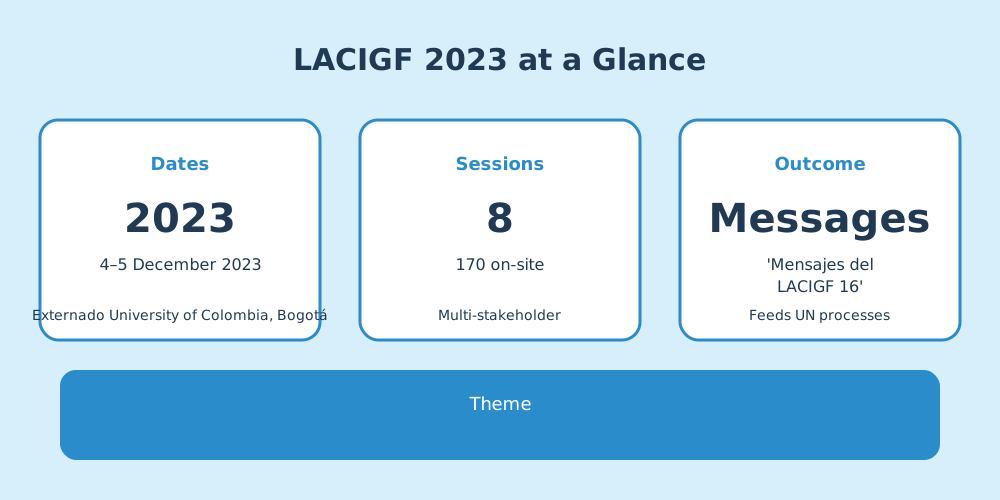
| Item | Detail |
|---|---|
| Edition | 16th edition (LACIGF 16) |
| Dates | 4–5 December 2023 |
| Venue | Externado University of Colombia, Bogotá, Colombia |
| Theme | Regional governance themes |
| On-site participants | 170 |
| Sessions | 8 |
| Host | Organised by Colnodo (Colombian NGO, new LACIGF Secretariat); hosted at Externado University of Colombia |
| Outcome | 'Mensajes del LACIGF 16' (Forum Messages) and a Final Report |
| Milestone | First in-person edition after three years online, and the first under Colnodo, which took over the Secretariat from LACNIC |
(See the source list at the end of this article.)
Discussion Digest — from the Session Records
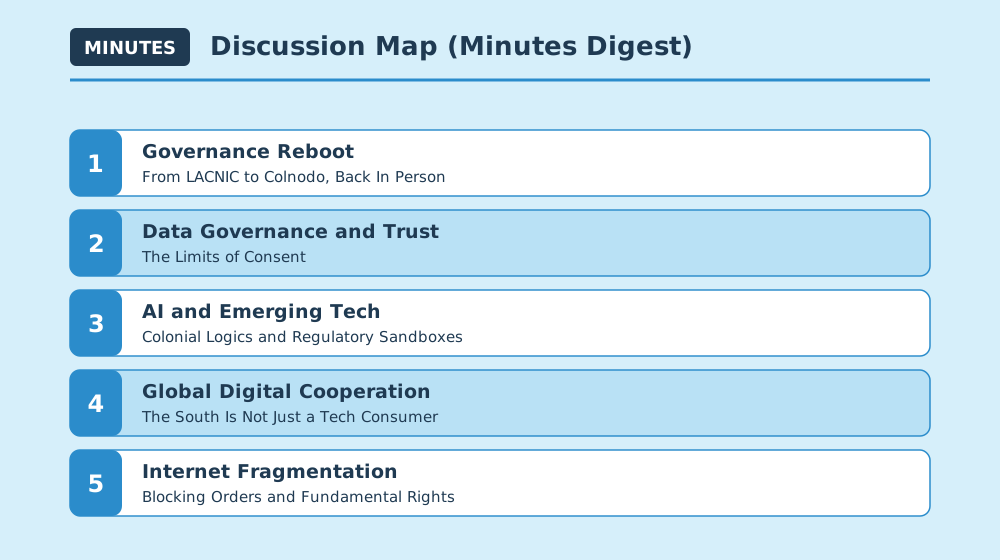
Key exchanges extracted from session records and transcripts.
1. Governance Reboot — From LACNIC to Colnodo, Back In Person
Sessions: Session 'LACIGF: New Bylaws and Intersessional Committees' (4 December) and the opening
"It is a great honour to announce Colnodo as the new executive secretariat of LACIGF (translated from Spanish)"
— Alejandra Erramuspe (LACIGF Programme Committee) [3][4][5]
- Under the 2021 bylaws, the forum reported its transition to a new structure: a Multistakeholder Committee (CMPI), a Workshop Selection Committee (CST) and Intersessional Working Groups (IWG) [3][4][5]
- Following an open call, the Secretariat passed in July 2023 from LACNIC — which had held it since the forum's creation in 2008 — to the Colombian NGO Colnodo [3][4][5]
- After three years of pandemic-era virtual sessions, the forum returned in person in a hybrid format; restarting the annual meeting was itself framed as the headline achievement [3][4][5]
2. Data Governance and Trust — The Limits of Consent
Sessions: Session 1 'Data Governance and Trust' (4 December, 9:30–11:00)
- Panellists recalled that the Inter-American Court of Human Rights treats control over one's personal data as a fundamental right — safeguarding privacy cannot be left to private companies alone [4][2]
- Informed consent was called insufficient: people cannot foresee how their data will actually be used, and while the ideal replacement is unclear, 'it is evident that it must change' [4][2]
- With no regulatory convergence across the region, interoperability schemes are for now the only bridge to free data flows — convergence is the goal, interoperability is what exists [4][2]
3. AI and Emerging Tech — Colonial Logics and Regulatory Sandboxes
Sessions: Session 4 'AI and Emerging Technologies' (4 December)
- Speakers warned that the data feeding AI models is tied to colonial logics and surveillance capitalism, reproducing biased outcomes — the key question being who benefits from AI and for whom it remains an unkept promise [4][2]
- Regulatory sandboxes and public-private collaboration were proposed to foster AI designed and built in Latin America while balancing regulation and innovation [4][2]
- Constant auditing across the AI lifecycle by diverse, multisectoral teams, and algorithmic transparency requirements for developers, were framed as prerequisites for fairness and accountability [4][2]
4. Global Digital Cooperation — The South Is Not Just a Tech Consumer
Sessions: Session 6 'Global Digital Governance and Cooperation' (5 December, 11:30–13:00), the NRIs session and the keynote
- Digital cooperation 'must not mean the Global North empowering itself over Global South countries as consumers of technology' — the region needs venues to build a common agenda [4][5]
- Brazil proposed NetMundial+10 as a transparent venue to debate the renewal of international internet governance, while Colombia reported its written contributions to the UN Global Digital Compact consultation [4][5]
- In the keynote, IGF MAG chair Carol Roach urged youth and diverse communities to engage at a pivotal moment — with the GDC under negotiation and the IGF itself under review — and called for a more strategic IGF [4][5]
5. Internet Fragmentation — Blocking Orders and Fundamental Rights
Sessions: Session 8 'Avoiding Internet Fragmentation' (5 December, 16:15–17:45)
- Fragmentation was mapped across three layers — technical, governance/coordination and user experience — with content blocking and user-specific restrictions flagged as potentially disproportionate measures [4][2]
- Small and mid-sized ISPs argued that blocking orders must be specific, technically feasible, economically reasonable, temporary and transparent [4][2]
- For encrypted messaging services, panellists insisted on proportionality and effectiveness tests, given the impact on privacy and freedom of expression [4][2]
Three-Minute Short Talk — Your Questions Answered
Q. So what did the forum actually decide?
A. LACIGF doesn't decide — it's the region's forum where governments, companies, civil society and the technical community talk as equals. But 2023 was a turning point: the Secretariat passed from LACNIC to Colnodo and the forum relaunched under new bylaws, with its key points published as the LACIGF Messages.
Q. What was the hottest debate?
A. AI and data. Critics argued the data feeding AI models is tied to colonial structures and surveillance capitalism, while others pushed regulatory sandboxes to balance innovation. The limits of consent-based data protection were also debated head-on.
Q. Why should I care?
A. The limits of consent and the proportionality of blocking orders are live issues in most jurisdictions. Note also that this event is catalogued as 'Santiago 2023', but the 2023 edition actually took place in Bogotá, Colombia.
What Is LACIGF? (for first-time readers)
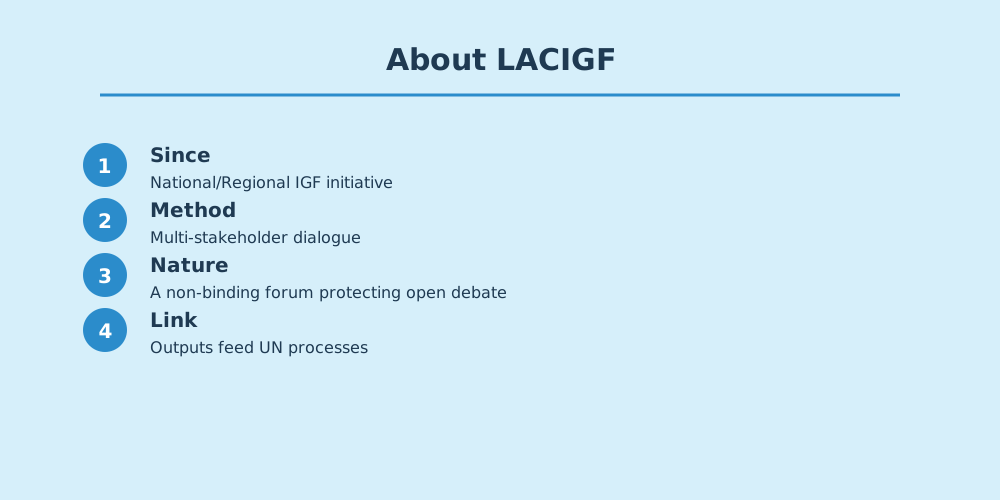
LACIGF is a National or Regional IGF Initiative (NRI), aligning local internet governance discussion with global IGF principles.
Why It Matters to You
What was discussed here becomes the baseline for national digital policy, platform rules and AI regulation worldwide within a few years. The principles confirmed at the 2023 meeting are the foundation of the "next rules" for the phones, social platforms and AI services you use every day.
Sources & References
- Foros anteriores(過去大会一覧) — LACIGF(公式) (accessed 2026-07-10)
- LACIGF 16 — event page & agenda — LACIGF(公式イベントサイト) (accessed 2026-07-10)
- Final report LACIGF 2023 (PDF) — LACIGF事務局(Colnodo) (accessed 2026-07-10)
- Mensajes del LACIGF 16 – 2023 (PDF) — LACIGF事務局(Colnodo) (accessed 2026-07-10)
- LACIGF 2023: Un espacio de diálogo y acción para la gobernanza digital — Colnodo(LACIGF事務局・APC加盟) (accessed 2026-07-10)
Quotes are translated or condensed from the records listed above. Bracketed numbers [n] refer to the source list.
Related links
- IGF official (NRI list): https://www.intgovforum.org/en/content/national-and-regional-igf-initiatives
- Japan IGF: https://japanigf.jp/
- Yuki Nakazawa's blog: https://nkzw.jp/category/igf/
Revision History
Rev. 1 — published 4 August 2023, 00:00 (Article published)
Rev. 2 — updated 10 July 2026, 14:28 (Fully revised into the in-depth edition: added the 3-line summary, minutes digest, short talk, source list and diagrams (all quotes verified against the listed sources))
— 中澤祐樹