


The 3-Line Summary
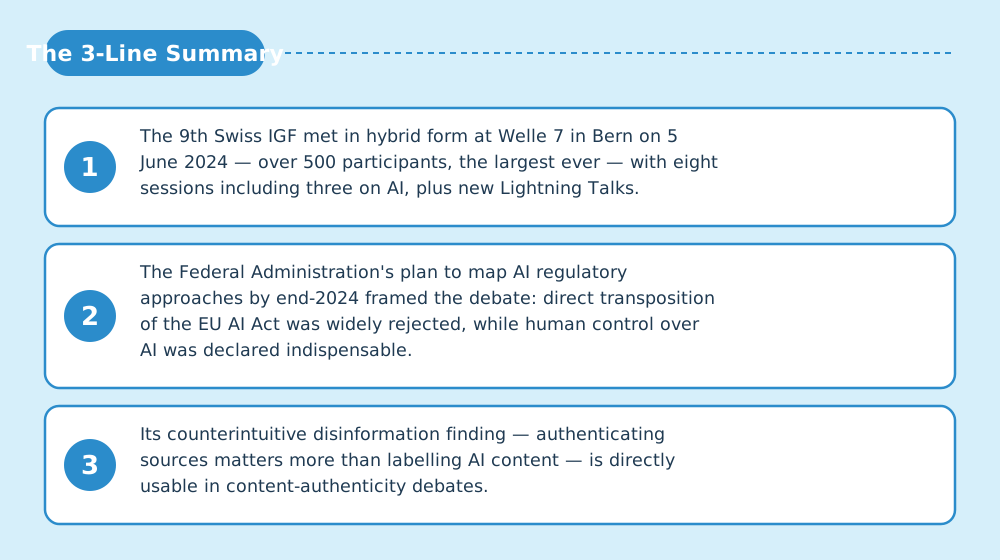
- The 9th Swiss IGF met in hybrid form at Welle 7 in Bern on 5 June 2024 — over 500 participants, the largest ever — with eight sessions including three on AI, plus new Lightning Talks.
- The Federal Administration's plan to map AI regulatory approaches by end-2024 framed the debate: direct transposition of the EU AI Act was widely rejected, while human control over AI was declared indispensable.
- Its counterintuitive disinformation finding — authenticating sources matters more than labelling AI content — is directly usable in content-authenticity debates.
Welcome — this is the Japan IGF Support Organization. This in-depth report on Swiss IGF 2024 (9th Swiss Internet Governance Forum) draws on official outputs, session records and on-site reporting. In a hurry? The three lines above and the diagrams carry the gist.
Conference at a Glance (from official records)
| Item | Detail |
|---|---|
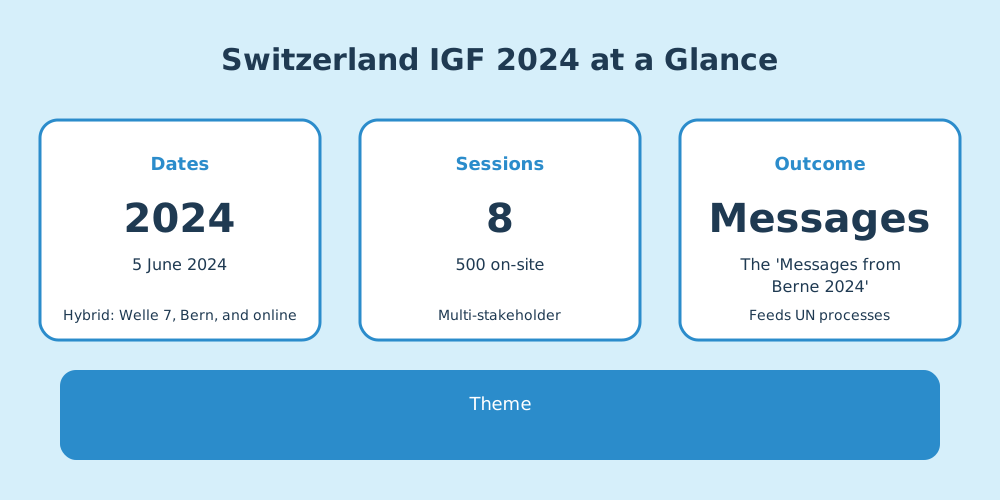
| Official name | Swiss IGF 2024 (9th Swiss Internet Governance Forum) |
| Dates | 5 June 2024 |
| Venue | Hybrid: Welle 7, Bern, and online |
| Theme | Regional governance themes |
| Participants | 500 (Official press release: more than 500 participants on- and offline — the largest in the conference's history) |
| Sessions | 8 (Eight sessions plus the newly introduced Lightning Talk format) |
| Host | A committed multistakeholder community under OFCOM patronage |
| Outcome | The 'Messages from Berne 2024', submitted to the UN IGF and EuroDIG |
(See the source list at the end of this article.)
Discussion Digest — from the Session Records
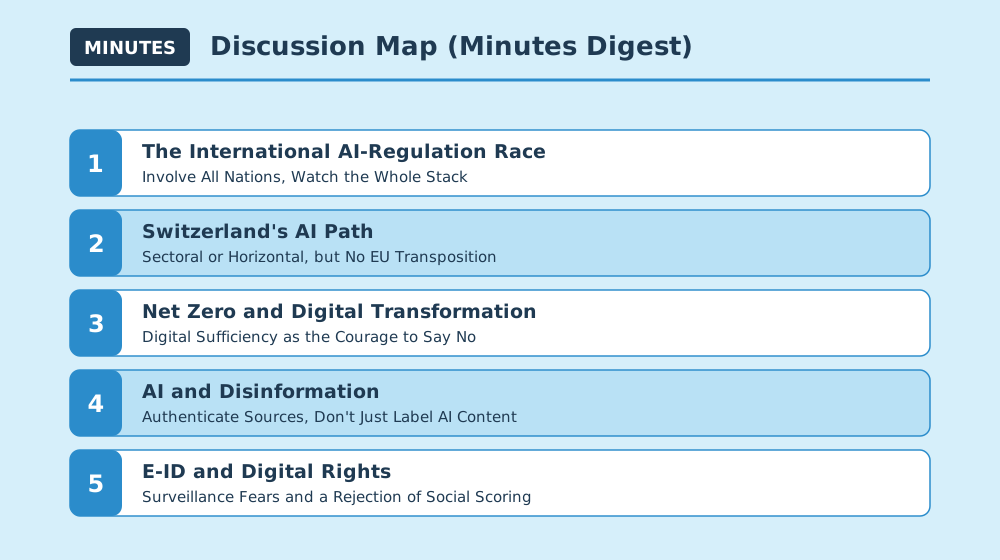
Key exchanges extracted from session records and transcripts.
1. The International AI-Regulation Race — Involve All Nations, Watch the Whole Stack
Sessions: Session 1 'Regulation of AI – Insights into the international race'
- All nations, regardless of political system and economic power, should be involved in international coordination on AI governance, aiming at long-term harmonisation that respects different contexts and use cases [1]
- Human control is indispensable for safe AI use — its form to be defined by industry and use case, with expertise built up quickly across all relevant organisations [1]
- Regulation should address not only AI models and applications but the entire tech stack — a comprehensive view of all levels and stakeholders is needed to tackle safety effectively [1]
2. Switzerland's AI Path — Sectoral or Horizontal, but No EU Transposition
Sessions: Session 3 'Regulation of Artificial Intelligence in Switzerland'
- By end-2024 the Federal Administration will draw up an interdepartmental overview of possible AI regulatory approaches, examining which areas are already sufficiently regulated and where gaps exist [1]
- Opinions split on sectoral versus horizontal regulation — tending toward sectoral for detail, horizontal for abstract principles; direct autonomous transposition of the EU AI Act was widely rejected [1]
- Sandboxing was well received yet noted as possibly indicating over-restrictive rules; employee protection, AI-related copyright challenges and the missing technical-implementation perspective were also discussed [1]
3. Net Zero and Digital Transformation — Digital Sufficiency as the Courage to Say No
Sessions: Session 4 'Net zero and digital transformation, a contradiction?'
- Digital technologies bring dematerialisation gains — but data centres' impact on national power demand will keep growing rapidly with the exponential rise of digital applications [1]
- After decades of efficiency optimism, net reduction targets are still not being met; rebound effects and ecological costs must now be accounted for, holding developers, society and politics to account [1]
- Digital sufficiency means using technology selectively and strategically where it delivers proven added value — the courage to say no — aiming for a win-win-win for society, planet and industry [1]
4. AI and Disinformation — Authenticate Sources, Don't Just Label AI Content
Sessions: Session 5 'AI and disinformation: counteracting the loss of trust in reporting'
- Authenticating sources and authorship is more important than labelling AI content as such; the challenge includes consumers — media and news literacy need promotion, especially positive examples of identifying reliable sources [1]
- Legal certainty is needed on platforms' moderator role: society must decide quickly and clearly how disinformation is handled in the digital space [1]
- Researchers urgently need data access for more and better disinformation research — not least to objectify the debate and prevent general uncertainty fuelled by over-excited deepfake coverage [1]
5. E-ID and Digital Rights — Surveillance Fears and a Rejection of Social Scoring
Sessions: Session 8 'Digital rights: security and efficiency versus freedom and privacy protection'
- The Swiss E-ID can improve online security and efficiency, but the 3D video facial images required for issuance could open new avenues for state surveillance; the general rise of compulsory identification and data collection was criticised [1]
- No consensus on how relevant social scoring already is for Switzerland — but agreement that such systems are incompatible with fundamental values and the kind of society people want to live in [1]
- Growing state surveillance fuels new fears: the loss of freedom and privacy may be irreversible, and the state's active rejection of modern encryption to keep surveillance loopholes open was criticised [1]
Three-Minute Short Talk — Your Questions Answered
Q. What did it decide?
A. Nothing binding — the 'Messages from Berne 2024' went to the UN IGF and EuroDIG. With 500+ participants it was the largest Swiss IGF ever.
Q. Most contentious point?
A. Sectoral versus horizontal AI regulation — with near-unanimous rejection of transposing the EU AI Act wholesale into Swiss law.
Q. Why care?
A. 'Authenticate the source, don't just label the AI' is becoming the global direction for disinformation policy — this forum said it plainly.
What Is Switzerland IGF? (for first-time readers)
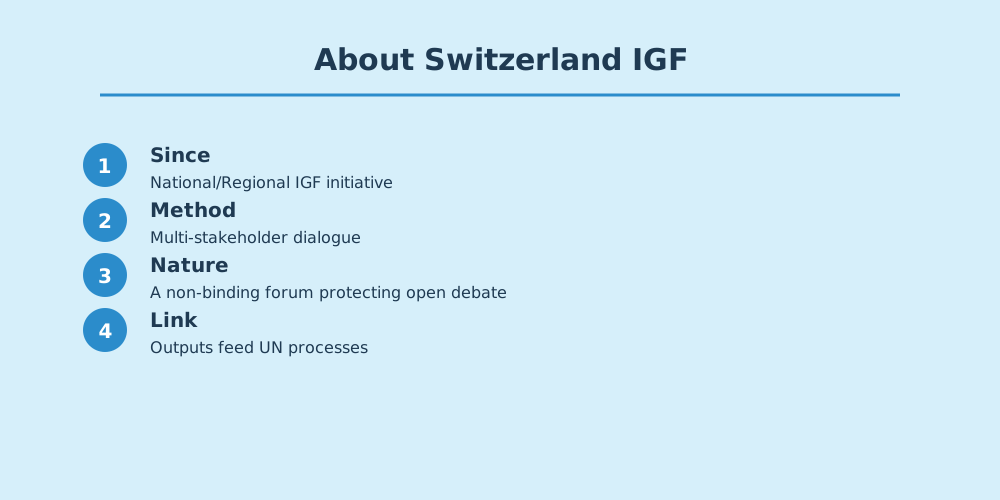
Switzerland IGF is a National or Regional IGF Initiative (NRI), aligning local internet governance discussion with global IGF principles.
Why It Matters to You
What was discussed here becomes the baseline for national digital policy, platform rules and AI regulation worldwide within a few years. The principles confirmed at the 2024 meeting are the foundation of the "next rules" for the phones, social platforms and AI services you use every day.
Sources & References
- Messages from Berne 2024 (Swiss IGF 2024) — Swiss IGF (accessed 2026-07-23)
- Largest Swiss Internet Governance Forum held since its foundation (Press Release) — Swiss IGF (accessed 2026-07-23)
- Swiss IGF 2024(大会ページ) — igf.swiss (accessed 2026-07-23)
- About the Swiss IGF — igf.swiss (accessed 2026-07-23)
Quotes are translated or condensed from the records listed above. Bracketed numbers [n] refer to the source list.
Related links
- IGF official (NRI list): https://www.intgovforum.org/en/content/national-and-regional-igf-initiatives
- Japan IGF: https://japanigf.jp/
- Yuki Nakazawa's blog: https://nkzw.jp/category/igf/
更新履歴
第1稿投稿 2026年8月9日 21時37分(記事コンテンツアップ)
— 中澤祐樹

