


The 3-Line Summary
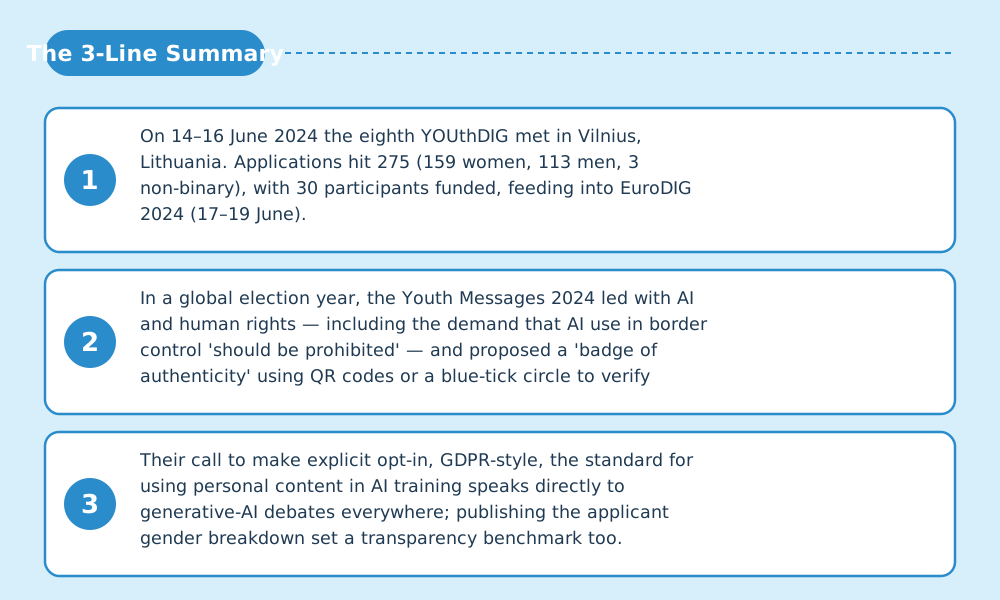
- On 14–16 June 2024 the eighth YOUthDIG met in Vilnius, Lithuania. Applications hit 275 (159 women, 113 men, 3 non-binary), with 30 participants funded, feeding into EuroDIG 2024 (17–19 June).
- In a global election year, the Youth Messages 2024 led with AI and human rights — including the demand that AI use in border control 'should be prohibited' — and proposed a 'badge of authenticity' using QR codes or a blue-tick circle to verify information against deepfakes.
- Their call to make explicit opt-in, GDPR-style, the standard for using personal content in AI training speaks directly to generative-AI debates everywhere; publishing the applicant gender breakdown set a transparency benchmark too.
Welcome — this is the Japan IGF Support Organization. This in-depth report on YOUthDIG 2024 — Youth Dialogue on Internet Governance, Vilnius draws on official outputs, session records and on-site reporting. In a hurry? The three lines above and the diagrams carry the gist.
Conference at a Glance (from official records)
| Item | Detail |
|---|---|
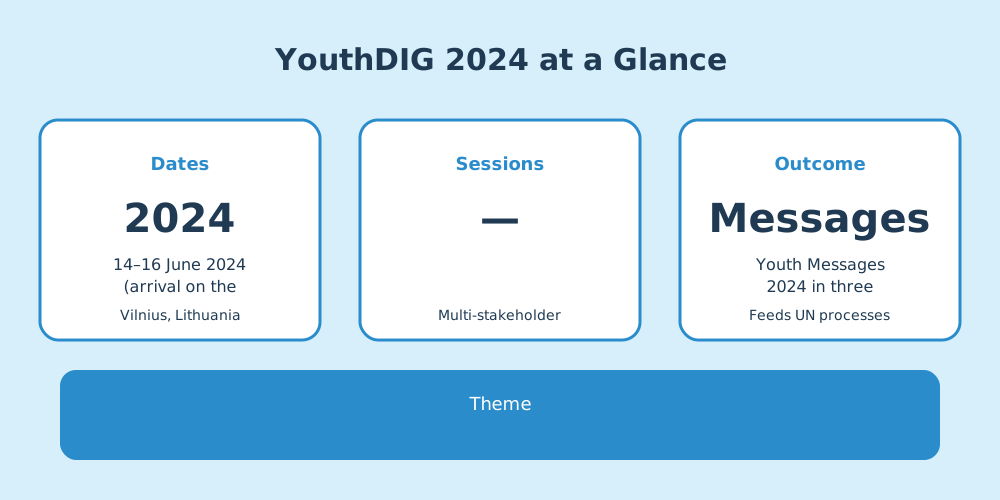
| Official name | YOUthDIG 2024 — Youth Dialogue on Internet Governance, Vilnius |
| Dates | 14–16 June 2024 (arrival on the 13th), preceded by an online phase with webinars on 13, 20 and 27 May and 2 and 10 June |
| Venue | Vilnius, Lithuania |
| Theme | Regional governance themes |
| Outcome | Youth Messages 2024 in three clusters — policy propositions on AI and human rights (discrimination, techno-solutionism, AI in border control, education, training data, deepfakes), an intersectional approach to youth participation, and fair and privacy-preserving use of data — presented at EuroDIG and the global IGF |
(See the source list at the end of this article.)
Discussion Digest — from the Session Records
Key exchanges extracted from session records and transcripts.
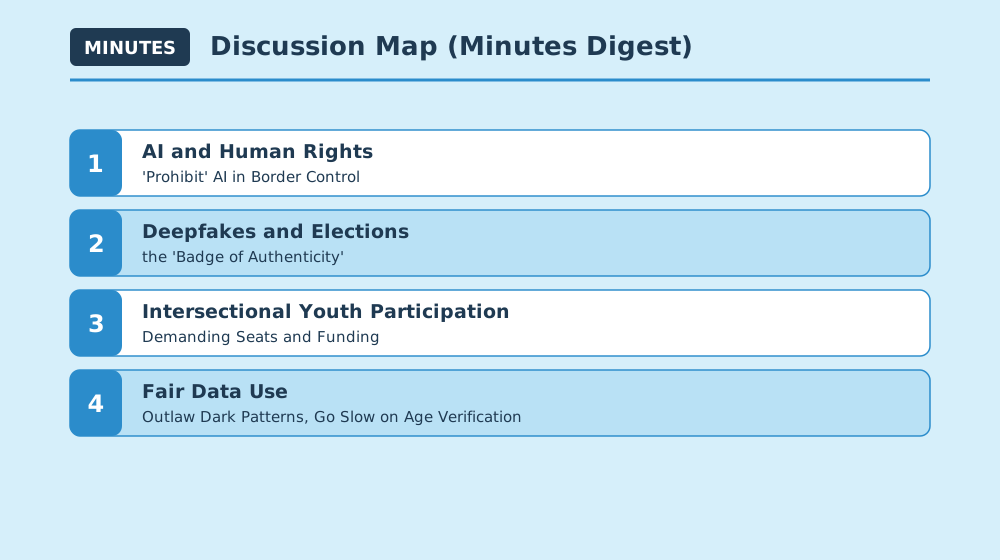
1. AI and Human Rights — 'Prohibit' AI in Border Control
Sessions: Youth Messages, 'Policy Propositions on Artificial Intelligence and Human Rights'
- The strongest prohibition in the series' history: AI in border control raises grave human-rights concerns for refugees and border-crossers, biometric data is collected without proper consent, AI is not a solution to the migration crisis — therefore 'the use of AI in border control should be prohibited' [1]
- Against AI-reproduced discrimination they proposed transparency, synthetic data, focus groups representing minority and intersectional backgrounds, and legal clarification of responsibility [1]
- Policy makers' techno-solutionism got its own warning: AI may not be the most efficient fix — from waste to migration management — so comprehensive multistakeholder impact assessments and accountability must precede deployment [1]
2. Deepfakes and Elections — the 'Badge of Authenticity'
Sessions: Youth Messages sections 'Deepfakes' and 'Data for AI training'
- Deepfake videos flooding the media in crises and elections prevent rational decision-making, fuel distrust in institutions and harm democracy, the messages argued — demanding a legal framework, funding for detection technology and mandatory labelling of all deepfakes [1]
- They proposed 'a system to confirm the authenticity of information, such as a badge of authenticity using a QR code or blue tick circle', for media houses to verify content [1]
- On AI training data: replace today's opt-out with explicit opt-in following the GDPR example — redesigning consent for the generative-AI era [1]
3. Intersectional Youth Participation — Demanding Seats and Funding
Sessions: Youth Messages, 'An intersectional approach for youth participation for a better Internet governance future'
- Make a youth 'seat at the table' a requirement, they demanded — with standards and recommendations for meaningful participation in high-level discussions and stable funding, including operational grants, for youth organisations [1]
- They proposed spaces with co-management structures where young people issue policy recommendations and monitor their implementation [1]
- Inclusivity starts with language: youth-friendly versions of policy documents, LLMs trained across European languages to narrow information gaps, and accessibility standards for users with disabilities [1]
4. Fair Data Use — Outlaw Dark Patterns, Go Slow on Age Verification
Sessions: Youth Messages, 'Fair and Privacy Preserving Use of Data'
- Data privacy should not depend on personal, social or economic status: outlaw dark patterns, empower consumer agencies to pursue them, and make opt-in the standard without penalty or exclusion [1]
- A 'new economics of data': data is an asset produced by users' labour and used to facilitate price discrimination — so companies should be barred from raising prices based on personal data shared without consent [1]
- On age verification the cohort was candid: no effective technical solution protects children without infringing privacy, so priority should go to strengthening law enforcement and shifting liability to providers of explicit content rather than privacy-reducing technocentric fixes [1]
Three-Minute Short Talk — Your Questions Answered
Q. How competitive was it?
A. 275 applications for 30 funded places — roughly nine to one. Publishing the gender breakdown (159 women, 113 men, 3 non-binary) set a transparency benchmark for youth programmes.
Q. What was the boldest demand?
A. Prohibit AI in border control — the strongest prohibition in the series' history, citing biometric data collected from refugees without proper consent. The 'badge of authenticity' against deepfakes was the most concrete invention.
Q. Why should I care?
A. The opt-in demand for AI training data and the scepticism about age-verification technology map directly onto generative-AI copyright debates and child-safety legislation in most countries.
What Is YouthDIG? (for first-time readers)
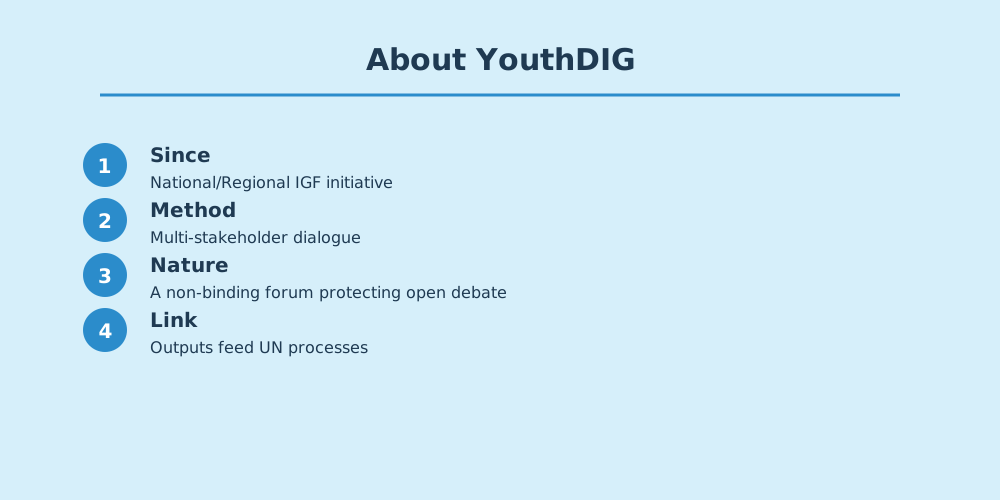
YouthDIG is a National or Regional IGF Initiative (NRI), aligning local internet governance discussion with global IGF principles.
Why It Matters to You
What was discussed here becomes the baseline for national digital policy, platform rules and AI regulation worldwide within a few years. The principles confirmed at the 2024 meeting are the foundation of the "next rules" for the phones, social platforms and AI services you use every day.
Sources & References
- YOUthDIG 2024(ユースメッセージ全文・応募統計275件/30人) — EuroDIG Wiki(EuroDIG公式) (accessed 2026-07-22)
- YOUthDIG 2024 programme(ウェビナー5回+現地6/14-16の詳細日程) — EuroDIG Wiki(EuroDIG公式) (accessed 2026-07-22)
- EuroDIG 2024(June 17–19 in Vilnius, Lithuania・RRTホスト) — EuroDIG Wiki(EuroDIG公式) (accessed 2026-07-22)
- YOUthDIG(系列概要と歴代ユースメッセージのアーカイブ) — EuroDIG(eurodig.org) (accessed 2026-07-22)
Quotes are translated or condensed from the records listed above. Bracketed numbers [n] refer to the source list.
Related links
- IGF official (NRI list): https://www.intgovforum.org/en/content/national-and-regional-igf-initiatives
- Japan IGF: https://japanigf.jp/
- Yuki Nakazawa's blog: https://nkzw.jp/category/igf/
更新履歴
第1稿投稿 2026年7月9日 17時22分(記事コンテンツアップ)
— 中澤祐樹

