


The 3-Line Summary
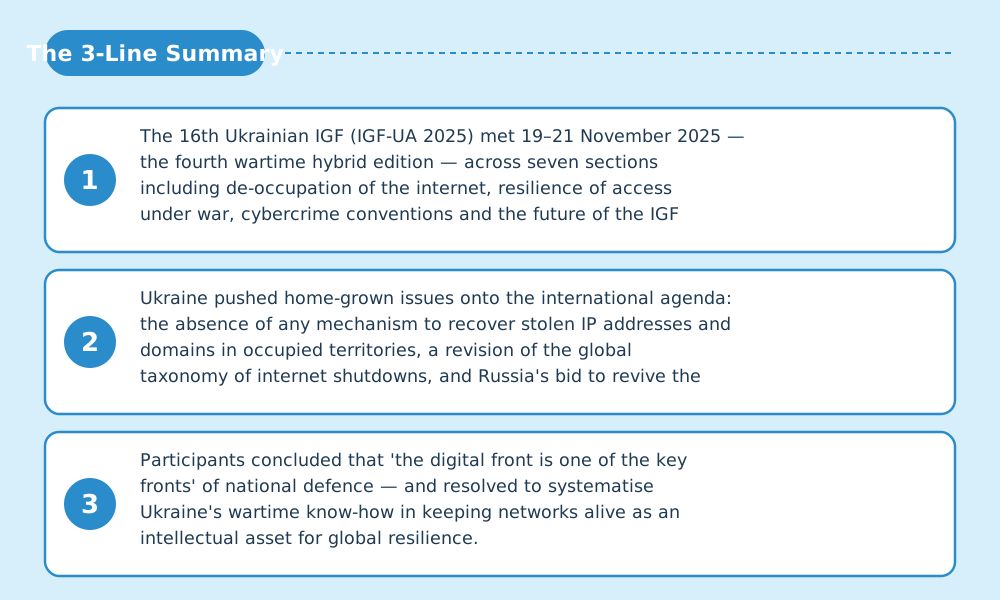
- The 16th Ukrainian IGF (IGF-UA 2025) met 19–21 November 2025 — the fourth wartime hybrid edition — across seven sections including de-occupation of the internet, resilience of access under war, cybercrime conventions and the future of the IGF mandate.
- Ukraine pushed home-grown issues onto the international agenda: the absence of any mechanism to recover stolen IP addresses and domains in occupied territories, a revision of the global taxonomy of internet shutdowns, and Russia's bid to revive the '.su' domain. The Foreign Ministry's cyber-diplomacy department joined the organising committee.
- Participants concluded that 'the digital front is one of the key fronts' of national defence — and resolved to systematise Ukraine's wartime know-how in keeping networks alive as an intellectual asset for global resilience.
Welcome — this is the Japan IGF Support Organization. This in-depth report on IGF-UA 2025 (16th Ukrainian Internet Governance Forum) draws on official outputs, session records and on-site reporting. In a hurry? The three lines above and the diagrams carry the gist.
Conference at a Glance (from official records)
| Item | Detail |
|---|---|
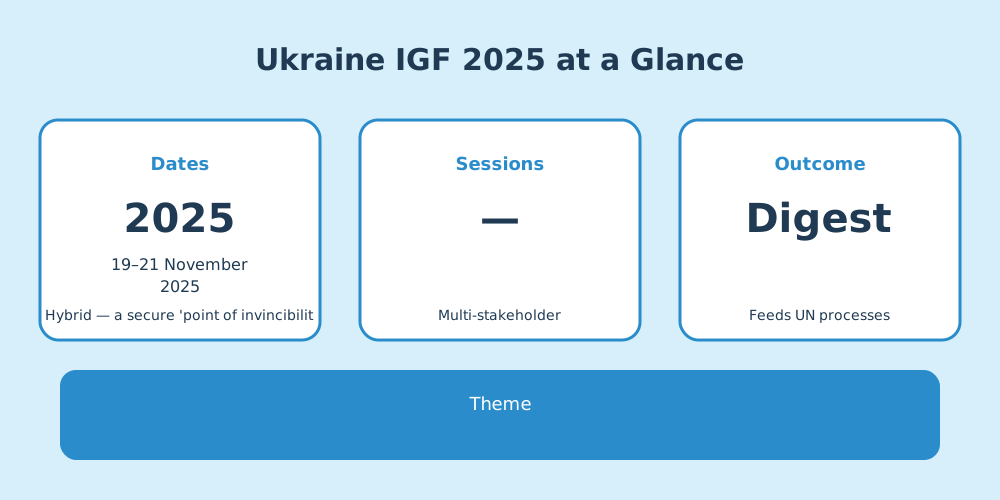
| Official name | IGF-UA 2025 (16th Ukrainian Internet Governance Forum) |
| Edition | 16th edition |
| Dates | 19–21 November 2025 |
| Venue | Hybrid — a secure 'point of invincibility' on the Adamant company site in Kyiv, plus videoconference |
| Theme | Regional governance themes |
| Host | Internet Association of Ukraine (InAU), Commission on Science and IT of the USPP, the NGO European Media Platform and Hostmaster LLC, supported by the parliamentary Digital Transformation Committee, the Foreign Ministry, the Digital Transformation Ministry and the NKEK regulator, sponsored by RIPE NCC and ICANN |
(See the source list at the end of this article.)
Discussion Digest — from the Session Records
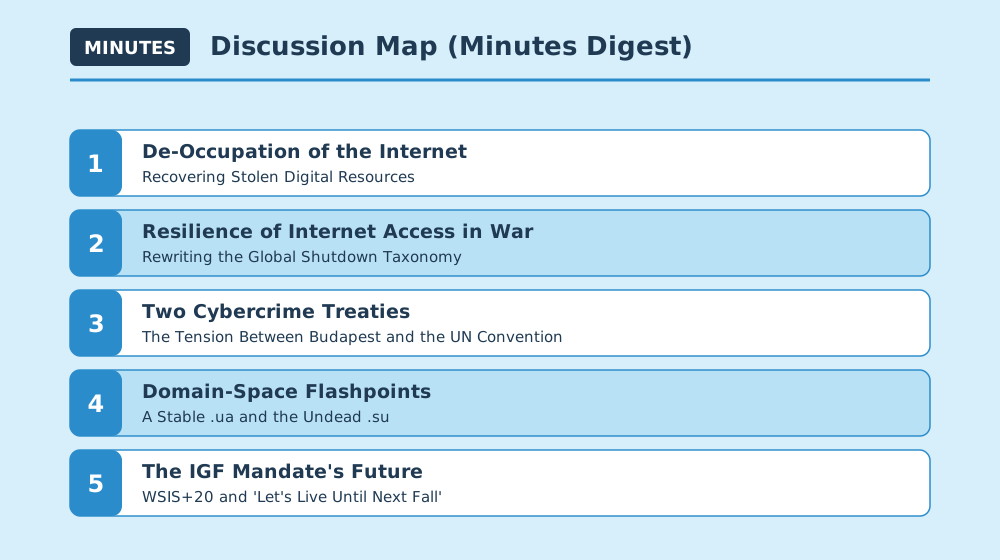
Key exchanges extracted from session records and transcripts.
1. De-Occupation of the Internet — Recovering Stolen Digital Resources
Sessions: Section 2 'De-Occupation of the Internet and Reducing Russia's Influence in Digital Space' (mod. Olena Kushnir, InAU)
- Russia is systematically altering routing, domains and network infrastructure in occupied territories; documenting these actions — route snapshots, domain changes, data from occupied networks — builds the evidentiary basis for international courts (Tetyana Dolinska, SUNIC). The Kherson restoration case showed Russia attempting to re-route traffic through its own operators [1][3]
- The section concluded that theft of IP addresses and ASNs violates digital sovereignty, that an international mechanism for returning digital resources is needed but does not yet exist, and proposed a 'digital occupation registry' recording changes to routes, domains and IP blocks [1][3]
- The Digital Ministry's Yuriy Matsyk stressed the role of ICANN, ITU and the GAC in returning digital resources, while Hostmaster's Svitlana Tkachenko noted the .ua domain has remained stable through the war — part of digital identity and national security [1][3]
2. Resilience of Internet Access in War — Rewriting the Global Shutdown Taxonomy
Sessions: Section 4 'Resilience of Internet Access During War (Blocking, Internet Shutdowns)' (mods. Yuriy Matsyk / Oleksiy Semenyaka)
- RIPE NCC's Oleksiy Semenyaka argued the existing global taxonomy of internet shutdowns — built around technical failures and political censorship — must be revised to account for natural disasters and hostile actions by other states, including warfare [1]
- Operators from the Kherson region reported on uninterrupted operations, new procedures and engineering solutions under occupation and shelling; participants resolved to systematise this 'unique Ukrainian know-how' as an intellectual asset for building resilient networks worldwide [1]
- The shared conclusion: communication today is not entertainment or business but a basic human need on a par with safety and food — the ability to get information, reach relatives or call for help saves lives [1]
3. Two Cybercrime Treaties — The Tension Between Budapest and the UN Convention
Sessions: Section 5 'Comparison of the Council of Europe and UN Approaches to Combating Cybercrime' (mod. Oksana Prykhodko)
- With Giorgi Jokhadze of the Council of Europe's Cybercrime Programme Office and Oleksiy Tkachenko, Ukraine's NSDC representative at ENISA, the section reaffirmed the Budapest Convention — ratified by Ukraine in 2005 — as a clear mechanism for trusted international cooperation grounded in human rights, transparency and the rule of law [1]
- The UN cybercrime convention adopted in 2024 with strong support from Russia, Iran and North Korea creates a parallel evidence framework: complementary in places, but bringing risks of weaker safeguards and fragmentation, with potential effects on freedom of expression and other rights. Ukraine did not take part in drafting it [1]
4. Domain-Space Flashpoints — A Stable .ua and the Undead .su
Sessions: Section 6 'Current Issues of the Domain Space' (mod. Oksana Prykhodko)
- Participants noted the exceptional stability of .ua administration — technical, administrative and international — while judging ICANN's 2026 new gTLD round to bring 'more challenges than opportunities' for Ukraine [1]
- Cabinet Resolution 851/2015, restricting official e-mail to the GOV.UA/.УКР zones, drew a proposal for repeal: its 'Ukrainian segment of the Internet' wording contradicts the 'One World – One Internet' principle and hints at Russian-Chinese governance concepts [1]
- The section flagged Russia's efforts to return .su — removed from ISO 3166-1 in 1992 yet still 'exceptionally reserved' — to the country-code list, and the opacity of the Cyrillic .укр administration (unreachable official contacts on IANA's records), prompting informal talks with ICANN [1]
5. The IGF Mandate's Future — WSIS+20 and 'Let's Live Until Next Fall'
Sessions: Section 7 'The Future of Internet Governance and the IGF Mandate' (mods. Oksana Prykhodko / Tetyana Dolinska)
- With the IGF Secretariat's Anja Gengo, ICANN, RIPE NCC, the IGF Supporting Association and EuroDIG's Olivier Crépin-Leblond taking part, the prevailing view was that the UNGA vote of 17 December would extend the IGF's mandate — perhaps in modified form, and for about another ten years [1][3]
- Mandate or no mandate, all participants stressed the value of an open multistakeholder platform capable of initiating discussion at national, regional and global levels [1][3]
- The joint IGF-UA/Youth IGF-UA budget was carried that year by RIPE NCC and ICANN, topped up by remnants of IGF SA's long-running support; some Ukrainian stakeholders were pessimistic, but the joke 'let's live until next fall' was, the report concludes, a challenge rather than a doubt [1][3]
Three-Minute Short Talk — Your Questions Answered
Q. What changed in year four of the war?
A. The agenda moved from defending to reclaiming: 'de-occupation of the internet' — returning stolen IP addresses and domains — got its own section, with a proposal for an international restitution mechanism.
Q. Which debates could ripple worldwide?
A. Two: revising the global taxonomy of internet shutdowns to include warfare and hostile state action, and the warning that the 2024 UN cybercrime convention risks weaker safeguards than the Budapest Convention.
Q. Why should I care?
A. Ukraine pledged to systematise its know-how for keeping networks alive in crisis — directly relevant to disaster-prone countries — and the IGF-mandate discussion frames the future of every national IGF.
What Is Ukraine IGF? (for first-time readers)
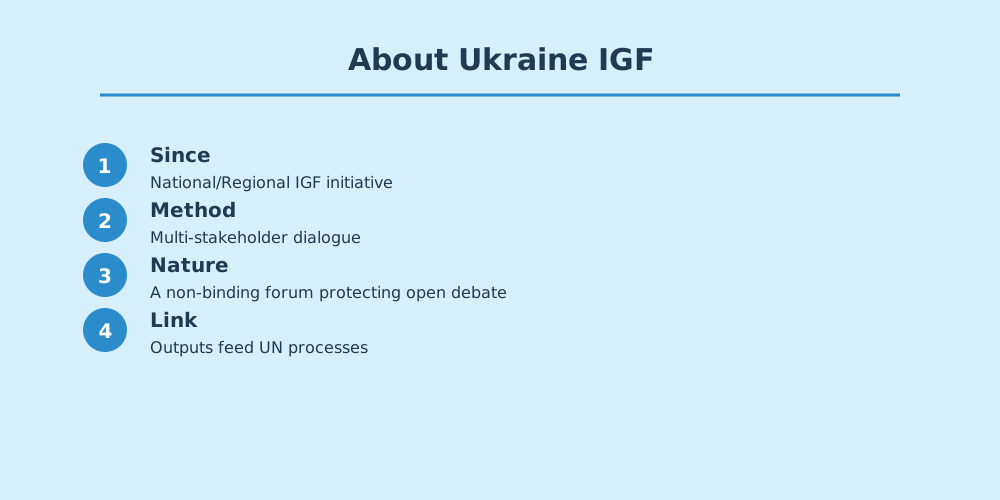
Ukraine IGF is a National or Regional IGF Initiative (NRI), aligning local internet governance discussion with global IGF principles.
Why It Matters to You
What was discussed here becomes the baseline for national digital policy, platform rules and AI regulation worldwide within a few years. The principles confirmed at the 2025 meeting are the foundation of the "next rules" for the phones, social platforms and AI services you use every day.
Sources & References
- Ukrainian IGF-UA 2025 Annual Report(XVI Український форум 公式年次報告書・英語DOCX。表題の「XV」は誤記で本文は第16回) — IGF-UA組織委員会 (accessed 2026-07-17)
- Ukrainian Internet Governance Forum IGF-UA, Kyiv, 19-21 November 2025(国連IGFサイト掲載版の年次報告書) — 国連IGF事務局ファイルデポ (accessed 2026-07-17)
- У Києві відбувся 16-й Український форум з управління Інтернетом IGF-UA 2025(開催報告ニュース・2025年11月22日) — IGF-UA組織委員会 (accessed 2026-07-17)
- IGF-UA 2025 公式アーカイブサイト(16-й Український форум з управління Інтернетом IGF-UA 2025) — IGF-UA組織委員会 (accessed 2026-07-17)
- IGF-UA 公式報告書一覧(Річний звіт IGF-UA 2025「16-й Український форум」の配布ページ) — IGF-UA組織委員会 (accessed 2026-07-17)
Quotes are translated or condensed from the records listed above. Bracketed numbers [n] refer to the source list.
Related links
- IGF official (NRI list): https://www.intgovforum.org/en/content/national-and-regional-igf-initiatives
- Japan IGF: https://japanigf.jp/
- Yuki Nakazawa's blog: https://nkzw.jp/category/igf/
更新履歴
第1稿投稿 2026年7月20日 16時28分(記事コンテンツアップ)
— 中澤祐樹