


The 3-Line Summary
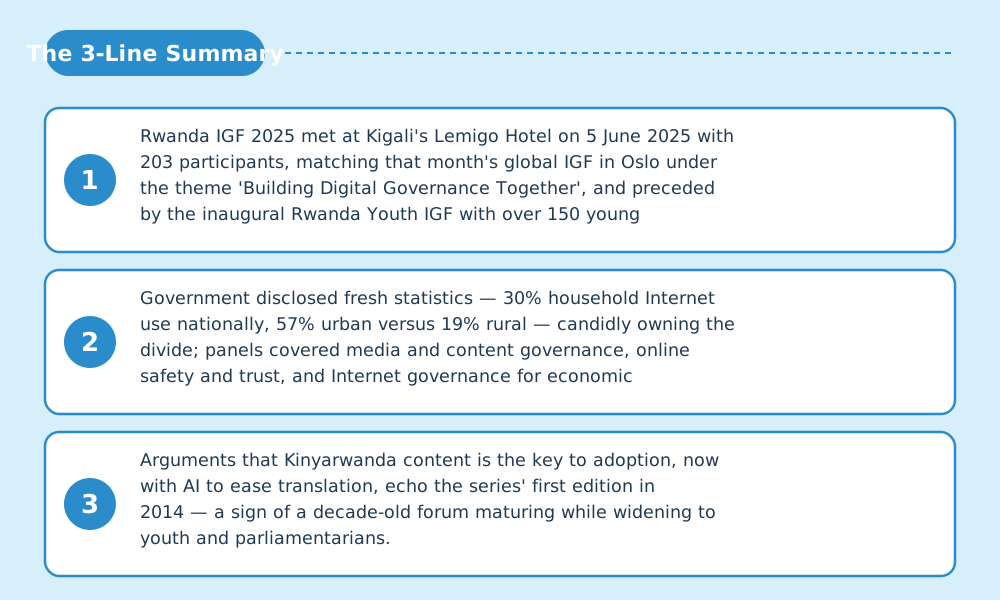
- Rwanda IGF 2025 met at Kigali's Lemigo Hotel on 5 June 2025 with 203 participants, matching that month's global IGF in Oslo under the theme 'Building Digital Governance Together', and preceded by the inaugural Rwanda Youth IGF with over 150 young participants.
- Government disclosed fresh statistics — 30% household Internet use nationally, 57% urban versus 19% rural — candidly owning the divide; panels covered media and content governance, online safety and trust, and Internet governance for economic development, with the NCSA chief presenting on data sovereignty.
- Arguments that Kinyarwanda content is the key to adoption, now with AI to ease translation, echo the series' first edition in 2014 — a sign of a decade-old forum maturing while widening to youth and parliamentarians.
Welcome — this is the Japan IGF Support Organization. This in-depth report on Rwanda Internet Governance Forum 2025 draws on official outputs, session records and on-site reporting. In a hurry? The three lines above and the diagrams carry the gist.
Conference at a Glance (from official records)
| Item | Detail |
|---|---|
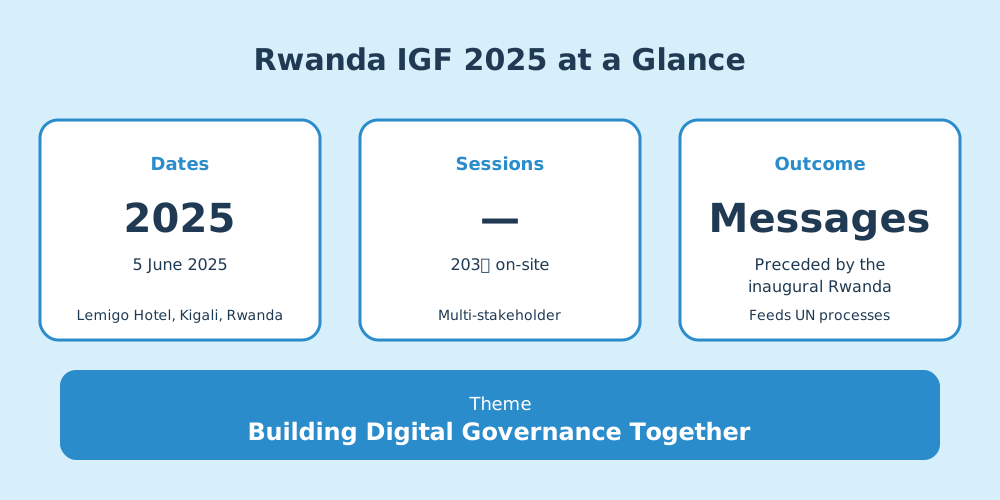
| Official name | Rwanda Internet Governance Forum 2025 |
| Dates | 5 June 2025 |
| Venue | Lemigo Hotel, Kigali, Rwanda |
| Theme | Building Digital Governance Together |
| Participants | 203 participants (25.4% female) |
| Host | Hosted by RICTA and the ICT Chamber with the Internet Society Foundation, the ISOC Rwanda Chapter, MINICT, RURA, NCSA, RGB, Airtel, MTN, Smart Africa, Zipline, Irembo, Team Cymru, TrAC and others |
| Outcome | Preceded by the inaugural Rwanda Youth IGF (150+ participants) and the 2nd Rwanda School on Internet Governance (50 participants) |
(See the source list at the end of this article.)
Discussion Digest — from the Session Records
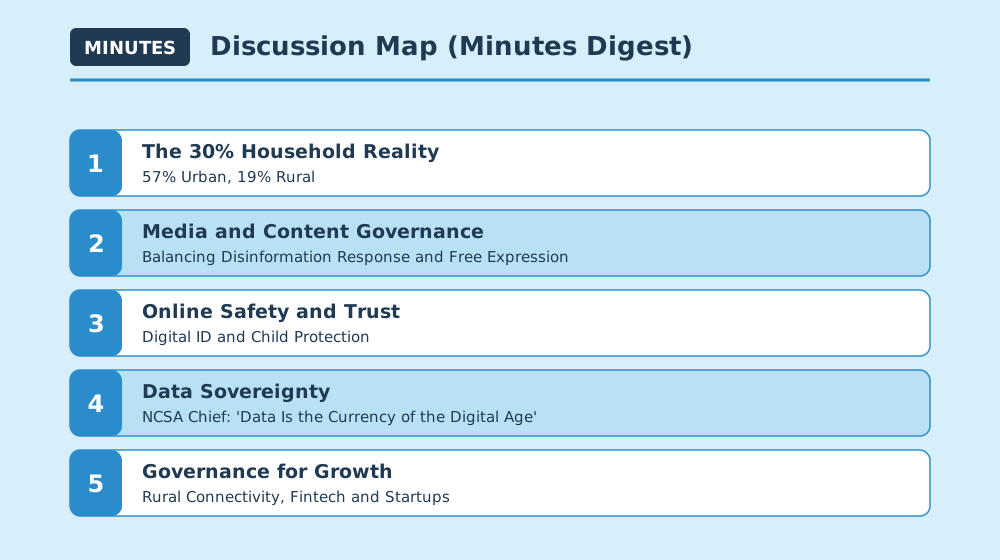
Key exchanges extracted from session records and transcripts.
1. The 30% Household Reality — 57% Urban, 19% Rural
Sessions: Guest-of-honour remarks by Esther Kunda, DG of Innovation and Emerging Technologies, MINICT
"While internet penetration is commendable, we still face gaps in access and affordability, especially between urban and rural areas. Many Rwandans use the internet for services, communication, and daily life, but not all can afford it or know how to use it productively"
— Esther Kunda (Director General of Innovation and Emerging Technologies, MINICT) [1]
- Household Internet use has reached 30% nationally — 57% urban against 19% rural — with 13.48 million active mobile subscriptions as of September 2024, up 7.5% year on year [1]
- As adoption grows, robust regulatory frameworks promoting trust, inclusion and sustainability are needed, and 'the inclusion of Parliament in these discussions is critical to formalizing supportive policies and laws' [1]
2. Media and Content Governance — Balancing Disinformation Response and Free Expression
Sessions: First panel moderated by Ian Nkera (Coventry University) with Dr. Alphonse Muleefu (University of Rwanda) and IGF committee chair Robert N. Ford
"Combating misinformation is not just about removing false content — it's about empowering people to question, verify, and engage critically"
— Dr. Alphonse Muleefu (Principal, College of Arts and Social Sciences, University of Rwanda) [1]
"Freedom of expression and content regulation must be carefully balanced — we must protect democracy without stifling voices"
— Robert N. Ford (Chair, Rwanda IGF Committee) [1]
- Fact-checking and media literacy were framed as the front line against misinformation, to be scaled through university-civil society-media partnerships [1]
- High-quality Kinyarwanda content was cast as both adoption driver and cultural preservation, with local-content quotas and AI-assisted translation entering the recommendations — Dr. Ojielo's keynote cited Nigeria's broadcasting quotas as precedent [1]
3. Online Safety and Trust — Digital ID and Child Protection
Sessions: Second panel moderated by Ghislain Nkeramugaba (ISOC IXP expert) with NIDA DG Josephine Mukesha, Airtel, TrAC and MTN
"Data protection is not just a legal requirement — it is the foundation of citizen confidence in e-services"
— Josephine Mukesha (Director General, National Identification Agency) [1]
- NIDA's digital ID systems were framed as the trust backbone reducing fraud and opening e-government and private services, with scaling recommended across services [1]
- TrAC CEO Sage Umutoniwabo warned that children are the earliest adopters and the most vulnerable — 'protection must be proactive, not reactive' — while both telcos pledged expanded anti-fraud tools and cooperation with government [1]
4. Data Sovereignty — NCSA Chief: 'Data Is the Currency of the Digital Age'
Sessions: Special presentation by Col. David Kanamugire, CEO of the National Cyber Security Authority
"Data is the currency of the digital age — its governance will determine not only trust, but also Rwanda's sovereignty in the global digital economy"
— Col. David Kanamugire (CEO, National Cyber Security Authority) [1]
- Sensitive data — financial, health, biometric — should stay within national jurisdiction, backed by local data centres and cloud, data-science and cyber skills, reduced foreign-provider dependency, and cross-border flow agreements that preserve sovereignty [1]
- He hailed the Data Protection and Privacy Law (gazetted October 2021) as granting citizens clear rights and businesses regulatory certainty, and cited France's CNIL and Singapore's PDPC in calling for robust independent enforcement [1]
5. Governance for Growth — Rural Connectivity, Fintech and Startups
Sessions: Third panel moderated by Smart Africa, with Zipline, Airtel, Irembo and BSC
- BSC CEO Gilbert Kayinamura argued 'the digital economy will only succeed if rural communities, SMEs, and ordinary citizens benefit from access and opportunity', with accelerated rural broadband and community networks/public Wi-Fi recommended [1]
- Zipline showcased medical-drone logistics as public-private innovation; policy, finance and incubation support for startups and mobile-money-driven financial inclusion — contingent on lower fees and literacy — were set out as growth pillars [1]
Three-Minute Short Talk — Your Questions Answered
Q. What did the meeting decide?
A. Seven recommendation clusters: rural connectivity investment, incentives for Kinyarwanda content (including possible quotas and AI translation), full enforcement of the data protection law, child protection, startup support, data sovereignty, and institutionalising the IGF with Parliament involved.
Q. The most candid number?
A. Household Internet use: 30% nationally, 57% urban versus 19% rural — the government owning the divide and admitting many users cannot afford the Internet or use it productively.
Q. Why should I care?
A. It is the national twin of the Oslo global IGF in theme and timing, and its data-sovereignty prescription — keep sensitive data onshore, reduce foreign-cloud dependency — maps directly onto government-cloud debates elsewhere.
What Is Rwanda IGF? (for first-time readers)
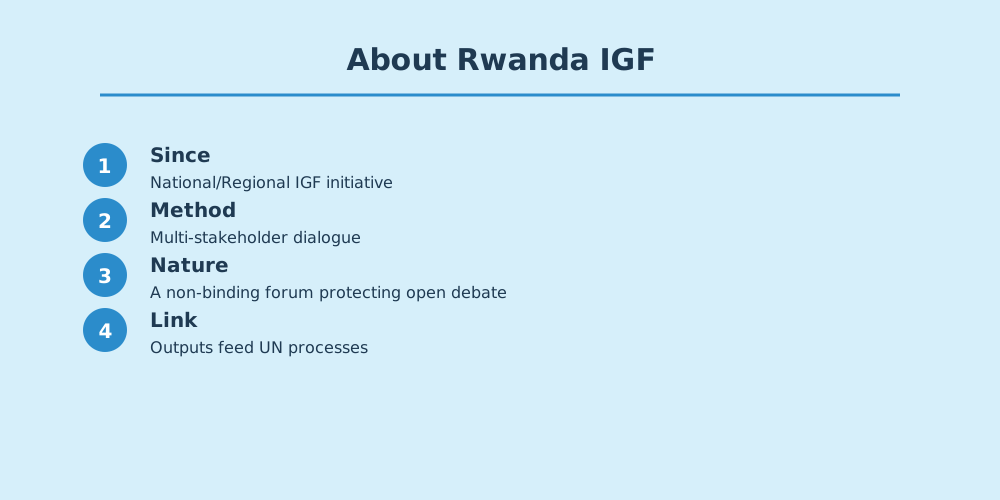
Rwanda IGF is a National or Regional IGF Initiative (NRI), aligning local internet governance discussion with global IGF principles.
Why It Matters to You
What was discussed here becomes the baseline for national digital policy, platform rules and AI regulation worldwide within a few years. The principles confirmed at the 2025 meeting are the foundation of the "next rules" for the phones, social platforms and AI services you use every day.
Sources & References
- Rwanda Internet Governance Forum (Rwanda IGF) 2025 Report(公式報告書: 2025-06-05・Lemigo Hotel・203名・3パネル1プレゼン・Youth IGF/RWSIG・7分野勧告) — RICTA / Rwanda IGF(国連IGF filedepot経由) (accessed 2026-07-23)
- Rwanda IGF 2025 – Agenda(公式アジェンダ: June 5th, 2025・Lemigo Hotel。Wayback捕捉 2025-06-19) — Rwanda IGF(rwigf.rw、Wayback Machine保存版) (accessed 2026-07-23)
- Rwanda IGF(NRI公式記録: 年次報告書一覧に2025年掲載・次回2026-07-27〜30キガリ) — 国連IGF事務局 (accessed 2026-07-23)
- About RwIGF(公式沿革: 2025年にYouth IGFと議員IGFトラックを開始・年間500名超参加) — Rwanda IGF(rwigf.rw) (accessed 2026-07-23)
Quotes are translated or condensed from the records listed above. Bracketed numbers [n] refer to the source list.
Related links
- IGF official (NRI list): https://www.intgovforum.org/en/content/national-and-regional-igf-initiatives
- Japan IGF: https://japanigf.jp/
- Yuki Nakazawa's blog: https://nkzw.jp/category/igf/
更新履歴
第1稿投稿 2026年8月9日 21時16分(記事コンテンツアップ)
— 中澤祐樹

