

日本語版: 日本語版
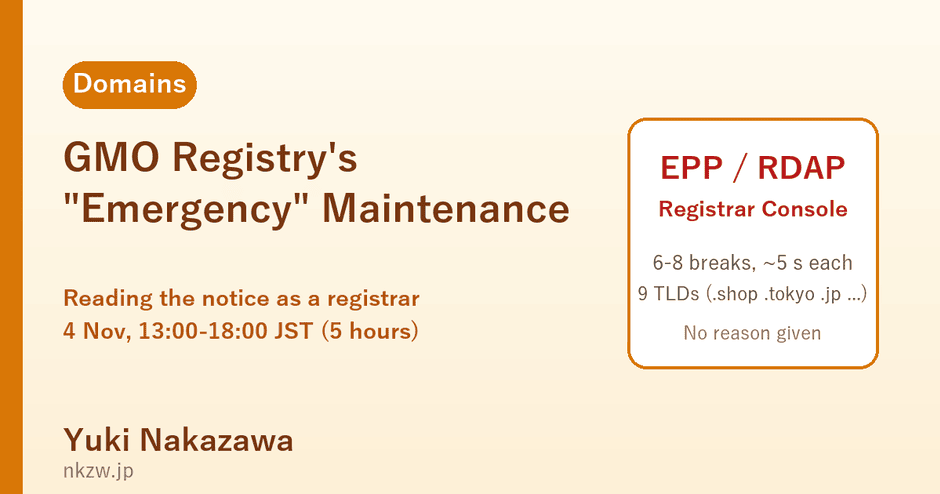
On the morning of Monday, 2 November 2026, GMO Registry (the registry operator of the GMO Internet Group) sent registrars a notice of network maintenance scheduled for 4 November. The subject line says “Emergency Network Maintenance”, while the body calls it a “planned outage”. It covers all TLDs operated on the company’s platform, such as .shop and .tokyo, and the affected systems are the registrar-facing provisioning services: EPP, RDAP and the Registrar Console. This article reads the notice as one of the registrars that received it. It keeps four things apart: what the notice says, how far the impact reaches, what is awkward for a registrar, and my own view.
I received this notice as a business that works as a registrar for .shop and .tokyo. I do not publish the original. This article carries only an image in which the sender, the recipient and links containing a subscriber ID are blacked out.
1. What the notice says (facts)
The notice as received (2 November 2026, 10:54 JST). The sender, the recipient and links containing a subscriber ID are blacked out
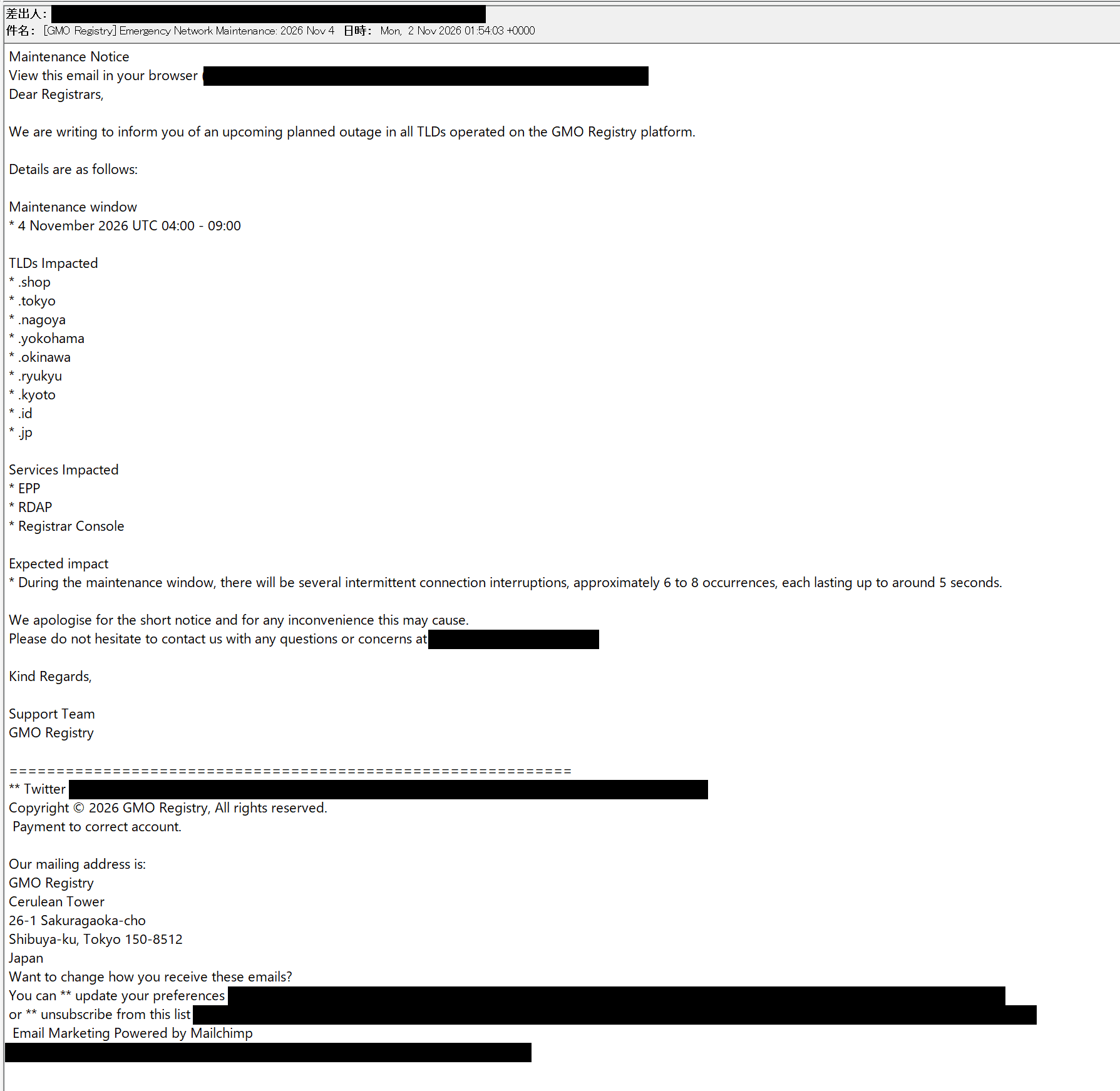
| Item | What the notice says |
|---|---|
| Received | 2 November 2026, 01:54:03 UTC (10:54 JST) |
| Subject | [GMO Registry] Emergency Network Maintenance: 2026 Nov 4 |
| Salutation | Dear Registrars |
| Wording in the body | “an upcoming planned outage in all TLDs operated on the GMO Registry platform” |
| Window | 4 November 2026, 04:00-09:00 UTC (13:00-18:00 JST, a Wednesday during business hours) |
| TLDs listed | .shop, .tokyo, .nagoya, .yokohama, .okinawa, .ryukyu, .kyoto, .id, .jp |
| Services affected | EPP, RDAP, Registrar Console |
| Expected impact | “several intermittent connection interruptions, approximately 6 to 8 occurrences, each lasting up to around 5 seconds” |
| Reason | Not stated |
| Other | “We apologise for the short notice” (two days between notice and work) |
That is all the notice says. It does not explain the purpose or content of the maintenance, whether DNS resolution is affected, or how this differs from ordinary planned maintenance.
The subject line (“Emergency”) and the body (“planned outage”) disagree within the same email. The work is called an emergency, yet it is set for a weekday daytime two days later, with an expected impact of a few seconds at a time. How to read that combination is the subject of section 4.
2. How far the impact reaches
The three services in the notice all sit between registrars and the registry.
- EPP (Extensible Provisioning Protocol): the channel a registrar uses to send the registry registrations, renewals, transfers, name server changes and so on. When it is down, the registrar’s processing stalls
- RDAP: lookup of registration data (the successor to WHOIS)
- Registrar Console: the registrar-facing management screen
The notice says nothing about DNS. When EPP or a management screen is down for a few seconds, name resolution for domains that are already registered is normally unaffected. So for registrants running sites on .shop or .tokyo, and for people visiting those sites, the impact reads as limited, if the notice holds. The most that can happen is that someone who happens to apply for a new registration or a renewal at a registrar during the window sees the procedure delayed by seconds to minutes.
Several things concern a registrar.
- Retries in automated processing: when an EPP connection drops, commands in flight fail. Even a break of about five seconds fails whatever command was sent at that moment, so retries are needed. Many registrar systems have them, but multi-step processes such as transfers need a state check when interrupted midway
- Customer support: explaining to customers whose application or renewal failed during the window. With two days’ notice there is little room to warn customers in advance
- No Registrar Console: manual checks and fixes are impossible, and the window overlaps a registrar’s business hours (13:00-18:00 on a weekday)
- Deadlines that fall in the window: domains whose renewal date or transfer completion falls on 4 November are safer handled before the window
All of these can be absorbed operationally if the premise, 6 to 8 interruptions of a few seconds each, is correct. If the work finishes as announced, ordinary users will hardly notice.
3. Who the listed TLDs are
The nine TLDs in the notice do not all have the same relationship with GMO Registry.
- .shop, .tokyo, .nagoya, .yokohama: TLDs for which GMO Registry itself is the registry operator (per the company profile)
- .okinawa, .ryukyu: regional TLDs whose registry operation the company took on under contract in 2012 (same source)
- .kyoto: the Kyoto regional TLD. I could not confirm its relationship with GMO Registry from the company profile, so I only note that the notice lists it
- .id: Indonesia’s country-code TLD (ccTLD). The registry is PANDI, and GMO Registry has been contracted since 2011 to build and run its registration system (the back end), according to the company profile and the announcement at the time
- .jp: Japan’s ccTLD, whose registry is JPRS (Japan Registry Services). The GMO Registry company profile does not mention .jp, and I could not confirm from official information which functions the company runs for .jp “on its platform”. I only note that the notice lists it
So the notice spans both TLDs that GMO Registry runs itself and systems it runs on behalf of other registries. For a registrar of .id, that means the connection to Indonesia’s registry will flicker because of maintenance by a Japanese company.
4. Why now (my view)
From here on, what I write is my view, not fact.
The email gives no reason. Even so, a notice labelled “emergency” for work two days away makes me think about timing. GMO Internet Group is still dealing with the unauthorized access to “Onamae.com Desktop Cloud” that it disclosed on 21 October, and on the afternoon of 2 November, the day the notice arrived, the group’s chairman and president Masatoshi Kumagai was scheduled to attend its first press conference (per reports by Nikkei, Jiji Press and others). I track the course of the incident every business day in a separate article, “The Day Financial Infrastructure Stops: Search Suggestions, Share Prices and a General View of Security Investment After the Unauthorized Access (Flash Edition)” (https://nkzw.jp/2026/10/27/gmo_incident_suggest_stock_security_investment_2026_en/).
While the group as a whole is reviewing its security, the registry company announces emergency network maintenance. Whether this is a measure related to the incident (for example a network equipment update or a configuration change) or has an entirely different reason cannot be told from the email or from public information. I can imagine the possibility, but I have no basis for asserting a connection. At the time of writing (afternoon of 2 November) I could not confirm the content of the press conference in the news. If it contains an explanation that bears on this notice, I will add it to this section once I can confirm it.
There is one thing I can say from a registrar’s side. A notice with no reason forces the recipient to guess. So does a subject line and a body that disagree (“emergency” versus “planned outage”). A registry-to-registrar notice becomes easier on both the recipient’s preparation and the explanation to customers with a single line giving the reason. This applies to any registry, not only GMO Registry.
5. What a registrar does before 4 November
These are the preparations my own business actually makes, written as a reference for others in the trade.
- Before the window (13:00-18:00 JST), finish processing domains in the listed TLDs whose renewal or transfer completion is near
- Check the EPP client’s retry and timeout settings: can it reconnect after a break of a few seconds, and can it re-fetch state when a multi-step process such as a transfer is cut in the middle?
- Schedule no work that needs the Registrar Console during the window
- If needed, warn customers beforehand that applications and renewals may be delayed by a few minutes (if the notice holds, most customers will not notice)
- After the window, check the logs for failed commands left behind
6. Limits and cautions
- This article rests only on one notice email sent to registrars, GMO Registry’s company profile and news reports. The purpose and content of the maintenance have not been made public, and I do not know them
- The view in section 4 is conjecture. I have not confirmed any relationship with the unauthorized access incident
- I could not confirm GMO Registry’s relationship with .kyoto and .jp from official information, so I have written the notice’s listing as it stands
- The actual result (how many interruptions occurred, how long they lasted, what the effect was) will be added after the 4 November window
Disclosure
I formerly sat on the board of a GMO group subsidiary. I currently run a domain business that handles .shop, .tokyo and other TLDs, and from GMO Registry’s point of view I am a registrar (a customer). This article is based only on the notice I received in that position and on public information, and uses nothing I learned while employed there.
About the author
Yuki Nakazawa (nkzw.jp)
- Website: nkzw.jp
- YouTube: @yknkzw
- Instagram: @nkzwyk
- LinkedIn: yukinakazawa
- X: @YukiNakazawa331
- Telegram: @yknkzw
2026.11.02 / written by Yuki Nakazawa
Update history
- 1st edition posted 2026-11-02 12:47 JST
- 2nd edition updated 2026-11-02 12:48 JST (link to the Japanese edition added)
