


The 3-Line Summary
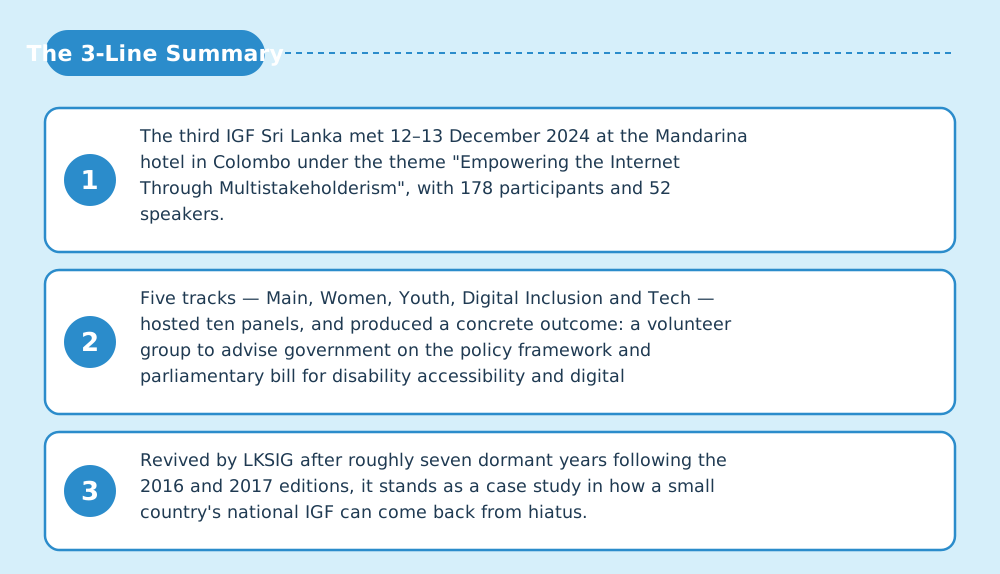
- The third IGF Sri Lanka met 12–13 December 2024 at the Mandarina hotel in Colombo under the theme "Empowering the Internet Through Multistakeholderism", with 178 participants and 52 speakers.
- Five tracks — Main, Women, Youth, Digital Inclusion and Tech — hosted ten panels, and produced a concrete outcome: a volunteer group to advise government on the policy framework and parliamentary bill for disability accessibility and digital rights.
- Revived by LKSIG after roughly seven dormant years following the 2016 and 2017 editions, it stands as a case study in how a small country's national IGF can come back from hiatus.
Welcome — this is the Japan IGF Support Organization. This in-depth report on IGF Sri Lanka 2024 (3rd National IGF) draws on official outputs, session records and on-site reporting. In a hurry? The three lines above and the diagrams carry the gist.
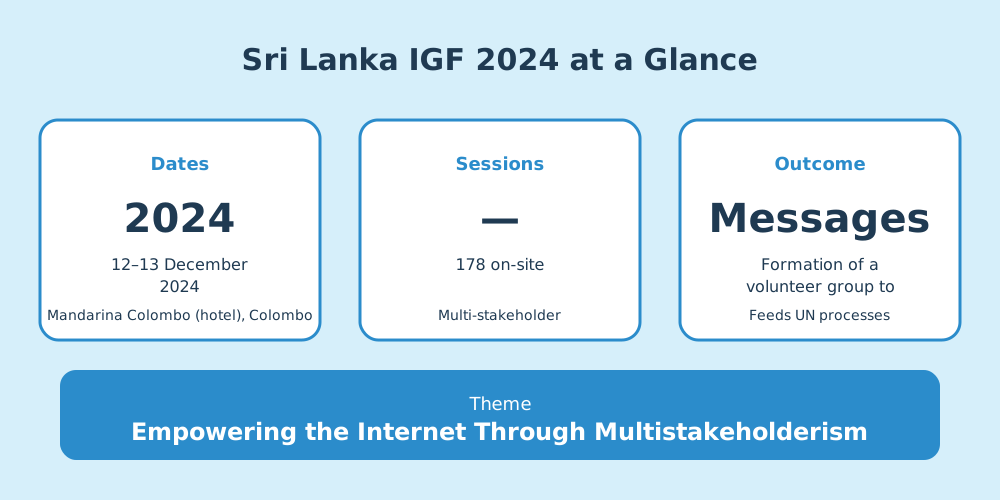
Conference at a Glance (from official records)
| Item | Detail |
|---|---|
| Official name | IGF Sri Lanka 2024 (3rd National IGF) |
| Dates | 12–13 December 2024 |
| Venue | Mandarina Colombo (hotel), Colombo |
| Theme | Empowering the Internet Through Multistakeholderism |
| Participants | 178 |
| Speakers | 52 |
| Panels | 10 |
| Tracks | 5 |
| Host | Lanka School on Internet Governance (LKSIG), the local representative of APSIG |
| Outcome | Formation of a volunteer group to advise government on the policy framework and parliamentary bill for accessibility and digital rights of persons with disabilities |
(See the source list at the end of this article.)
Discussion Digest — from the Session Records
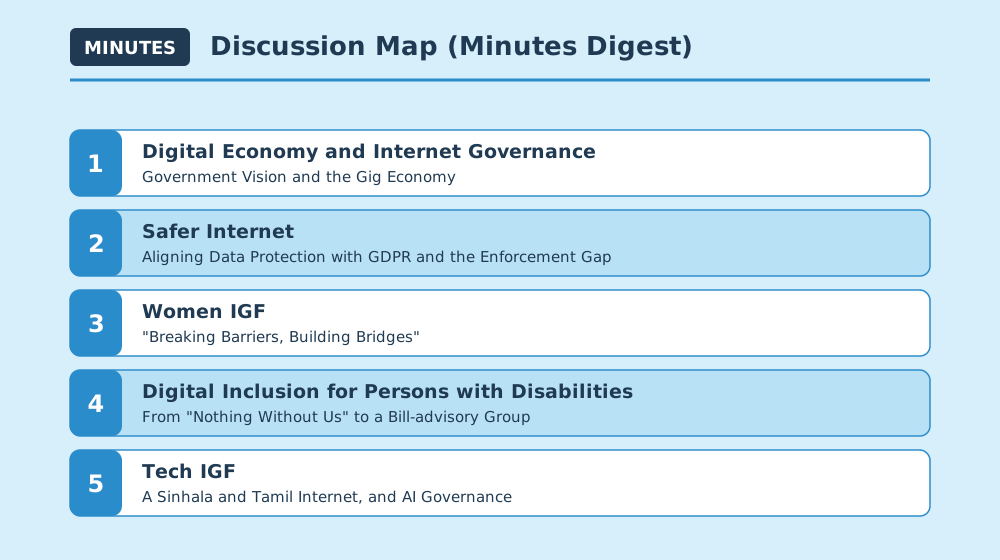
Key exchanges extracted from session records and transcripts.
1. Digital Economy and Internet Governance — Government Vision and the Gig Economy
Sessions: Main Forum Panel 1 "Internet Governance and Digital Economy" (12 December)
- Chief guest Eranga Weerathna, Deputy Minister of Digital Economy, laid out the government's digital-economy vision, calling forums like the IGF eye-openers that show policymakers best practices [1]
- The acting secretary of the Ministry of Digital Economy, Mastercard's country manager for Sri Lanka and the Maldives, and ICANN's global stakeholder engagement manager debated the institutional design of digital payments and the gig economy [1]
- Recommendations distilled into three: build a comprehensive digital-economy framework, expand financial inclusion to marginalised and rural communities, and institutionalise regular multistakeholder dialogue [1]
2. Safer Internet — Aligning Data Protection with GDPR and the Enforcement Gap
Sessions: Main Forum Panel 2 "Safer Internet, Privacy, and Regulations" (12 December)
- Practitioners from Sri Lanka CERT, a major bank, the bar and security firms audited Sri Lanka's data-protection regime, flagging enforcement gaps and the need to build regulator capacity [1]
- They urged faster implementation of comprehensive data-protection legislation aligned with GDPR-class standards, plus specific rules and technical safeguards for children's online safety [1]
- Encryption was affirmed as a critical safeguard for user data, with public-private partnerships called on to deliver child-safety programmes and digital literacy [1]
3. Women IGF — "Breaking Barriers, Building Bridges"
Sessions: Session 2: Women Internet Governance Forum (12 December), themed "Breaking Barriers, Building Bridges: Women in Internet Governance"
- ISOC trustee Sagarika Wickramasekera opened the track, and ISOC CEO Sally Wentworth's video message underscored why women's participation in digital governance matters [1]
- It was deliberately participatory: a "Voice of Influence" simulation put attendees into government, civil-society, private-sector, academic and technical roles, alongside vision-mapping toward 2030 [1]
- Four recommendations emerged: stronger online-safety policies for women, digital literacy for women and marginalised communities, more women in governance bodies, and mentorship programmes [1]
4. Digital Inclusion for Persons with Disabilities — From "Nothing Without Us" to a Bill-advisory Group
Sessions: Session 4: Digital Inclusion and Accessibility in Internet Governance (13 December)
- Persons with vision, hearing, physical, psychosocial and intellectual disabilities spoke and participated — "Nothing Without Us" in practice — and even the hotel was chosen for its accessibility, down to Braille-marked, voice-announcing lifts [1][4]
- LIRNEasia's 2019 survey data showed a stark gap: 78% mobile ownership nationally versus 32% among persons with disabilities — who nonetheless skew more heavily to smartphones (63% vs 50%), signalling demand for capable devices [1][4]
- The concrete outcome: a multistakeholder volunteer group to advise government on the accessibility and digital-rights policy framework and parliamentary bill, with calls to align national policy with the UNCRPD and WCAG [1][4]
5. Tech IGF — A Sinhala and Tamil Internet, and AI Governance
Sessions: Session 5: Technical IGF (13 December): Multilingual Internet & Universal Acceptance; AI/ML, Data Governance and Trust
- Growing Sinhala and Tamil content, spreading internationalised domain names and localised ccTLDs, and achieving Universal Acceptance were framed as the agenda for leaving no language behind [1][2]
- The AI panel worked through black-box opacity, scarce annotated data, adversarial attacks and the operational risks of generative AI, recommending a national AI committee with technical authority [1][2]
- The technical community's recorded recommendations included R&D investment in Sinhala/Tamil NLP, speech recognition and machine translation, plus GDPR-level data-protection alignment [1][2]
Three-Minute Short Talk — Your Questions Answered
Q. So what did the meeting actually decide?
A. No binding decisions — but something tangible did emerge: a volunteer group, formed at the forum, to advise government on the policy framework and parliamentary bill for disability accessibility and digital rights.
Q. What was the most contentious topic?
A. Data protection's law-versus-enforcement gap. Calls to fast-track GDPR-class legislation collided with the reality that the regulator lacks the people and capacity to enforce it.
Q. Why should I care?
A. A national IGF dormant for seven years came back, anchored by a school-style community (LKSIG). Its playbooks — a native-language Internet, disability inclusion — travel to any country.
What Is Sri Lanka IGF? (for first-time readers)
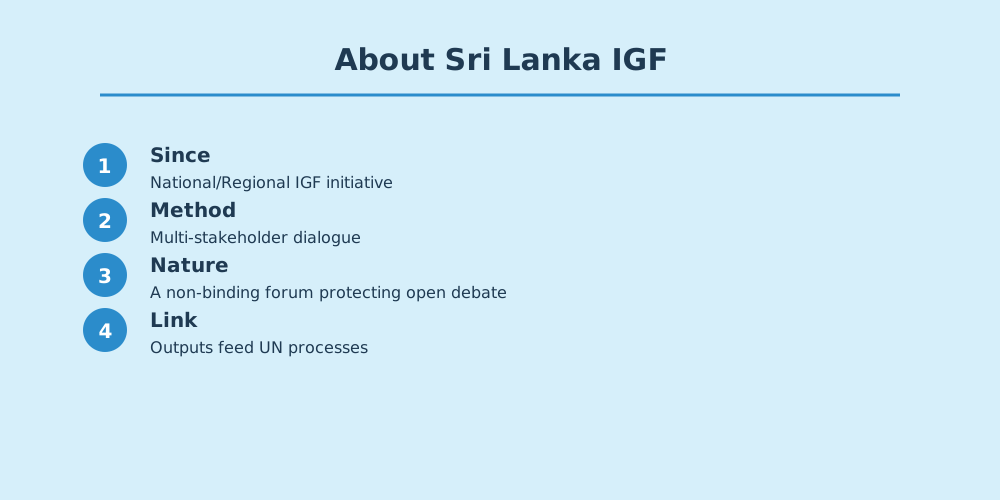
Sri Lanka IGF is a National or Regional IGF Initiative (NRI), aligning local internet governance discussion with global IGF principles.
Why It Matters to You
What was discussed here becomes the baseline for national digital policy, platform rules and AI regulation worldwide within a few years. The principles confirmed at the 2024 meeting are the foundation of the "next rules" for the phones, social platforms and AI services you use every day.
Sources & References
- Report on IGF Sri Lanka 2024(公式報告書PDF) — Lanka School on Internet Governance (LKSIG) / 国連IGF事務局filedepot (accessed 2026-07-11)
- IGF Sri Lanka(公式サイト) — IGF Sri Lanka / LKSIG (accessed 2026-07-11)
- Sri Lanka IGF(NRI公式記録ページ・2024年次報告リンク) — UN IGF Secretariat (accessed 2026-07-11)
- LIRNEasia at IGF Sri Lanka 2024: Bridging the digital divide — LIRNEasia (accessed 2026-07-11)
Quotes are translated or condensed from the records listed above. Bracketed numbers [n] refer to the source list.
Related links
- IGF official (NRI list): https://www.intgovforum.org/en/content/national-and-regional-igf-initiatives
- Japan IGF: https://japanigf.jp/
- Yuki Nakazawa's blog: https://nkzw.jp/category/igf/
更新履歴
第1稿投稿 2026年7月16日 12時55分(記事コンテンツアップ)
— 中澤祐樹

