


The 3-Line Summary
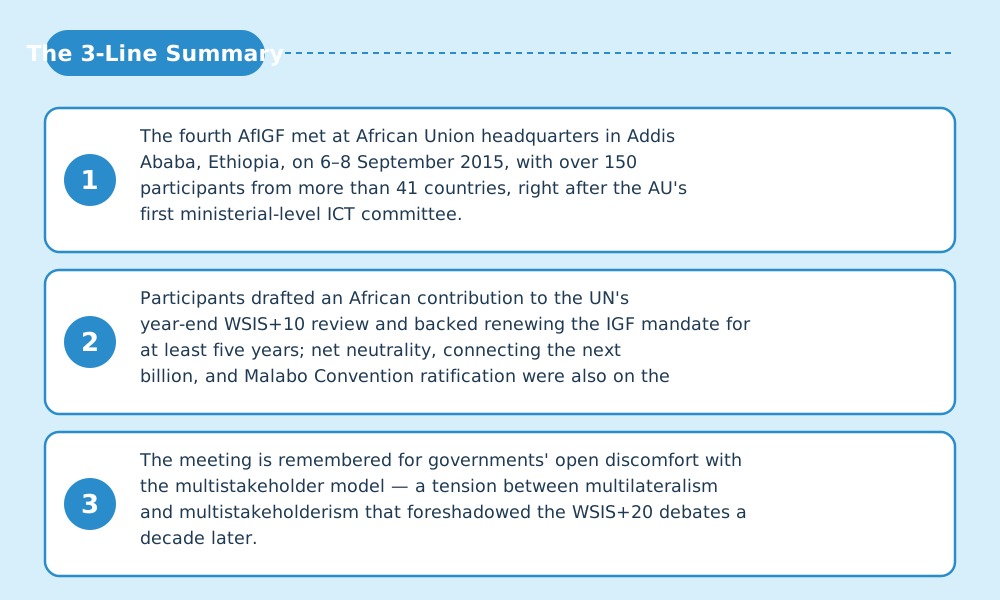
- The fourth AfIGF met at African Union headquarters in Addis Ababa, Ethiopia, on 6–8 September 2015, with over 150 participants from more than 41 countries, right after the AU's first ministerial-level ICT committee.
- Participants drafted an African contribution to the UN's year-end WSIS+10 review and backed renewing the IGF mandate for at least five years; net neutrality, connecting the next billion, and Malabo Convention ratification were also on the table.
- The meeting is remembered for governments' open discomfort with the multistakeholder model — a tension between multilateralism and multistakeholderism that foreshadowed the WSIS+20 debates a decade later.
Welcome — this is the Japan IGF Support Organization. This in-depth report on AfIGF 2015 in Addis Ababa draws on official outputs, session records and on-site reporting. In a hurry? The three lines above and the diagrams carry the gist.
Conference at a Glance (from official records)
| Item | Detail |
|---|---|
| Edition | Fourth meeting |
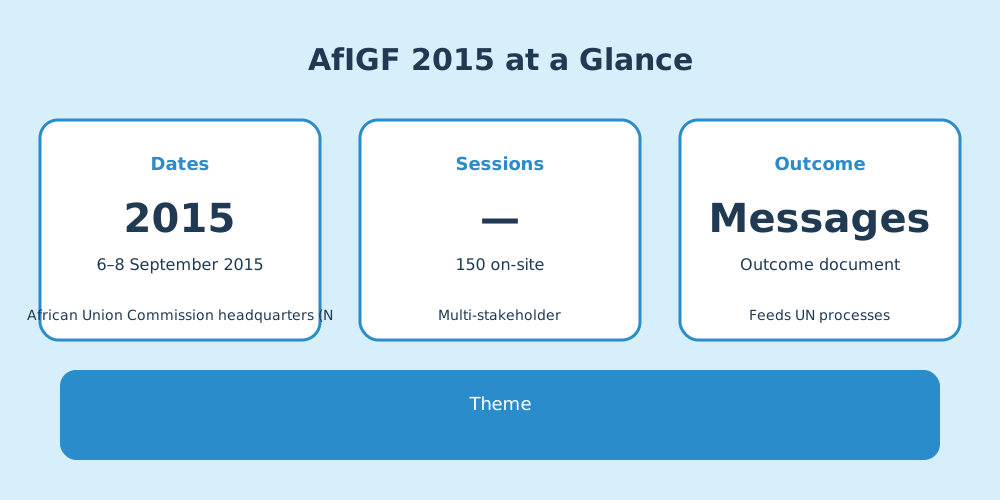
| Dates | 6–8 September 2015 (Pre-conference workshops on 6 September; plenary sessions ran 7–8 September) |
| Venue | African Union Commission headquarters (New Conference Center), Addis Ababa, Ethiopia |
| Theme | Regional governance themes |
| Participants | 150 (Over 150 on-site participants from more than 41 countries, plus about 30 remote participants and three remote hubs (Nigeria, The Gambia, Uganda)) |
| Opening | Officially opened by Hon. Prof. Hlengiwe Mkhize, South Africa's Deputy Minister of Telecommunications and Postal Services; the first AU Specialized Technical Committee on Communication and ICT met at the same venue on 31 August – 4 September |
| Host | Co-organised by the African Union Commission and UNECA, in cooperation with the NEPAD Agency |
| Outcome | Outcome document, including the AfIGF contribution to the WSIS+10 review non-paper |
(See the source list at the end of this article.)
Discussion Digest — from the Session Records
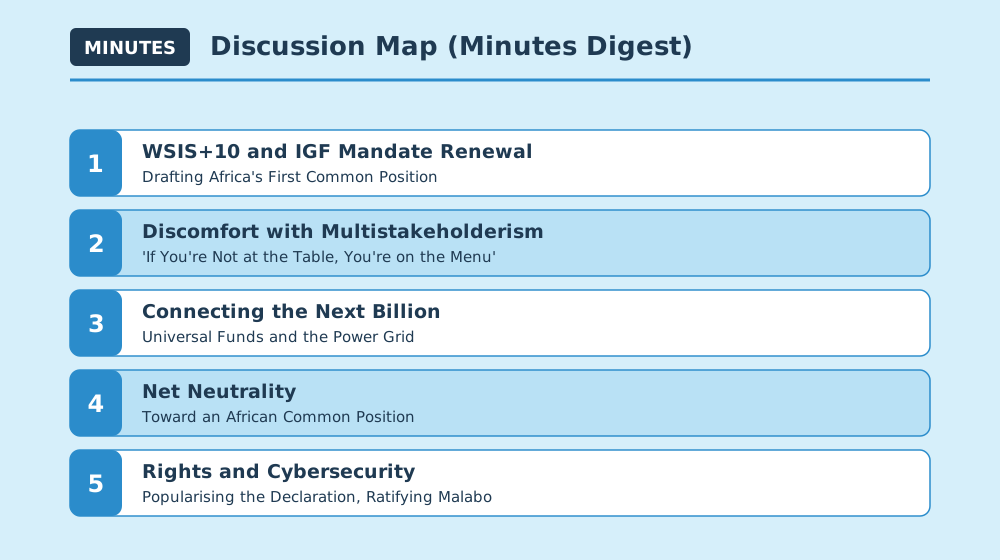
Key exchanges extracted from session records and transcripts.
1. WSIS+10 and IGF Mandate Renewal — Drafting Africa's First Common Position
Sessions: Plenary on WSIS+10, the AU Declaration on Internet Governance and IGF renewal (7 September)
"As Africa what is our role in the Internet ecosystem, where do we see ourselves in the next five to ten years? We need to find ways to ensure that Africa benefits from the digital era"
— Hon. Prof. Hlengiwe Mkhize (Deputy Minister of Telecommunications and Postal Services, South Africa) [1][2]
- Noting the absence of an African position on the WSIS+10 review, participants drafted an African contribution to the UN non-paper of 2 September 2015 and forwarded it to the facilitators [1][2]
- The forum backed the IGF as a space for non-binding dialogue and called on the UN to renew its mandate for at least five years beyond 2015 with more secretariat resources [1][2]
- The AUC was asked to circulate the AU Declaration on Internet Governance to all member states [1][2]
2. Discomfort with Multistakeholderism — 'If You're Not at the Table, You're on the Menu'
Sessions: Plenary on enhancing multi-stakeholder cooperation (8 September)
- Government delegates openly voiced discomfort with a model giving equal voice to civil society and business; a Council on Foreign Relations dispatch noted an AU representative's critique drew the loudest applause of the forum [1][4]
- 'If you're not at the table, you're on the menu' captured the anxiety about African representation in global internet governance (CFR) [1][4]
- The outcome document recommended that any future AfIGF panel on multi-stakeholder governance include government representatives, and that rules of engagement be developed [1][4]
3. Connecting the Next Billion — Universal Funds and the Power Grid
Sessions: Plenary on connecting the next billion (7–8 September)
- 'Connecting the next billion' should be run as a programme/project with indicators and targets, feeding into the global IGF's policy-options process of the same name [1]
- Recommendations included channelling universal service funds into underserved areas, boosting power-grid capacity from diverse sources, and sustaining the Kagame-led Smart Africa initiative [1]
- The AU and ECA were asked to explore a continental toll-free internet platform with telcos to preserve Africa's identity and cultural heritage [1]
4. Net Neutrality — Toward an African Common Position
Sessions: Plenary on net neutrality and its implications for Africa (8 September)
- Participants agreed net neutrality might require regulation tailored to African contexts, but that a common position needed further research and dialogue [1]
- The AU, with ECA and partners, was asked to convene an African Forum on Net Neutrality, backed by national and regional policy, legal and regulatory research [1]
- Regulators should address ISP practices such as NAT that restrict end-user service, and civil society should run consumer-awareness initiatives [1]
5. Rights and Cybersecurity — Popularising the Declaration, Ratifying Malabo
Sessions: Plenaries on human rights on the internet and on cybersecurity including spam (7–8 September)
- Working with the ACHPR, the forum called for mechanisms to promote, monitor and popularise the African Declaration on Internet Rights and Freedoms and UNESCO's internet universality concept across the continent [1][3]
- Governments were again urged to ratify the AU Convention on Cyber Security and Personal Data Protection (Malabo) and to frame national cyber laws on it [1][3]
- Meaningful access to and control over ICTs was recognised as key to advancing women's and girls' rights, with stronger responses to online violence against women; the 3rd AfriSIG and a Gender and IG eXchange preceded the forum [1][3]
Three-Minute Short Talk — Your Questions Answered
Q. What did this meeting decide?
A. It drafted and submitted an 'African contribution' to the UN's WSIS+10 review — the process deciding the IGF's survival — with support for renewing the IGF mandate for at least five years.
Q. What was most contentious?
A. The multistakeholder model itself. Calls for a more government-centric approach, including from an AU representative, reportedly drew the loudest applause of the forum.
Q. Why should I care?
A. The IGF mandate renewed after this review is the foundation on which every later IGF stands, and the multilateralism-versus-multistakeholderism fight previewed here is exactly the one replayed in the WSIS+20 debates.
What Is AfIGF? (for first-time readers)
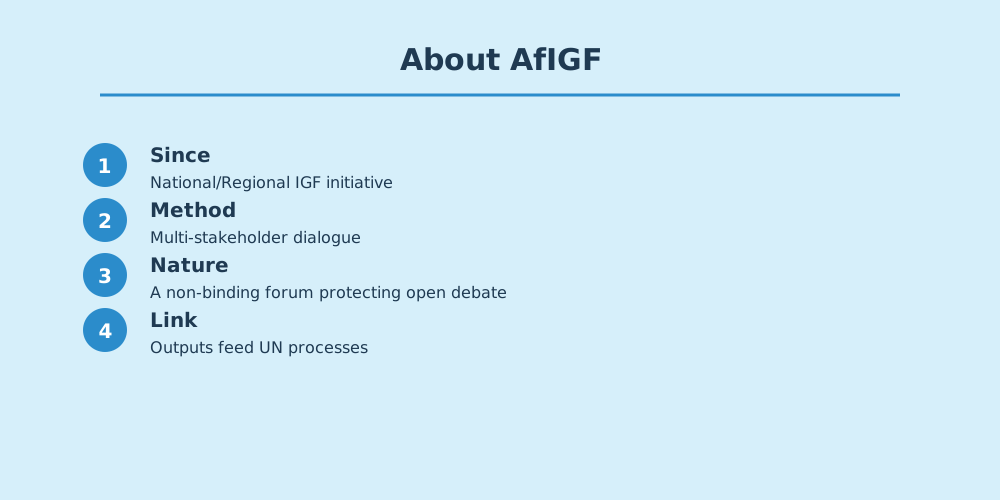
AfIGF is a National or Regional IGF Initiative (NRI), aligning local internet governance discussion with global IGF principles.
Why It Matters to You
What was discussed here becomes the baseline for national digital policy, platform rules and AI regulation worldwide within a few years. The principles confirmed at the 2015 meeting are the foundation of the "next rules" for the phones, social platforms and AI services you use every day.
Sources & References
- The African Internet Governance Forum – AfIGF 2015, Outcome Document (PDF) — AfIGF事務局 (AUC/ECA) — igf.africa アーカイブ (accessed 2026-07-10)
- AfIGF 2015 Event Report — igf.africa (accessed 2026-07-10)
- 4th African Internet Governance Forum — DiploFoundation (accessed 2026-07-10)
- The African Internet Governance Forum: Continued Discomfort with Multistakeholderism (Mailyn Fidler) — Net Politics blog (accessed 2026-07-10)
- African Internet Governance Forum — en (accessed 2026-07-10)
Quotes are translated or condensed from the records listed above. Bracketed numbers [n] refer to the source list.
Related links
- IGF official (NRI list): https://www.intgovforum.org/en/content/national-and-regional-igf-initiatives
- Japan IGF: https://japanigf.jp/
- Yuki Nakazawa's blog: https://nkzw.jp/category/igf/
Revision History
Rev. 1 — published 6 September 2015, 09:00 (Article published)
Rev. 2 — updated 10 July 2026, 23:16 (Fully revised into the in-depth edition: added the 3-line summary, minutes digest, short talk, source list and diagrams (all quotes verified against the listed sources))
— 中澤祐樹

