


The 3-Line Summary
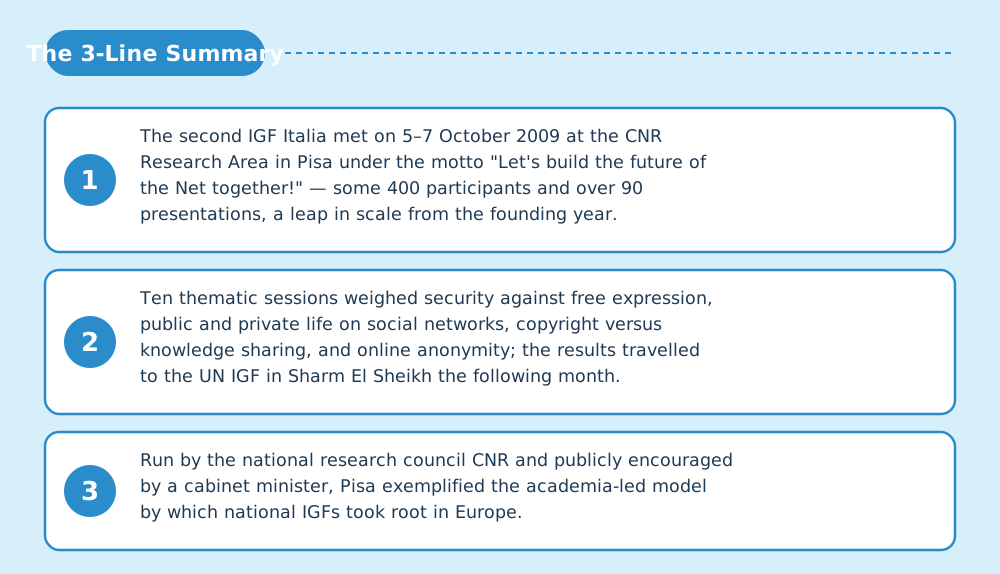
- The second IGF Italia met on 5–7 October 2009 at the CNR Research Area in Pisa under the motto "Let's build the future of the Net together!" — some 400 participants and over 90 presentations, a leap in scale from the founding year.
- Ten thematic sessions weighed security against free expression, public and private life on social networks, copyright versus knowledge sharing, and online anonymity; the results travelled to the UN IGF in Sharm El Sheikh the following month.
- Run by the national research council CNR and publicly encouraged by a cabinet minister, Pisa exemplified the academia-led model by which national IGFs took root in Europe.
Welcome — this is the Japan IGF Support Organization. This in-depth report on IGF Italia 2009 (Internet Governance Forum Italia 2009) draws on official outputs, session records and on-site reporting. In a hurry? The three lines above and the diagrams carry the gist.
Conference at a Glance (from official records)
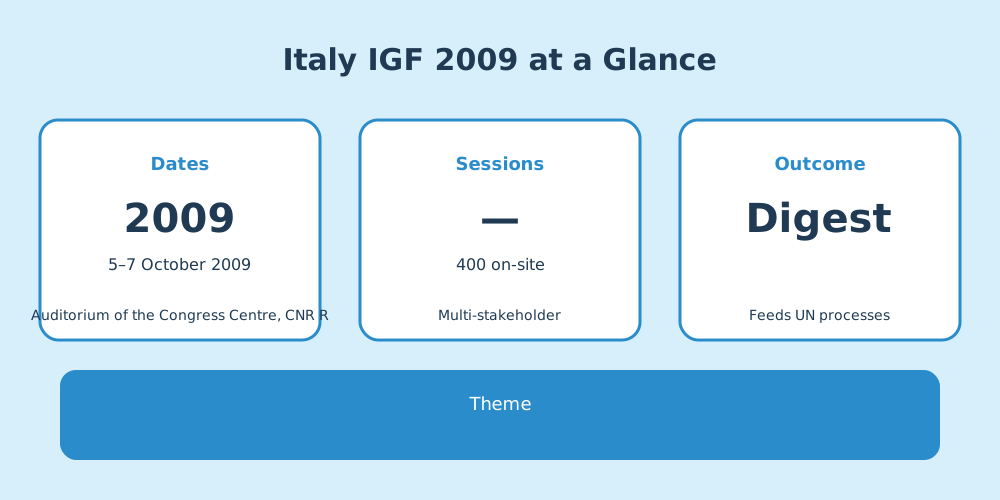
| Item | Detail |
|---|---|
| Official name | IGF Italia 2009 (Internet Governance Forum Italia 2009) |
| Edition | 2nd edition (II edizione) |
| Dates | 5–7 October 2009 |
| Venue | Auditorium of the Congress Centre, CNR Research Area, Pisa |
| Theme | Regional governance themes |
| Participants | 400 (About 400 participants and more than 90 presentations, per the ISOC Italia interview with Laura Abba) |
| Purpose | To distil Italy's positions for the UN IGF in Sharm El Sheikh (November 2009), answering the European Parliament's invitation to hold national IGFs |
| Host | Organised by the Institute of Informatics and Telematics of the CNR (IIT-CNR), with ISOC Italia and the Italian office of the W3C |
(See the source list at the end of this article.)
Discussion Digest — from the Session Records
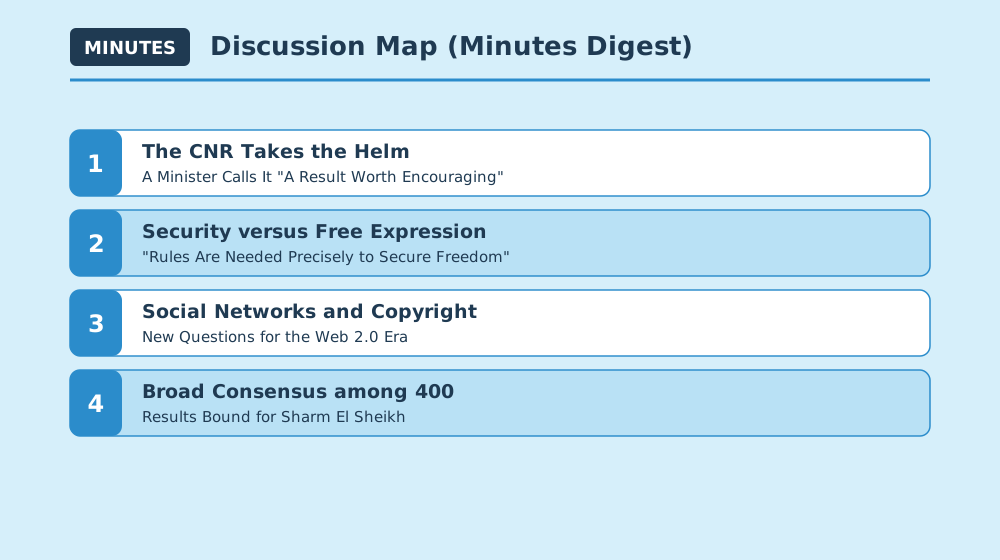
Key exchanges extracted from session records and transcripts.
1. The CNR Takes the Helm — A Minister Calls It "A Result Worth Encouraging"
Sessions: Overall organisation: three days curated by an interdisciplinary programme committee under IIT-CNR
"It is an important result that should be encouraged"
— Renato Brunetta (Minister for Public Administration and Innovation) [2][3][1]
"Economic growth, social participation, the rights and duties of network users: the development of future societies passes through the Internet"
— Domenico Laforenza (Director, IIT-CNR) [2][3][1]
- The organiser was the CNR's Institute of Informatics and Telematics (IIT) in Pisa — also the registry of the .it domain — which mobilised institute-wide to convene Italy's internet community [2][3][1]
- The forum was framed as Italy's answer to the European Parliament's invitation to hold national IGFs, extending Italy's engagement dating back to the WSIS process [2][3][1]
- Ministerial backing spanned two governments: Luigi Nicolais first invited the CNR to take up internet governance, and his successor Renato Brunetta endorsed the work [2][3][1]
2. Security versus Free Expression — "Rules Are Needed Precisely to Secure Freedom"
Sessions: Thematic sessions incl. "Security and freedom of expression: what balance?" and "Identity online: anonymity or identifiability?"
"Rules are absolutely necessary precisely to ensure freedom, individual rights, and the stability and security of the network in the future"
— Laura Abba (Senior technologist, CNR; IGF Italia promoter) [1][2][5]
- The three days ran through ten thematic sessions — from "security and freedom of expression" to "rights and principles online" and "network management: towards what future" — all recorded and published [1][2][5]
- The anonymity session confronted head-on the tension between protecting anonymity and identifying actors, a debate that continues today [1][2][5]
- Against the then-common view of regulation as freedom's enemy, the organisers argued explicitly for rules as guarantors of rights [1][2][5]
3. Social Networks and Copyright — New Questions for the Web 2.0 Era
Sessions: Thematic sessions incl. "Social networks: what is public, what is private" and "Copyright: between protection and the diffusion of knowledge"
- With social networks booming in 2009, a dedicated session asked where the line between public and private now runs on profiles and posts [2][3]
- The copyright session framed the issue as a balance between protection and the diffusion of knowledge, with further sessions on culture and the arts, new forms of enterprise, and administrative and political uses of the net [2][3]
- A "future internet" session connected the forum to the EU's Seventh Framework Programme research agenda [2][3]
4. Broad Consensus among 400 — Results Bound for Sharm El Sheikh
Sessions: Closing stocktake; outcomes submitted to the UN IGF in Sharm El Sheikh, November 2009
"IGF Italia 2009 in Pisa was a great success, both for its content and for the high turnout of participants"
— Laura Abba (Senior technologist, CNR) [1][2][4]
- Some 400 participants and more than 90 presentations far outgrew the founding Cagliari meeting; Radio Radicale recorded and published the full proceedings [1][2][4]
- The organisers aimed at what the internet world calls broad consensus on each theme, reserving ample time for stakeholder dialogue and floor interventions [1][2][4]
- The outcomes were submitted to the 4th UN IGF in Sharm El Sheikh, hosted by Egypt the following month [1][2][4]
Three-Minute Short Talk — Your Questions Answered
Q. What was this meeting, exactly?
A. The second Italian national IGF, organised by the CNR — the research council that also runs the .it registry — with about 400 participants. Ten themes, from security to social networks, copyright and anonymity, were debated and the results delivered to the UN IGF in Sharm El Sheikh.
Q. What was the most contentious issue?
A. Balancing security against free expression, and anonymity against identifiability. The organisers argued that rules are needed precisely to secure freedom — a pointed challenge to the idea that regulation is freedom's enemy.
Q. Why should I care today?
A. The 2009 questions — where public ends and private begins on social platforms, and how far anonymity should reach — are still the live wires of platform regulation everywhere.
What Is Italy IGF? (for first-time readers)
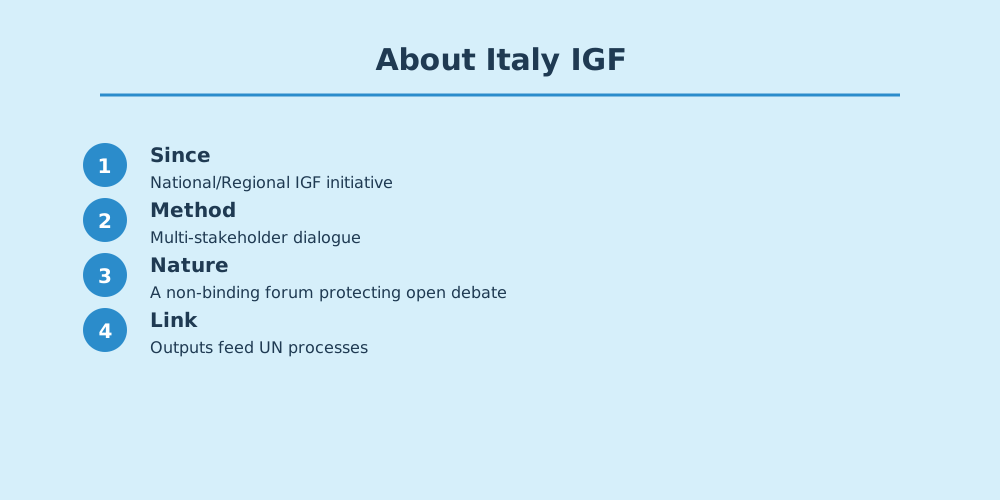
Italy IGF is a National or Regional IGF Initiative (NRI), aligning local internet governance discussion with global IGF principles.
Why It Matters to You
What was discussed here becomes the baseline for national digital policy, platform rules and AI regulation worldwide within a few years. The principles confirmed at the 2009 meeting are the foundation of the "next rules" for the phones, social platforms and AI services you use every day.
Sources & References
- IGF Italia 2009: la parola a Laura Abba(約400名参加・90本超の報告、Abba・ブルネッタ発言) — isoc.it (accessed 2026-07-17)
- IGF Italia 2009 — Pisa, 5–7 Ottobre 2009(旧公式アーカイブ:会場・主催・10テーマ・シャルム提出) — IGF Italia(igf-italia.it、ISOC Italia運営、Wayback Machine保存) (accessed 2026-07-17)
- IGF: a Pisa, dal 5 al 7 ottobre 2009, il secondo Internet Governance Forum Italia(Laforenza所長談話) — Key4biz(2009-09-04) (accessed 2026-07-17)
- Internet Governance Forum Italia. "Costruiamo insieme il futuro della Rete!"(最終日 2009-10-07 の全収録) — Radio Radicale (accessed 2026-07-17)
- IGF Italia 2009 — sessioni tematiche e videoregistrazioni(テーマ別セッションと録画一覧) — IGF Italia(igf-italia.it、Wayback Machine保存) (accessed 2026-07-17)
Quotes are translated or condensed from the records listed above. Bracketed numbers [n] refer to the source list.
Related links
- IGF official (NRI list): https://www.intgovforum.org/en/content/national-and-regional-igf-initiatives
- Japan IGF: https://japanigf.jp/
- Yuki Nakazawa's blog: https://nkzw.jp/category/igf/
更新履歴
第1稿投稿 2026年7月17日 14時37分(記事コンテンツアップ)
— 中澤祐樹

