


The 3-Line Summary
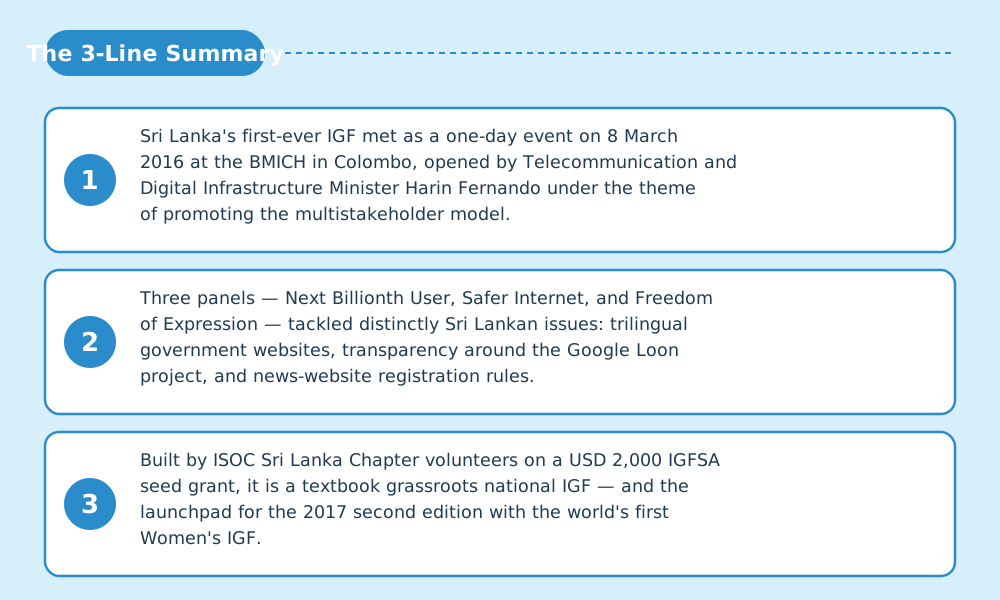
- Sri Lanka's first-ever IGF met as a one-day event on 8 March 2016 at the BMICH in Colombo, opened by Telecommunication and Digital Infrastructure Minister Harin Fernando under the theme of promoting the multistakeholder model.
- Three panels — Next Billionth User, Safer Internet, and Freedom of Expression — tackled distinctly Sri Lankan issues: trilingual government websites, transparency around the Google Loon project, and news-website registration rules.
- Built by ISOC Sri Lanka Chapter volunteers on a USD 2,000 IGFSA seed grant, it is a textbook grassroots national IGF — and the launchpad for the 2017 second edition with the world's first Women's IGF.
Welcome — this is the Japan IGF Support Organization. This in-depth report on IGF Sri Lanka 2016 (1st National IGF) draws on official outputs, session records and on-site reporting. In a hurry? The three lines above and the diagrams carry the gist.
Conference at a Glance (from official records)
| Item | Detail |
|---|---|
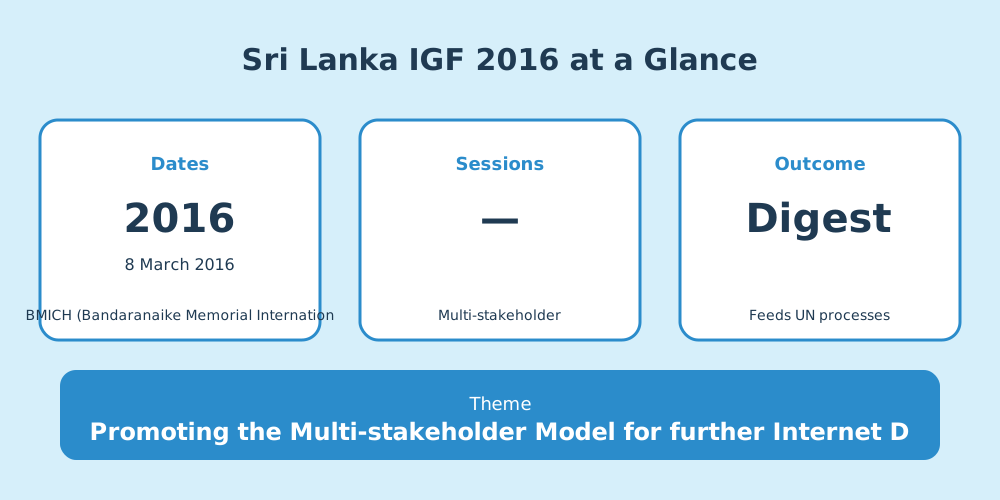
| Official name | IGF Sri Lanka 2016 (1st National IGF) |
| Dates | 8 March 2016 |
| Venue | BMICH (Bandaranaike Memorial International Conference Hall), Colombo |
| Theme | Promoting the Multi-stakeholder Model for further Internet Development in Sri Lanka |
| Panels | 3 |
| Opening | Opened by Harin Fernando, Minister of Telecommunication and Digital Infrastructure |
| Host | Volunteer organizing committee of the Internet Society Sri Lanka Chapter (ISOC-LK) |
(See the source list at the end of this article.)
Discussion Digest — from the Session Records
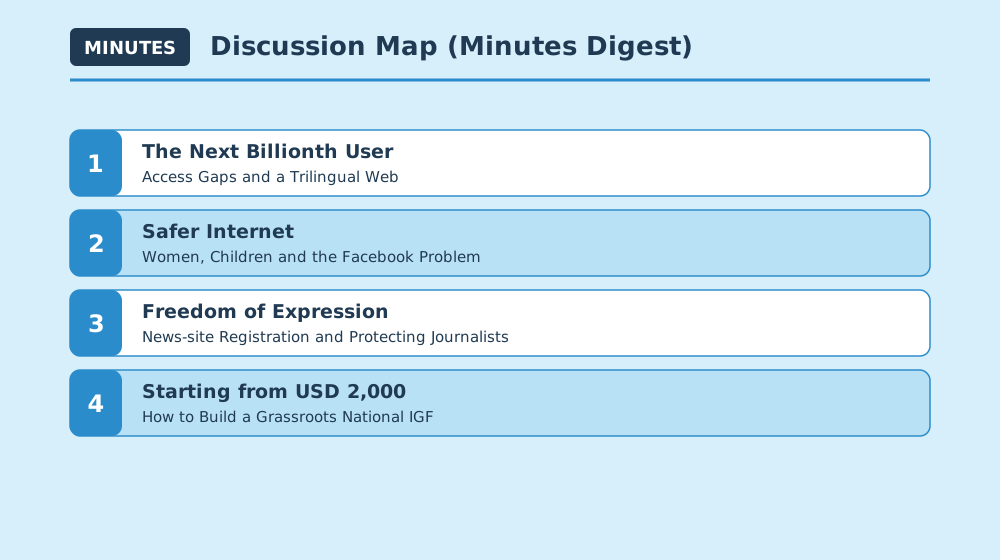
Key exchanges extracted from session records and transcripts.
1. The Next Billionth User — Access Gaps and a Trilingual Web
Sessions: Panel 1 "Next Billionth User" (chaired by Prof. Gihan Dias, President, ISOC Sri Lanka)
- Panelists called for all government websites to be kept accurate in Sinhala, Tamil and English, and to follow W3C accessibility standards for persons with disabilities [1]
- ICTA outlined plans to connect 4,500 government organisations within three years at 20–100 Mbps — while participants noted rural areas were left out and public Wi-Fi hotspots alone would not close the gap [1]
- With the defence ministry and telecom regulator still vetting the Google Loon project, participants argued such projects need public information and open debate — exactly what an IGF provides [1]
2. Safer Internet — Women, Children and the Facebook Problem
Sessions: Panel 2 "Safer Internet" (chaired by Harsha Wijayawardhana, ex-President, ISOC Sri Lanka)
- Speakers raised cultural conflicts, privacy violations and harassment of women online; frustration that Facebook does not respond to local cultural concerns was described as common across SAARC countries, calling for a joint regional approach [1]
- Home-grown initiatives were showcased, including the "Respect Girls on Internet" privacy handbook and the "Pro Hitawathie" project for recognising and preventing cyber-harassment [1]
- Noting that young people constrained by cultural barriers turn to the Internet to express themselves, panelists argued for empowering both children and parents rather than policing them [1]
3. Freedom of Expression — News-site Registration and Protecting Journalists
Sessions: Panel 3 "Freedom of Expression" (chaired by Thilina Pathirana, University of Kelaniya)
"Asia needs standardization not just in terms of policy but it needs cooperation in terms of action (from his participation report; translated)"
— Shreedeep Rayamajhi (Nepali civil-society activist and IRPC Steering Committee member; panelist) [1][3]
- Recorded talking points included news-media web registration, journalists' responsibility and ethics, technical blocking of news sites, defamation in the Internet age, and protection of online journalists [1][3]
- A Nepali civil-society activist joined the panel, giving the inaugural forum a cross-border, regional dimension [1][3]
4. Starting from USD 2,000 — How to Build a Grassroots National IGF
Sessions: Organization and outcomes (chair's message and financial statements in the official report)
"Creating the first Sri Lankan IGF was a challenge. There were many hurdles. We came across all the challenges and were able to complete the first-ever IGF in Sri Lanka on a very high note (translated)"
— Maheeshwara Kirindigoda (Chairman, IGF Sri Lanka 2016 organizing committee; message in the official report) [1][2]
- Seeded by IGFSA's USD 2,000 grant, the volunteers ran everything through an open online group (starting from 56 people) with decisions by poll, delivering the event for about LKR 332,000 against a LKR 604,000 budget [1][2]
- Sri Lanka Telecom (principal sponsor), LEARN (co-organizer) and LankaCom (connectivity) later joined, and the telecom minister pledged ministry backing and a partnership with IGF Sri Lanka [1][2]
- The report records calls to make the forum annual, take it to the provinces and set up a local secretariat — with ISOC-LK deciding to organize it yearly [1][2]
Three-Minute Short Talk — Your Questions Answered
Q. So what did the meeting actually decide?
A. Nothing binding — it was Sri Lanka's first forum where government, business, civil society and technologists talked as equals. But it did produce commitments: make it annual, and the telecom ministry pledged its support.
Q. What was the most contentious topic?
A. How government-led connectivity projects — free Wi-Fi schemes and Google Loon — were being run. Participants repeatedly demanded transparency and public debate.
Q. Why should I care?
A. It shows a national IGF can be built with a USD 2,000 grant and volunteers. The playbook for giving citizens a voice in Internet policy works anywhere.
What Is Sri Lanka IGF? (for first-time readers)
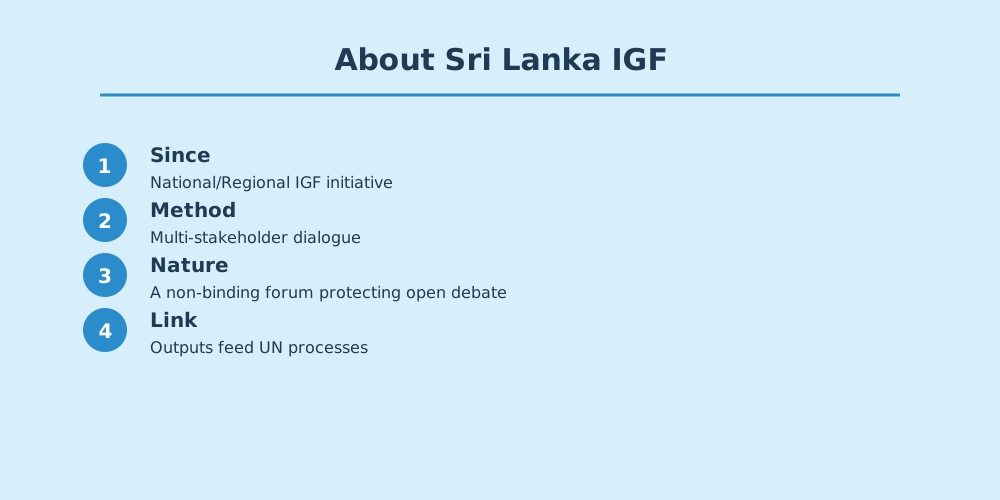
Sri Lanka IGF is a National or Regional IGF Initiative (NRI), aligning local internet governance discussion with global IGF principles.
Why It Matters to You
What was discussed here becomes the baseline for national digital policy, platform rules and AI regulation worldwide within a few years. The principles confirmed at the 2016 meeting are the foundation of the "next rules" for the phones, social platforms and AI services you use every day.
Sources & References
- IGF Sri Lanka 2016 Report(公式報告書PDF) — IGF Sri Lanka 2016組織委員会 / 国連IGF事務局filedepot (accessed 2026-07-11)
- Sri Lanka IGF(NRI公式記録ページ) — UN IGF Secretariat (accessed 2026-07-11)
- My experience at the Sri Lankan IGF 2016 — Internet Rights and Principles Coalition(Shreedeep Rayamajhi参加報告) (accessed 2026-07-11)
- Report on IGF Sri Lanka 2024(2016年3月8日初開催を明記) — Lanka School on Internet Governance (LKSIG) / 国連IGF事務局filedepot (accessed 2026-07-11)
- IGF Sri Lanka(現行公式サイト・「initiated in 2016」) — IGF Sri Lanka / LKSIG (accessed 2026-07-11)
Quotes are translated or condensed from the records listed above. Bracketed numbers [n] refer to the source list.
Related links
- IGF official (NRI list): https://www.intgovforum.org/en/content/national-and-regional-igf-initiatives
- Japan IGF: https://japanigf.jp/
- Yuki Nakazawa's blog: https://nkzw.jp/category/igf/
更新履歴
第1稿投稿 2026年7月13日 11時41分(記事コンテンツアップ)
— 中澤祐樹

