


The 3-Line Summary
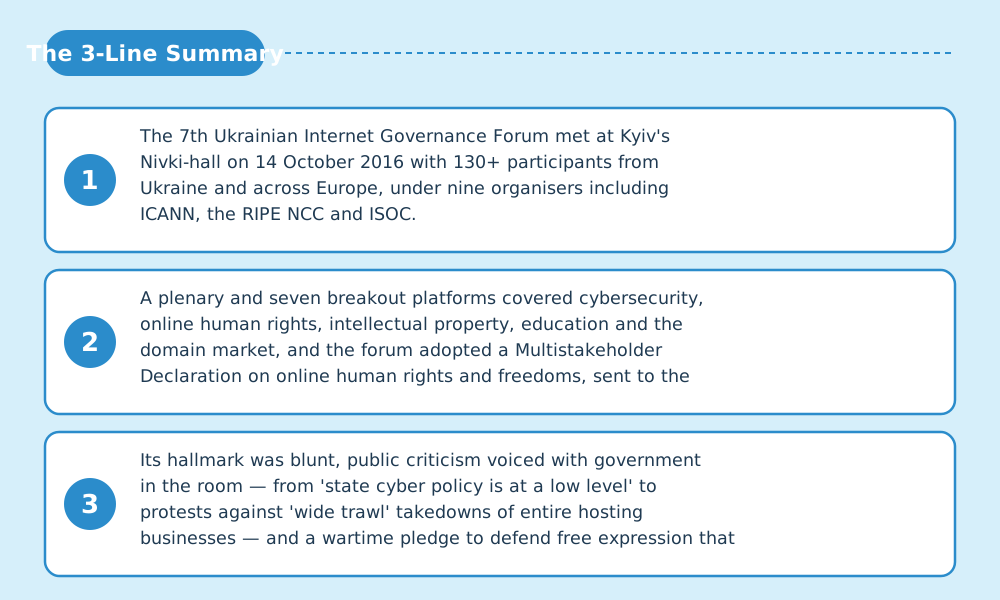
- The 7th Ukrainian Internet Governance Forum met at Kyiv's Nivki-hall on 14 October 2016 with 130+ participants from Ukraine and across Europe, under nine organisers including ICANN, the RIPE NCC and ISOC.
- A plenary and seven breakout platforms covered cybersecurity, online human rights, intellectual property, education and the domain market, and the forum adopted a Multistakeholder Declaration on online human rights and freedoms, sent to the President and other top officials with a recommendation to join the Freedom Online Coalition.
- Its hallmark was blunt, public criticism voiced with government in the room — from 'state cyber policy is at a low level' to protests against 'wide trawl' takedowns of entire hosting businesses — and a wartime pledge to defend free expression that is still cited today.
Welcome — this is the Japan IGF Support Organization. This in-depth report on 7th Ukrainian Internet Governance Forum (IGF-UA 2016) draws on official outputs, session records and on-site reporting. In a hurry? The three lines above and the diagrams carry the gist.
Conference at a Glance (from official records)
| Item | Detail |
|---|---|
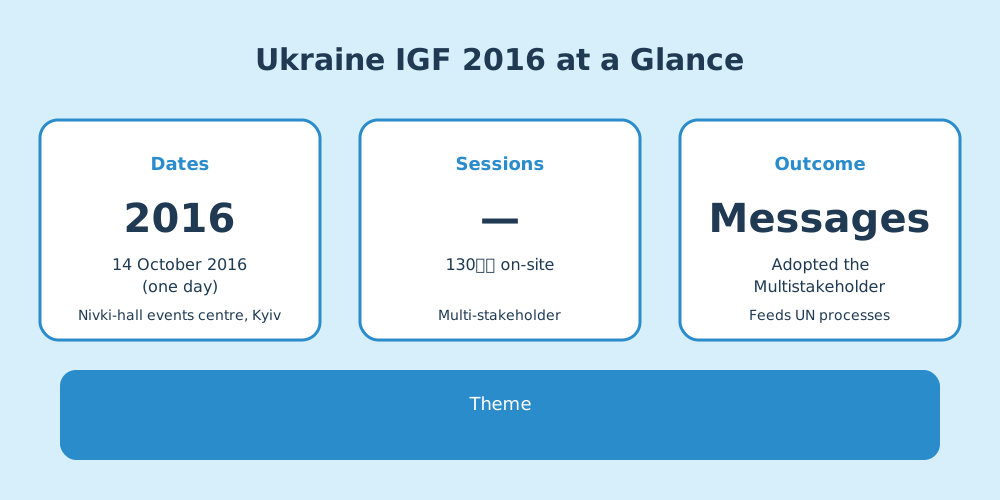
| Official name | 7th Ukrainian Internet Governance Forum (IGF-UA 2016) |
| Dates | 14 October 2016 (one day) |
| Venue | Nivki-hall events centre, Kyiv |
| Theme | Regional governance themes |
| Participants | Over 130 participants from across Ukraine and other European countries per the official annual report (ISOC's write-up estimated some 150), plus significant remote participation |
| Host | Nine organisers: InAU, the Commission on Science and IT of the Ukrainian League of Industrialists and Entrepreneurs, the joint EU–Council of Europe project 'Freedom of media in Ukraine', ICANN, the RIPE NCC, ISOC, regulator NKRZI, the IGF support association and the European Media Platform |
| Outcome | Adopted the Multistakeholder Declaration on the protection of human rights and freedoms online, recommending Ukraine's accession to the Freedom Online Coalition and forwarding it to the President, Prime Minister, parliamentary speaker and Constitutional Court chair |
(See the source list at the end of this article.)
Discussion Digest — from the Session Records
Key exchanges extracted from session records and transcripts.
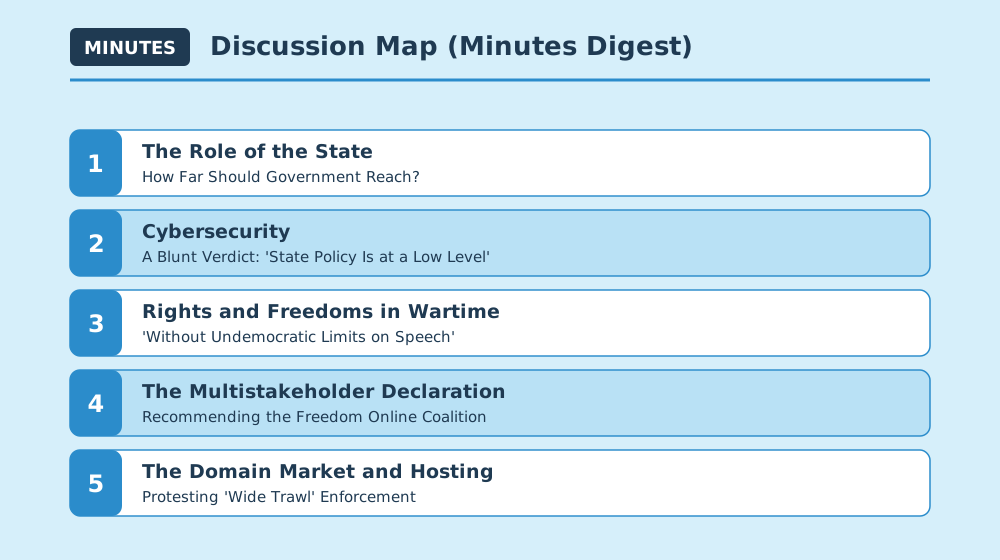
1. The Role of the State — How Far Should Government Reach?
Sessions: Plenary and discussion site 1.1 'The role of the state in internet governance processes' (14 October)
"This year's UA-IGF piloted a new interactive format with minimal slide shows, lively moderated discussions and an 'open mic' for Q&A … we witnessed some juicy debates and questions from the audience were abundant"
— Maarit Palovirta (Internet Society Europe, in her blog write-up) [3][4]
- The underlying question was how far government should intervene through regulation, policy and investment; officials, civil society and business split over obliging ISPs to publish access-quality data [3][4]
- Practical joint steps were proposed for government and the internet community, from ICT administrative reform to publicising user-rights protections [3][4]
- 14 October was a public holiday — Defender of Ukraine Day — yet the room still filled, as ISOC's write-up noted [3][4]
2. Cybersecurity — A Blunt Verdict: 'State Policy Is at a Low Level'
Sessions: Discussion site 2.1 'Cybersecurity' — legislation, war, industry certification and human rights (14 October)
- The official report concluded bluntly that 'state policy on cyber security is at a low level in general, which provokes criminals and aggressors' to act against Ukraine's national interests; 'cybersecurity and war' was an explicit agenda point [2][3]
- Panellists urged separating information security from cybersecurity at the conceptual and legislative level, and subjecting every bill touching information resources to open expert review by academics, IT professionals and civic groups [2][3]
- State support for CERTs was found 'virtually absent' even as Ukraine's first private CERT won international certification — a stark public-private gap [2][3]
3. Rights and Freedoms in Wartime — 'Without Undemocratic Limits on Speech'
Sessions: Discussion site 2.2 'Rights and freedoms online' — European standards balancing rights and security (14 October)
- The report concluded that despite the annexation of Crimea — with repression of Crimean Tatar and Ukrainian online media — the armed conflict in the east and intense propaganda, Ukrainian society had adapted to hybrid war through free media 'without resorting to undemocratic methods of limiting freedom of speech online' [2][3][4]
- For the Council of Europe, Monica Horten noted that ISPs hold the tools for both surveillance and protecting correspondence, stressing judicial oversight of surveillance under CoE standards (per ISOC's write-up) [2][3][4]
- Self-regulation against 'jeansa' (paid disguised articles), media bots and information noise was urged, alongside media-literacy programmes and ownership-transparency reform [2][3][4]
4. The Multistakeholder Declaration — Recommending the Freedom Online Coalition
Sessions: Adoption of the Declaration at the closing plenary (14 October)
- The forum adopted the Multistakeholder Declaration on the protection of human rights and freedoms online and sent it — with a recommendation that Ukraine join the Freedom Online Coalition — to the President, Prime Minister, parliamentary speaker and Constitutional Court chair [2][3]
- It confined blocking and filtering legislation to child protection, counter-terrorism, hate speech and IP enforcement under 'necessity and proportionality', guided by European Court of Human Rights case law and the Council of Europe's April 2016 recommendation on internet freedom [2][3]
5. The Domain Market and Hosting — Protesting 'Wide Trawl' Enforcement
Sessions: Discussion site 3.1 'Intellectual property rights protection' and the 3.3 domain-issues round table (14 October)
- Participants protested 'wide trawl' enforcement — blocking or shutting whole hosting services and data centres instead of identifying specific violations — which had repeatedly battered Ukraine's hosting market and driven businesses abroad; they called for self-regulatory institutions to set objective violation criteria [2][3]
- For .UA, fragmented third-level domain management without uniform registration rules and the market's lack of say over pricing topped the list, with google.ua cited as an example of trademark-requirement confusion at the second level [2][3]
- The Cyrillic .УКР domain was found stagnating, hampered by the absence of full-fledged email support; the IANA transition, new gTLDs and UDRP/ADRP-style dispute resolution rounded out the round table [2][3]
Three-Minute Short Talk — Your Questions Answered
Q. What did this meeting decide?
A. It adopted a Multistakeholder Declaration on online human rights and freedoms and sent it to Ukraine's top officials, recommending the country join the Freedom Online Coalition.
Q. What was the most contentious topic?
A. The state's reach. Criticism flew with officials in the room — from 'state cyber policy is at a low level' to protests against law enforcement shutting down whole hosting services to chase single violations.
Q. Why should I care?
A. A country at war publicly pledging not to resort to undemocratic speech restrictions is a test case for balancing security and freedom anywhere — and its 'necessity and proportionality' framework for blocking laws mirrors debates in every democracy.
What Is Ukraine IGF? (for first-time readers)
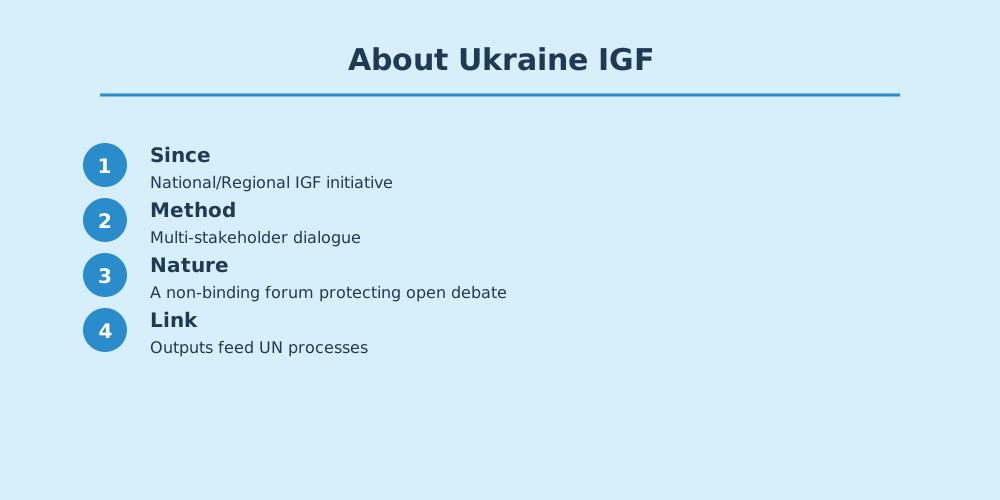
Ukraine IGF is a National or Regional IGF Initiative (NRI), aligning local internet governance discussion with global IGF principles.
Why It Matters to You
What was discussed here becomes the baseline for national digital policy, platform rules and AI regulation worldwide within a few years. The principles confirmed at the 2016 meeting are the foundation of the "next rules" for the phones, social platforms and AI services you use every day.
Sources & References
- IGF-UA 2016 公式アーカイブ(ヘッダに第7回・2016年10月14日・キーウ) — IGF-UA組織委員会 (accessed 2026-07-11)
- 14 жовтня 2016 року відбувся 7-й Український форум з управління Інтернетом IGF-UA(第7回開催報告・各セクションの結論と宣言採択) — IGF-UA公式サイト (accessed 2026-07-11)
- VII Ukrainian Internet Governance Forum IGF-UA — Annual report(公式年次報告書・組織委員会26人の構成、9主催団体、7討論サイト、結論、宣言全文を収録) — IGF-UA組織委員会(国連IGF事務局提出年次報告書) (accessed 2026-07-11)
- Building Consensus for a Stronger Internet in Ukraine(ISOC欧州マーリット・パロヴィルタによる参加報告・2016年10月19日) — ISOC (accessed 2026-07-11)
Quotes are translated or condensed from the records listed above. Bracketed numbers [n] refer to the source list.
Related links
- IGF official (NRI list): https://www.intgovforum.org/en/content/national-and-regional-igf-initiatives
- Japan IGF: https://japanigf.jp/
- Yuki Nakazawa's blog: https://nkzw.jp/category/igf/
更新履歴
第1稿投稿 2026年7月11日 13時58分(記事コンテンツアップ)
— 中澤祐樹

