


The 3-Line Summary
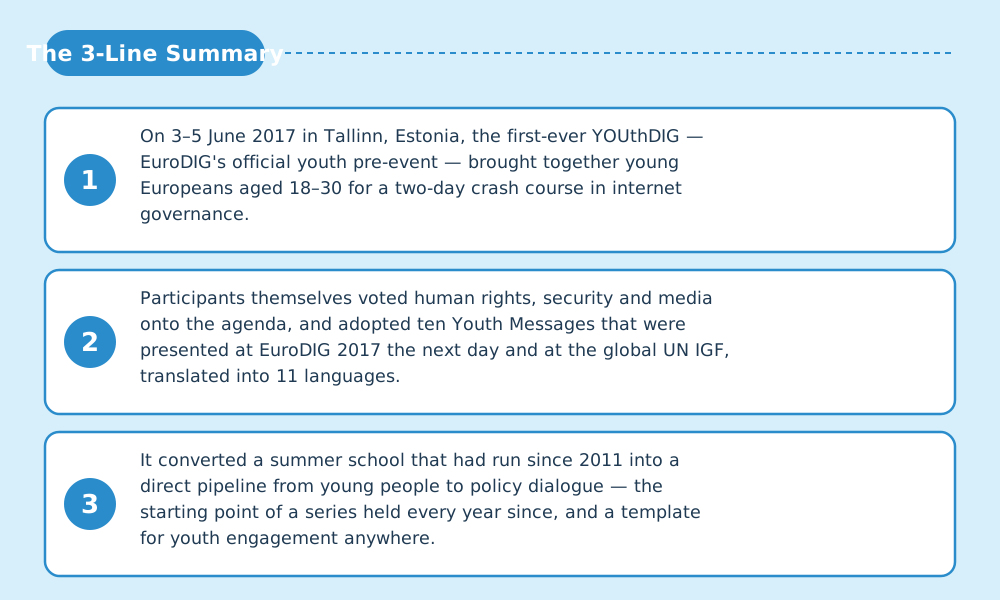
- On 3–5 June 2017 in Tallinn, Estonia, the first-ever YOUthDIG — EuroDIG's official youth pre-event — brought together young Europeans aged 18–30 for a two-day crash course in internet governance.
- Participants themselves voted human rights, security and media onto the agenda, and adopted ten Youth Messages that were presented at EuroDIG 2017 the next day and at the global UN IGF, translated into 11 languages.
- It converted a summer school that had run since 2011 into a direct pipeline from young people to policy dialogue — the starting point of a series held every year since, and a template for youth engagement anywhere.
Welcome — this is the Japan IGF Support Organization. This in-depth report on YOUthDIG 2017 — the first Youth Dialogue on Internet Governance draws on official outputs, session records and on-site reporting. In a hurry? The three lines above and the diagrams carry the gist.
Conference at a Glance (from official records)
| Item | Detail |
|---|---|
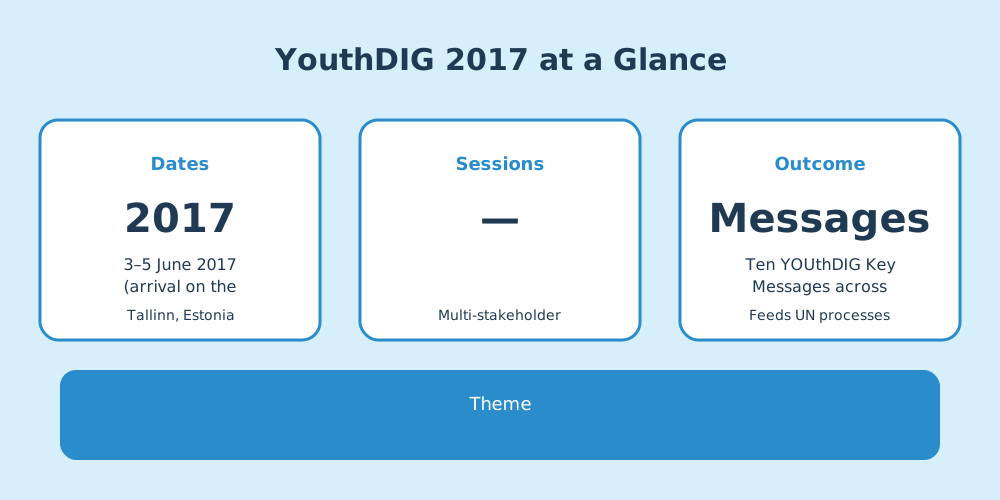
| Official name | YOUthDIG 2017 — the first Youth Dialogue on Internet Governance |
| Dates | 3–5 June 2017 (arrival on the 3rd; the two-day programme ran 4–5 June) |
| Venue | Tallinn, Estonia |
| Theme | Regional governance themes |
| Outcome | Ten YOUthDIG Key Messages across media and content, human rights and cybersecurity, translated into 11 languages and presented at EuroDIG and the global UN IGF |
(See the source list at the end of this article.)
Discussion Digest — from the Session Records
Key exchanges extracted from session records and transcripts.
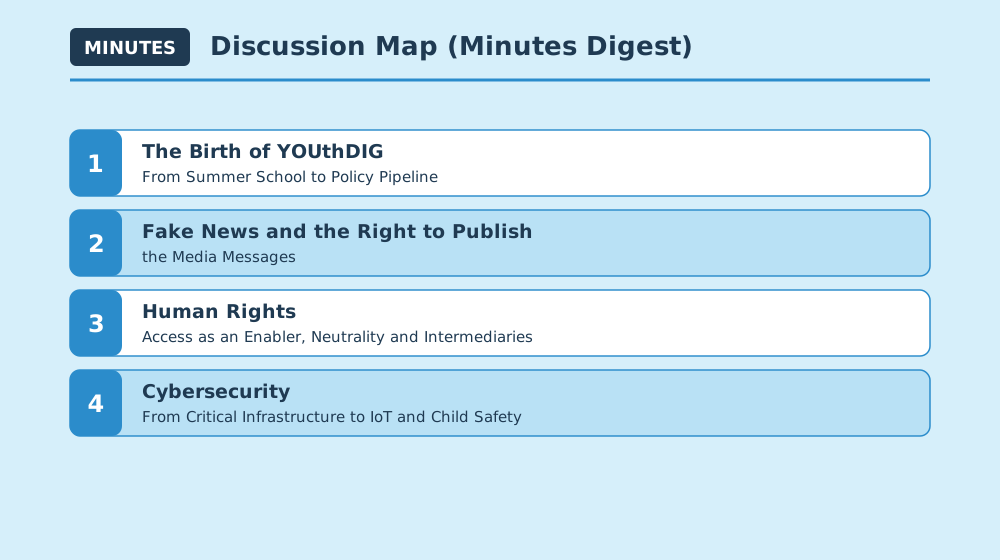
1. The Birth of YOUthDIG — From Summer School to Policy Pipeline
Sessions: Overall programme (4–5 June, Tallinn)
- The New Media Summer School, run since 2011, was redesigned into a two-day pre-event wired directly into EuroDIG, alongside the copyright-focused 'Copyfighters' programme of the Young Pirates of Europe [1][2]
- The agenda was partly set by participant vote — human rights, security and media won that year — with each field pairing a Subject Matter Expert with a youth Focal Point to co-design the session [1][2]
- The official page cites sociologist Roger Hart's Ladder of Youth Participation, classifying the programme as rung 6: adult-initiated, shared decisions with young people [1][2]
2. Fake News and the Right to Publish — the Media Messages
Sessions: Media category session (5 June, 9:00; SME Yrjö Länsipuro, Focal Point Daniel Waugh)
- Youth Message no. 1 declared that 'fake news' undermines democracy and trust in the media, calling on all stakeholders to prioritise digital literacy including critical thinking [1]
- At the same time it defended the right to publish content without government restriction, explicitly anchored in Article 10 of the European Convention on Human Rights [1]
- Coming just after the 2016 US election, the young cohort put disinformation at the top of the agenda before it became mainstream policy fare [1]
3. Human Rights — Access as an Enabler, Neutrality and Intermediaries
Sessions: Human rights category session (4 June, 11:00; SME Mart Susi, Focal Point Elisabeth Schauermann)
- Access to the internet, while not yet universally recognised as a human right, should be treated as a crucial enabler of freedom of expression and assembly and the rights to information and education, the messages argued [1]
- On net neutrality: economic interests should not be the single defining factor in who can access what content and services, where and when [1]
- On intermediary liability: content takedown should not be the lowest common denominator between regulators and providers, controversial content is not inherently harmful, and platform business practices and algorithms need transparency — with the principle that what applies offline also applies online [1]
4. Cybersecurity — From Critical Infrastructure to IoT and Child Safety
Sessions: Security category session (4 June, 14:00; SME Tatiana Tropina, Focal Point Michael J. Oghia)
- The messages called on all stakeholders to secure critical internet infrastructure against both physical and cyber threats 'without violating human rights' — a distant preview of the submarine-cable debates that would headline the IGF in 2025 [1]
- They warned that end-user vulnerability in emerging technologies — IoT, AI, botnets — 'can and does jeopardize life, health, property, and human rights' [1]
- Stronger cooperation between law enforcement and ISPs against online child sexual exploitation, parent-school collaboration on cyberbullying, and respect for the integrity, confidentiality and availability of data rounded out the security agenda [1]
Three-Minute Short Talk — Your Questions Answered
Q. So what is YOUthDIG exactly?
A. It's EuroDIG's official pre-event: young Europeans aged 18–30 gather just before the main meeting to learn, debate and adopt 'Youth Messages' that are delivered to EuroDIG and the global UN IGF. Tallinn 2017 was the very first edition.
Q. What was most distinctive about the first edition?
A. Participants voted on the agenda themselves — human rights, security and media won — and each field paired an expert with a youth focal point to co-design its session.
Q. Why should I care?
A. The shift from a summer-school format to a policy-pipeline format is a reusable lesson for youth engagement anywhere, and the ten messages translated into 11 languages show how to make youth voices travel.
What Is YouthDIG? (for first-time readers)
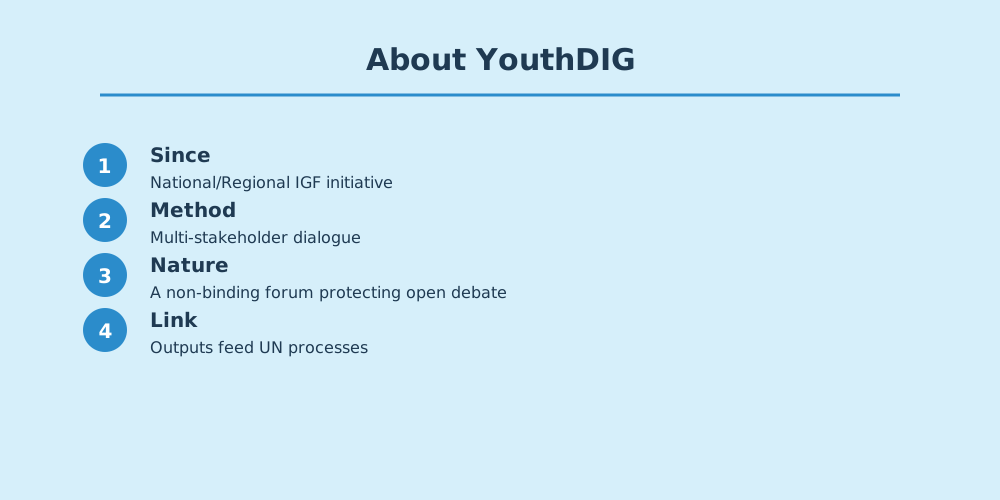
YouthDIG is a National or Regional IGF Initiative (NRI), aligning local internet governance discussion with global IGF principles.
Why It Matters to You
What was discussed here becomes the baseline for national digital policy, platform rules and AI regulation worldwide within a few years. The principles confirmed at the 2017 meeting are the foundation of the "next rules" for the phones, social platforms and AI services you use every day.
Sources & References
- YOUthDIG 2017(ユースメッセージ全文掲載) — EuroDIG Wiki(EuroDIG公式) (accessed 2026-07-22)
- Programme overview YOUthDIG 2017(3〜5 June 2017, Tallinn / Estonia) — EuroDIG Wiki(EuroDIG公式) (accessed 2026-07-22)
- EuroDIG 2017(June 6-7, Tallinn / Estonia) — EuroDIG Wiki(EuroDIG公式) (accessed 2026-07-22)
- YOUthDIG(系列概要と歴代ユースメッセージのアーカイブ) — EuroDIG(eurodig.org) (accessed 2026-07-22)
Quotes are translated or condensed from the records listed above. Bracketed numbers [n] refer to the source list.
Related links
- IGF official (NRI list): https://www.intgovforum.org/en/content/national-and-regional-igf-initiatives
- Japan IGF: https://japanigf.jp/
- Yuki Nakazawa's blog: https://nkzw.jp/category/igf/
更新履歴
第1稿投稿 2026年7月21日 16時57分(記事コンテンツアップ)
— 中澤祐樹

