


The 3-Line Summary
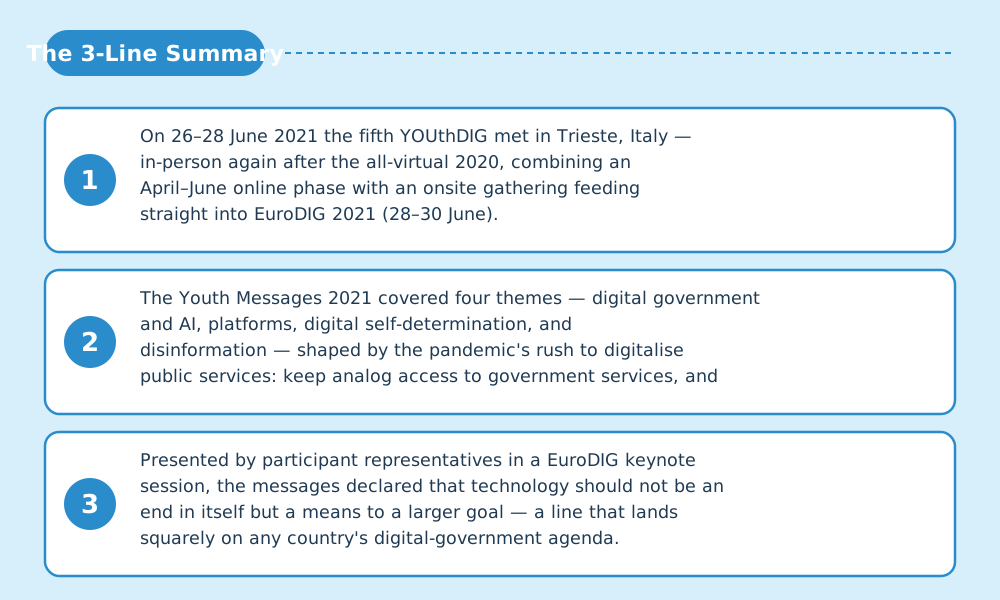
- On 26–28 June 2021 the fifth YOUthDIG met in Trieste, Italy — in-person again after the all-virtual 2020, combining an April–June online phase with an onsite gathering feeding straight into EuroDIG 2021 (28–30 June).
- The Youth Messages 2021 covered four themes — digital government and AI, platforms, digital self-determination, and disinformation — shaped by the pandemic's rush to digitalise public services: keep analog access to government services, and treat raw data as 'the new oil'.
- Presented by participant representatives in a EuroDIG keynote session, the messages declared that technology should not be an end in itself but a means to a larger goal — a line that lands squarely on any country's digital-government agenda.
Welcome — this is the Japan IGF Support Organization. This in-depth report on YOUthDIG 2021 — Youth Dialogue on Internet Governance, Trieste draws on official outputs, session records and on-site reporting. In a hurry? The three lines above and the diagrams carry the gist.
Conference at a Glance (from official records)
| Item | Detail |
|---|---|
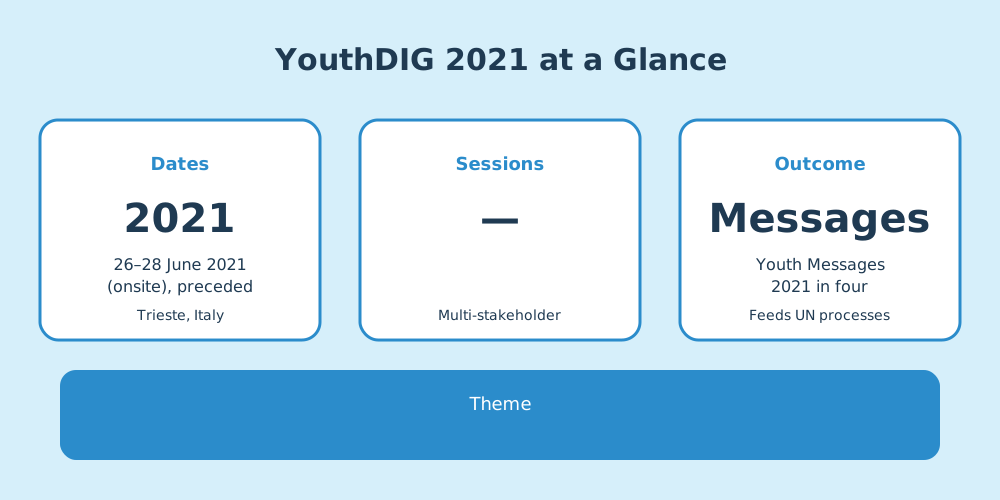
| Official name | YOUthDIG 2021 — Youth Dialogue on Internet Governance, Trieste |
| Dates | 26–28 June 2021 (onsite), preceded by an online phase April–June with webinars on 24 April, 8 May, 15 May and 5 June |
| Venue | Trieste, Italy |
| Theme | Regional governance themes |
| Outcome | Youth Messages 2021 in four themes — digital technologies within government bodies, platforms, digital self-determination & digital literacy, and disinformation — presented by participant representatives in a EuroDIG 2021 keynote session on 30 June |
(See the source list at the end of this article.)
Discussion Digest — from the Session Records
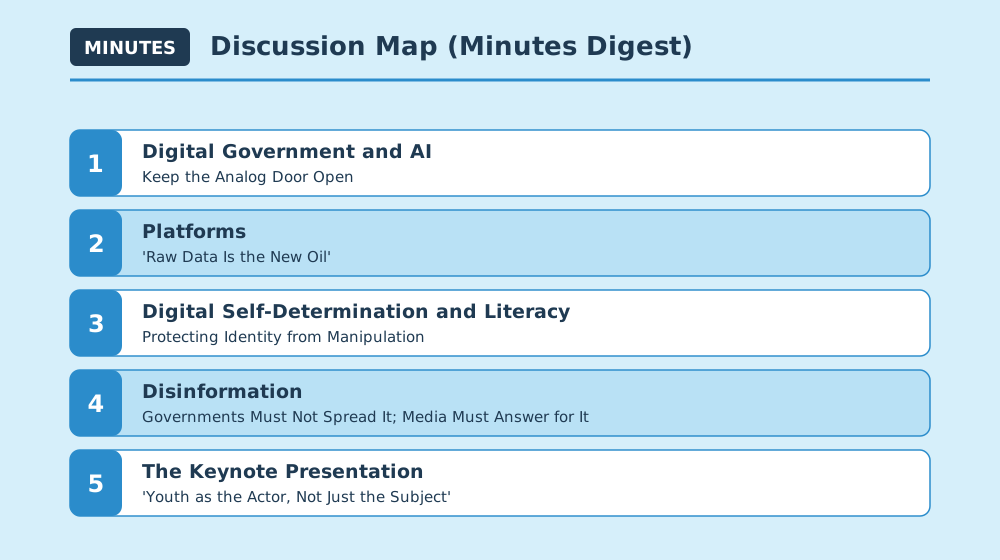
Key exchanges extracted from session records and transcripts.
1. Digital Government and AI — Keep the Analog Door Open
Sessions: Youth Message 'Digital Technologies Within Government Bodies' (drafted onsite, 27 June)
- Governments should ensure analog access to digitalised services remains, so that people without digital access or skills are not left behind — a check on the pandemic's all-digital rush [1][3]
- Digital government services should be built by in-house IT teams where possible, limiting private-sector involvement so governments themselves can be held accountable, with 'inclusion by design' as the guiding principle [1][3]
- Human involvement must be guaranteed where government AI significantly affects citizens' lives — and governments 'should not experiment with the use of AI on the general public' where fundamental rights are at stake [1][3]
2. Platforms — 'Raw Data Is the New Oil'
Sessions: Youth Message 'Platforms' (deep dive on platform regulation, 26 June, 15:00)
- Raw data is 'the new oil': platforms were encouraged to provide access to resources and raw data on a fair, reasonable and non-discriminatory basis, opening the field to start-ups and researchers [1][2]
- Technical norms for interoperability and portability of data, information and applications should be created in a multistakeholder process spanning platforms, governments, users, technical companies and researchers [1][2]
- On transparency the messages were unusually practical: define it granularly for each audience and subject matter, balancing it proportionately against trade secrets and IP [1][2]
3. Digital Self-Determination and Literacy — Protecting Identity from Manipulation
Sessions: Youth Message 'Digital Self-Determination & Digital Literacy'
- With mass digitalisation eroding individual and collective agency, the cohort tied digital self-determination to protecting 'the very creation of our identities' from manipulation — and thus to human rights and democratic values [1]
- Neither national security interests nor private-sector profit should override digital self-determination; public and private bodies should deploy algorithmic audits and children's-rights and human-rights impact assessments [1]
- Digital literacy was framed as the tool that gives people a confident approach to self-determination, requiring accessible provision and appropriate regulation [1]
4. Disinformation — Governments Must Not Spread It; Media Must Answer for It
Sessions: Youth Message 'Disinformation' (fact-checking workshop, 27 June, 15:00)
- Governments should not be involved in spreading disinformation or benefit from it — and should take concrete preventive steps without curbing free speech, the messages stated, squarely addressing state information operations [1]
- Media should build tools and guidelines for recognising trustworthy information, but also be held accountable through monitoring when they create or spread disinformation, and make sources visible except where people would be put at risk [1]
- The private sector should publish the algorithms used to tackle disinformation and accept transparent rules on machine-learning classifiers, while literacy programmes and peer educators spread the skills in and out of school [1]
5. The Keynote Presentation — 'Youth as the Actor, Not Just the Subject'
Sessions: EuroDIG 2021 session 'Keynote 02 and YouthDIG Messages' (30 June, 10:00–10:30, streamed from Studio Bruges; messages presented by Stephanie Teeuwen and Luisa Franco Machado)
"At the YouthDIG we really believe that the time has come for the youth to be the actor, and not just the subject"
— Youth Messages presentation (Luisa Franco Machado / Stephanie Teeuwen) [3]
"The YouthDIG believes technology should not be an end in itself but rather a means to a larger goal"
— Youth Messages presentation (Luisa Franco Machado / Stephanie Teeuwen) [3]
- The Youth Messages shared a keynote slot with Delphine Ernotte, President of France Télévisions and of the European Broadcasting Union — youth input programmed as a headline act, not a side show [3]
- The presenters explained how the pandemic-era surge in digital government and the fight for digital self-determination and literacy shaped this year's priorities [3]
Three-Minute Short Talk — Your Questions Answered
Q. Was this the return to in-person?
A. Yes — a two-stage design: an online phase with four webinars from April to June, then an onsite gathering in Trieste on 26–28 June. The parent EuroDIG 2021 was itself a hybrid meeting broadcast from Trieste's ICTP.
Q. What was the headline demand?
A. Keep analog access to digitalised government services. Against the pandemic's all-digital rush, the cohort insisted no one should be locked out — and pushed platforms to open raw data, 'the new oil', on fair terms.
Q. Why should I care?
A. Anywhere digital government is accelerating, the trio of demands — analog fallback, guaranteed human oversight of government AI, and no experimenting on the public — maps directly onto the policy debate.
What Is YouthDIG? (for first-time readers)
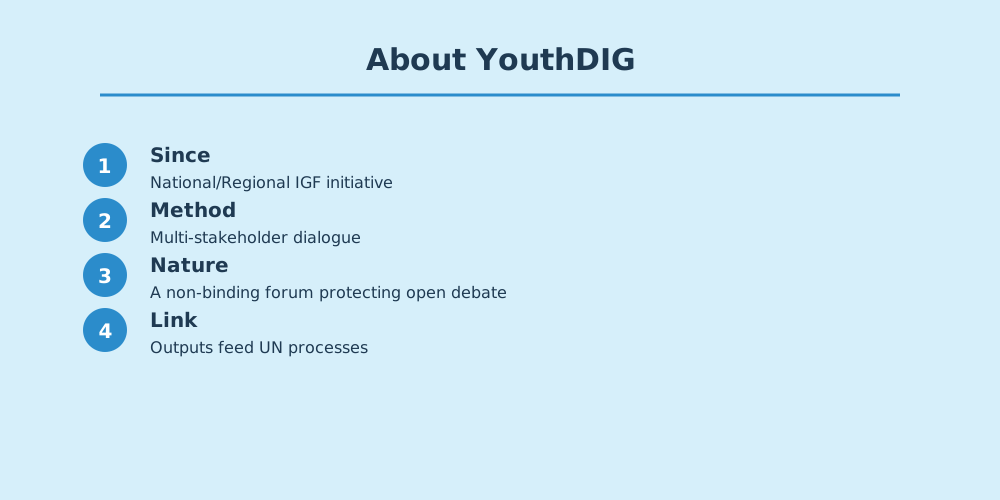
YouthDIG is a National or Regional IGF Initiative (NRI), aligning local internet governance discussion with global IGF principles.
Why It Matters to You
What was discussed here becomes the baseline for national digital policy, platform rules and AI regulation worldwide within a few years. The principles confirmed at the 2021 meeting are the foundation of the "next rules" for the phones, social platforms and AI services you use every day.
Sources & References
- YOUthDIG 2021(ユースメッセージ全文・開催概要) — EuroDIG Wiki(EuroDIG公式) (accessed 2026-07-22)
- YOUthDIG 2021 programme(ウェビナー日程と現地プログラム詳細) — EuroDIG Wiki(EuroDIG公式) (accessed 2026-07-22)
- Keynote 02 and YouthDIG Messages 2021(セッション書き起こし・発表者) — EuroDIG Wiki(EuroDIG公式) (accessed 2026-07-22)
- EuroDIG 2021(June 28-30・ICTPホストのバーチャル開催) — EuroDIG Wiki(EuroDIG公式) (accessed 2026-07-22)
- YOUthDIG(系列概要と歴代ユースメッセージのアーカイブ) — EuroDIG(eurodig.org) (accessed 2026-07-22)
Quotes are translated or condensed from the records listed above. Bracketed numbers [n] refer to the source list.
Related links
- IGF official (NRI list): https://www.intgovforum.org/en/content/national-and-regional-igf-initiatives
- Japan IGF: https://japanigf.jp/
- Yuki Nakazawa's blog: https://nkzw.jp/category/igf/
更新履歴
第1稿投稿 2026年7月13日 12時49分(記事コンテンツアップ)
— 中澤祐樹

