


The 3-Line Summary
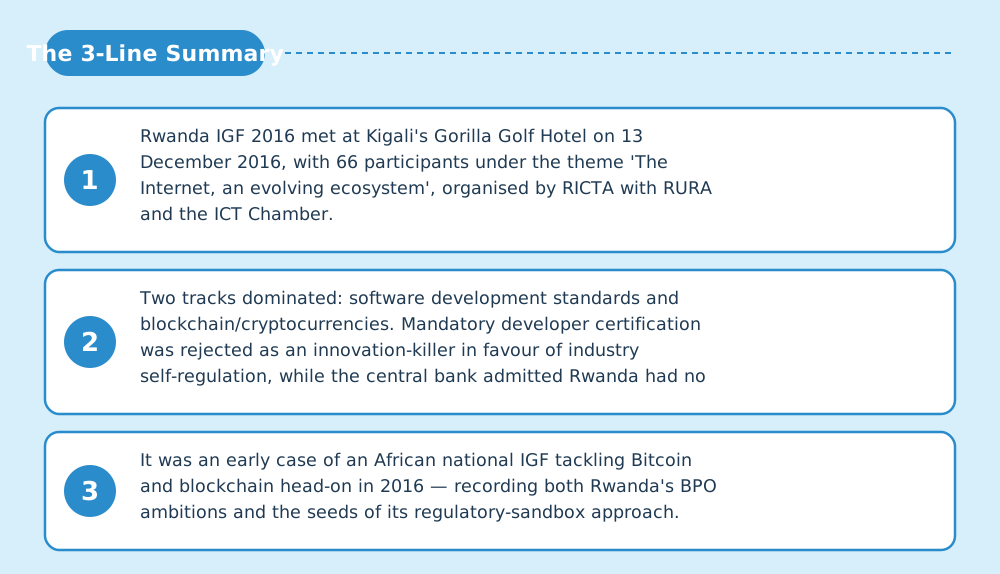
- Rwanda IGF 2016 met at Kigali's Gorilla Golf Hotel on 13 December 2016, with 66 participants under the theme 'The Internet, an evolving ecosystem', organised by RICTA with RURA and the ICT Chamber.
- Two tracks dominated: software development standards and blockchain/cryptocurrencies. Mandatory developer certification was rejected as an innovation-killer in favour of industry self-regulation, while the central bank admitted Rwanda had no enabling legal framework for digital currency.
- It was an early case of an African national IGF tackling Bitcoin and blockchain head-on in 2016 — recording both Rwanda's BPO ambitions and the seeds of its regulatory-sandbox approach.
Welcome — this is the Japan IGF Support Organization. This in-depth report on Rwanda Internet Governance Forum 2016 draws on official outputs, session records and on-site reporting. In a hurry? The three lines above and the diagrams carry the gist.
Conference at a Glance (from official records)
| Item | Detail |
|---|---|
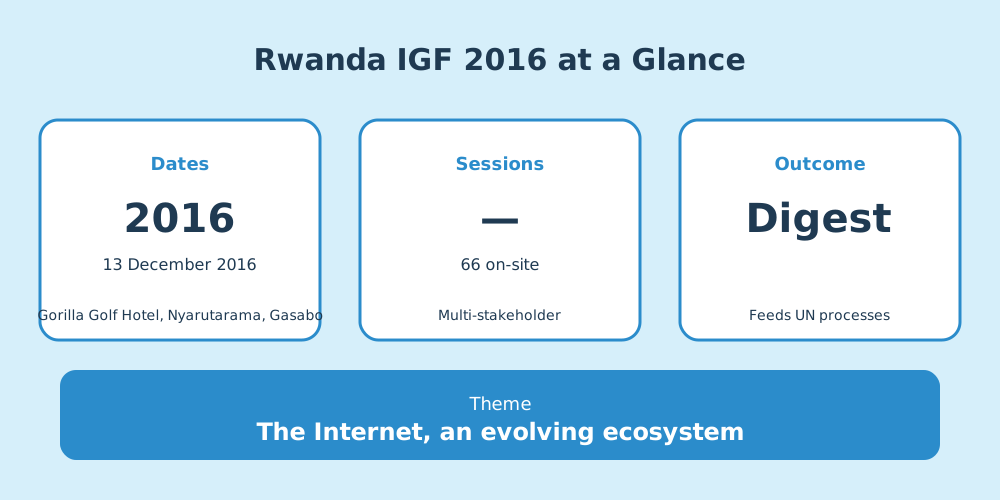
| Official name | Rwanda Internet Governance Forum 2016 |
| Dates | 13 December 2016 |
| Venue | Gorilla Golf Hotel, Nyarutarama, Gasabo District, Kigali, Rwanda |
| Theme | The Internet, an evolving ecosystem |
| Participants | 66 |
| Host | Organised by RICTA in partnership with RURA and the ICT Chamber of the Private Sector Federation |
(See the source list at the end of this article.)
Discussion Digest — from the Session Records
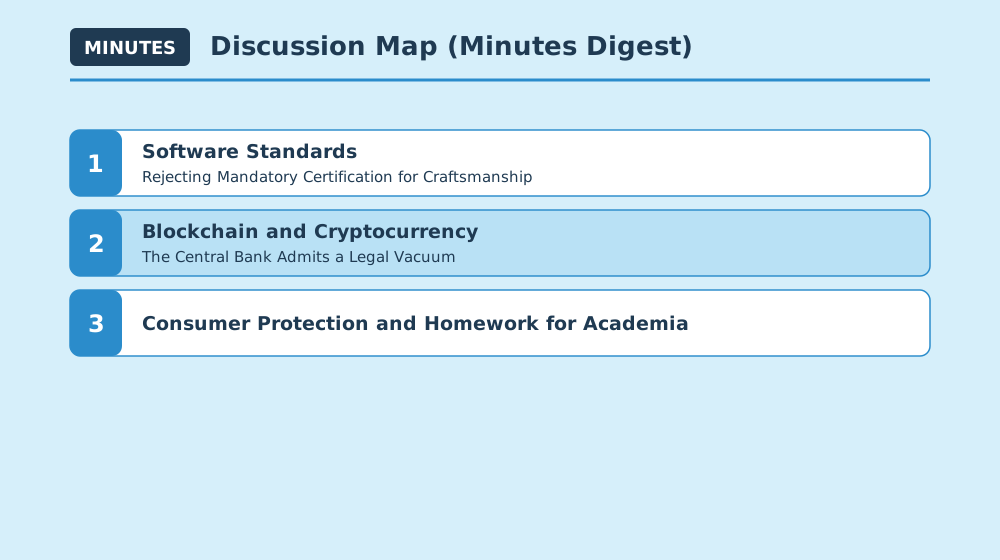
Key exchanges extracted from session records and transcripts.
1. Software Standards — Rejecting Mandatory Certification for Craftsmanship
Sessions: First panel moderated by Jimmy Rutabingwa (IMAGINET), with Regis Rugemanshuro (BK Telecom), Alain Kajangwe (WiredIn) and Aimable Kimenyi (PSF software association)
- BK Telecom CEO Regis Rugemanshuro championed 'software craftsmanship': quality lives in developers' continuous learning and culture, not in institutions [1]
- On whether developer certification should be mandatory, the forum explicitly rejected certification and a third-party body to certify all Rwandan software as impractical and innovation-hindering [1]
- Instead it recommended industry self-regulation via PSF/ICT Chamber guidelines, with adherence to international practice (Agile and others) deemed vital to Rwanda's BPO ambitions [1]
2. Blockchain and Cryptocurrency — The Central Bank Admits a Legal Vacuum
Sessions: Second panel moderated by RICTA CEO Ghislain Nkeramugaba, with Martin Saint (CMU Rwanda) and John Karamuka (National Bank of Rwanda, Director of Payment Systems)
- CMU's Martin Saint explained blockchain as a cryptographically secured distributed ledger, mapping applications from finance and healthcare to voting and domain names alongside regulatory unknowns [1]
- BNR payments director John Karamuka stated plainly that Rwanda had no enabling legal framework for digital currency, described regulatory responses worldwide from warnings to bans, and cited the Mt. Gox collapse (850,000 BTC, about $450 million) as a user-risk case [1]
- The way forward on record: explore distributed-ledger technology as financial innovation and create an enabling regulatory sandbox for testing innovative products [1]
3. Consumer Protection and Homework for Academia and Finance
Sessions: Outcomes and recommendations
- Comparing mandatory certification with best-practice adherence as consumer-protection tools, the forum discarded the former while affirming developers' critical role in protecting consumers [1]
- It recommended continued study of blockchain in academia, banking and finance — groundwork for Rwanda's later fintech sandbox regime [1]
Three-Minute Short Talk — Your Questions Answered
Q. What did the meeting decide?
A. Nothing binding, but the direction was clear: no mandatory certification for software developers, industry self-regulation through PSF/ICT Chamber guidelines instead, and continued study — not prohibition — of blockchain.
Q. What was most contentious?
A. Whether developers should be certified. Against calls for quality assurance, the room concluded a certification body would be impractical and would kill innovation, betting instead on a craftsmanship culture.
Q. Why should I care?
A. In 2016 the Mt. Gox collapse was fresh, and Rwanda's central bank cited it by name as a user-risk case. The certification-versus-culture debate over software quality is a universal question for tech workforce policy.
What Is Rwanda IGF? (for first-time readers)
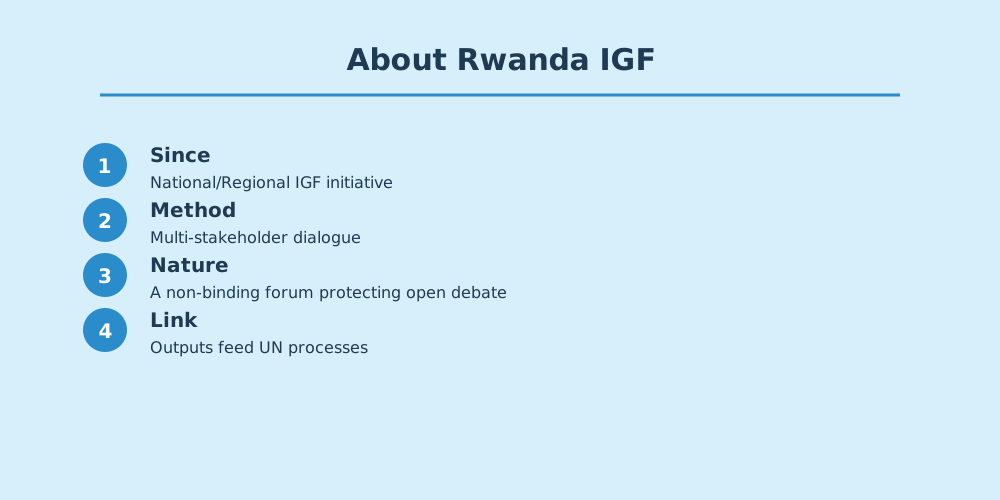
Rwanda IGF is a National or Regional IGF Initiative (NRI), aligning local internet governance discussion with global IGF principles.
Why It Matters to You
What was discussed here becomes the baseline for national digital policy, platform rules and AI regulation worldwide within a few years. The principles confirmed at the 2016 meeting are the foundation of the "next rules" for the phones, social platforms and AI services you use every day.
Sources & References
- Rwanda Internet Governance Forum – 2016 Report(公式報告書: 2016-12-13・Gorilla Golf Hotel・66名・2セッションの詳細と勧告・登壇者略歴) — RICTA / Rwanda IGF(国連IGF filedepot経由) (accessed 2026-07-23)
- Rwanda IGF(NRI公式記録: established in 2014・RICTA事務局・年次報告書一覧に2016年掲載、2015年は欠落) — 国連IGF事務局 (accessed 2026-07-23)
- About RwIGF(公式沿革) — Rwanda IGF(rwigf.rw) (accessed 2026-07-23)
Quotes are translated or condensed from the records listed above. Bracketed numbers [n] refer to the source list.
Related links
- IGF official (NRI list): https://www.intgovforum.org/en/content/national-and-regional-igf-initiatives
- Japan IGF: https://japanigf.jp/
- Yuki Nakazawa's blog: https://nkzw.jp/category/igf/
更新履歴
第1稿投稿 2026年8月2日 8時56分(記事コンテンツアップ)
— 中澤祐樹

