


The 3-Line Summary
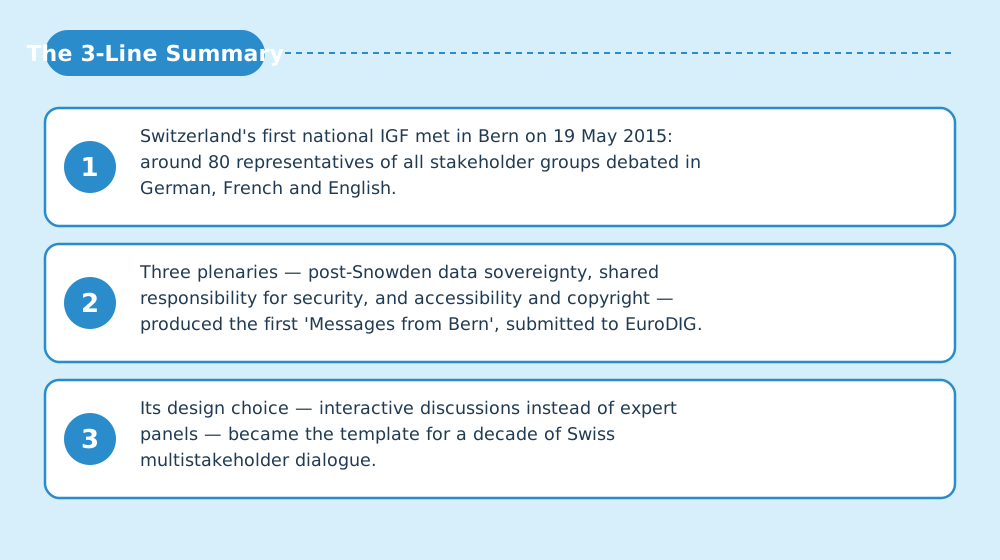
- Switzerland's first national IGF met in Bern on 19 May 2015: around 80 representatives of all stakeholder groups debated in German, French and English.
- Three plenaries — post-Snowden data sovereignty, shared responsibility for security, and accessibility and copyright — produced the first 'Messages from Bern', submitted to EuroDIG.
- Its design choice — interactive discussions instead of expert panels — became the template for a decade of Swiss multistakeholder dialogue.
Welcome — this is the Japan IGF Support Organization. This in-depth report on Swiss IGF 2015 (1st Swiss Internet Governance Forum) draws on official outputs, session records and on-site reporting. In a hurry? The three lines above and the diagrams carry the gist.
Conference at a Glance (from official records)
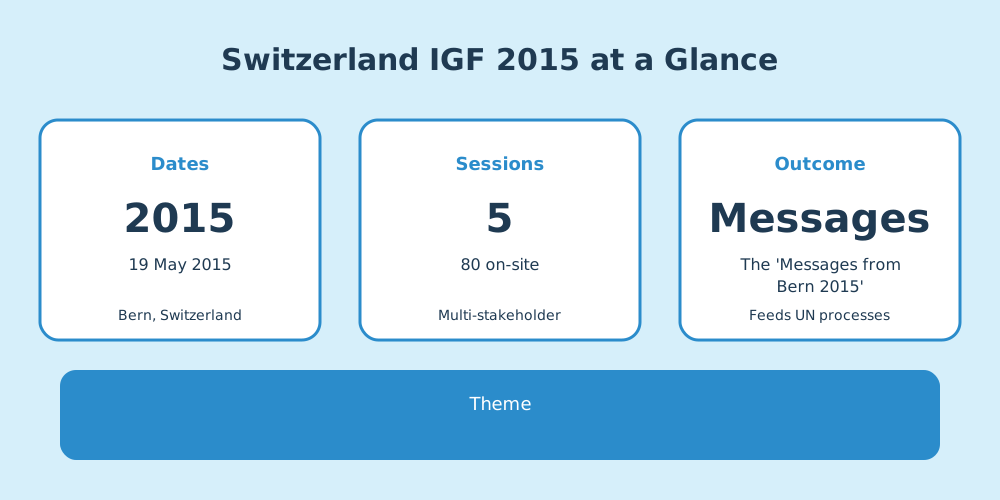
| Item | Detail |
|---|---|
| Official name | Swiss IGF 2015 (1st Swiss Internet Governance Forum) |
| Dates | 19 May 2015 |
| Venue | Bern, Switzerland |
| Theme | Regional governance themes |
| Participants | 80 (The official report records 'around 80' representatives of all Swiss stakeholder groups) |
| Sessions | 5 (Three plenary sessions and two workshops) |
| Host | A multistakeholder steering group, under the patronage of the Federal Office of Communications (OFCOM/BAKOM) |
| Outcome | The 'Messages from Bern 2015', submitted to EuroDIG and the UN IGF |
| Note | First-ever Swiss national IGF |
(See the source list at the end of this article.)
Discussion Digest — from the Session Records
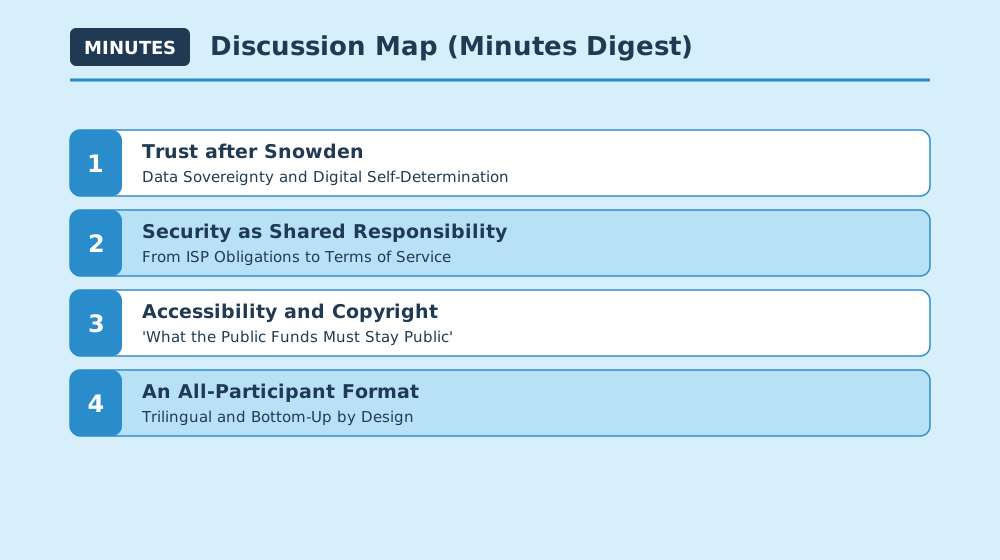
Key exchanges extracted from session records and transcripts.
1. Trust after Snowden — Data Sovereignty and Digital Self-Determination
Sessions: Plenary 1
- The starting dilemma: as the Snowden revelations showed, users cannot fully control how platforms use their data or what profiling and big-data analytics do to their privacy [1]
- To the question 'whom can end users trust?', participants agreed a democratic multistakeholder debate is needed, covering transparency measures, practical capacity building, privacy by default and awareness education for the young generation [1]
- Participants proposed international, democratic framework conditions with end users' digital self-determination as a core principle — the issue being control over personal data more than privacy per se [1]
2. Security as Shared Responsibility — From ISP Obligations to Terms of Service
Sessions: Plenary 2
- Security is a shared responsibility in which end users, service providers and technology vendors each play roles — to be delimited transparently, future-oriented and in line with technical realities [1]
- Proprietary versus open-source software: with proprietary products support dies with the vendor's business, while open source lacks a single accountable provider — both scenarios worry users [1]
- On terms of service, a balance is needed between minimal, understandable, user-friendly rights and an innovation-friendly environment; peer reviews of terms and a simple common terminology could help [1]
3. Accessibility and Copyright — 'What the Public Funds Must Stay Public'
Sessions: Plenary 3
- Despite existing legal frameworks, accessibility implementation lags badly in both private and public sectors; awareness raising and training are needed, and accessibility requirements should be mandatory in public procurement [1]
- Copyright should be adapted to the digital environment on a fact-based approach, preserving public-interest uses — public libraries, archiving of born-digital public content — and legitimate private copying [1]
- Open access to publicly funded academic publications was welcomed as a step in the right direction: what the public finances must remain publicly accessible [1]
4. An All-Participant Format — Trilingual and Bottom-Up by Design
Sessions: Meeting design (Call for Issues and wrap-up)
- Topics were crowdsourced through a Call for Issues and shaped into the programme by a multistakeholder steering group — a bottom-up method adopted from the very first edition [1][2]
- Sessions were interactive discussions involving every participant rather than expert panels; the report was compiled by Jorge Cancio, Olivier MJ Crépin-Leblond and Nicolas Rollier [1][2]
- This free, open, trilingual, bottom-up design became the standing format of the Swiss IGF, with the pipeline to the UN IGF and EuroDIG established from year one [1][2]
Three-Minute Short Talk — Your Questions Answered
Q. What did it decide?
A. Nothing formally — it was Switzerland's first national IGF, where government, business and civil society talked as equals. The essentials went to Europe's EuroDIG as the 'Messages from Bern'.
Q. Biggest issue?
A. Post-Snowden trust. The sharpest framing: privacy ultimately means control over your own data.
Q. Why care?
A. It shows how a small country bootstrapped a free, trilingual, bottom-up national IGF with 80 people — a model for national digital-policy dialogue anywhere.
What Is Switzerland IGF? (for first-time readers)
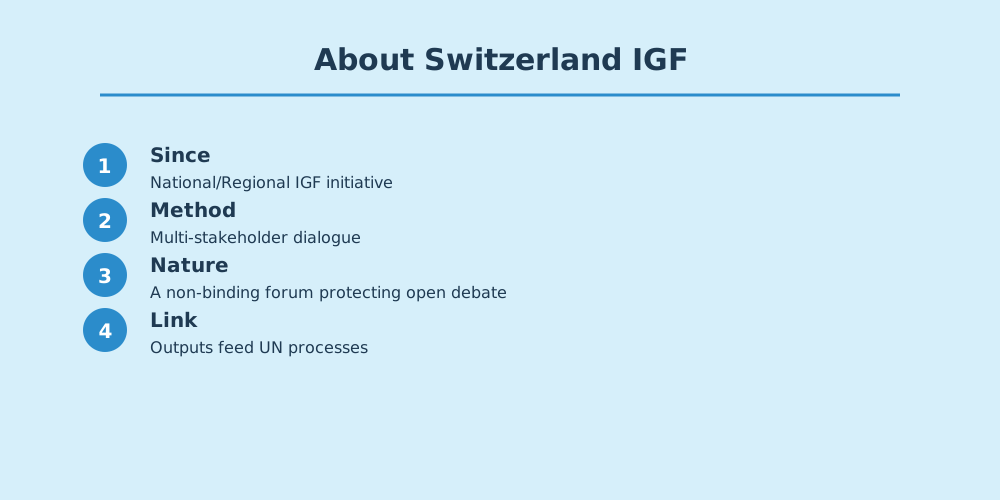
Switzerland IGF is a National or Regional IGF Initiative (NRI), aligning local internet governance discussion with global IGF principles.
Why It Matters to You
What was discussed here becomes the baseline for national digital policy, platform rules and AI regulation worldwide within a few years. The principles confirmed at the 2015 meeting are the foundation of the "next rules" for the phones, social platforms and AI services you use every day.
Sources & References
- Swiss-IGF 2015: Bericht aus Bern(独語) — Swiss Internet Governance Forum(旧swiss-igf.ch、Waybackアーカイブ) (accessed 2026-07-23)
- About the Swiss IGF — igf.swiss (accessed 2026-07-23)
- National IGFs — Western European and Others Regional Group (WEOG) — 国連IGF事務局(Waybackアーカイブ) (accessed 2026-07-23)
- Largest Swiss Internet Governance Forum held since its foundation (Press Release 2024) — Swiss IGF (accessed 2026-07-23)
Quotes are translated or condensed from the records listed above. Bracketed numbers [n] refer to the source list.
Related links
- IGF official (NRI list): https://www.intgovforum.org/en/content/national-and-regional-igf-initiatives
- Japan IGF: https://japanigf.jp/
- Yuki Nakazawa's blog: https://nkzw.jp/category/igf/
更新履歴
第1稿投稿 2026年8月13日 19時33分(記事コンテンツアップ)
— 中澤祐樹

