


The 3-Line Summary
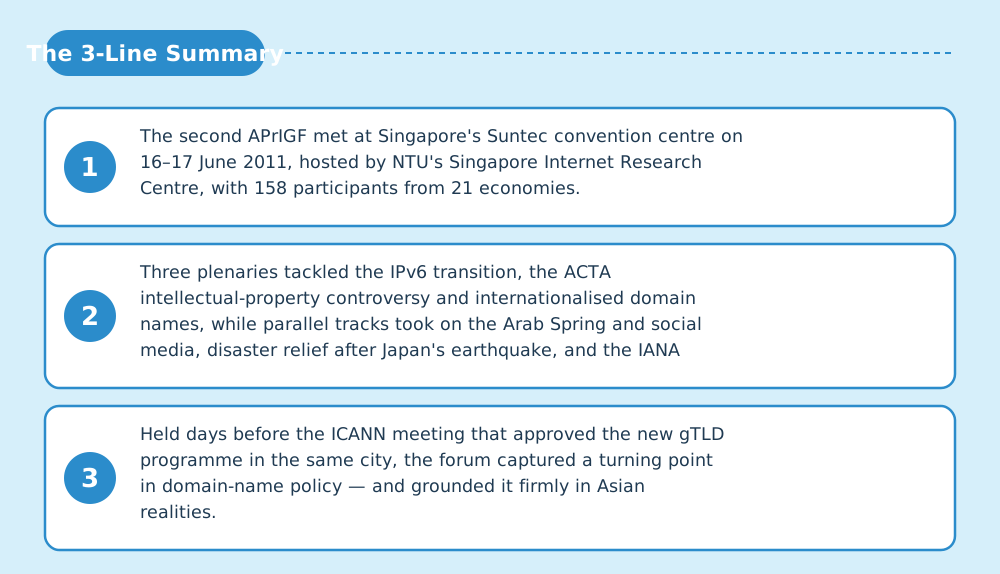
- The second APrIGF met at Singapore's Suntec convention centre on 16–17 June 2011, hosted by NTU's Singapore Internet Research Centre, with 158 participants from 21 economies.
- Three plenaries tackled the IPv6 transition, the ACTA intellectual-property controversy and internationalised domain names, while parallel tracks took on the Arab Spring and social media, disaster relief after Japan's earthquake, and the IANA review; outcomes went to the global IGF in Nairobi that September.
- Held days before the ICANN meeting that approved the new gTLD programme in the same city, the forum captured a turning point in domain-name policy — and grounded it firmly in Asian realities.
Welcome — this is the Japan IGF Support Organization. This in-depth report on AprIGF 2011 in Singapore draws on official outputs, session records and on-site reporting. In a hurry? The three lines above and the diagrams carry the gist.
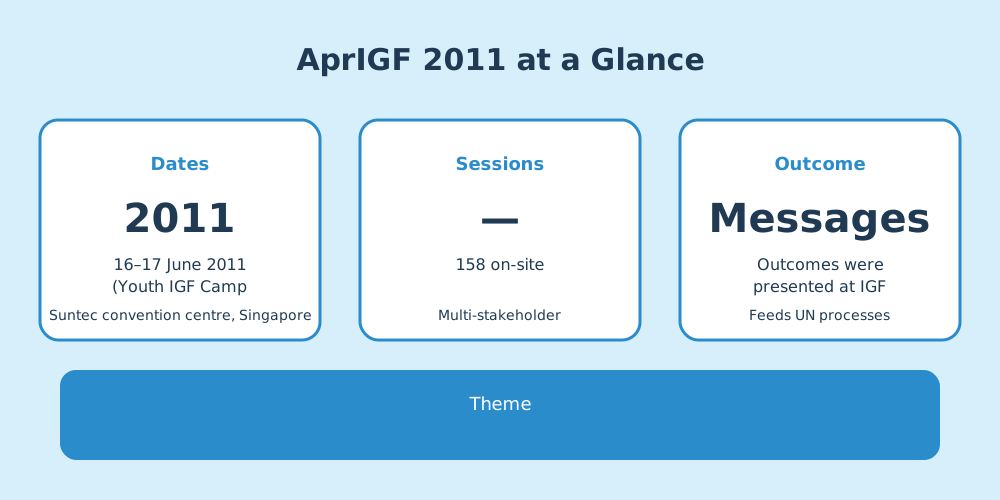
Conference at a Glance (from official records)
| Item | Detail |
|---|---|
| Dates | 16–17 June 2011 (Youth IGF Camp 16–18 June) |
| Venue | Suntec convention centre, Singapore |
| Theme | Regional governance themes |
| Participants | 158 (218 registered online, 158 attended over the two days (organiser's post-project report); 42% from Singapore, then Hong Kong 9%, US 8%, Australia 8%, from 21 economies in total. The meeting summary describes 'some 200' senior government, private-sector, technical and academic participants) |
| Registrations | 218 |
| Keynote | Keynote 'Enabling Policies for the Internet' by Aileen Chia, Deputy Director-General (Telecoms and Post), IDA Singapore |
| Host | Hosted and organised by the Singapore Internet Research Centre (SiRC) at NTU's Wee Kim Wee School of Communication and Information, with DotAsia, APNIC and NetMission Ambassadors; supported by IDA Singapore, Google, M1, the Lee Foundation and NTU |
| Outcome | Outcomes were presented at IGF 2011 in Nairobi (27–30 September, UNON); four outstanding Youth IGF Camp participants were flown to Nairobi |
| Context | Deliberately scheduled just before ICANN's 41st meeting in Singapore, where the Board was to decide on launching the new gTLD programme on 20 June 2011 |
(See the source list at the end of this article.)
Discussion Digest — from the Session Records
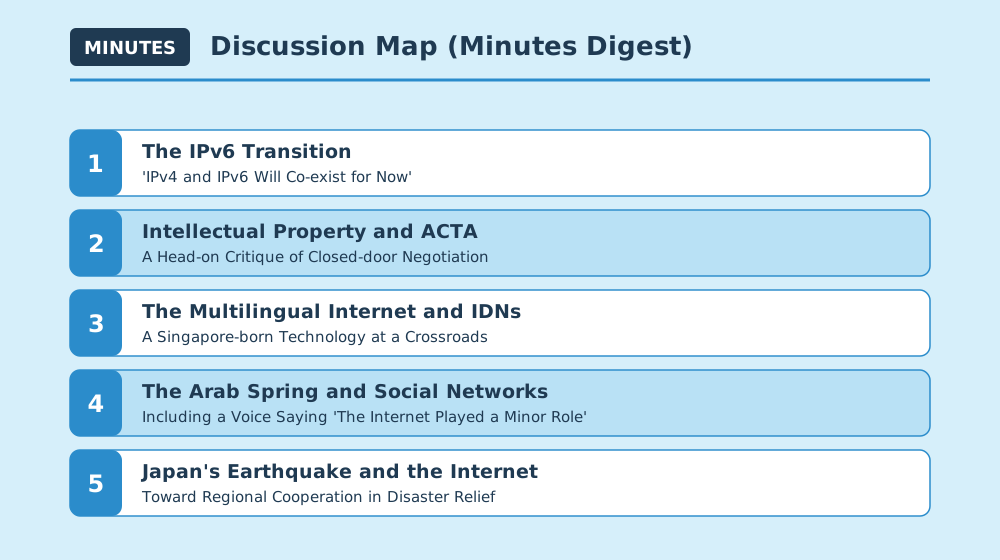
Key exchanges extracted from session records and transcripts.
1. The IPv6 Transition — 'IPv4 and IPv6 Will Co-exist for Now'
Sessions: Plenary 1 "IPv6: How Ready is Asia for this Critical Resource?" (16 June, chaired by Kuo-Wei Wu, ICANN; with Miwa Fujii (APNIC), Chris Disspain (auDA), Rajnesh Singh (ISOC), Akinori Maemura (JPNIC) and Tetsuya Innami (Cisco))
- Panellists agreed IPv4 would not vanish at transition — the two protocols would run side by side — and called for awareness campaigns and government incentives for ISPs and content providers [1]
- The just-held World IPv6 Day (June 2011) was judged a success, roughly 2.5 times more websites signalling willingness to serve IPv6 [1]
2. Intellectual Property and ACTA — A Head-on Critique of Closed-door Negotiation
Sessions: Plenary 2 "Intellectual Property: ACTA and Other Controversies" (16 June, chaired by Hong Xue, Beijing Normal University; with Mary Wong, Goh Seow Hiong (Cisco), Jordan Carter (InternetNZ), Siew Kum Hong (Yahoo! SEA) and William J. Drake)
- ACTA's closed-door negotiation was criticised as running against the multistakeholder, open and transparent principles developed for internet governance [1]
- IP should enable creativity, not stifle it: enforcement must weigh its impact on consumer protection, competition and human rights — notably privacy and free speech [1]
3. The Multilingual Internet and IDNs — A Singapore-born Technology at a Crossroads
Sessions: Plenary 3 "IDN Governance and Policy for an Equitable and Diverse Multilingual Internet" (16 June, chaired by Subbiah Subramaniam, i-DNS.net; with Tan Tin Wee (NUS), Jian Zhang (APTLD) and Lim Choon Sai (IDA))
- Modern IDN technology was pioneered in Singapore around 1997–98, making this a signature host-country topic; the Chinese and Tamil versions of '.sg' were reported to have taken considerable time to approve due to dense processes [1]
- With many issues still unresolved after the 2010 launch of IDN ccTLDs, panellists pressed for equitable arrangements ahead of mass IDN deployment under the new gTLD programme, warning against Western-tilted rules [1]
4. The Arab Spring and Social Networks — Including a Voice Saying 'The Internet Played a Minor Role'
Sessions: Track 1a "The Arabic Revolutions, their Impact on the World, Roles of Social Networks" (17 June, chaired by Khaled Fattal; with remote video participation from Egypt, Tunisia, Yemen and elsewhere)
- Panellists examined why social media proved effective in Tunisia and Egypt yet had limited impact elsewhere, pointing to context and internet penetration [1]
- A blogger from Tunisia argued the internet had in fact played a minor role in the revolution — a counterpoint to cyber-utopianism [1]
- The session raised more questions than answers, leaving open how the multilingual internet and social media would reshape politics [1]
5. Japan's Earthquake and the Internet — Toward Regional Cooperation in Disaster Relief
Sessions: Track 3a "Internet for Disaster Relief and Recovery" (17 June, chaired by Izumi Aizu (ANR); with Toshiaki Tateishi (JAIPA), Tsuyoshi Kinoshita (Cisco), Valens Riyadi (APJII, Indonesia) and Deborah Nga (Google))
- Three months after the Great East Japan Earthquake, Japan's ISP association JAIPA reported on restoring connectivity in devastated areas, alongside Google's information-support work and Indonesia's experience since the 2004 tsunami [1]
- Speakers noted that while the internet was heavily used in relief work, no governance structure yet existed to coordinate it — and Japan still lacked a multistakeholder relief framework [1]
- The session proposed building a regional framework for international cooperation on ICT-enabled disaster relief [1]
Three-Minute Short Talk — Your Questions Answered
Q. What did this meeting actually decide?
A. Nothing binding — it's a dialogue venue. Its discussions on IPv6, intellectual property and multilingual domain names were delivered as the Asia Pacific's input to the global IGF in Nairobi that September.
Q. What was the most contentious topic?
A. ACTA, the anti-counterfeiting trade agreement. Panellists argued its closed-door negotiation betrayed the openness and multistakeholder principles of internet governance and ignored human-rights concerns like free speech.
Q. Why does it matter beyond 2011?
A. It met days before ICANN approved the new gTLD programme in the same city, aired early warnings about equity in the multilingual internet, and — three months after Japan's earthquake — started a regional conversation on internet-enabled disaster relief.
What Is AprIGF? (for first-time readers)
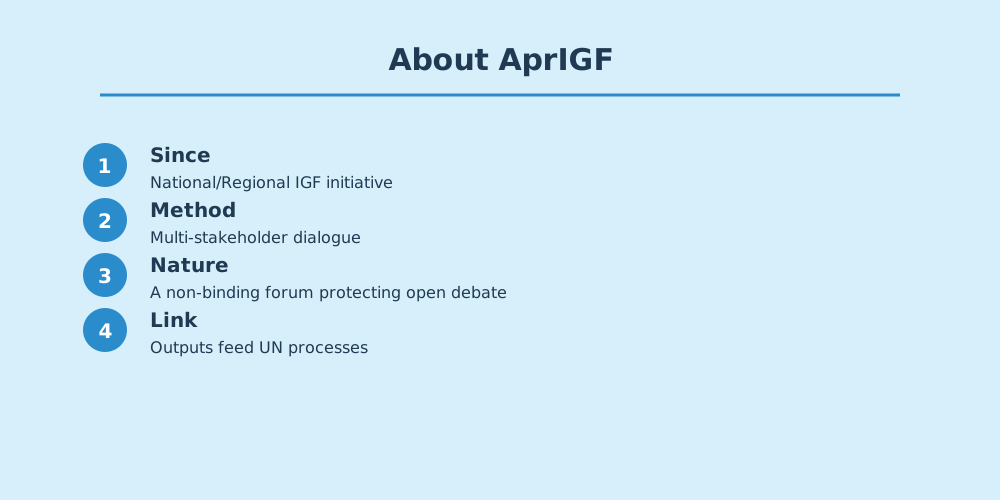
AprIGF is a National or Regional IGF Initiative (NRI), aligning local internet governance discussion with global IGF principles.
Why It Matters to You
What was discussed here becomes the baseline for national digital policy, platform rules and AI regulation worldwide within a few years. The principles confirmed at the 2011 meeting are the foundation of the "next rules" for the phones, social platforms and AI services you use every day.
Sources & References
- Asia Pacific Regional Internet Governance Forum, 16 & 17 June 2011, Suntec Convention City, Singapore — Post Project Report(サマリーレポート・全プログラム収録) — Singapore Internet Research Centre(南洋理工大学) (accessed 2026-07-10)
- Events — APrIGF.Asia(歴代開催一覧: 2011 Singapore, June 16-18) — AprIGF事務局 (accessed 2026-07-10)
- About Asia Pacific Regional Internet Governance Forum — AprIGF事務局 (accessed 2026-07-10)
- Home Page — APrIGF.Asia(「Hong Kong in 2010, followed by Singapore…」の開催都市履歴) — AprIGF事務局 (accessed 2026-07-10)
- Asia Pacific Regional Internet Governance Forum (APrIGF) — APC (accessed 2026-07-10)
Quotes are translated or condensed from the records listed above. Bracketed numbers [n] refer to the source list.
Related links
- IGF official (NRI list): https://www.intgovforum.org/en/content/national-and-regional-igf-initiatives
- Japan IGF: https://japanigf.jp/
- Yuki Nakazawa's blog: https://nkzw.jp/category/igf/
Revision History
Rev. 1 — published 15 June 2011, 09:00 (Article published)
Rev. 2 — updated 10 July 2026, 23:16 (Fully revised into the in-depth edition: added the 3-line summary, minutes digest, short talk, source list and diagrams (all quotes verified against the listed sources))
— 中澤祐樹

