


The 3-Line Summary
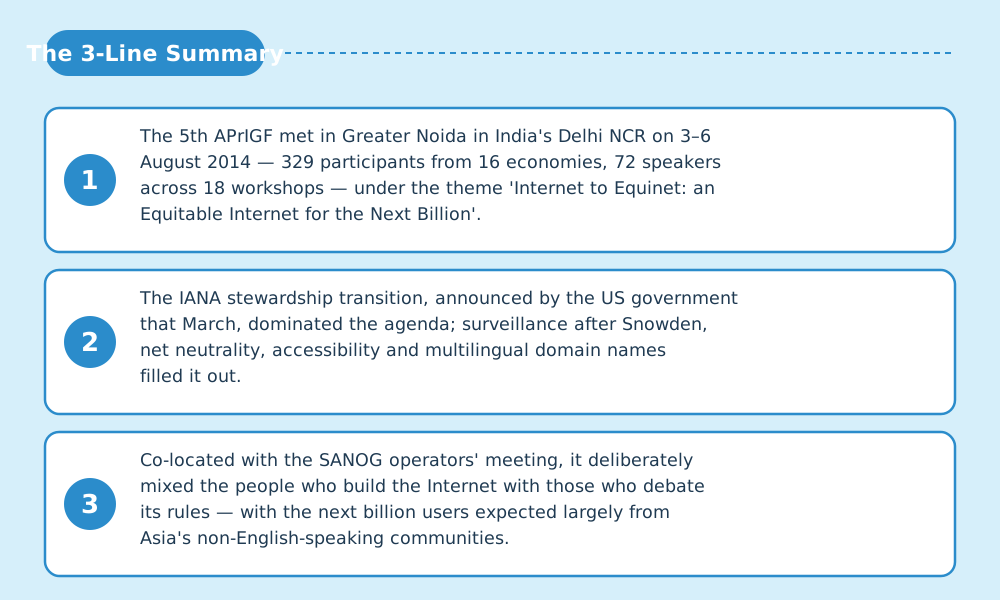
- The 5th APrIGF met in Greater Noida in India's Delhi NCR on 3–6 August 2014 — 329 participants from 16 economies, 72 speakers across 18 workshops — under the theme 'Internet to Equinet: an Equitable Internet for the Next Billion'.
- The IANA stewardship transition, announced by the US government that March, dominated the agenda; surveillance after Snowden, net neutrality, accessibility and multilingual domain names filled it out.
- Co-located with the SANOG operators' meeting, it deliberately mixed the people who build the Internet with those who debate its rules — with the next billion users expected largely from Asia's non-English-speaking communities.
Welcome — this is the Japan IGF Support Organization. This in-depth report on AprIGF 2014 in New Delhi draws on official outputs, session records and on-site reporting. In a hurry? The three lines above and the diagrams carry the gist.
📍 Catalogued as New Delhi; per the official report the venue, Hotel Crowne Plaza, is in Greater Noida, a Delhi-NCR satellite city in Uttar Pradesh
Conference at a Glance (from official records)
| Item | Detail |
|---|---|
| Edition | 5th APrIGF |
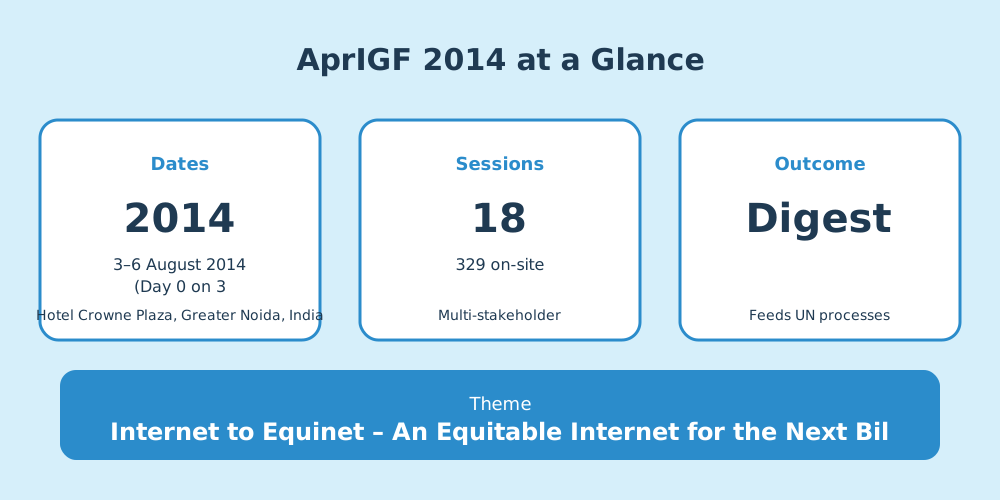
| Dates | 3–6 August 2014 (Day 0 on 3 August; main conference 4–6 August) |
| Venue | Hotel Crowne Plaza, Greater Noida, India (Delhi National Capital Region) |
| Theme | Internet to Equinet – An Equitable Internet for the Next Billion |
| Participants | 329 |
| Sessions | 18 |
| Speakers | 72 |
| Participation detail | 329 participants (56 overseas, 273 domestic) from 16 countries |
| Co-located events | Co-located with SANOG 24 (South Asia Network Operators Group, 1–9 August), the Youth IGF, and the inaugural Asia Pacific Internet Leadership Program (APILP) |
| Host | Hosted by the Internet Service Providers Association of India (ISPAI), co-hosted by NIXI (National Internet Exchange of India); APrIGF secretariat: DotAsia |
(See the source list at the end of this article.)
Discussion Digest — from the Session Records
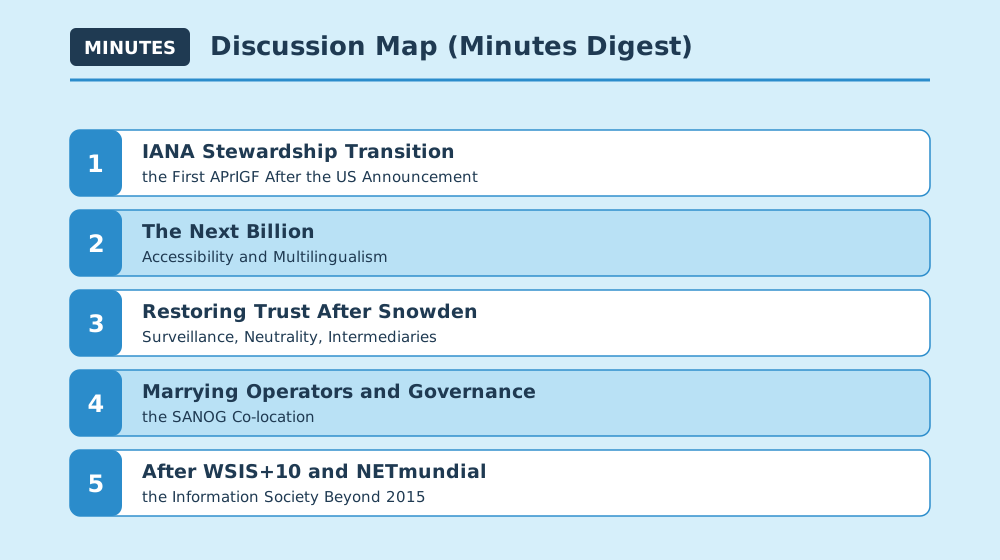
Key exchanges extracted from session records and transcripts.
1. IANA Stewardship Transition — the First APrIGF After the US Announcement
Sessions: Plenary Session 1 'IANA Stewardship Transition and the Asia Pacific Community' (5 August, 13:30)
"The US Government's announcement of the final steps in transitioning the IANA into the hands of the Internet community have been widely welcomed. However they have given us a challenge to finally determine future arrangements for IANA that will maintain the openness and acceptability of IANA's functions, and ensure technical reliability and stability"
— Paul Wilson (Director General of APNIC; MSG Chair — welcome message in the conference report) [1][2]
- Participants pressed on the transition timeline, the transparency of NTIA's judgement, and what 'the global multistakeholder community' actually means [1][2]
- Panellists held that transparency and accountability are imperative in multistakeholder models, while acknowledging that the debate over the model itself will continue for the foreseeable future [1][2]
2. The Next Billion — Accessibility and Multilingualism
Sessions: 'Enabling Access' workshops: disability access; a unified IDN ruleset; FOSS; the digital divide
- 'The next billion to go online will be the more disadvantaged, more underserved who live in more remote areas, and have languages other than English as their mother tongue' — and access must mean content, applications and services, not just connectivity [1]
- Workshops called for a unified IDN ruleset bridging language communities, scalable solutions fitted to the region's linguistic, cultural, topographic and economic diversity, and locally relevant content [1]
3. Restoring Trust After Snowden — Surveillance, Neutrality, Intermediaries
Sessions: 'Internet and Human Rights' workshops, including 'Surveillance – Restoring Trust on the Net' (5 August)
- In the shadow of the Snowden revelations, the surveillance session noted the international move to treat metadata as sensitive personal information and urged surveillance procedures complying with necessary-and-proportionate principles, plus a push for free and open-source software [1]
- Panels asked whether net neutrality is a Western construct that fits Asia, and examined the legal risks online intermediaries face in a region where services are often blocked over user-generated content [1]
- The gender session called for capacity building and broader participation by women and marginalised groups, underrepresented in Internet governance forums [1]
4. Marrying Operators and Governance — the SANOG Co-location
Sessions: Co-located SANOG 24 (1–9 August); Day 0 justice-sector primer and APILP capacity building (3 August)
"The technical community can be proud of what we have achieved in building the Internet, but we also have to ensure that critical technical issues are better understood by all, particularly those with concerns to regulate the Internet"
— Paul Wilson (Director General of APNIC; MSG Chair — welcome message in the conference report) [1][2]
- The inaugural Asia Pacific Internet Leadership Program (APILP) and the Youth IGF ran alongside, institutionalising next-generation capacity building [1][2]
- With cybercrime costs reported to exceed USD 1 trillion a year, a dedicated primer walked India's justice sector through how the Internet's names and numbers actually work [1][2]
5. After WSIS+10 and NETmundial — the Information Society Beyond 2015
Sessions: Plenary Session 2 'Developing the Information Society Beyond 2015: Lessons from the WSIS+10 Review and NETmundial' (6 August, 13:00)
- Building on NETmundial (Brazil, April 2014) and the WSIS+10 review, the plenary looked at developing the information society beyond 2015 and the IGF's future [1]
- How to integrate and strengthen participation at both regional and global levels was flagged as a common concern [1]
Three-Minute Short Talk — Your Questions Answered
Q. What was the headline issue?
A. The IANA stewardship transition — the US had just announced it would hand oversight of the Internet's naming and numbering to the global community, and this was the region's first chance to debate how. The transition completed in 2016.
Q. What does 'Equinet' mean?
A. A coinage of 'equal' plus 'Internet' — the conference theme. The next billion users would come largely from underserved, non-English-speaking communities, and the forum asked how to make their Internet genuinely equitable.
Q. Did any of it stick?
A. Yes — the IANA transition completed along lines debated here, and the accessibility and multilingual-domain agenda still frames digital-inclusion policy across Asia.
What Is AprIGF? (for first-time readers)
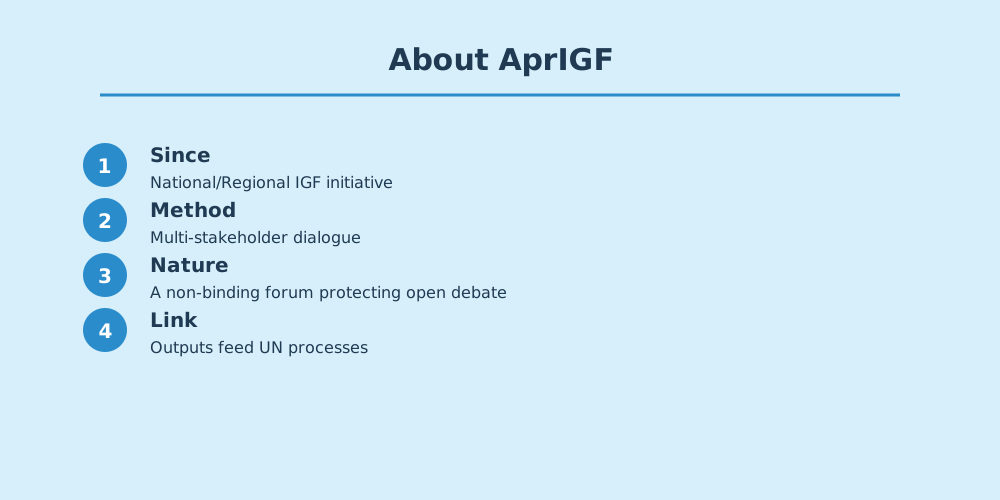
AprIGF is a National or Regional IGF Initiative (NRI), aligning local internet governance discussion with global IGF principles.
Why It Matters to You
What was discussed here becomes the baseline for national digital policy, platform rules and AI regulation worldwide within a few years. The principles confirmed at the 2014 meeting are the foundation of the "next rules" for the phones, social platforms and AI services you use every day.
Sources & References
- APrIGF Delhi 2014 Summary Report(大会報告書) — APrIGF事務局(DotAsia)・ISPAI (accessed 2026-07-10)
- Event Wrap: APrIGF Delhi 2014 — APNIC Blog (accessed 2026-07-10)
- Asia Pacific Regional Internet Governance Forum (APrIGF)(イベント紹介) — APC (accessed 2026-07-10)
- APrIGF 公式サイト(過去大会アーカイブ) — APrIGF (accessed 2026-07-10)
Quotes are translated or condensed from the records listed above. Bracketed numbers [n] refer to the source list.
Related links
- IGF official (NRI list): https://www.intgovforum.org/en/content/national-and-regional-igf-initiatives
- Japan IGF: https://japanigf.jp/
- Yuki Nakazawa's blog: https://nkzw.jp/category/igf/
Revision History
Rev. 1 — published 4 July 2014, 09:00 (Article published)
Rev. 2 — updated 10 July 2026, 23:16 (Fully revised into the in-depth edition: added the 3-line summary, minutes digest, short talk, source list and diagrams (all quotes verified against the listed sources))
— 中澤祐樹