


The 3-Line Summary
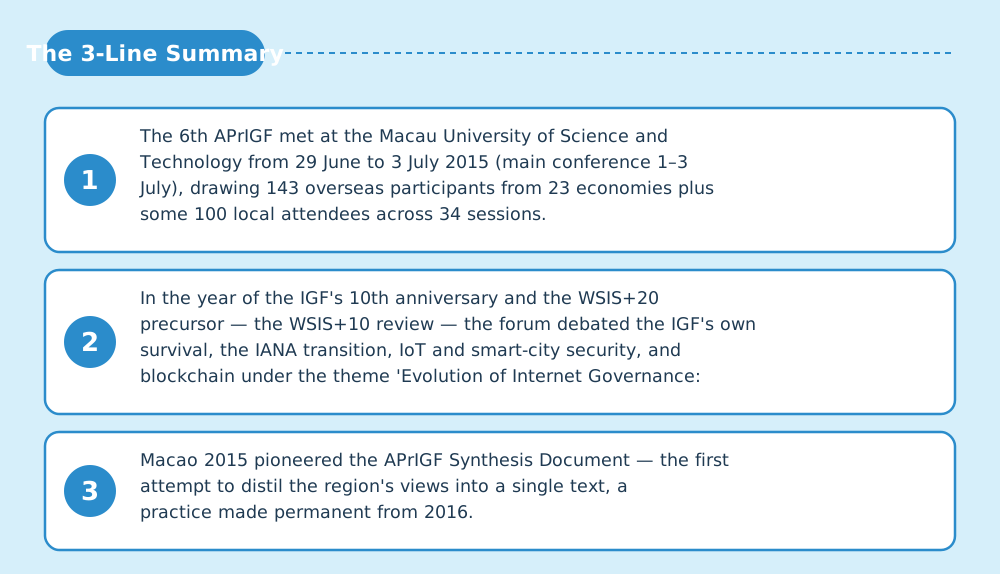
- The 6th APrIGF met at the Macau University of Science and Technology from 29 June to 3 July 2015 (main conference 1–3 July), drawing 143 overseas participants from 23 economies plus some 100 local attendees across 34 sessions.
- In the year of the IGF's 10th anniversary and the WSIS+20 precursor — the WSIS+10 review — the forum debated the IGF's own survival, the IANA transition, IoT and smart-city security, and blockchain under the theme 'Evolution of Internet Governance: Empowering Sustainable Development'.
- Macao 2015 pioneered the APrIGF Synthesis Document — the first attempt to distil the region's views into a single text, a practice made permanent from 2016.
Welcome — this is the Japan IGF Support Organization. This in-depth report on AprIGF 2015 in Macau draws on official outputs, session records and on-site reporting. In a hurry? The three lines above and the diagrams carry the gist.
Conference at a Glance (from official records)
| Item | Detail |
|---|---|
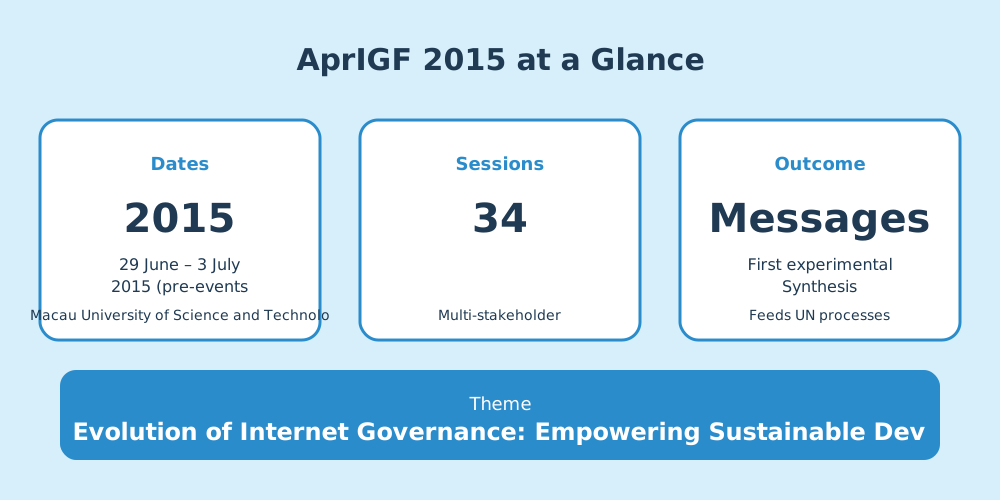
| Edition | 6th APrIGF; first held in Macao |
| Dates | 29 June – 3 July 2015 (pre-events 29–30 June; main conference 1–3 July) |
| Venue | Macau University of Science and Technology, Macao |
| Theme | Evolution of Internet Governance: Empowering Sustainable Development |
| Sessions | 34 |
| Participation detail | 143 overseas participants from 23 countries and districts, plus around 100 local (Macao) participants; 24 government representatives from 10 countries |
| Host | Hosted by HNET Asia Limited (operator of MONIC, the .mo registry), co-hosted by the E-Commerce Association of Macau; APrIGF secretariat: DotAsia; supported by Macao's telecoms regulator (DSRT), tourism office and trade-promotion agency (IPIM) |
| Outcome | First experimental Synthesis Document; finalised on 18 August 2015 after on-site input and two public comment rounds, becoming an integral part of APrIGF from 2016 |
(See the source list at the end of this article.)
Discussion Digest — from the Session Records
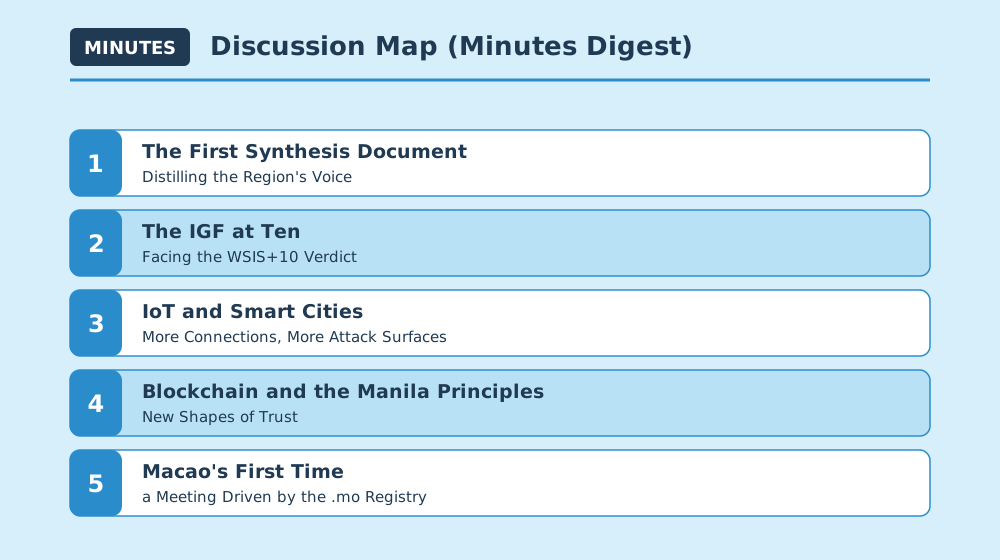
Key exchanges extracted from session records and transcripts.
1. The First Synthesis Document — Distilling the Region's Voice
Sessions: A meeting-wide experiment, with on-site and remote input plus two public comment rounds
- The first Synthesis Document set out to record items of common regional interest; after on-site and remote comments and two public comment periods, the final text was released on 18 August 2015 [1][3][4]
- The experiment became an integral part of APrIGF programming from 2016, giving the region a written channel into the global IGF and WSIS review processes [1][3][4]
2. The IGF at Ten — Facing the WSIS+10 Verdict
Sessions: MSG chair's message and the workshop 'From Periphery to Core: Towards an Asia-Pacific Agenda for the WSIS+10 Review'
"In that 10 years, the Internet itself has grown from 1 billion users to over 3 billion today; it has grown from being a 'fact of life' in 2005, to a 'necessity of life' in 2015, for nearly 50% of the world's population"
— Paul Wilson (Director General of APNIC; MSG Chair — welcome message in the conference report) [1]
"It would be a huge shame, 10 years after the recognition of Internet Governance as a multistakeholder process, for a closed process to determine its fate or to reshape its form"
— Paul Wilson (ibid.) [1]
- With the UN General Assembly due to decide the IGF's mandate at the end of 2015, reaffirming the forum's value was an explicit goal of the meeting [1]
- The 'From Periphery to Core' workshop worked on a distinctly Asia-Pacific agenda for the WSIS+10 review [1]
3. IoT and Smart Cities — More Connections, More Attack Surfaces
Sessions: Cybersecurity & Trust track: 'Information Security and Privacy in the IoT Era', 'Smart Cities in Asia and the Deployment of Big Data', and more
- Sessions warned that IoT devices built for functionality rather than security create sprawling attack surfaces — from heart monitors to a city's electrical systems — and can be conscripted into botnets [1]
- On smart cities, panellists asked what the sensors actually collect, whether the data is anonymised and securely stored, and whether citizens can opt out of being tracked [1]
- Active surveillance was documented too: legislative creep towards mass surveillance in Pakistan and commercial spyware being sold across the region [1]
4. Blockchain and the Manila Principles — New Shapes of Trust
Sessions: Internet economy track: 'Building an Internet for Trust on a Trustless Internet' and 'The Manila Principles on Intermediary Liability'
- Panels framed blockchain as an accounting revolution and smart contracts atop it as a trust revolution — a shift from state-backed centralised trust to decentralised trust, with potential to interconnect 25 Asian markets [1]
- The freshly launched Manila Principles on intermediary liability were presented — designed, panellists stressed, to protect end users' free expression rather than the intermediaries themselves — drawing on cases from Korea, India, Hong Kong and China [1]
5. Macao's First Time — a Meeting Driven by the .mo Registry
Sessions: Opening ceremony (1 July, 11:00, N Hall, Macau University of Science and Technology) and closing
- HNET Asia, operator of the .mo registry MONIC, hosted with backing from Macao's telecoms regulator, tourism office and trade-promotion agency; Bangladesh's information minister Hasanul Haq Inu and Thailand's ICANN GAC vice-chair Wanawit Akhuputra spoke at the opening [1][5]
- Local outlets such as Macao Daily News covered the forum, which ran back-to-back with the CommuniMacao expo — a whole-territory effort by the small SAR [1][5]
Three-Minute Short Talk — Your Questions Answered
Q. What was new this time?
A. The Synthesis Document — a first attempt to distil the whole meeting into one written statement of regional views. After public comment it was finalised that August, and it became a permanent APrIGF fixture from 2016.
Q. What was the biggest worry?
A. The IGF's own survival. The UN's WSIS+10 review would decide its mandate at year's end, and the forum urged that no closed process should determine its fate. The mandate was ultimately renewed for ten years.
Q. Why should I care?
A. The IoT and smart-city warnings sounded here — insecure devices, botnets, sensors tracking citizens — read like a preview of today's connected-device rules, and the Manila Principles still anchor debates on platform takedowns and free expression.
What Is AprIGF? (for first-time readers)
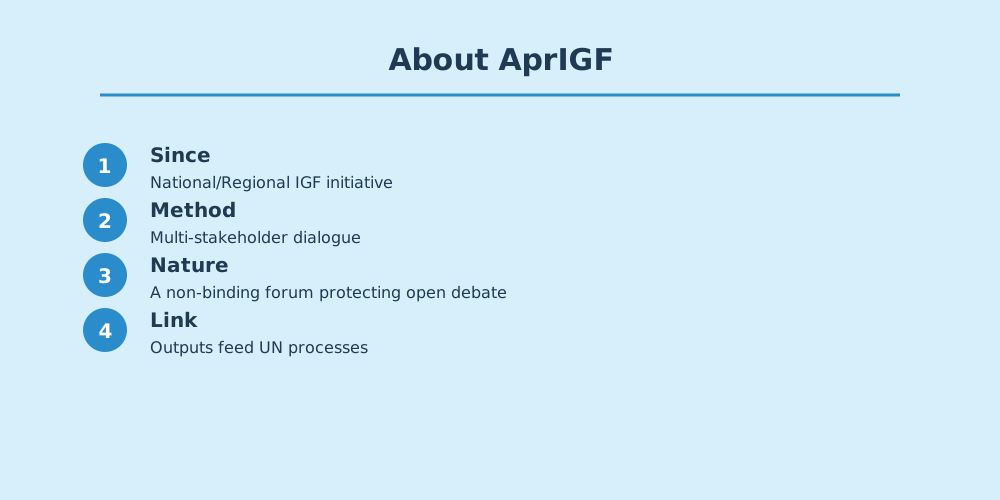
AprIGF is a National or Regional IGF Initiative (NRI), aligning local internet governance discussion with global IGF principles.
Why It Matters to You
What was discussed here becomes the baseline for national digital policy, platform rules and AI regulation worldwide within a few years. The principles confirmed at the 2015 meeting are the foundation of the "next rules" for the phones, social platforms and AI services you use every day.
Sources & References
- Conference Report — APrIGF Macao 2015(大会報告書) — APrIGF事務局(DotAsia)・HNET Asia (accessed 2026-07-10)
- APrIGF 公式サイト(過去大会アーカイブ) — APrIGF (accessed 2026-07-10)
- Final Synthesis Document is Out!(最終統合文書の公開告知、2015年8月18日) — APrIGF (accessed 2026-07-10)
- 2019 APrIGF Synthesis Document Process Announcement(統合文書が2015年に始まった経緯に言及) — APrIGF (accessed 2026-07-10)
- Call for Workshop Proposals — APrIGF 2015 Macau(開催決定告知) — APrIGF (accessed 2026-07-10)
Quotes are translated or condensed from the records listed above. Bracketed numbers [n] refer to the source list.
Related links
- IGF official (NRI list): https://www.intgovforum.org/en/content/national-and-regional-igf-initiatives
- Japan IGF: https://japanigf.jp/
- Yuki Nakazawa's blog: https://nkzw.jp/category/igf/
Revision History
Rev. 1 — published 30 June 2015, 09:00 (Article published)
Rev. 2 — updated 10 July 2026, 23:16 (Fully revised into the in-depth edition: added the 3-line summary, minutes digest, short talk, source list and diagrams (all quotes verified against the listed sources))
— 中澤祐樹

