


The 3-Line Summary
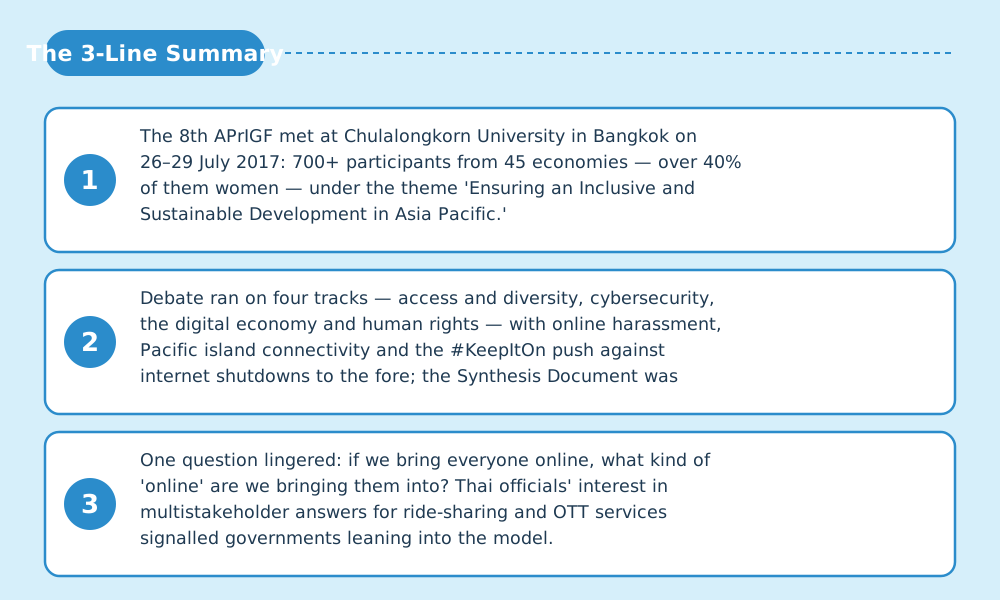
- The 8th APrIGF met at Chulalongkorn University in Bangkok on 26–29 July 2017: 700+ participants from 45 economies — over 40% of them women — under the theme 'Ensuring an Inclusive and Sustainable Development in Asia Pacific.'
- Debate ran on four tracks — access and diversity, cybersecurity, the digital economy and human rights — with online harassment, Pacific island connectivity and the #KeepItOn push against internet shutdowns to the fore; the Synthesis Document was finalised that December.
- One question lingered: if we bring everyone online, what kind of 'online' are we bringing them into? Thai officials' interest in multistakeholder answers for ride-sharing and OTT services signalled governments leaning into the model.
Welcome — this is the Japan IGF Support Organization. This in-depth report on AprIGF 2017 in Bangkok draws on official outputs, session records and on-site reporting. In a hurry? The three lines above and the diagrams carry the gist.
Conference at a Glance (from official records)
| Item | Detail |
|---|---|
| Edition | Eighth APrIGF, comprising pre-event meetings, the main conference and the Youth IGF (yIGF) |
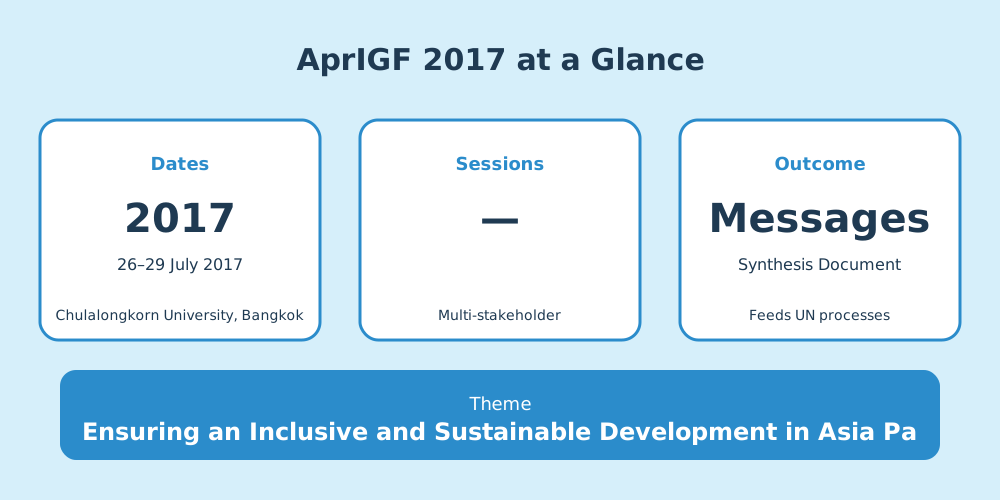
| Dates | 26–29 July 2017 |
| Venue | Chulalongkorn University, Bangkok |
| Theme | Ensuring an Inclusive and Sustainable Development in Asia Pacific: A Regional Agenda for Internet Governance |
| Leadership | Paul Wilson (APNIC) handed the MSG chairmanship to Rajnesh Singh (ISOC Asia-Pacific Regional Bureau Director) |
| Host | Co-hosted by Chulalongkorn University and Thailand's National Broadcasting and Telecommunications Commission (NBTC) |
| Outcome | Synthesis Document (finalised 6 December 2017), developed through two webinars and two public comment periods |
(See the source list at the end of this article.)
Discussion Digest — from the Session Records
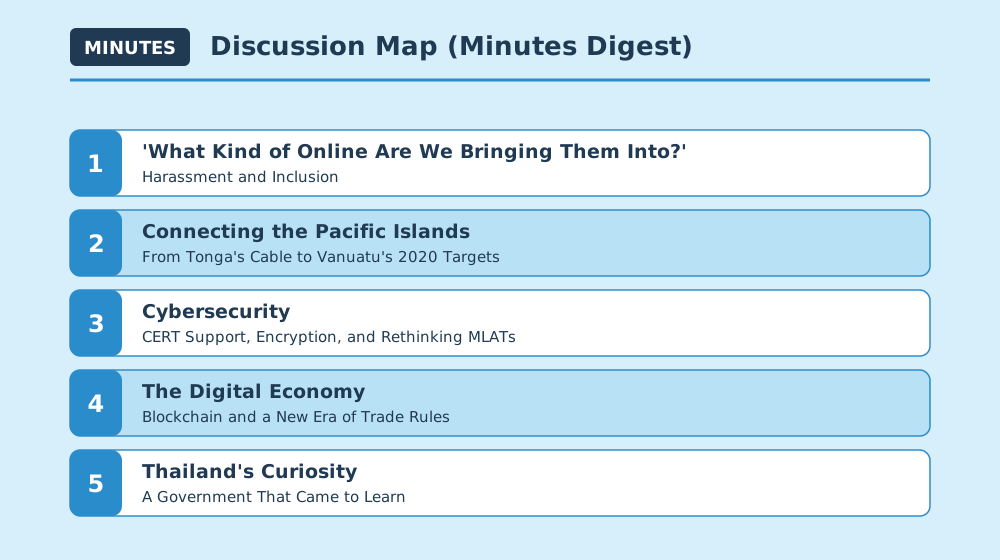
Key exchanges extracted from session records and transcripts.
1. 'What Kind of Online Are We Bringing Them Into?' — Harassment and Inclusion
Sessions: Content moderation and online harassment sessions (Merger 2 and others, as recorded on the APNIC Blog)
"If we want to bring everyone online, what kind of 'online' are we bringing them into"
— Mal Jayaram [2][1]
- Beyond counting new users, the meeting asked about the quality of the online space awaiting them — one free of harassment [2][1]
- The Synthesis Document stated that online gender-based violence acts as a barrier to access and worsens the gender digital gap, recommending redress mechanisms and legislative responses [2][1]
- Sessions dug into surveillance from a feminist perspective (WS.63) and the digital gap for disenfranchised communities (WS.4) [2][1]
2. Connecting the Pacific Islands — From Tonga's Cable to Vanuatu's 2020 Targets
Sessions: Connectivity sessions (as recorded on the APNIC Blog)
- Concrete Pacific initiatives were tabled: Tonga's fibre backbone, Vanuatu's 2020 connectivity targets and Fiji's cost-reduction project [2][1]
- The Synthesis Document recorded rapid disaster reconnection (RREACT), community networks and public access as last-mile answers for landlocked and small-island states [2][1]
- Engagement with the #KeepItOn movement against internet shutdowns reaffirmed the ICCPR tests of legality, necessity and proportionality [2][1]
3. Cybersecurity — CERT Support, Encryption, and Rethinking MLATs
Sessions: Security workshops (WS.25, WS.29, WS.83, WS.98 and others)
- The forum ran capacity building for national CERTs, including a cyber-incident role-play exercise [1][3]
- Encryption protections were noted to expire as technology advances — regulation should be future-proofed — and IoT makers should be responsible for securing devices for a reasonable period [1][3]
- Cross-border data sharing under MLATs was to be re-examined against tests of legality, legitimacy and proportionality, with oversight and transparency [1][3]
4. The Digital Economy — Blockchain and a New Era of Trade Rules
Sessions: WS.81 on blockchain and Merger 4 'Trade Rules for the Digital Economy: Asia's Agreements at the WTO and RCEP'
- Disruptive innovations like blockchain were weighed as forces that could redesign business, politics and society — and possibly decentralise internet governance itself [1]
- Using WTO and RCEP e-commerce rules as the canvas, the forum kept pushing back on data-localisation and source-code disclosure mandates absent legitimate public-policy grounds [1]
- Trust was declared a precondition of the digital economy, putting interoperable online authentication and identification on the agenda [1]
5. Thailand's Curiosity — A Government That Came to Learn
Sessions: Across the meeting (APNIC Blog) and the MSG chair handover at its close
- Thai government co-hosts came asking how multistakeholder approaches could govern emerging service categories like ride-sharing and OTT platforms [2][3][4]
- The co-hosting arrangement — a national university (Chulalongkorn) plus the regulator (NBTC) — was itself a model of academia-government-community collaboration [2][3][4]
- The meeting closed with Paul Wilson handing the MSG chairmanship to Rajnesh Singh, marking the end of an era [2][3][4]
Three-Minute Short Talk — Your Questions Answered
Q. So what did the conference actually decide?
A. It's a dialogue forum, not a decision body — but the discussions were distilled into a Synthesis Document in December 2017 and carried the region's voice into the global IGF and national policy debates.
Q. What was the most memorable thread?
A. The question 'if we bring everyone online, what kind of online are we bringing them into?' — a shift from counting connections to caring about the safety and quality of the space. Over 40% of attendees were women, itself a statement.
Q. Why should I care?
A. Topics rehearsed here — IoT security liability, cross-border data rules, platform responsibility for harassment — became mainstream regulation across Asia Pacific in the years that followed.
What Is AprIGF? (for first-time readers)
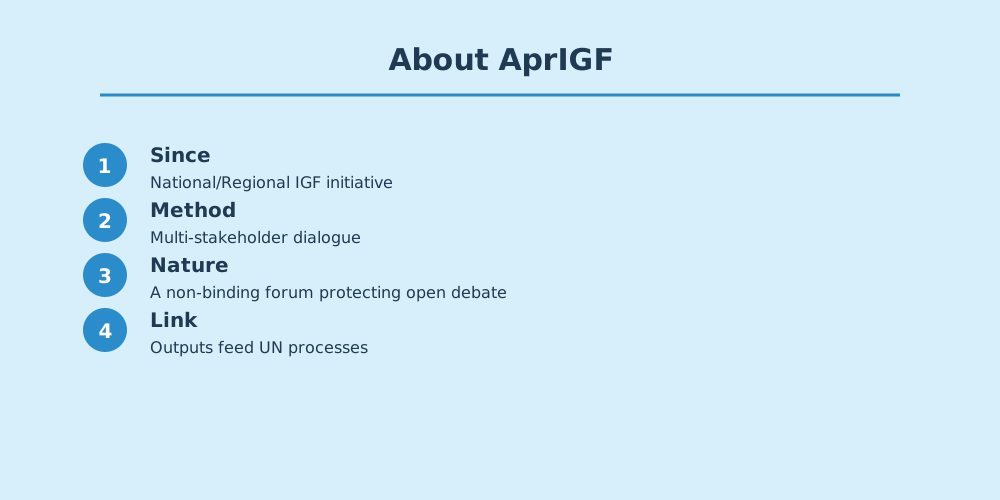
AprIGF is a National or Regional IGF Initiative (NRI), aligning local internet governance discussion with global IGF principles.
Why It Matters to You
What was discussed here becomes the baseline for national digital policy, platform rules and AI regulation worldwide within a few years. The principles confirmed at the 2017 meeting are the foundation of the "next rules" for the phones, social platforms and AI services you use every day.
Sources & References
- APrIGF 2017 Bangkok Synthesis Document FINAL (PDF) — APrIGF Secretariat (accessed 2026-07-10)
- APrIGF 2017: A regional agenda for Internet governance(奥谷泉・寄稿) — APNIC Blog (accessed 2026-07-10)
- Event Wrap: APrIGF 2017, Bangkok — APNIC Blog (accessed 2026-07-10)
- APrIGF 2017 — DiploFoundation (accessed 2026-07-10)
- APrIGF 2017 Bangkok Synthesis Document(公式サイトアーカイブ) — APrIGF 2017 Bangkok 公式サイト (accessed 2026-07-10)
Quotes are translated or condensed from the records listed above. Bracketed numbers [n] refer to the source list.
Related links
- IGF official (NRI list): https://www.intgovforum.org/en/content/national-and-regional-igf-initiatives
- Japan IGF: https://japanigf.jp/
- Yuki Nakazawa's blog: https://nkzw.jp/category/igf/
Revision History
Rev. 1 — published 26 July 2017, 09:00 (Article published)
Rev. 2 — updated 10 July 2026, 23:16 (Fully revised into the in-depth edition: added the 3-line summary, minutes digest, short talk, source list and diagrams (all quotes verified against the listed sources))
— 中澤祐樹

