


The 3-Line Summary
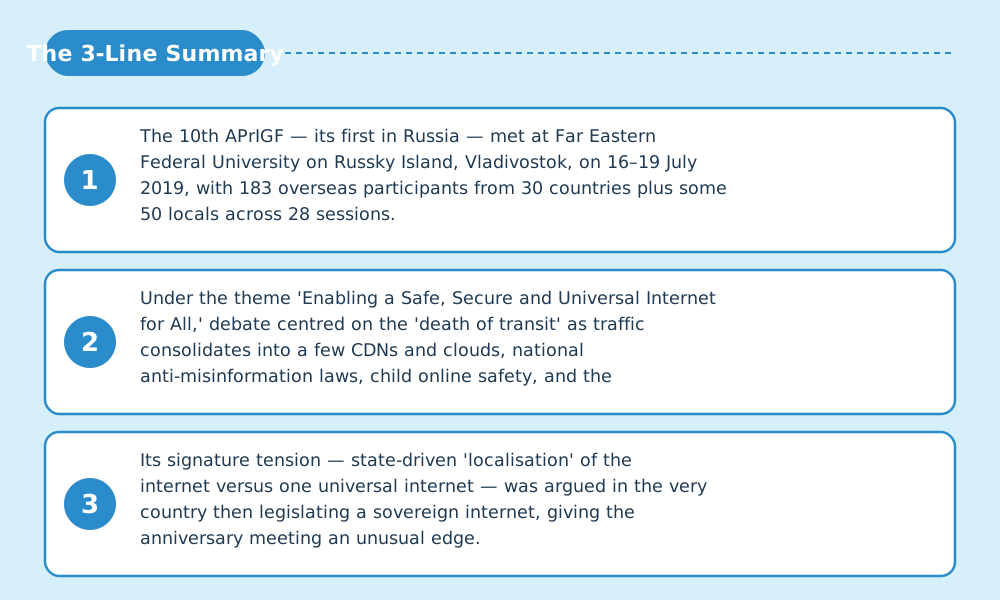
- The 10th APrIGF — its first in Russia — met at Far Eastern Federal University on Russky Island, Vladivostok, on 16–19 July 2019, with 183 overseas participants from 30 countries plus some 50 locals across 28 sessions.
- Under the theme 'Enabling a Safe, Secure and Universal Internet for All,' debate centred on the 'death of transit' as traffic consolidates into a few CDNs and clouds, national anti-misinformation laws, child online safety, and the governance of crypto assets.
- Its signature tension — state-driven 'localisation' of the internet versus one universal internet — was argued in the very country then legislating a sovereign internet, giving the anniversary meeting an unusual edge.
Welcome — this is the Japan IGF Support Organization. This in-depth report on AprIGF 2019 in Vladivostok draws on official outputs, session records and on-site reporting. In a hurry? The three lines above and the diagrams carry the gist.
Conference at a Glance (from official records)
| Item | Detail |
|---|---|
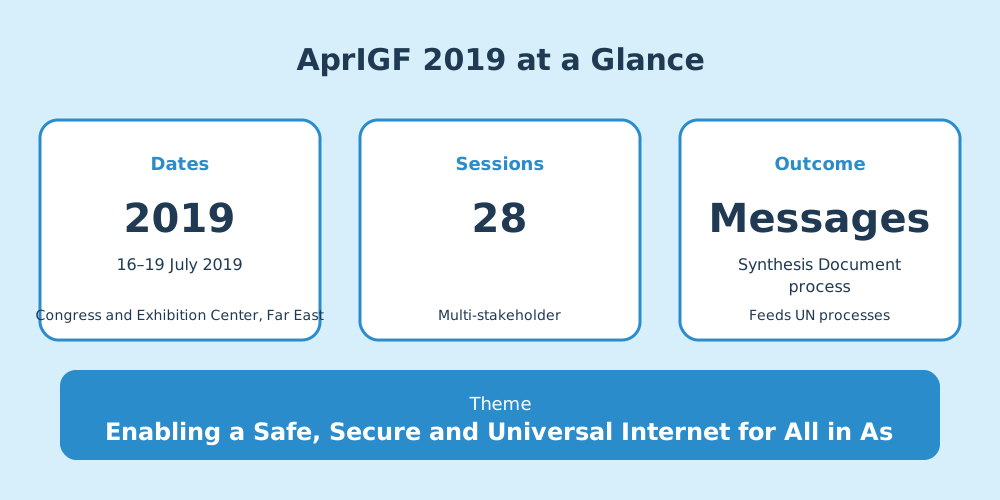
| Edition | Tenth APrIGF, marking the forum's 10th anniversary — its first time in Russia, coinciding with the 25th anniversary of the .RU ccTLD |
| Dates | 16–19 July 2019 (16 July was the pre-event day; the main conference ran 17–19 July) |
| Venue | Congress and Exhibition Center, Far Eastern Federal University (FEFU), Russky Island, Vladivostok |
| Theme | Enabling a Safe, Secure and Universal Internet for All in Asia Pacific |
| Sessions | 28 |
| Sub-themes | Six sub-themes: Safer Internet, Cybersecurity & Regulation; Access & Universality; Emerging Technologies & Society; Human Rights Online; Evolving Role of Internet Governance & Multistakeholder Participation; Digital Economy |
| Opening | Opening speakers included Andrei Vorobyov (CEO, Coordination Center), Sergei Maksimchuk (Vice-Governor, Far East region), Hasanul Haq Inu MP (Bangladesh, former Information Minister), Rajnesh Singh (MSG Chair), Victoria Panova (FEFU Vice President), Vladimir Solodov (Prime Minister of the Republic of Sakha), Chengetai Masango (UN IGF Secretariat), Elena Voronina (CEO, MSK-IX) and Edmon Chung (CEO, DotAsia) |
| Host | Hosted by the Coordination Center for TLD .RU/.РФ (the Russian registry), co-hosted by FEFU, with DotAsia as secretariat and support from ICANN, APNIC, ISOC, the global IGF Secretariat and the Office of the Governor of Russia's Far East region |
| Outcome | Synthesis Document process (framework document open for public input 16–31 July, with townhall sessions during the meeting) |
(See the source list at the end of this article.)
Discussion Digest — from the Session Records
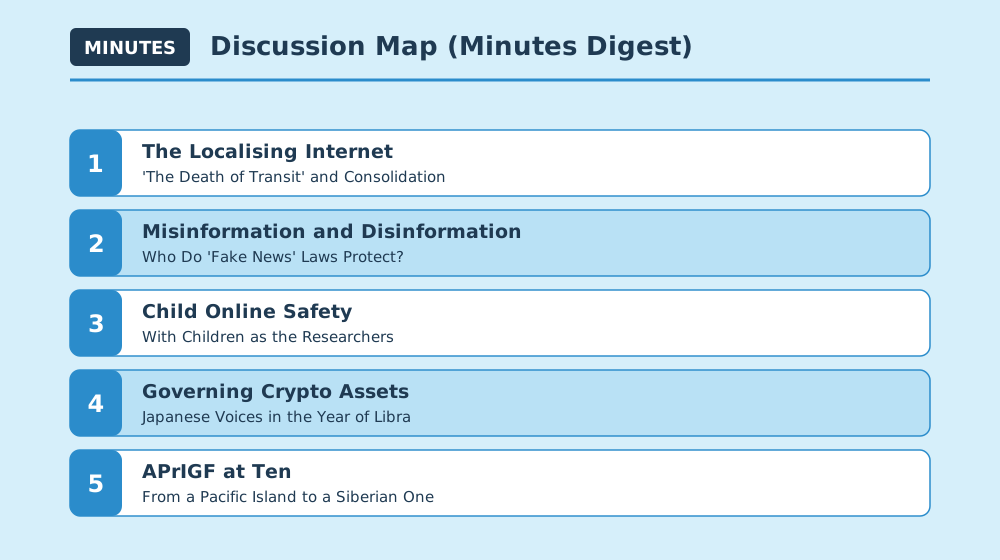
Key exchanges extracted from session records and transcripts.
1. The Localising Internet — 'The Death of Transit' and Consolidation
Sessions: Workshop 'Localized Internet: two sides of a coin' (organised by APNIC)
- Aggregating local traffic at IXPs to cut upstream costs was framed as one side of the coin — the classic recipe for internet development [1][2]
- Geoff Huston (APNIC) presented data showing transit traffic flat-lining even as the internet grows, arguing in line with his essay 'The Death of Transit' that content now flows from a handful of CDNs and cloud providers — consolidation as the coin's other side [1][2]
- Security concerns at the national level and market concentration emerged as twin forces localising the internet — a debate sharpened by the Russian setting [1][2]
2. Misinformation and Disinformation — Who Do 'Fake News' Laws Protect?
Sessions: Workshop 'Coping with misinformation in an era of information deluge: Who is Responsible?'
- India's Amrita Choudhury described lynchings triggered by rumours on messaging apps, and the fact-checking and intermediary-liability reforms debated around the 2019 general election [1]
- Nadira Al Araj noted a post-Arab Spring trend of governments branding dissent 'fake news' without evidence, citing Egypt's fake-news law criticised by human-rights activists [1]
- Rajnesh Singh outlined Australia's violent-content law and Singapore's new act, warning against content blocking, internet shutdowns and poorly thought-out rules [1]
3. Child Online Safety — With Children as the Researchers
Sessions: 'Child research on promoting safer Internet from children's perspective' and 'Protection of Child Online'
- In a novel session, children presented their own statistical research on online-gaming friendships, online learning and negotiating with parents — with a TikTok manager responding [1]
- Valentina Picco of the UK's Internet Watch Foundation explained its child-abuse-content reporting platform, alongside Nepal's experience running a child-safety portal [1]
- Rajesh Charia, president of India's ISP association, said industry follows regulators' orders rather than blocking proactively, describing India's 'green internet' practice of child-friendly content [1]
4. Governing Crypto Assets — Japanese Voices in the Year of Libra
Sessions: Workshop 'Can we apply the multi-stakeholder approach for governance of crypto assets?'
- Two Mercari engineers from Japan, Mariko Kobayashi and Hirotaka Nakajima, introduced blockchain fundamentals and dissected APAC exchange-security incidents, from phishing to hot-wallet vulnerabilities [1]
- A Japanese regulatory perspective set out three goals — financial stability, investor protection, preventing financial crime — alongside G20 outcomes and the lack of harmonisation among stakeholders [1]
- Satish Babu argued that crypto policy is made by a few designers, with no IETF-style rough consensus or bottom-up process — and concerns were aired over Facebook's newly announced Libra [1]
5. APrIGF at Ten — From a Pacific Island to a Siberian One
Sessions: Opening ceremony (17 July) and 'Is e-Government an effective mechanism for developing economies'
- The meeting marked both APrIGF's 10th anniversary and the .RU domain's 25th, with the Far East region's vice-governor, the Prime Minister of Sakha, and the UN IGF Secretariat's Chengetai Masango among opening speakers [1][3][4]
- Following up Vanuatu's 2018 e-government session, Fiji's new Singapore-supported e-government portal was showcased, and Masango and PICISOC's Anju Mangal weighed e-government's promise for climate-threatened small island states like Kiribati [1][3][4]
- ISOC, APNIC and the Coordination Center sponsored 20 fellows, carrying Pacific island voices to the far edge of Siberia [1][3][4]
Three-Minute Short Talk — Your Questions Answered
Q. So what did the conference actually decide?
A. It's a dialogue forum, not a decision body — the 10th-anniversary edition fed its discussions into the Synthesis Document process and onward to the global IGF.
Q. What made the Russian edition special?
A. The tension between one universal internet and state-driven localisation was debated in the very country then building its 'sovereign internet' — and Geoff Huston's 'death of transit' data showed market forces localising the net too.
Q. Why should I care?
A. Consolidation into a few clouds and CDNs, fake-news laws that can silence dissent, crypto governance in the year of Libra — the fault lines mapped in Vladivostok now run through every country's digital policy.
What Is AprIGF? (for first-time readers)
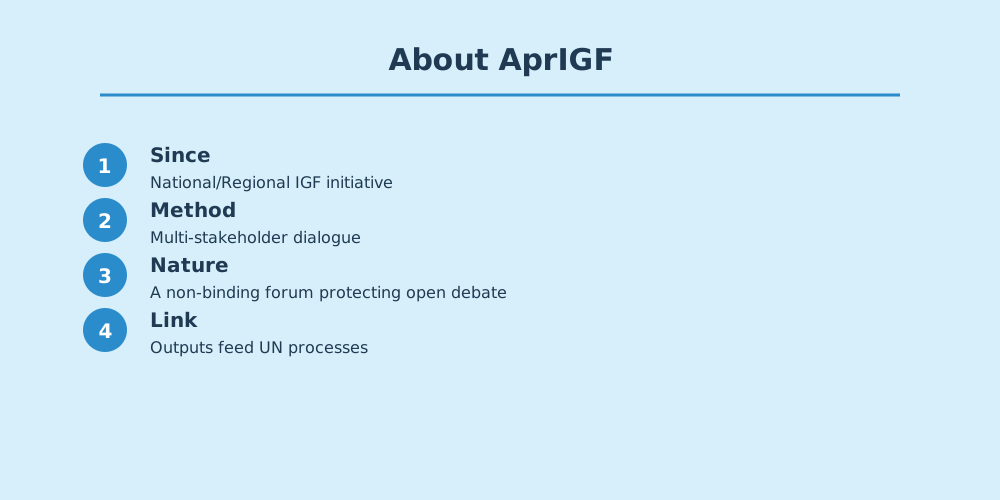
AprIGF is a National or Regional IGF Initiative (NRI), aligning local internet governance discussion with global IGF principles.
Why It Matters to You
What was discussed here becomes the baseline for national digital policy, platform rules and AI regulation worldwide within a few years. The principles confirmed at the 2019 meeting are the foundation of the "next rules" for the phones, social platforms and AI services you use every day.
Sources & References
- Conference Report: APrIGF Vladivostok 2019 (PDF) — Coordination Center for TLD .RU/.РФ / APrIGF Secretariat (accessed 2026-07-10)
- Event Wrap: APrIGF 2019 — APNIC Blog (accessed 2026-07-10)
- MSK-IX Director General Yelena Voronina to speak at APrIGF 2019 opening ceremony — MSK-IX(モスクワ・インターネットエクスチェンジ) (accessed 2026-07-10)
- 10th Asia Pacific Regional Internet Governance Forum — DiploFoundation (accessed 2026-07-10)
- 2019 APrIGF Synthesis Document Process Announcement — APrIGF Secretariat (accessed 2026-07-10)
Quotes are translated or condensed from the records listed above. Bracketed numbers [n] refer to the source list.
Related links
- IGF official (NRI list): https://www.intgovforum.org/en/content/national-and-regional-igf-initiatives
- Japan IGF: https://japanigf.jp/
- Yuki Nakazawa's blog: https://nkzw.jp/category/igf/
Revision History
Rev. 1 — published 16 July 2019, 09:00 (Article published)
Rev. 2 — updated 10 July 2026, 23:16 (Fully revised into the in-depth edition: added the 3-line summary, minutes digest, short talk, source list and diagrams (all quotes verified against the listed sources))
— 中澤祐樹

