


The 3-Line Summary
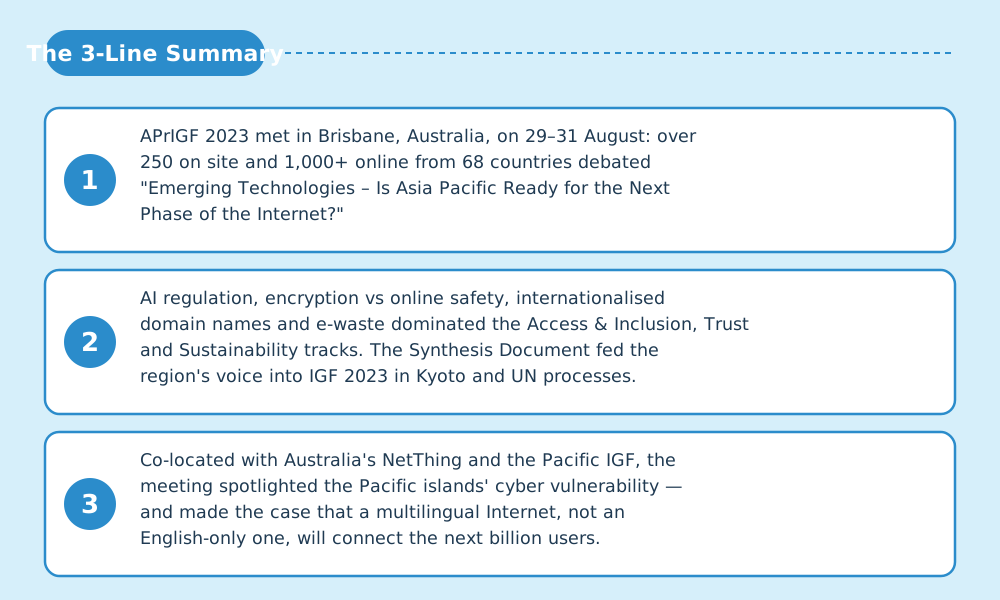
- APrIGF 2023 met in Brisbane, Australia, on 29–31 August: over 250 on site and 1,000+ online from 68 countries debated "Emerging Technologies – Is Asia Pacific Ready for the Next Phase of the Internet?"
- AI regulation, encryption vs online safety, internationalised domain names and e-waste dominated the Access & Inclusion, Trust and Sustainability tracks. The Synthesis Document fed the region's voice into IGF 2023 in Kyoto and UN processes.
- Co-located with Australia's NetThing and the Pacific IGF, the meeting spotlighted the Pacific islands' cyber vulnerability — and made the case that a multilingual Internet, not an English-only one, will connect the next billion users.
Welcome — this is the Japan IGF Support Organization. This in-depth report on AprIGF 2023 in Brisbane draws on official outputs, session records and on-site reporting. In a hurry? The three lines above and the diagrams carry the gist.
Conference at a Glance (from official records)
| Item | Detail |
|---|---|
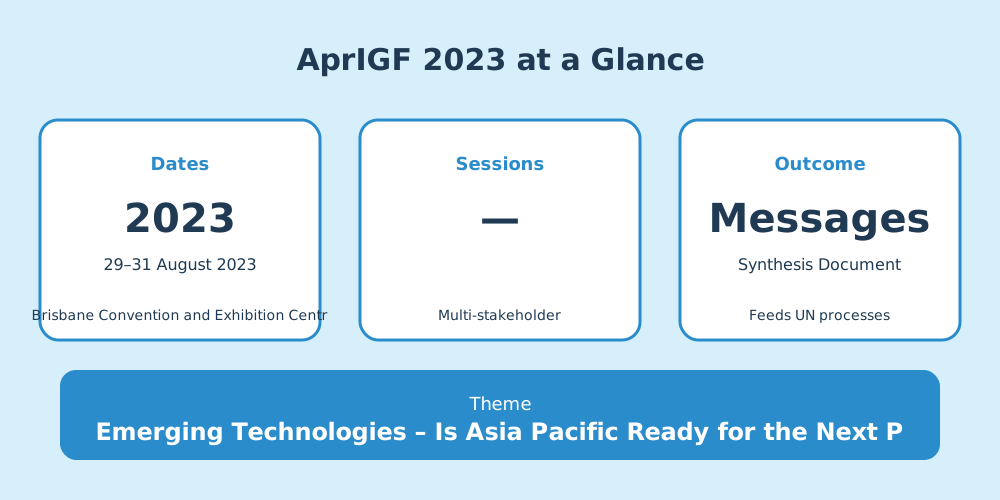
| Dates | 29–31 August 2023 |
| Venue | Brisbane Convention and Exhibition Centre, Brisbane, Australia (hybrid) |
| Theme | Emerging Technologies – Is Asia Pacific Ready for the Next Phase of the Internet? |
| Host | auDA (administrator of Australia's .au domain) |
| Outcome | Synthesis Document (published 6 October 2023; fed into IGF 2023 in Kyoto) |
(See the source list at the end of this article.)
Discussion Digest — from the Session Records
Key exchanges extracted from session records and transcripts.
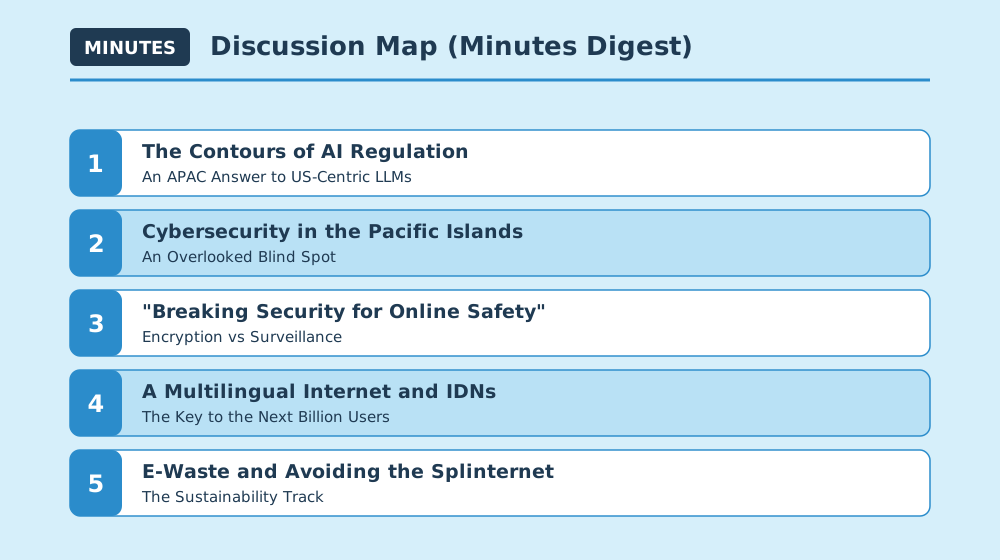
1. The Contours of AI Regulation — An APAC Answer to US-Centric LLMs
Sessions: Trust track, incl. "AI in Asia-Pacific: Charting a Path for Responsible Innovation"
"AI and other emerging technologies are rapidly transforming the way we live and work"
— Rosemary Sinclair AM (CEO, auDA) [1][3]
- With LLM development concentrated in the US, the region should become a developer of open-source LLMs, not just a consumer and data provider [1][3]
- Citing ASEAN's AI governance 'guardrails' code due in 2024, participants urged APAC economies to expedite their own AI frameworks [1][3]
- Safeguards were demanded against AI-driven disinformation and echo chambers — especially during elections — and against bias in AI models [1][3]
2. Cybersecurity in the Pacific Islands — An Overlooked Blind Spot
Sessions: "Stories from the Pacific – the human side of cyber incidents" and others, alongside PacIGF 2023
- Cyber incidents are spiking in Fiji and Tonga yet receive far less media attention than other regions; gaps in technical, policy and business responses must be closed [1][4]
- Tonga's CERT, established in 2016, covers the whole kingdom with minimal staff — its workforce programme with CERT New Zealand was showcased [1][4]
- Protecting connectivity was framed as protecting the Pacific's voice itself, which links distant islands and amplifies the region in the climate fight [1][4]
3. "Breaking Security for Online Safety" — Encryption vs Surveillance
Sessions: Trust track, "Breaking security for 'online safety': What's at stake for Asia-Pacific"
- Mandated encryption backdoors and communications surveillance undermine user privacy and platform trust, and hand governments tools to suppress dissent [1]
- Concrete APAC examples were debated: China's real-name registration regime and India's IT Act allowing warrantless interception [1]
- Governments and law enforcement should invest in strong encryption and cybersecurity education instead of breaking security in the name of safety [1]
4. A Multilingual Internet and IDNs — The Key to the Next Billion Users
Sessions: Access & Inclusion track (IDN and Universal Acceptance sessions)
- For the unconnected who don't use English, language is the biggest barrier: internationalised domain names (IDNs) and Universal Acceptance were presented as the way to connect the next billion [1]
- IDNs also preserve culture — from the 100+ Aboriginal languages of Australia to Indonesia's many scripts — with voice-driven IDN use flagged as a next step [1]
- With online content still overwhelmingly English, participants warned that LLMs risk baking language bias into the AI era [1]
5. E-Waste and Avoiding the Splinternet — The Sustainability Track
Sessions: Sustainability track (e-waste, circular economy and Internet fragmentation sessions)
- 45% of the world's Internet users are under 25; tracing the material lifecycle of smartphones was proposed as education to cut e-waste and drive a circular economy [1]
- Data localisation, incompatible devices and geopolitical tension raise splinternet risks — participants reaffirmed 'One World, One Internet' [1]
- The sustainability of the multistakeholder model itself — how to re-gather global support for it — was posed as an open question [1]
Three-Minute Short Talk — Your Questions Answered
Q. So what did the conference actually decide?
A. Nothing binding — it's the Asia-Pacific edition of the IGF, where governments, business, civil society and technologists talk as equals. The discussions were distilled into a Synthesis Document that carried the region's voice into the global IGF in Kyoto two months later and into UN processes.
Q. What was the most contentious topic?
A. Whether encryption may be weakened in the name of 'online safety.' Government arguments for backdoors and surveillance collided head-on with privacy and trust — and the forum's advice was blunt: don't break security to achieve safety.
Q. Why should I care?
A. Because the trade-offs debated here — encryption backdoors, AI bias, who builds the LLMs — are the same ones now landing in national legislation everywhere, and the multilingual-Internet agenda decides who the next billion users will be.
What Is AprIGF? (for first-time readers)
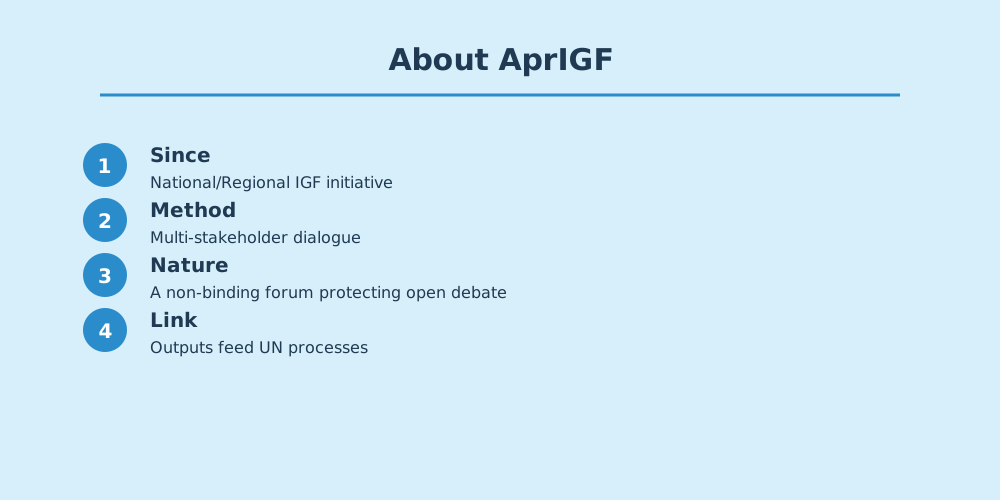
AprIGF is a National or Regional IGF Initiative (NRI), aligning local internet governance discussion with global IGF principles.
Why It Matters to You
What was discussed here becomes the baseline for national digital policy, platform rules and AI regulation worldwide within a few years. The principles confirmed at the 2023 meeting are the foundation of the "next rules" for the phones, social platforms and AI services you use every day.
Sources & References
- Synthesis Document — Asia Pacific Regional Internet Governance Forum Brisbane 2023 (PDF) — APrIGF Secretariat (accessed 2026-07-10)
- APrIGF 2023: Asia Pacific and the next phase of the internet — auDA(ホスト・豪州.au管理団体) (accessed 2026-07-10)
- AI and emerging tech headline regional internet governance forum — auDA (accessed 2026-07-10)
- Event Wrap: APrIGF 2023, Net Thing 2023, and PacIGF 2023 — APNIC Blog (accessed 2026-07-10)
- The Asia Pacific Regional Internet Governance Forum Brisbane 2023 Synthesis Document is now published — APrIGF.Asia(公式サイト) (accessed 2026-07-10)
Quotes are translated or condensed from the records listed above. Bracketed numbers [n] refer to the source list.
Related links
- IGF official (NRI list): https://www.intgovforum.org/en/content/national-and-regional-igf-initiatives
- Japan IGF: https://japanigf.jp/
- Yuki Nakazawa's blog: https://nkzw.jp/category/igf/
Revision History
Rev. 1 — published 29 August 2023, 08:00 (Article published)
Rev. 2 — updated 10 July 2026, 14:28 (Fully revised into the in-depth edition: added the 3-line summary, minutes digest, short talk, source list and diagrams (all quotes verified against the listed sources))
— 中澤祐樹

