


The 3-Line Summary
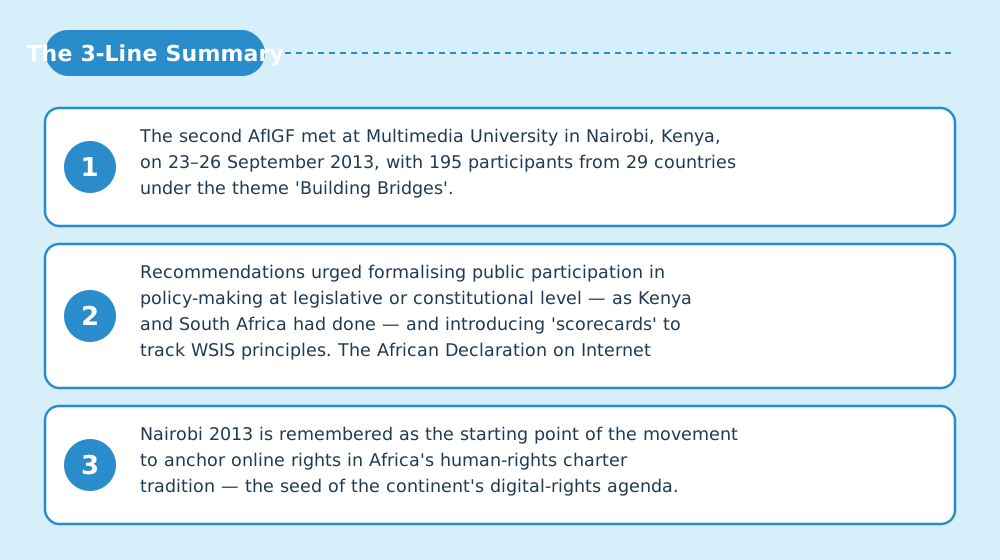
- The second AfIGF met at Multimedia University in Nairobi, Kenya, on 23–26 September 2013, with 195 participants from 29 countries under the theme 'Building Bridges'.
- Recommendations urged formalising public participation in policy-making at legislative or constitutional level — as Kenya and South Africa had done — and introducing 'scorecards' to track WSIS principles. The African Declaration on Internet Rights and Freedoms was agreed here.
- Nairobi 2013 is remembered as the starting point of the movement to anchor online rights in Africa's human-rights charter tradition — the seed of the continent's digital-rights agenda.
Welcome — this is the Japan IGF Support Organization. This in-depth report on AfIGF 2013 in Nairobi draws on official outputs, session records and on-site reporting. In a hurry? The three lines above and the diagrams carry the gist.
Conference at a Glance (from official records)
| Item | Detail |
|---|---|
| Edition | Second meeting |
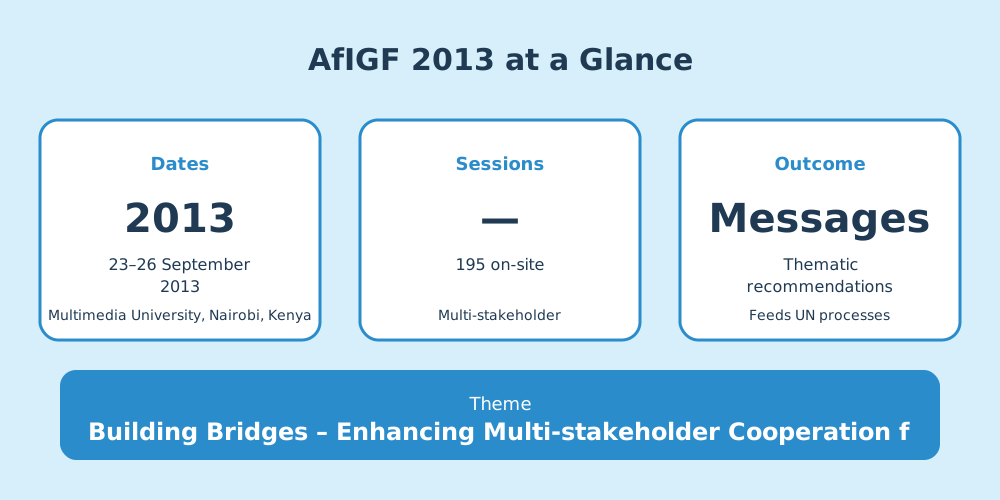
| Dates | 23–26 September 2013 (Pre-conference workshops on 23–24 September; the main forum opened on the afternoon of the 24th. English Wikipedia's '11–13 September' conflicts with the official report and UNECA (23–26, main sessions 24–26) and is incorrect) |
| Venue | Multimedia University, Nairobi, Kenya |
| Theme | Building Bridges – Enhancing Multi-stakeholder Cooperation for Growth and Sustainable Development |
| Participants | 195 |
| Participating countries | 29 |
| Host | Co-organised by the Government of Kenya (Ministry of Communication), the Communications Commission of Kenya, the African Union Commission, UNECA and TESPOK |
| Outcome | Thematic recommendations (institutionalising multi-stakeholder participation, WSIS scorecards). The African Declaration on Internet Rights and Freedoms was agreed at this meeting |
(See the source list at the end of this article.)
Discussion Digest — from the Session Records
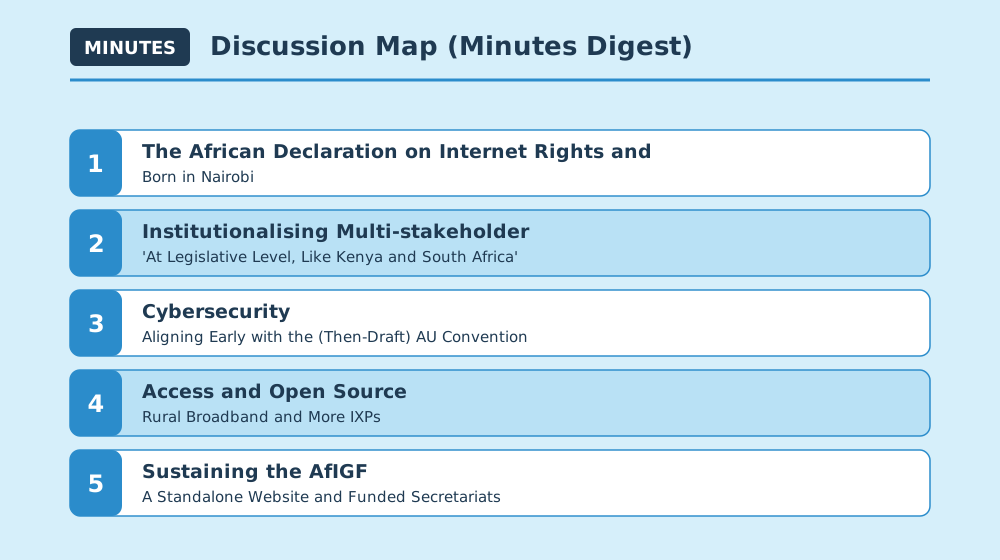
Key exchanges extracted from session records and transcripts.
1. The African Declaration on Internet Rights and Freedoms — Born in Nairobi
Sessions: Session on Openness: human rights, freedom of expression and free flow of information (26 September) and related discussions
- Participants called for protecting internet rights the way human rights have always been protected; the African Declaration on Internet Rights and Freedoms was agreed at this forum and launched at the 2014 global IGF in Istanbul [1][4]
- Recommendations included following up UN Human Rights Council resolutions, reinforcing press freedom, and embedding fundamental rights in national and regional internet policies [1][4]
2. Institutionalising Multi-stakeholder Participation — 'At Legislative Level, Like Kenya and South Africa'
Sessions: Session on IG principles and enhanced cooperation (24 September) and the APC pre-event
- Public participation in policy processes should be formalised at legislative or constitutional level, as in Kenya and South Africa [1][2]
- Participants recommended developing 'scorecards' to monitor governments' progress against WSIS participation principles [1][2]
- APC hosted a pre-event on 'building a roadmap for sustainable multi-stakeholder processes in Africa', aiming at guidelines for the AU Commission [1][2]
3. Cybersecurity — Aligning Early with the (Then-Draft) AU Convention
Sessions: Session on Security: legal and other frameworks — spam, hacking and cyber-crime (25 September)
- National and sub-regional policies should be harmonised with the African Union Cybersecurity Convention, then still a draft (later the Malabo Convention) [1]
- Recommendations covered national CERT ecosystems, capacity-building for legislators and law enforcement, and a common regional understanding of what constitutes cybercrime [1]
- Participants called for effective mechanisms and rapid intervention to protect children online [1]
4. Access and Open Source — Rural Broadband and More IXPs
Sessions: Sessions on access and diversity, and on infrastructure, knowledge management and African content (25–26 September)
- African governments were urged to adopt open-source solutions with clear policy support and political will [1]
- The forum encouraged establishing IXPs at national and regional levels and extending broadband to rural areas [1]
- Digital inclusion was framed as a development imperative — 'nations that are not technologically sovereign are not considered sovereign' in the current sense [1]
5. Sustaining the AfIGF — A Standalone Website and Funded Secretariats
Sessions: Recommendations on the sustainability of the AfIGF (closing, 26 September)
- Recommendations included a standalone AfIGF website and 'funded and functional' IGF secretariats at national, sub-regional and continental levels [1][3]
- Interpretation and remote participation were to become mandatory for all face-to-face AfIGFs, and the African School on Internet Governance (AfriSIG) reinforced [1][3]
- ICANN CEO Fadi Chehadé addressed the opening by video message; ICANN, OIF, ISOC, Google and AFRINIC were among the supporters [1][3]
Three-Minute Short Talk — Your Questions Answered
Q. What did this meeting decide?
A. Nothing binding — but it issued recommendations to governments, business and civil society: formalise public participation in law, build 'scorecards' to track WSIS principles, and more. The African Declaration on Internet Rights and Freedoms was also agreed here.
Q. What's the highlight?
A. The idea that online rights deserve the same protection as human rights took regional shape here — the starting point of the Declaration launched at the 2014 global IGF in Istanbul.
Q. Why should I care?
A. Anchoring digital rights in a regional human-rights system became a reference model for internet bills of rights elsewhere, and the scorecard idea is a useful benchmark for anyone assessing how open their own country's policy-making really is.
What Is AfIGF? (for first-time readers)
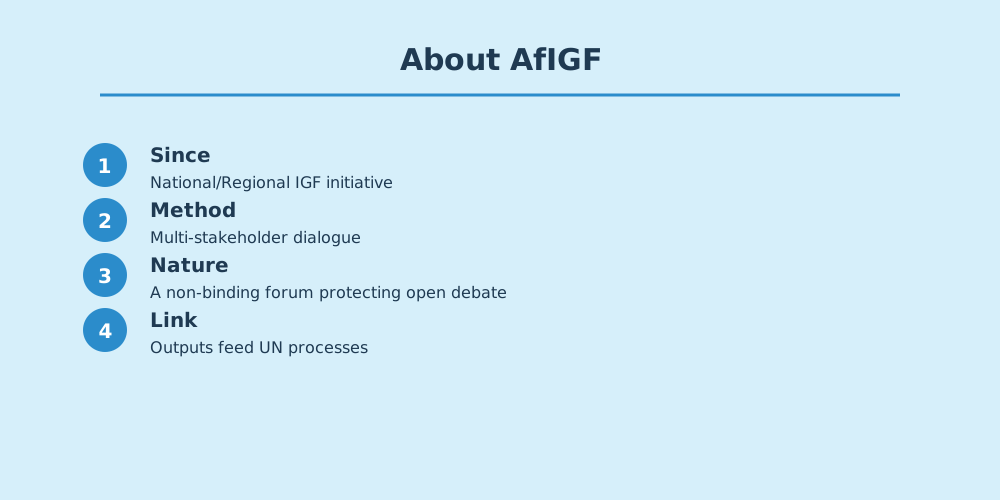
AfIGF is a National or Regional IGF Initiative (NRI), aligning local internet governance discussion with global IGF principles.
Why It Matters to You
What was discussed here becomes the baseline for national digital policy, platform rules and AI regulation worldwide within a few years. The principles confirmed at the 2013 meeting are the foundation of the "next rules" for the phones, social platforms and AI services you use every day.
Sources & References
- African Internet Governance Forum – AfIGF 2013, Final Draft Report (PDF) — AfIGF事務局 (UNECA/AUC) — igf.africa アーカイブ (accessed 2026-07-10)
- APC at the African Internet Governance Forum in Nairobi — APC (accessed 2026-07-10)
- African Internet Governance Forum (AfIGF) — archived programme page — UNECA (accessed 2026-07-10)
- African Declaration on Internet Rights and Freedoms — en (accessed 2026-07-10)
- African IGF (AfIGF) — Regional IGF initiative page — UN IGF Secretariat (accessed 2026-07-10)
Quotes are translated or condensed from the records listed above. Bracketed numbers [n] refer to the source list.
Related links
- IGF official (NRI list): https://www.intgovforum.org/en/content/national-and-regional-igf-initiatives
- Japan IGF: https://japanigf.jp/
- Yuki Nakazawa's blog: https://nkzw.jp/category/igf/
Revision History
Rev. 1 — published 25 September 2013, 09:00 (Article published)
Rev. 2 — updated 10 July 2026, 23:16 (Fully revised into the in-depth edition: added the 3-line summary, minutes digest, short talk, source list and diagrams (all quotes verified against the listed sources))
— 中澤祐樹

