


The 3-Line Summary
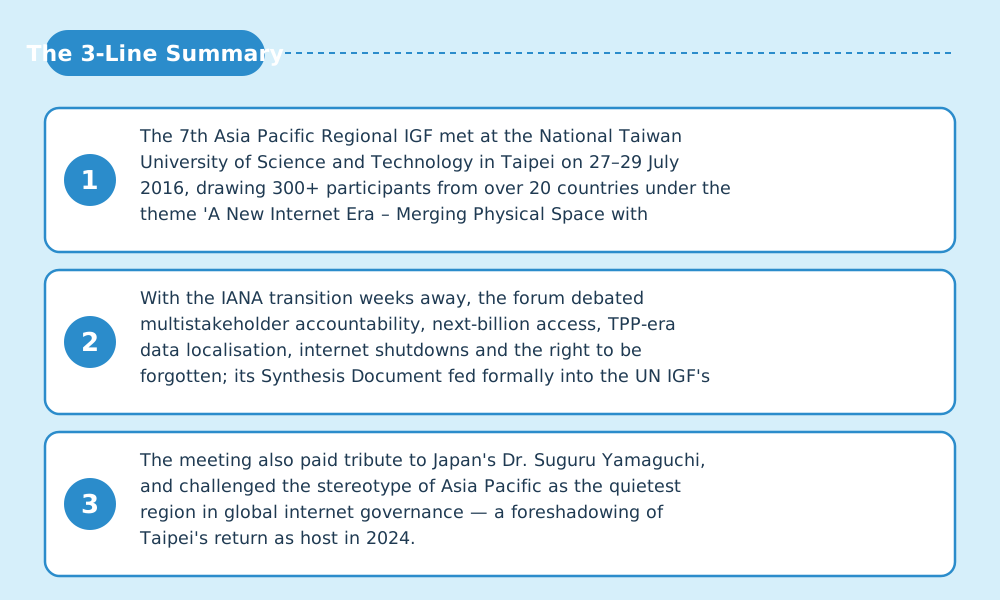
- The 7th Asia Pacific Regional IGF met at the National Taiwan University of Science and Technology in Taipei on 27–29 July 2016, drawing 300+ participants from over 20 countries under the theme 'A New Internet Era – Merging Physical Space with Cyberspace.'
- With the IANA transition weeks away, the forum debated multistakeholder accountability, next-billion access, TPP-era data localisation, internet shutdowns and the right to be forgotten; its Synthesis Document fed formally into the UN IGF's Connecting the Next Billion process.
- The meeting also paid tribute to Japan's Dr. Suguru Yamaguchi, and challenged the stereotype of Asia Pacific as the quietest region in global internet governance — a foreshadowing of Taipei's return as host in 2024.
Welcome — this is the Japan IGF Support Organization. This in-depth report on AprIGF 2016 in Taipei draws on official outputs, session records and on-site reporting. In a hurry? The three lines above and the diagrams carry the gist.
Conference at a Glance (from official records)
| Item | Detail |
|---|---|
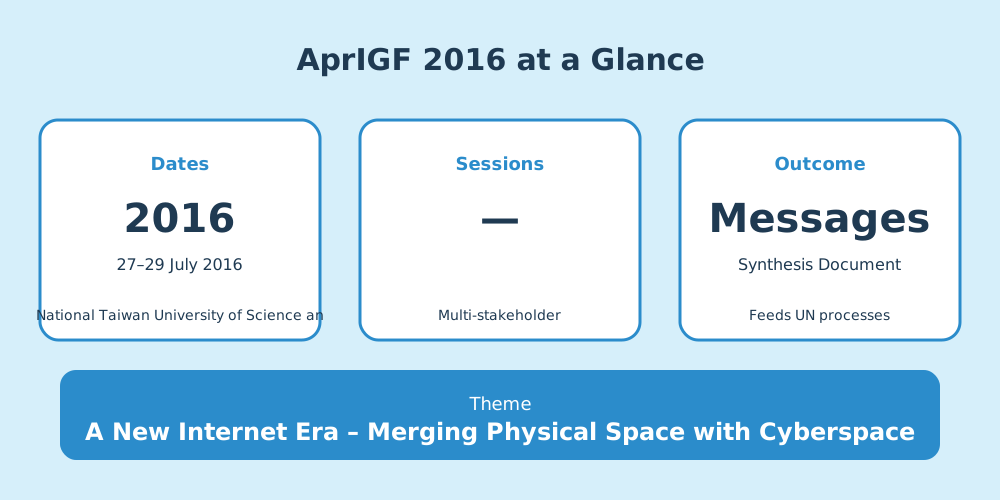
| Edition | Seventh APrIGF since the inaugural 2010 Hong Kong meeting; the Asia Pacific Internet Leadership Program (APILP) and Youth IGF ran in parallel |
| Dates | 27–29 July 2016 |
| Venue | National Taiwan University of Science and Technology (NTUST), Taipei |
| Theme | A New Internet Era – Merging Physical Space with Cyberspace |
| Opening | The opening plenary featured Paul Wilson (APrIGF MSG Chair, APNIC), local host Kuo-Wei Wu, Taiwan's Minister of Transportation and Communications Ho-Chen Tan, Markus Kummer (ICANN Board) and Susan Pointer (Google), with Vint Cerf appearing by video; tribute was paid to Dr. Suguru Yamaguchi of JPNIC |
| Outcome | Synthesis Document (finalised 10 September 2016), formally submitted to the IGF 2016 intersessional programme 'Policy Options for Connecting and Enabling the Next Billion – Phase II' |
(See the source list at the end of this article.)
Discussion Digest — from the Session Records
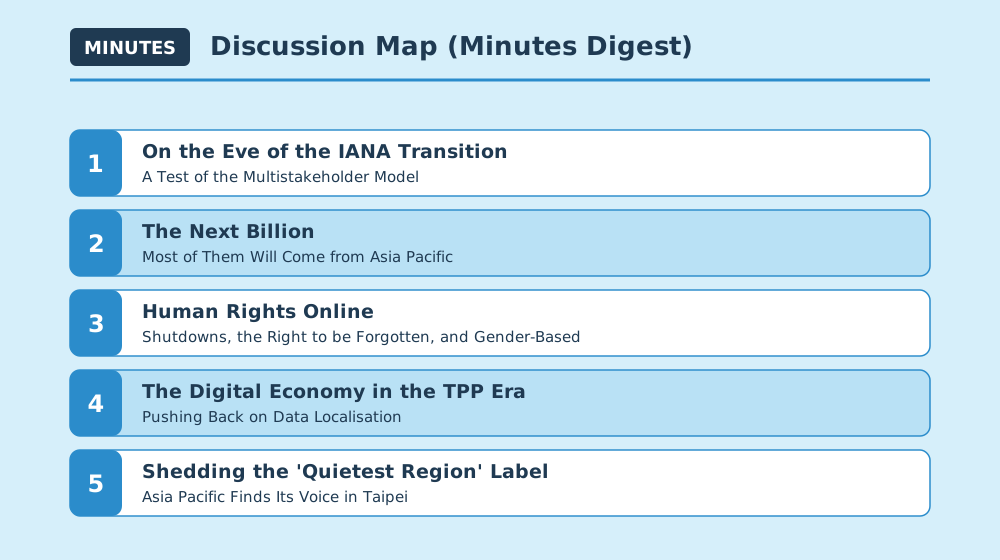
Key exchanges extracted from session records and transcripts.
1. On the Eve of the IANA Transition — A Test of the Multistakeholder Model
Sessions: Session on the history and future process of the IANA stewardship transition
- Held months after the transition proposal went to the US Government (March 2016) and weeks before the October handover, the forum walked the regional community through the remaining process [1][2]
- The Synthesis Document called the IANA transition 'an ongoing example of the multistakeholder approach at work,' noting that cross-community efforts born of it would keep improving ICANN's accountability, transparency, structure and processes [1][2]
2. The Next Billion — Most of Them Will Come from Asia Pacific
Sessions: Connectivity and diversity workshops (WS.79, WS.95, WS.81 and others) and the Synthesis Document discussions
- Premised on the majority of the next billion users coming from Asia Pacific, the forum called for public-private-community initiatives on affordable access, digital literacy and mobile technology [1]
- IPv6, Internationalized Domain Names (IDNs) and Email Address Internationalization (EAI) were framed as gateways for new users, with explicit measures urged to preserve the linguistic, geographic and cultural diversity they bring [1]
- IoT and fast broadband were seen accelerating transformation while creating new digital divides that skew benefits toward those who already have skills and resources [1]
3. Human Rights Online — Shutdowns, the Right to be Forgotten, and Gender-Based Violence
Sessions: Human-rights workshops (WS.67, Mergers 6–9 and others)
- Network shutdowns and blocking were declared economically damaging and rights-impeding, permissible only within the ICCPR's tests of legality, necessity and proportionality [1]
- The right to be forgotten was to be approached with caution, given conflicts with extraterritorial reach, the integrity of media archives and press freedom [1]
- The forum urged action on the gender digital divide and online gender-based violence through rights-based capacity building, redress mechanisms and legislation [1]
4. The Digital Economy in the TPP Era — Pushing Back on Data Localisation
Sessions: Merger 2: 'The Future of Internet Rulemaking Through Trade Agreements' and related sessions
- Government moves to restrict information flows and mandate data localisation were labelled protectionism that hinders global economic growth [1]
- The forum strongly recommended free-trade agreements that prohibit data-localisation and source-code disclosure requirements absent a legitimate public-policy reason [1]
- It examined how the TPP and other agreements reach into copyright, domain-name disputes and cross-border data flows, urging safeguards for developing economies [1]
5. Shedding the 'Quietest Region' Label — Asia Pacific Finds Its Voice in Taipei
Sessions: Observations across the meeting (APNIC Blog guest post) and the opening ceremony
"When I have participated at the global IGF, the Asia Pacific has generally been the least vocal region"
— Izumi Okutani (JPNIC) [3][5]
- Participants from non-English-speaking countries moderated sessions and debated across development levels; Okutani concluded the region contributes actively 'if given the right environment and setting' [3][5]
- Okutani also convened a session on IPv6 deployment challenges, while intermediary liability, content management and surveillance justification emerged as regional preoccupations [3][5]
- The opening ceremony paid tribute to Dr. Suguru Yamaguchi of JPNIC, who had passed away that May, for his service to global internet development [3][5]
Three-Minute Short Talk — Your Questions Answered
Q. So what did the conference actually decide?
A. It's a dialogue forum, not a decision body — but its Synthesis Document was formally submitted to the UN IGF's 'Connecting the Next Billion' policy process, carrying the region's voice upward.
Q. What made 2016 special?
A. The IANA transition. Weeks before oversight of the internet's address book passed from the US Government to the global community, the region took stock of what that milestone meant. TPP-era data-localisation fights were the other signature topic.
Q. Why should I care?
A. The battles named here — internet shutdowns, the right to be forgotten, data localisation — went on to define digital policy debates worldwide for the rest of the decade.
What Is AprIGF? (for first-time readers)
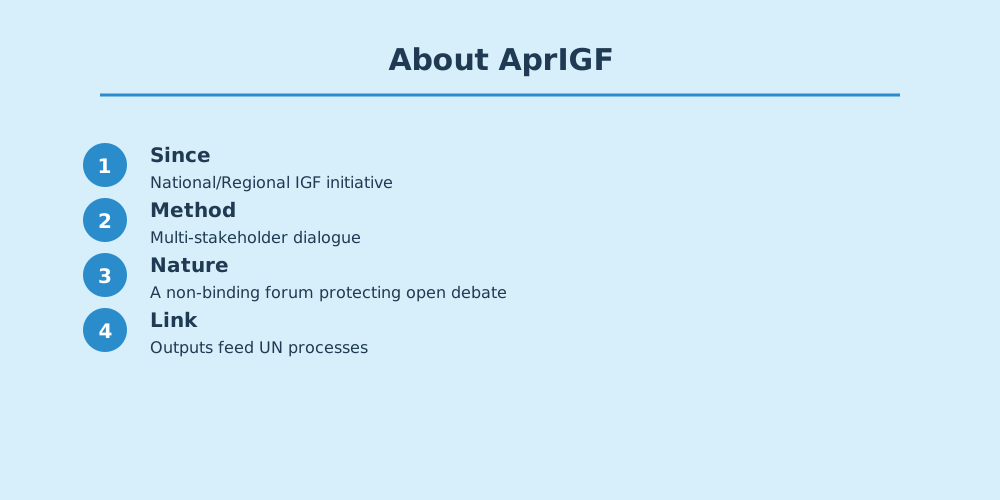
AprIGF is a National or Regional IGF Initiative (NRI), aligning local internet governance discussion with global IGF principles.
Why It Matters to You
What was discussed here becomes the baseline for national digital policy, platform rules and AI regulation worldwide within a few years. The principles confirmed at the 2016 meeting are the foundation of the "next rules" for the phones, social platforms and AI services you use every day.
Sources & References
- APrIGF 2016 Taipei Synthesis Document (PDF) — APrIGF Secretariat (accessed 2026-07-10)
- Event Wrap: 2016 APrIGF Taipei — APNIC Blog (accessed 2026-07-10)
- Reflections from APrIGF 2016, Taipei(奥谷泉・寄稿) — APNIC Blog (accessed 2026-07-10)
- APrIGF 2016 — DiploFoundation (accessed 2026-07-10)
- PICISOC attends APrIGF Taipei 2016 — PICISOC (accessed 2026-07-10)
Quotes are translated or condensed from the records listed above. Bracketed numbers [n] refer to the source list.
Related links
- IGF official (NRI list): https://www.intgovforum.org/en/content/national-and-regional-igf-initiatives
- Japan IGF: https://japanigf.jp/
- Yuki Nakazawa's blog: https://nkzw.jp/category/igf/
Revision History
Rev. 1 — published 26 July 2016, 09:00 (Article published)
Rev. 2 — updated 10 July 2026, 23:16 (Fully revised into the in-depth edition: added the 3-line summary, minutes digest, short talk, source list and diagrams (all quotes verified against the listed sources))
— 中澤祐樹

