


The 3-Line Summary
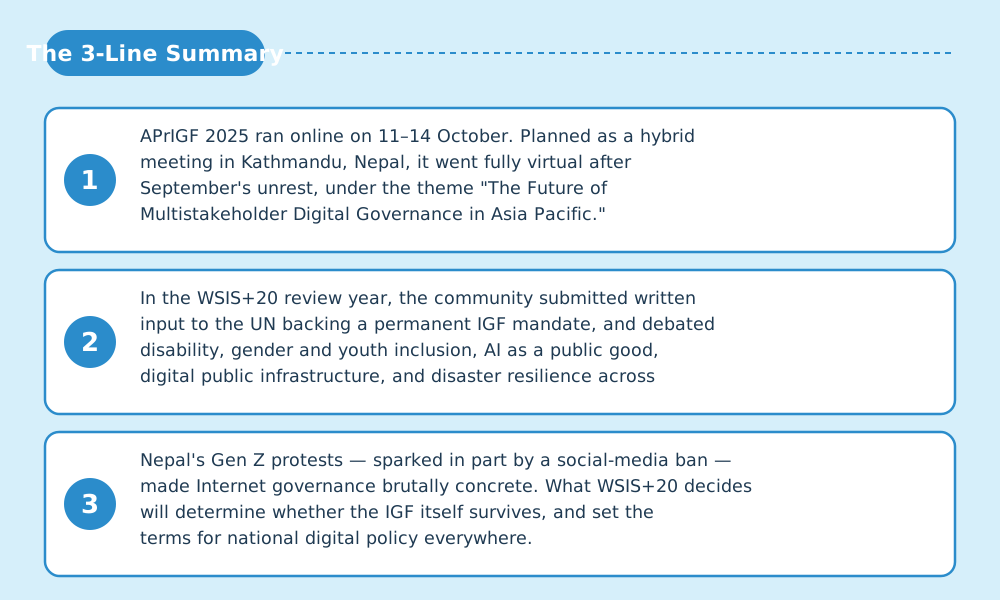
- APrIGF 2025 ran online on 11–14 October. Planned as a hybrid meeting in Kathmandu, Nepal, it went fully virtual after September's unrest, under the theme "The Future of Multistakeholder Digital Governance in Asia Pacific."
- In the WSIS+20 review year, the community submitted written input to the UN backing a permanent IGF mandate, and debated disability, gender and youth inclusion, AI as a public good, digital public infrastructure, and disaster resilience across five tracks.
- Nepal's Gen Z protests — sparked in part by a social-media ban — made Internet governance brutally concrete. What WSIS+20 decides will determine whether the IGF itself survives, and set the terms for national digital policy everywhere.
Welcome — this is the Japan IGF Support Organization. This in-depth report on AprIGF 2025 in Kathmandu draws on official outputs, session records and on-site reporting. In a hurry? The three lines above and the diagrams carry the gist.
📍 Catalogued as the Kathmandu meeting, but after the September 2025 unrest in Nepal (the 8–10 September Gen Z protests, sparked in part by a mass social-media ban, which brought down the government), organisers announced on 17 September that the forum would move fully online for participants' safety; the Internet Governance Institute in Kathmandu remained the host
Conference at a Glance (from official records)
| Item | Detail |
|---|---|
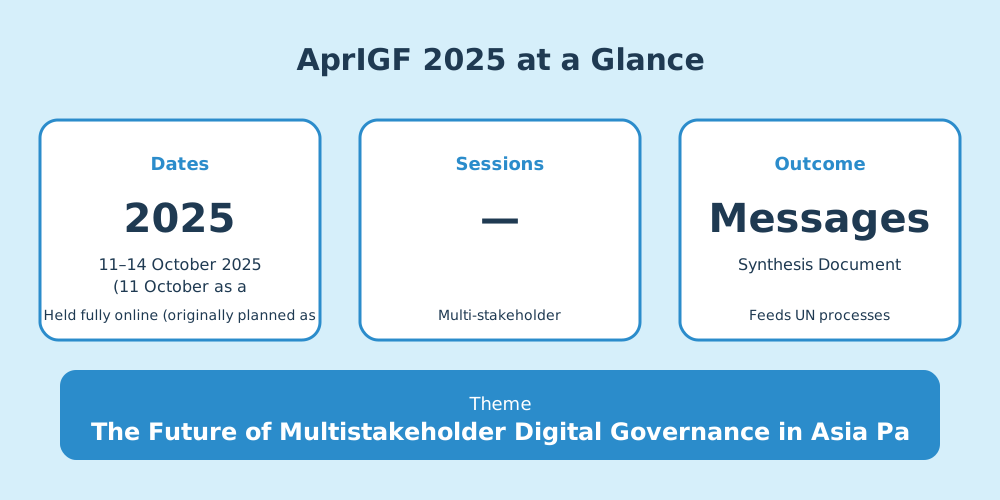
| Dates | 11–14 October 2025 (11 October as a 'Zero Day' engagement) |
| Venue | Held fully online (originally planned as a hybrid meeting at the Nepal Administrative Staff College, Jawalakhel, Kathmandu) |
| Theme | The Future of Multistakeholder Digital Governance in Asia Pacific |
| Host | Internet Governance Institute (IGI, Nepal), co-hosted by the Internet Society Nepal Chapter, executed by the APrIGF Multi-Stakeholder Group (MSG) and Secretariat |
| Outcome | Synthesis Document (Virtual Conference edition); a written regional input was submitted to the UN WSIS+20 co-facilitators |
| Note | Held in the 20th-anniversary year of WSIS (Geneva, 2003), amid the WSIS+20 review |
(See the source list at the end of this article.)
Discussion Digest — from the Session Records
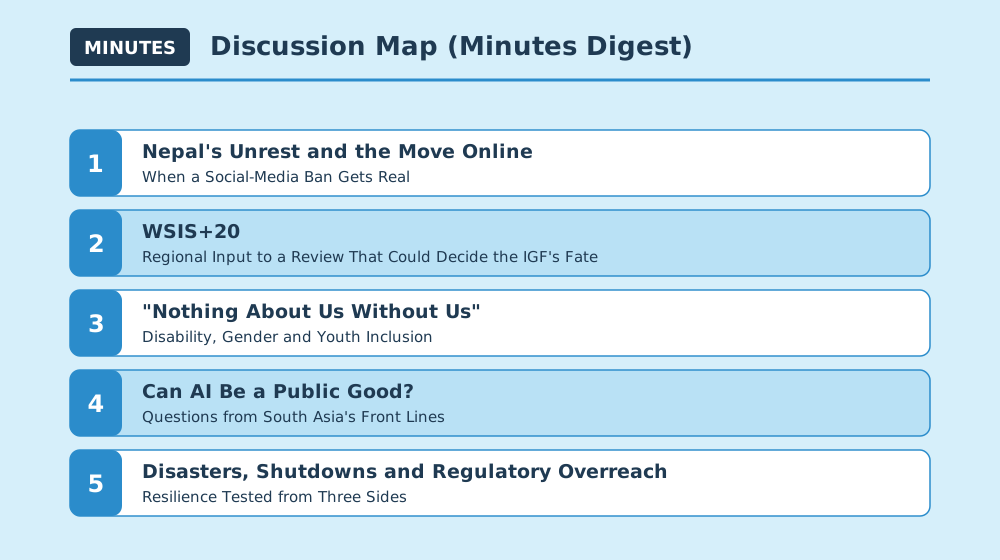
Key exchanges extracted from session records and transcripts.
1. Nepal's Unrest and the Move Online — When a Social-Media Ban Gets Real
Sessions: Format-change announcement (17 September 2025, jointly by the MSG leadership, local host and Secretariat)
- On 8–10 September 2025, Gen Z protests — triggered in part by a mass social-media ban — swept Nepal and brought down the government. After weighing postponement, organisers moved the forum fully online, putting participant safety first [2][5]
- The announcement extended 'heartfelt condolences to all affected communities and families in Nepal' and hoped for a swift return of peace and stability [2][5]
- An Internet governance meeting planned for a country just shaken by an Internet shutdown ended up online because of it — embodying the region's own agenda of shutdowns, platform regulation and youth voice [2][5]
2. WSIS+20 — Regional Input to a Review That Could Decide the IGF's Fate
Sessions: Special WSIS+20 track (High-Level Plenary and Townhall attended by the UN co-facilitators, plus three webinars before and after)
"We are in the midst of the UN's WSIS+20 Review, a pivotal moment where the global community is evaluating our progress and charting the course for the next decade of our digital society"
— Sally Wentworth (President and CEO, Internet Society, keynote) [1][4]
- A WSIS+20 Working Group submitted written input to the UN co-facilitators, assessing the Zero Draft and Revision 1 and backing a permanent IGF mandate and recognition of NRIs [1][4]
- The community welcomed Revision 1 language on financing to close the digital divide and the NETmundial+10 guidelines, but flagged the softening of human-rights and environmental language [1][4]
- It urged WSIS+20 to deliver action-oriented outcomes on AI governance and its impact on trade, human rights and labour [1][4]
3. "Nothing About Us Without Us" — Disability, Gender and Youth Inclusion
Sessions: Access & Inclusion track: "Nothing About Us Without Us," "Prioritising Digital Gender Inclusion in Asia," "Bridging the Digital Divide: Youth Access to Knowledge, Policy, and Power"
- Persons with disabilities must be co-designers of policy and infrastructure, not subjects of support; host Nepal was specifically urged to ratify the Marrakesh Treaty and include persons with disabilities in its e-Governance Commission [1]
- Research showed middle-income countries lost roughly half a billion US dollars in 2023 because women are excluded from meaningful connectivity; Pakistan's Digital Gender Inclusion Strategy illustrated the implementation hurdles [1]
- Youth were framed as co-governors of the Internet: participation must be structural, not symbolic — formal seats, ring-fenced budgets for youth-led projects, and an end to checkbox consultation [1]
4. Can AI Be a Public Good? — Questions from South Asia's Front Lines
Sessions: "AI as Public Good: Analysing the interplay of Private Investments, Public Infrastructure and Public Accountability" and related sessions
- India has pledged $1.12 billion to its AI ecosystem while Nepal has no dedicated AI budget — and across the region, opaque budgeting and performance evaluation make public value impossible to track [1]
- Concrete accountability failures were tabled: sanitation workers in an Indian smart city tracked via RFID tags with data owned by a private third party, and pandemic QR-code data in the Philippines collected without government approval and sold to marketers [1]
- A guiding principle emerged: design inclusive AI systems first, then automate — 'if we do it the other way around, we're automating exclusion' — with calls for regionally contextualised AI norms drawing on non-Western ethical traditions [1]
5. Disasters, Shutdowns and Regulatory Overreach — Resilience Tested from Three Sides
Sessions: Resilience track: "Disasters, Data, and Digital Rights" and "The Growing Threat of Personal Liability in Platform Regulation"
- With climate disasters intensifying, connectivity is a lifeline of crisis response: hybrid fibre–microwave–satellite architectures, elimination of single points of failure, and formally designating the Internet as critical infrastructure were recommended [1]
- Community-driven tools that work offline were showcased, including PAROLI, a voice-based communication platform co-designed in Bangladesh under PROTIC II for alerts and SOS during cyclones and floods [1]
- Citing the arrest of Telegram's founder and the suspension of X in Brazil, participants warned that personal criminal liability for platform staff can morph into intimidation and surveillance where the rule of law is weak [1]
Three-Minute Short Talk — Your Questions Answered
Q. So what did the conference actually decide?
A. It's a dialogue forum, not a decision body — but this year it delivered something concrete: written regional input to the UN's WSIS+20 co-facilitators, backing a permanent mandate for the IGF.
Q. Why did a Kathmandu meeting end up online?
A. A month before the event, Nepal's Gen Z protests — sparked in part by a mass social-media ban — brought down the government. Organisers moved the forum fully online for safety. A meeting about Internet governance was displaced by the fallout of an Internet shutdown: the agenda made real.
Q. Why should I care?
A. Because the WSIS+20 review decides whether the IGF itself continues, and Nepal's experience — a social-media ban helping trigger an uprising — is a cautionary tale for every country now writing platform rules.
What Is AprIGF? (for first-time readers)
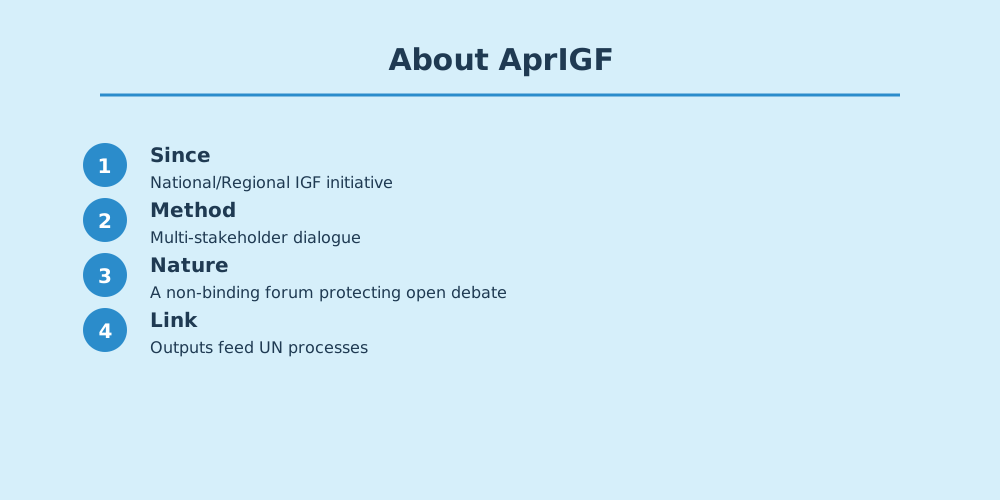
AprIGF is a National or Regional IGF Initiative (NRI), aligning local internet governance discussion with global IGF principles.
Why It Matters to You
What was discussed here becomes the baseline for national digital policy, platform rules and AI regulation worldwide within a few years. The principles confirmed at the 2025 meeting are the foundation of the "next rules" for the phones, social platforms and AI services you use every day.
Sources & References
- Synthesis Document — Asia Pacific Regional Internet Governance Forum 2025 (Virtual Conference) (PDF) — APrIGF Secretariat (accessed 2026-07-10)
- APrIGF 2025 Will Be Held Virtually — APrIGF.Asia(公式サイト) (accessed 2026-07-10)
- OFFICIAL: APrIGF 2025 will be held in Nepal in October! — APrIGF.Asia(公式サイト) (accessed 2026-07-10)
- The Future of Multistakeholder Digital Governance in Asia-Pacific(Sally Wentworth基調講演) — Internet Society (accessed 2026-07-10)
- 2025 Nepalese Gen Z protests — en (accessed 2026-07-10)
- Asia Pacific Regional Internet Governance Forum (APrIGF) 2025 — APC (accessed 2026-07-10)
Quotes are translated or condensed from the records listed above. Bracketed numbers [n] refer to the source list.
Related links
- IGF official (NRI list): https://www.intgovforum.org/en/content/national-and-regional-igf-initiatives
- Japan IGF: https://japanigf.jp/
- Yuki Nakazawa's blog: https://nkzw.jp/category/igf/
Revision History
Rev. 1 — published 11 October 2025, 12:15 (Article published)
Rev. 2 — updated 10 July 2026, 14:28 (Fully revised into the in-depth edition: added the 3-line summary, minutes digest, short talk, source list and diagrams (all quotes verified against the listed sources))
— 中澤祐樹

