

The 3-Line Summary
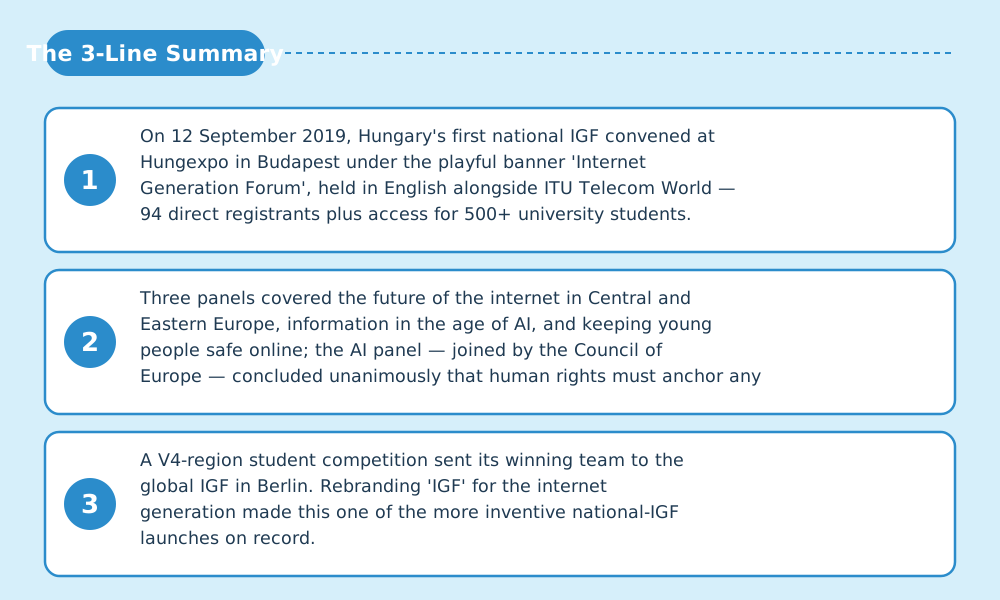
- On 12 September 2019, Hungary's first national IGF convened at Hungexpo in Budapest under the playful banner 'Internet Generation Forum', held in English alongside ITU Telecom World — 94 direct registrants plus access for 500+ university students.
- Three panels covered the future of the internet in Central and Eastern Europe, information in the age of AI, and keeping young people safe online; the AI panel — joined by the Council of Europe — concluded unanimously that human rights must anchor any AI policy approach.
- A V4-region student competition sent its winning team to the global IGF in Berlin. Rebranding 'IGF' for the internet generation made this one of the more inventive national-IGF launches on record.
Welcome — this is the Japan IGF Support Organization. This in-depth report on Hungary IGF 2019 (The Internet Generation Forum Hungary) draws on official outputs, session records and on-site reporting. In a hurry? The three lines above and the diagrams carry the gist.
📍 Held in conjunction with ITU Telecom World 2019 (9–12 September, Budapest), using the same venue and facilities
Conference at a Glance (from official records)
| Item | Detail |
|---|---|
| Official name | Hungary IGF 2019 (The Internet Generation Forum Hungary) |
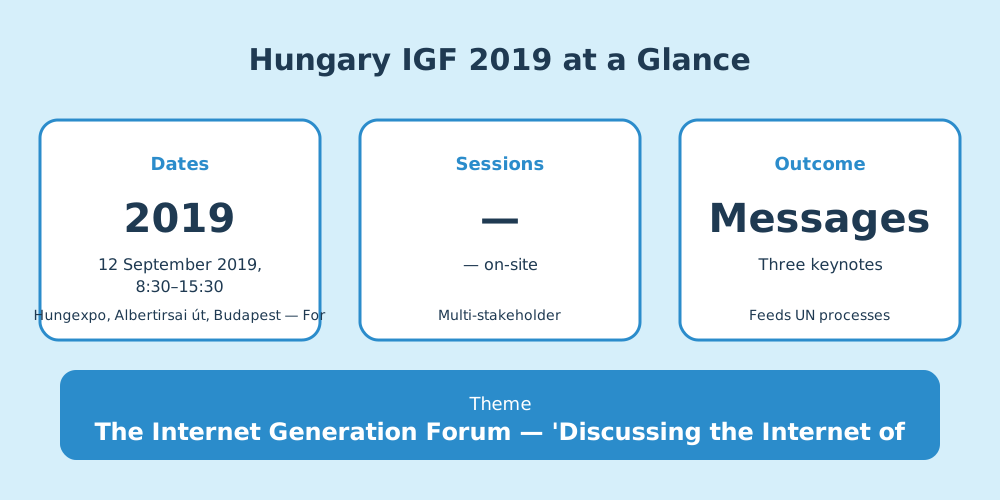
| Dates | 12 September 2019, 8:30–15:30 |
| Venue | Hungexpo, Albertirsai út, Budapest — Forum Area, Room 4 'Helicopter' |
| Theme | The Internet Generation Forum — 'Discussing the Internet of Today and Tomorrow', with a dedicated youth focus |
| Participants | 94 direct registrations (56 male, 38 female; 57 from Hungary plus other European countries); also open to ITU Telecom World attendees, including many of the 500+ university students registered that day |
| Host | Co-organised by the Scientific Association for Infocommunications (HTE) and the ICT Association of Hungary (IVSZ), supported by the Ministry of Innovation and Technology, with the IGF Secretariat, ICANN and SEEDIG as partners |
| Outcome | Three keynotes, three panels and a student-competition grand final; an official report was filed with the IGF Secretariat |
(See the source list at the end of this article.)
Discussion Digest — from the Session Records
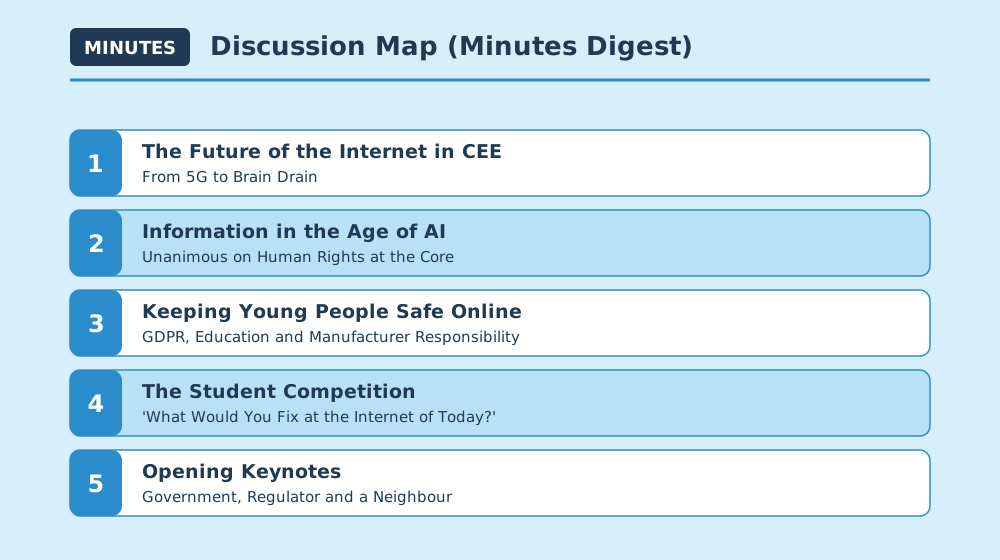
Key exchanges extracted from session records and transcripts.
1. The Future of the Internet in CEE — From 5G to Brain Drain
Sessions: Panel 1, 'Future of Internet in CEE', moderated by Joanna Kulesza (ICANN At-Large)
- The panel asked whether 5G security and privacy have a regional dimension, and how to stem the brain drain of CEE tech talent [1]
- Universal acceptance and IDNs — readiness for non-Latin scripts — and how to get regional end-user needs reflected in global discourse were also on the table [1]
- Speakers from Albania, North Macedonia, Italy and Hungary (including SEEDIG ambassador Oliana Sula, .hu registry's János Zsakó and the UN CSTD's Péter Major) closed on whether the region needs its own multistakeholder platform [1]
2. Information in the Age of AI — Unanimous on Human Rights at the Core
Sessions: Panel 2, 'Information in the age of AI', moderated by Levente Nyakas (NMHH), with Council of Europe participation
- The panel worked through four questions: what guarantees ensure transparency in AI development, how to build trust in AI among both politicians and users, how AI-driven filter bubbles and content removal affect access to information, and how to model unbiased AI [1][4]
- Panellists included Access Now's Fanni Hidvégi (also on the EU's High-Level Expert Group on AI), Facebook's Gabriella Cseh, ELTE law scholar Gergely Gosztonyi and Poland's Krzysztof Izdebski [1][4]
- Per the Council of Europe's account, the multistakeholder panel arrived at 'a unanimous conclusion that human rights must be at the heart' of any policy approach to AI [1][4]
3. Keeping Young People Safe Online — GDPR, Education and Manufacturer Responsibility
Sessions: Panel 3, 'Keeping the Internet of tomorrow safe and secure for youngsters', moderated by Ottó Dalos (CEO, Cisco Hungary)
- The panel examined how the cloud can protect young users' security and data integrity, the role of the GDPR, and best practices in cybersecurity education [1]
- Practical questions — how dangerous is social media, and how do you convince teenagers that safety matters — were fielded by ICANN's Jean-Jacques Sahel and cloud-security expert Predrag Tasevski among others [1]
- The division of responsibility between device manufacturers and the state in keeping young people safe foreshadowed later online-safety legislation debates [1]
4. The Student Competition — 'What Would You Fix at the Internet of Today?'
Sessions: Grand final of the student competition for university students and young innovators from the V4 countries and wider CEE
- Students from the V4 countries and wider CEE answered the prompt 'What would you fix at the Internet of today for a better Internet of tomorrow?', with four university teams from Hungary and Armenia reaching the final [1]
- The winning team from Corvinus University of Budapest — Anna Kollár and Virág Kiss — won a fully paid trip to that year's global IGF in Berlin [1]
- The event ran on a shoestring: no speaker fees or travel costs, with the venue and facilities provided through ITU Telecom World and in-kind sponsor support [1]
5. Opening Keynotes — Government, Regulator and a Neighbour
Sessions: Keynotes by Deputy State Secretary Károly Solymár, Ervin Kajzinger (NMHH) and Agnieszka Gładysz (UKE, Poland)
- Deputy State Secretary Károly Solymár (Ministry of Innovation and Technology) and Ervin Kajzinger (NMHH) both stressed the importance of youth involvement in technology and internet debates [1][5]
- Agnieszka Gładysz of Poland's Office for Electronic Communications (UKE) surveyed the Polish telecoms sector, bringing a V4 perspective [1][5]
- The day was moderated by Péter Major, Hungary's ICANN GAC representative and a member of the UN CSTD [1][5]
Three-Minute Short Talk — Your Questions Answered
Q. What is the 'Internet Generation Forum' — is it different from an IGF?
A. Same thing. Hungary's first national IGF rebranded the acronym to put youth front and centre. It was formally recognised as an NRI by the UN IGF Secretariat in June 2019.
Q. Did it decide anything?
A. IGFs don't decide, but the AI panel reached a unanimous conclusion that human rights must anchor any AI policy approach — notable for a CEE national forum in 2019, well before the EU AI Act.
Q. Why should I care?
A. It is a masterclass in launching a national IGF on a shoestring: piggyback on an ITU world event for the venue, rebrand for young people, and make the prize of your student competition a trip to the global IGF.
What Is Hungary IGF? (for first-time readers)
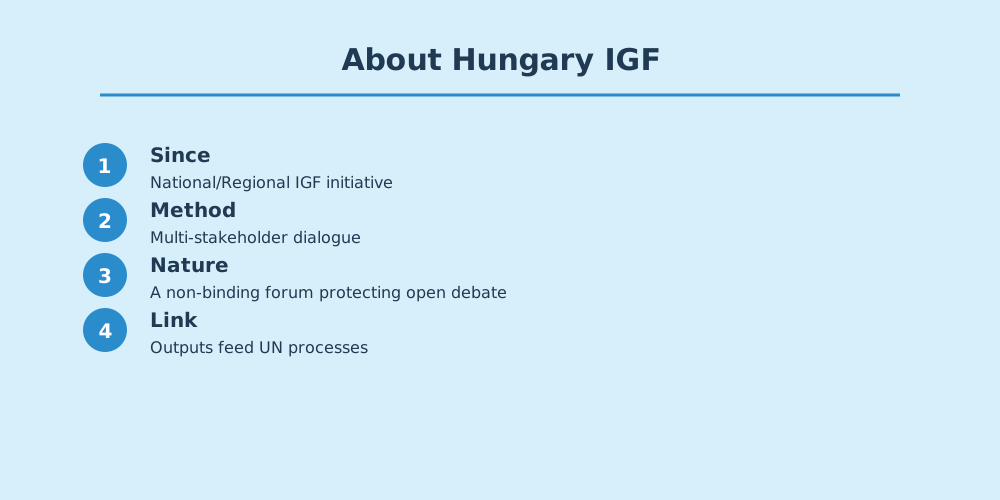
Hungary IGF is a National or Regional IGF Initiative (NRI), aligning local internet governance discussion with global IGF principles.
Why It Matters to You
What was discussed here becomes the baseline for national digital policy, platform rules and AI regulation worldwide within a few years. The principles confirmed at the 2019 meeting are the foundation of the "next rules" for the phones, social platforms and AI services you use every day.
Sources & References
- The Internet Generation Forum Hungary 2019 — 公式報告書(PDF・Wayback Machine) — IGF Hungary(igfhungary.hu) (accessed 2026-07-16)
- Hungary IGF(NRI記録:2019年設立・コーディネーター情報) — intgovforum.org (accessed 2026-07-16)
- Internet Governance Forum 2019(開催告知) — IVSZ(ハンガリーICT協会) (accessed 2026-07-16)
- Council of Europe at the IGF – Hungary: Human rights must be at heart of the policy approach towards artificial intelligence(Wayback Machine) — Council of Europe (accessed 2026-07-16)
- Hungary IGF(開会の様子。基調登壇者とメインテーマの記録・Wayback Machine) — IGF Italia 2019(トリノ工科大学) (accessed 2026-07-16)
Quotes are translated or condensed from the records listed above. Bracketed numbers [n] refer to the source list.
Related links
- IGF official (NRI list): https://www.intgovforum.org/en/content/national-and-regional-igf-initiatives
- Japan IGF: https://japanigf.jp/
- Yuki Nakazawa's blog: https://nkzw.jp/category/igf/
Revision History
Rev. 1 — published 13 June 2019, 09:00 (Article published)
Rev. 2 — updated 17 July 2026, 12:32 (Fully revised into the in-depth edition: added the 3-line summary, minutes digest, short talk, source list and diagrams (all quotes verified against the listed sources))
— 中澤祐樹

