


The 3-Line Summary
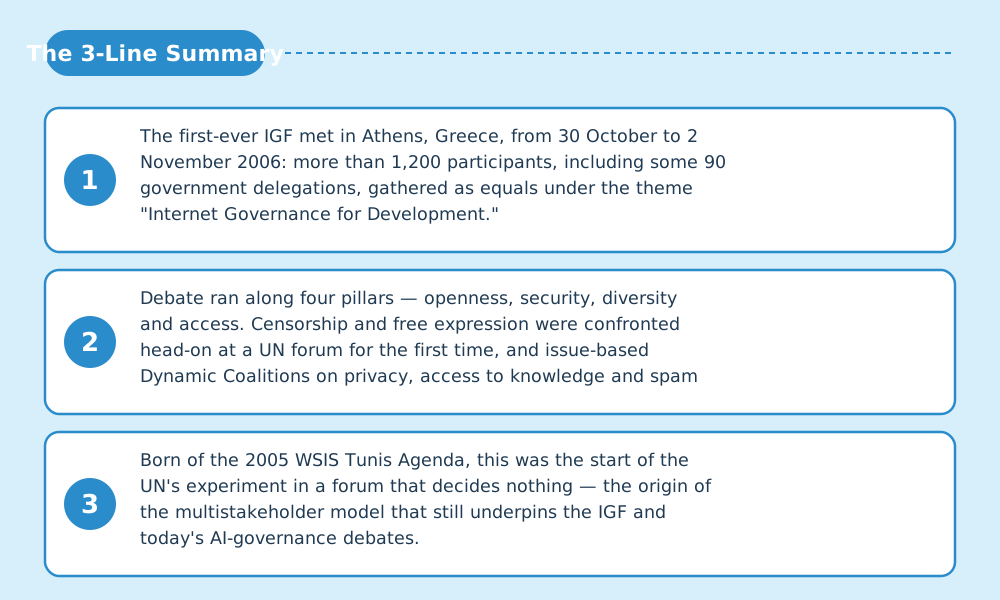
- The first-ever IGF met in Athens, Greece, from 30 October to 2 November 2006: more than 1,200 participants, including some 90 government delegations, gathered as equals under the theme "Internet Governance for Development."
- Debate ran along four pillars — openness, security, diversity and access. Censorship and free expression were confronted head-on at a UN forum for the first time, and issue-based Dynamic Coalitions on privacy, access to knowledge and spam emerged as the meeting's only tangible output.
- Born of the 2005 WSIS Tunis Agenda, this was the start of the UN's experiment in a forum that decides nothing — the origin of the multistakeholder model that still underpins the IGF and today's AI-governance debates.
Welcome — this is the Japan IGF Support Organization. This in-depth report on Global IGF 2006 in Athens draws on official outputs, session records and on-site reporting. In a hurry? The three lines above and the diagrams carry the gist.
📍 Officially the Athens meeting; sessions were held at the Divani Apollon Palace Hotel in a coastal suburb of Athens
Conference at a Glance (from official records)
| Item | Detail |
|---|---|
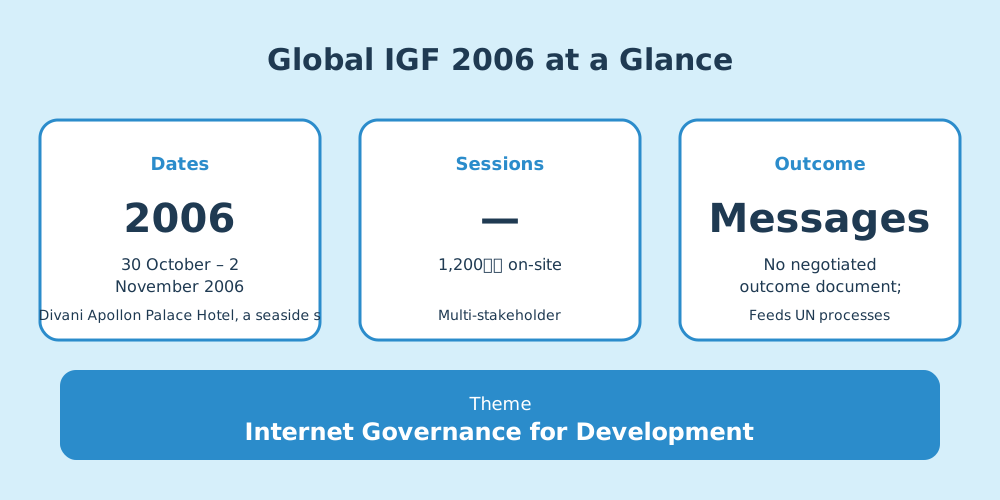
| Dates | 30 October – 2 November 2006 |
| Venue | Divani Apollon Palace Hotel, a seaside suburb of Athens, Greece |
| Theme | Internet Governance for Development |
| Participants | More than 1,200 participants, including some 10 ministers and some 90 government delegations |
| Main sessions | 8 |
| Workshops | more than 30 |
| Sub-themes | Openness, Security, Diversity, Access, plus emerging issues |
| Chair | Michalis Liapis, Greek Minister of Transport and Communications (Forum Chairman) |
| MAG Chair | Nitin Desai, Special Adviser to the UN Secretary-General and chair of the Advisory Group |
| Host | Government of Greece and the United Nations |
| Outcome | No negotiated outcome document; the launch of issue-based Dynamic Coalitions was the most tangible result |
| Mandate | Paragraph 72 of the WSIS Tunis Agenda (November 2005) asked the UN Secretary-General to convene the IGF |
| Milestone | The first-ever IGF — the start of the UN's experiment in multistakeholder dialogue |
(See the source list at the end of this article.)
Discussion Digest — from the Session Records
Key exchanges extracted from session records and transcripts.
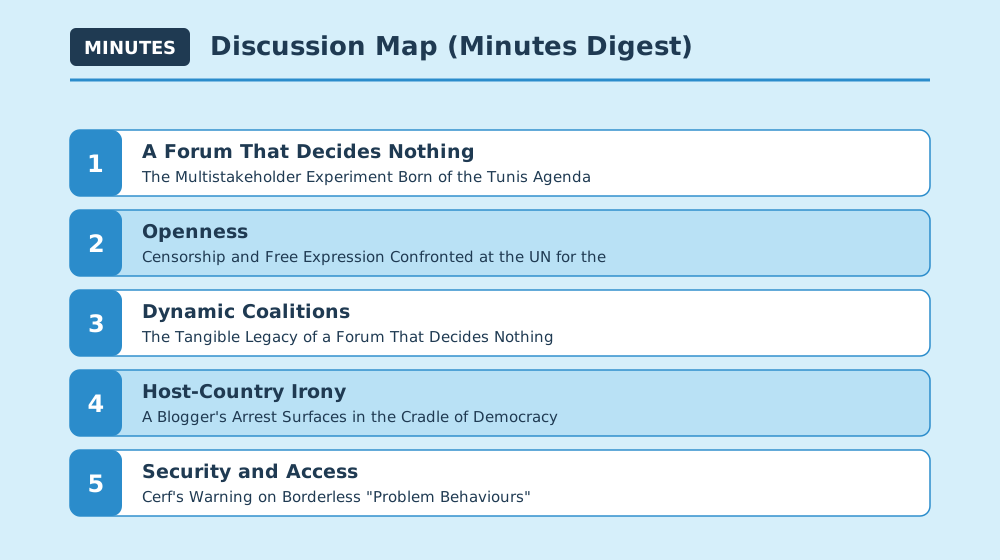
1. A Forum That Decides Nothing — The Multistakeholder Experiment Born of the Tunis Agenda
Sessions: Opening Session (30 October)
"The Internet can play a powerful role in helping developing countries to advance their economic and social well-being"
— UN Secretary-General Kofi Annan (message delivered by Special Adviser Nitin Desai) [2][3][4]
"But I think you also all acknowledge the need for more international participation in discussions of Internet governance issues. The question is how to achieve this. So let those discussions continue."
— UN Secretary-General Kofi Annan (same message) [2][3][4]
- Convened by Secretary-General Annan under paragraph 72 of the 2005 WSIS Tunis Agenda, the IGF debuted a new format: a forum for dialogue with no binding decisions [2][3][4]
- Annan's message framed the challenge as bridging two cultures — the informal, bottom-up Internet community and the formal, structured world of governments [2][3][4]
- Advisory Group chair Nitin Desai noted it was fitting that the meeting took place in a city associated with the very idea of open democracy [2][3][4]
2. Openness — Censorship and Free Expression Confronted at the UN for the First Time
Sessions: Main Session "Openness" (31 October) and related sessions
"I believe the Internet should be a force for political freedom, not repression"
— Amnesty International (Irrepressible.info pledge, presented at the Forum) [5][7]
- The three sessions on content regulation were dominated by anti-censorship and access-to-knowledge advocates; the Chinese government delegate was pressed hard from the floor about his country's record on freedom of speech [5][7]
- A Council of Europe official defending regulation of "harmful content" drew concentrated criticism from panellists opposed to extending filtering and blocking [5][7]
- Amnesty International handed over its online pledge urging governments to stop unwarranted restrictions on online expression — and companies to stop helping them [5][7]
3. Dynamic Coalitions — The Tangible Legacy of a Forum That Decides Nothing
Sessions: Workshops and closing day (2 November)
- On 2 November the Dynamic Coalition on Privacy was launched, with Privacy International, Microsoft, the ACLU, the French government, Canada's Privacy Commissioner, Harvard's Berkman Center and over 30 other organisations [6][4]
- Coalitions on Access to Knowledge (A2K), an Internet Bill of Rights, and the Stop Spam Alliance of six major anti-spam bodies followed, establishing issue-based standing groups as a new mode of cooperation [6][4]
- For a forum that issues no binding decisions, the establishment of the Dynamic Coalitions was judged its most tangible result [6][4]
4. Host-Country Irony — A Blogger's Arrest Surfaces in the Cradle of Democracy
Sessions: Immediately before the Forum and during the Openness session (31 October)
- Just before the opening it emerged that Antonis Tsipropoulos, administrator of the Greek blog aggregator blogme.gr, had been arrested and his home raided by the cybercrime division over a libel suit about a satirical blog his site merely linked to — an awkward backdrop for a forum championing free expression [8][7]
- Asked about the case during the Openness session, Greek State Minister Theodoros Roussopoulos claimed ignorance, then criticised "bloggers who spread lies through television," further antagonising the blogging community [8][7]
- Greek bloggers posted hundreds of protest entries within two days of the raid; the case drew international coverage and raised fears of a chilling effect on bloggers with unclear legal status [8][7]
5. Security and Access — Cerf's Warning on Borderless "Problem Behaviours"
Sessions: Opening session and the Security and Access main sessions
"These concerns will need to be addressed at local, national and international levels and will call for cooperative technical, political and legal efforts for their solution"
— Vint Cerf (Vice-President of Google, ICANN Board Chairman, co-designer of TCP/IP) [3][2][7]
- Cerf, saluted as one of the "fathers of the Internet," noted that many of the Internet's "problem behaviours" — fraud, harassment, illegal copying, material unsuited to children — were international in scope [3][2][7]
- Over four days the Forum held eight main sessions and more than 30 workshops, with development as the overarching priority and access gaps and multilingualism (diversity) as central threads [3][2][7]
- Fittingly for a meeting about governing the Internet, the venue's own network failed for two days and a rogue wireless access point was discovered on site [3][2][7]
Three-Minute Short Talk — Your Questions Answered
Q. Why was this conference held at all?
A. The 2005 World Summit on the Information Society nearly deadlocked over who should govern the Internet. The compromise was the IGF: under paragraph 72 of the Tunis Agenda, UN Secretary-General Kofi Annan convened a forum where governments, business and civil society talk as equals but decide nothing — an unprecedented UN experiment that began in Athens.
Q. What was the most contentious topic?
A. Censorship and free expression. The Chinese delegate was grilled from the floor over his country's controls, Amnesty International presented its pledge that the Internet 'should be a force for political freedom, not repression' — and host Greece was embarrassed by news that a local blog aggregator's administrator had been arrested.
Q. Why should I care?
A. The anti-spam and privacy coalitions launched here seeded later international cooperation on spam and data protection. And the multistakeholder format piloted in Athens — everyone at the same table — is the same model now shaping global AI-governance debates.
What Is Global IGF? (for first-time readers)
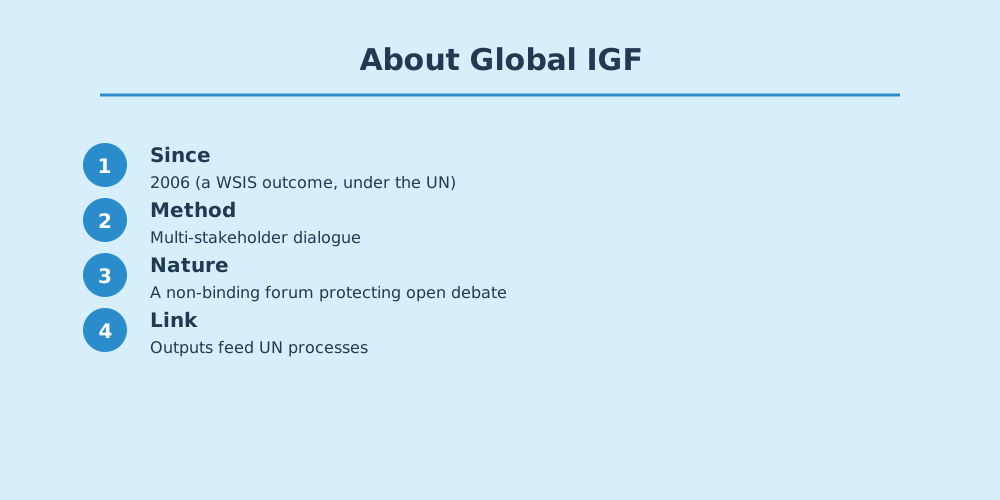
Global IGF has met annually under UN auspices since 2006 — the one global conference where governments, business, civil society, the technical community and youth debate internet governance as equals (the multistakeholder model).
Why It Matters to You
What was discussed here becomes the baseline for national digital policy, platform rules and AI regulation worldwide within a few years. The principles confirmed at the 2006 meeting are the foundation of the "next rules" for the phones, social platforms and AI services you use every day.
Sources & References
- First IGF Meeting: Athens, Greece — UN IGF Secretariat (accessed 2026-07-10)
- Annan stresses development role at first ever meeting of the Internet Governance Forum — UN News (accessed 2026-07-10)
- Internet Governance Forum Opens in Athens (PI/1749) — UN Meetings Coverage and Press Releases (accessed 2026-07-10)
- Internet Governance Forum — en (accessed 2026-07-10)
- Discussion during IGF against Internet content control (EDRi-gram 4.21) — EDRi (accessed 2026-07-10)
- Dynamic Coalition on Privacy launched at UN Internet Meeting in Athens — Berkman Klein Center, Harvard University (accessed 2026-07-10)
- A glimpse inside the real IGF — The Register (accessed 2026-07-10)
- Greek blog aggregator admin arrested (EDRi-gram 4.21) — EDRi (accessed 2026-07-10)
Quotes are translated or condensed from the records listed above. Bracketed numbers [n] refer to the source list.
Related links
- IGF official (NRI list): https://www.intgovforum.org/en/content/national-and-regional-igf-initiatives
- Japan IGF: https://japanigf.jp/
- Yuki Nakazawa's blog: https://nkzw.jp/category/igf/
Revision History
Rev. 1 — published 30 October 2006, 16:00 (Article published)
Rev. 2 — updated 10 July 2026, 14:28 (Fully revised into the in-depth edition: added the 3-line summary, minutes digest, short talk, source list and diagrams (all quotes verified against the listed sources))
— 中澤祐樹

