
The 3-Line Summary
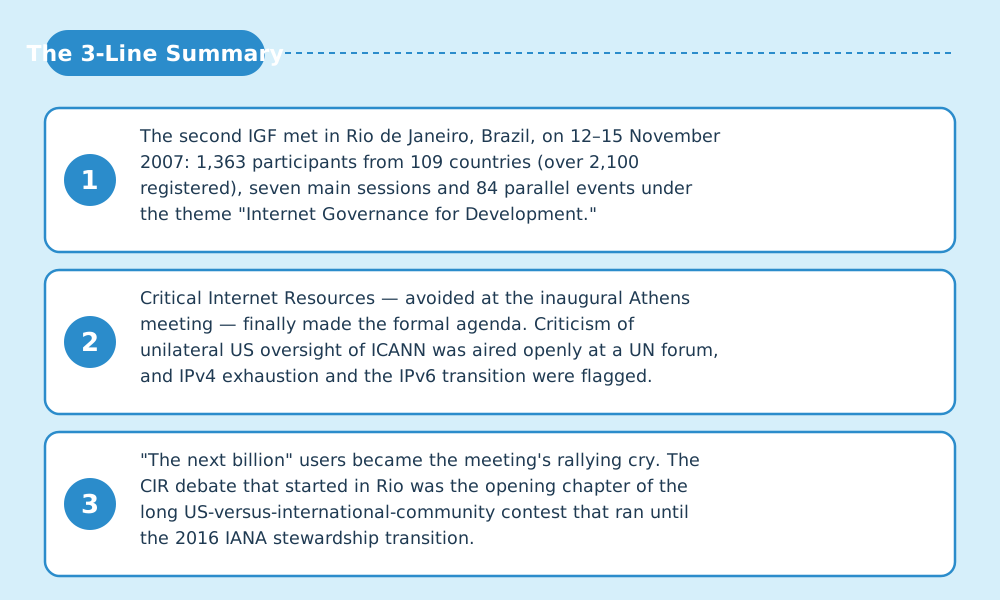
- The second IGF met in Rio de Janeiro, Brazil, on 12–15 November 2007: 1,363 participants from 109 countries (over 2,100 registered), seven main sessions and 84 parallel events under the theme "Internet Governance for Development."
- Critical Internet Resources — avoided at the inaugural Athens meeting — finally made the formal agenda. Criticism of unilateral US oversight of ICANN was aired openly at a UN forum, and IPv4 exhaustion and the IPv6 transition were flagged.
- "The next billion" users became the meeting's rallying cry. The CIR debate that started in Rio was the opening chapter of the long US-versus-international-community contest that ran until the 2016 IANA stewardship transition.
Welcome — this is the Japan IGF Support Organization. This in-depth report on Global IGF 2007 in Rio de Janeiro draws on official outputs, session records and on-site reporting. In a hurry? The three lines above and the diagrams carry the gist.
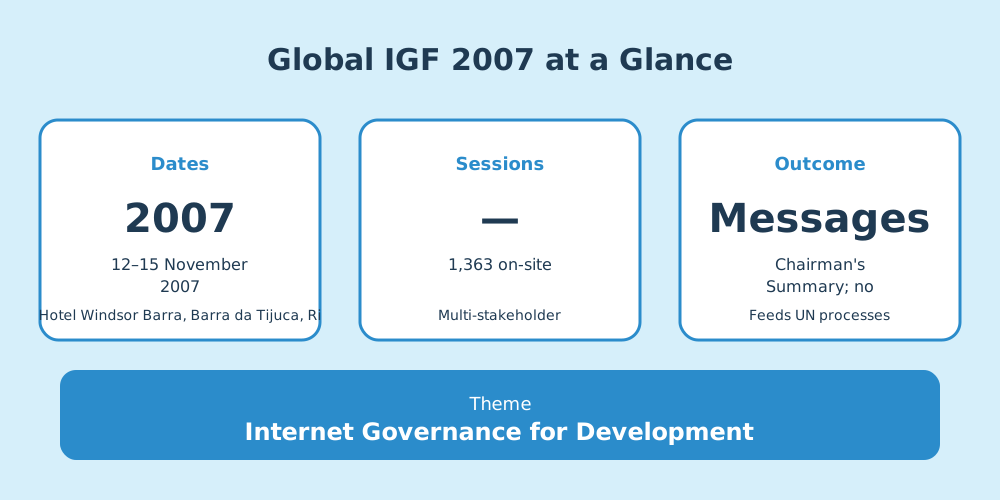
Conference at a Glance (from official records)
| Item | Detail |
|---|---|
| Dates | 12–15 November 2007 |
| Venue | Hotel Windsor Barra, Barra da Tijuca, Rio de Janeiro, Brazil |
| Theme | Internet Governance for Development |
| Participants | 1,363 (1,363 on-site participants from 109 countries; over 2,100 registered in advance (700 civil society, 550 government, 300 business, 100 international organisations, 400 others) plus 100+ press) |
| Main sessions | 7 |
| Parallel events | 84 (36 workshops, 23 best practice forums, 11 dynamic coalition meetings, 8 open forums, 6 other events) |
| Chair | Sérgio Rezende, Brazil's Minister of Science and Technology (Meeting Chairman) |
| Host | Government of Brazil (Brazilian Internet Steering Committee, CGI.br) and the United Nations |
| Outcome | Chairman's Summary; no negotiated outcome document |
| First | First IGF to put Critical Internet Resources (CIR) on the agenda as a main session |
(See the source list at the end of this article.)
Discussion Digest — from the Session Records
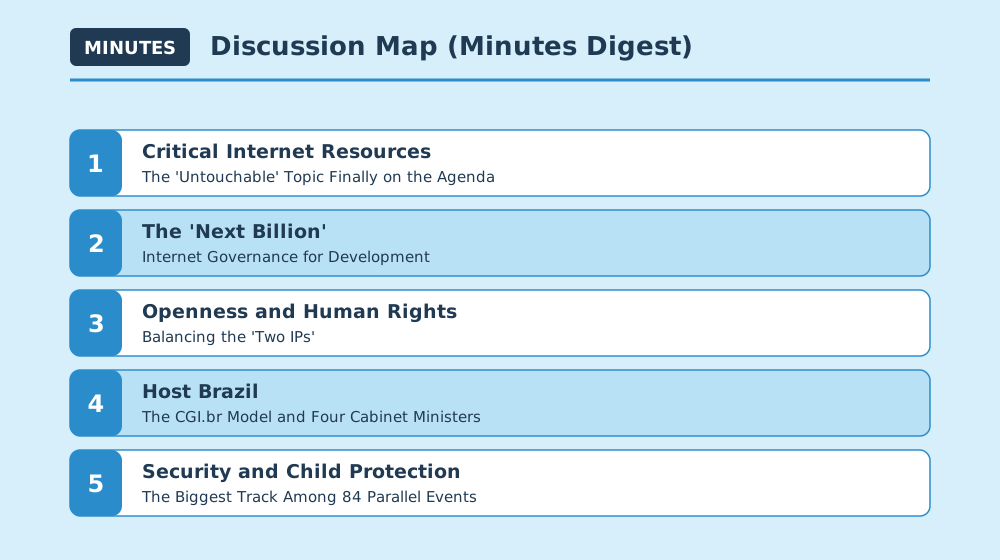
Key exchanges extracted from session records and transcripts.
1. Critical Internet Resources — The 'Untouchable' Topic Finally on the Agenda
Sessions: Main Session "Critical Internet Resources" (first of the five thematic sessions; chaired by Plínio de Aguiar Junior, CGI.br Board Member)
"We want to ensure that our members continue to operate and grow their businesses in the self-regulated environment that has proved so crucial to the success of the Internet"
— Axel Pawlik (Managing Director, RIPE NCC) [1][4][6]
- CIR — management of domain names, IP addresses and root servers, dodged in Athens — got its first main session, and 'unilateral control of ICANN by a single government' was criticised openly [1][4][6]
- One proposal called for a special multi-stakeholder working group under the UN Secretary-General to discuss gradually transferring Internet governance to the authority of the international community; others defended ICANN's independence from governments [1][4][6]
- Panellists discussed the coming exhaustion of ICANN's unassigned IPv4 pool — not a fatal event, but proof that IPv6 deployment and full IPv4/IPv6 interoperability were urgent [1][4][6]
2. The 'Next Billion' — Internet Governance for Development
Sessions: Opening Session and Main Session "Access" (chaired by Hélio Costa, Brazil's Minister of Communications)
- Under the theme "Internet Governance for Development," connecting the five and a half billion people still offline framed the whole meeting, and "the next billion" emerged as a call for action [1]
- Regional Internet Exchange Points (IXPs) were showcased as collaboration that cuts costs and keeps traffic local, while governments' role in solid regulatory frameworks for universal access was affirmed [1]
- For people living on two dollars a day, telecom and Internet budgets mean less than two dollars a month — new business models and public-private partnerships were called essential [1]
3. Openness and Human Rights — Balancing the 'Two IPs'
Sessions: Main Session "Openness" (chaired by Ronaldo Lemos, law professor, Center of Technology and Society, Rio de Janeiro)
"Internet is a public good and should be governed based on public interest principles including human rights, free expression, open standards, privacy, balanced intellectual property, interoperability, creativity, transparency, and accountability"
— Anriette Esterhuysen (Executive Director, APC) [1][3]
- The session weighed the 'two IPs' — Internet protocol and intellectual property — and grounded openness in Article 19 of the Universal Declaration of Human Rights, framing human rights compliance as 'a journey, not a destination' for business as well as governments [1][3]
- IP Justice's report charged that censorship and human rights discussion was discouraged — China reportedly vetoed human rights as a cross-cutting theme in consultations — while Brazil and Italy jointly called for human rights to be a focus of IGF 2008 [1][3]
- Criticism lingered over gender imbalance: all seven panellists in the Openness main session were men [1][3]
4. Host Brazil — The CGI.br Model and Four Cabinet Ministers
Sessions: Opening Ceremony and the main sessions (chaired by host Brazil)
"The IGF had a mission to discuss and find ways to ensure that Internet can be a tool for meeting the principles and commitments of the Tunis Agenda, to build an Information Society which is inclusive, human centered, and geared to development"
— Sérgio Rezende (Brazil's Minister of Science and Technology, Meeting Chairman) [1][3][7]
"Like the Internet itself, all the real action at this forum was at the edges"
— Nitin Desai (UN Secretary-General's Special Adviser for Internet Governance) [1][3][7]
- Multi-stakeholder CGI.br (Brazilian Internet Steering Committee) hosted, and four Brazilian cabinet ministers took part — including musician-turned-Culture-Minister Gilberto Gil, who chaired the Diversity session [1][3][7]
- Rio pioneered sharing main-session chairs across stakeholders (civil society chaired Openness; the private sector chaired Security). In his message, UN Secretary-General Ban Ki-moon called the IGF a 'new model of international cooperation and, just like the Internet, it is in constant evolution' [1][3][7]
- Yet grievances were recorded too: VIP badges went only to government and business representatives, sidelining civil society [1][3][7]
5. Security and Child Protection — The Biggest Track Among 84 Parallel Events
Sessions: Main Session "Security" (chaired by Antonio Tavares, private-sector representative on CGI.br) and related workshops
- Of the 84 parallel events, 19 dealt with security — the largest cluster — and 9 of those spotlighted child protection and the fight against child pornography online [1]
- It was noted that 95% of online crimes are covered by existing legislation; the real gap is cross-border enforcement, prompting calls for police cooperation and wider adoption of the Council of Europe Convention on Cybercrime [1]
- One speaker framed security as an attempt to achieve 'control over the future' — 100% security is impossible — while others argued that strong privacy laws themselves enhance security, notably against identity theft [1]
Three-Minute Short Talk — Your Questions Answered
Q. So what did the conference actually decide?
A. The IGF doesn't 'decide' — it's the UN's forum where governments, companies and civil society talk as equals. But Rio broke new ground: who controls the Internet's core resources (domain names, IP addresses) — taboo at the first meeting — finally made the formal agenda.
Q. What was the most contentious topic?
A. Unilateral US oversight of ICANN. A proposal to gradually transfer Internet governance to the international community collided head-on with defenders of the private-sector-led status quo. Civil society's protest at the sidelining of human rights added fuel.
Q. Why should I care?
A. Rio put IPv4 address exhaustion and the IPv6 transition on the UN's radar — the shift your devices quietly rely on today. And the US-versus-international-community contest that opened in Rio ran all the way to the 2016 IANA stewardship transition, shaping how the Internet is run now.
What Is Global IGF? (for first-time readers)
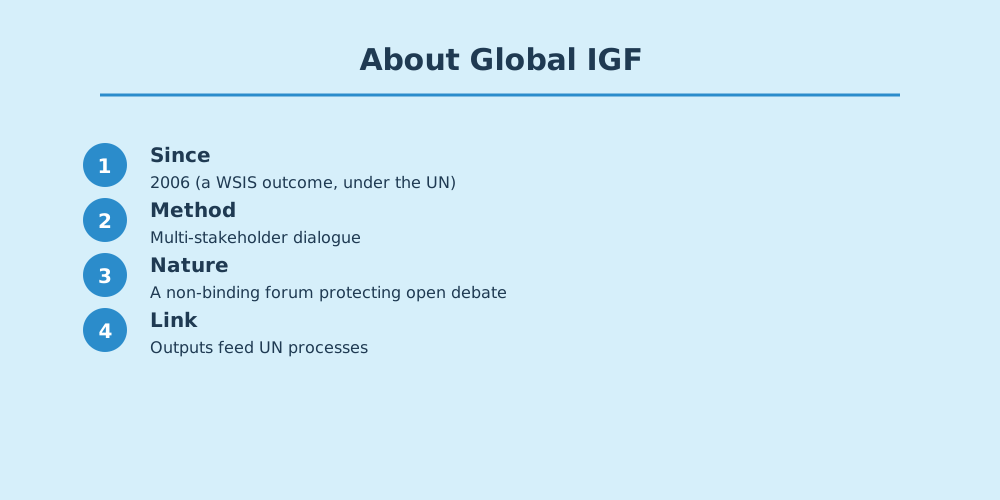
Global IGF has met annually under UN auspices since 2006 — the one global conference where governments, business, civil society, the technical community and youth debate internet governance as equals (the multistakeholder model).
Why It Matters to You
What was discussed here becomes the baseline for national digital policy, platform rules and AI regulation worldwide within a few years. The principles confirmed at the 2007 meeting are the foundation of the "next rules" for the phones, social platforms and AI services you use every day.
Sources & References
- Internet Governance Forum (IGF) The First Two Years — Rio de Janeiro Meeting 2007, Chairman's Summary — UN IGF Secretariat / UN DESA (accessed 2026-07-10)
- Second IGF Meeting: Rio de Janeiro, Brazil — UN IGF Secretariat (accessed 2026-07-10)
- IP Justice Report on 2007 Internet Governance Forum (IGF) — IP Justice (accessed 2026-07-10)
- Internet Governance Forum – Rio de Janeiro 2007 — RIPE NCC (accessed 2026-07-10)
- Internet Governance Forum — IGF II, Rio de Janeiro 2007 — en (accessed 2026-07-10)
- The power struggle over critical Internet resources / IGF 2007 coverage — Elon University Imagining the Internet (accessed 2026-07-10)
- Participe dos debates promovidos pelo CGI.br no IGF 2007 — ブラジル・インターネット運営委員会 (accessed 2026-07-10)
Quotes are translated or condensed from the records listed above. Bracketed numbers [n] refer to the source list.
Related links
- IGF official (NRI list): https://www.intgovforum.org/en/content/national-and-regional-igf-initiatives
- Japan IGF: https://japanigf.jp/
- Yuki Nakazawa's blog: https://nkzw.jp/category/igf/
Revision History
Rev. 1 — published 12 November 2007, 21:00 (Article published)
Rev. 2 — updated 10 July 2026, 14:28 (Fully revised into the in-depth edition: added the 3-line summary, minutes digest, short talk, source list and diagrams (all quotes verified against the listed sources))
— 中澤祐樹