
The 3-Line Summary
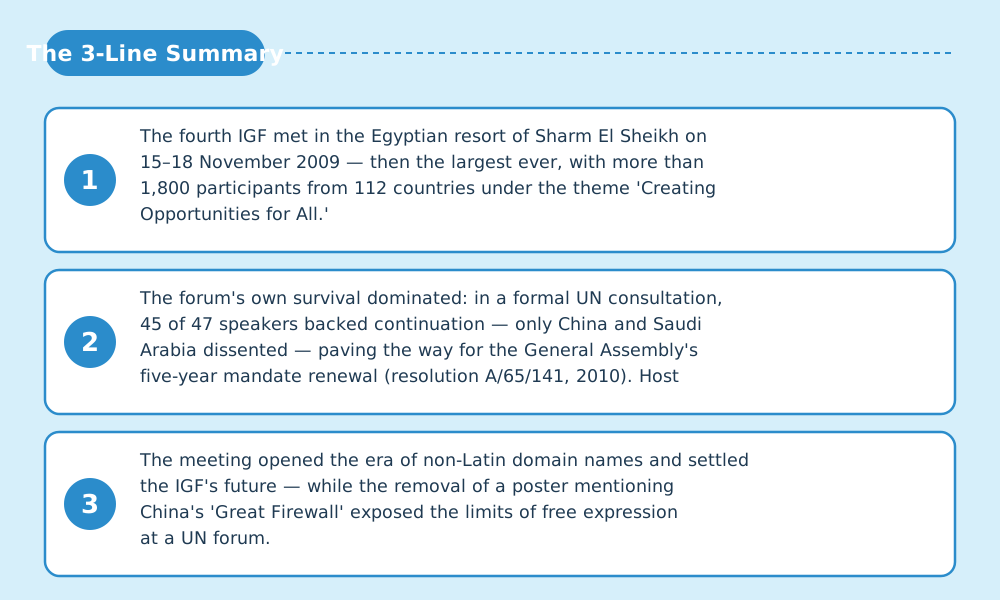
- The fourth IGF met in the Egyptian resort of Sharm El Sheikh on 15–18 November 2009 — then the largest ever, with more than 1,800 participants from 112 countries under the theme 'Creating Opportunities for All.'
- The forum's own survival dominated: in a formal UN consultation, 45 of 47 speakers backed continuation — only China and Saudi Arabia dissented — paving the way for the General Assembly's five-year mandate renewal (resolution A/65/141, 2010). Host Egypt unveiled its Arabic-script domain.
- The meeting opened the era of non-Latin domain names and settled the IGF's future — while the removal of a poster mentioning China's 'Great Firewall' exposed the limits of free expression at a UN forum.
Welcome — this is the Japan IGF Support Organization. This in-depth report on Global IGF 2009 in Sharm El Sheikh draws on official outputs, session records and on-site reporting. In a hurry? The three lines above and the diagrams carry the gist.
Conference at a Glance (from official records)
| Item | Detail |
|---|---|
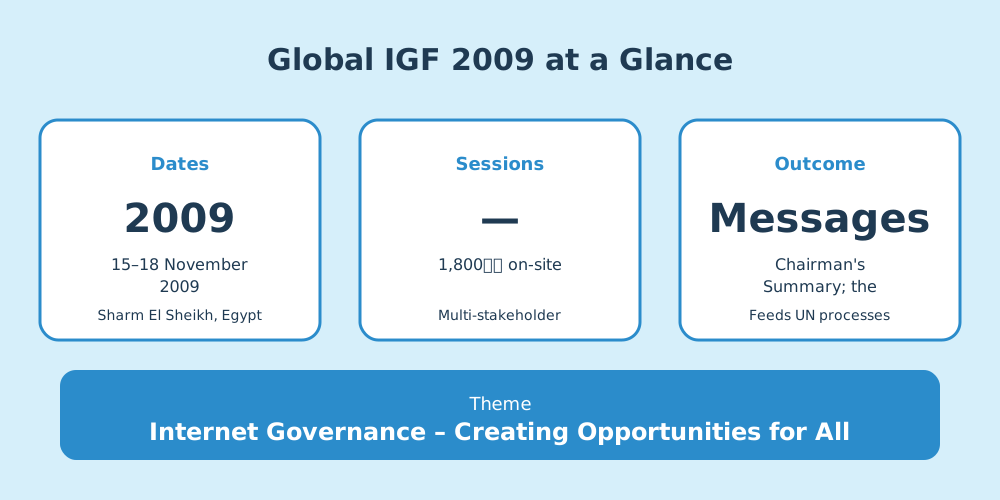
| Edition | Fourth IGF meeting |
| Dates | 15–18 November 2009 |
| Venue | Sharm El Sheikh, Egypt |
| Theme | Internet Governance – Creating Opportunities for All |
| Participants | More than 1,800 participants (largest IGF attendance to date) |
| Countries | 112 |
| Governments | 96 |
| Accredited media | 122 |
| Remote hubs | 11 |
| Host | Government of Egypt and the United Nations |
| Outcome | Chairman's Summary; the continuation consultation fed into the Secretary-General's report and the UN General Assembly's five-year mandate renewal (2011–2015) via resolution A/65/141 in 2010 |
(See the source list at the end of this article.)
Discussion Digest — from the Session Records
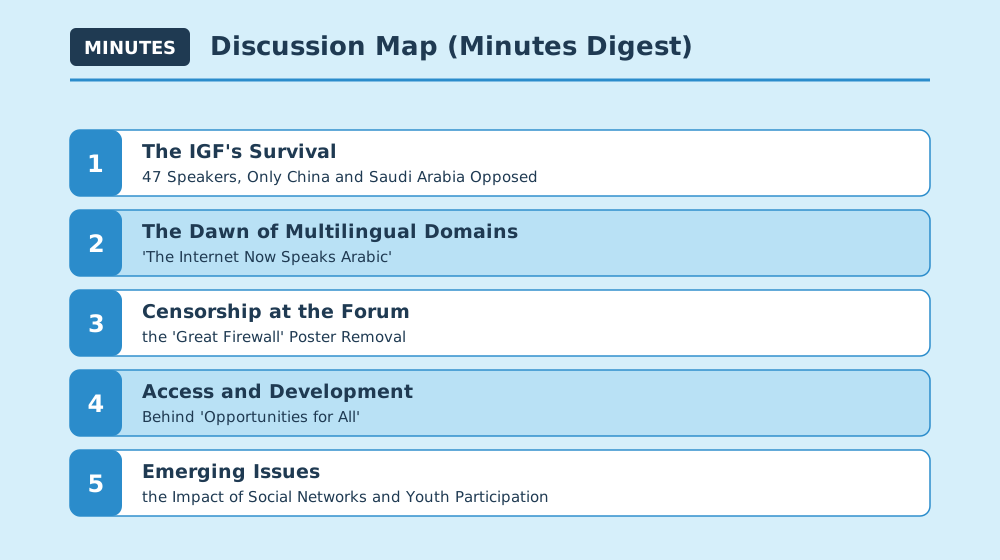
Key exchanges extracted from session records and transcripts.
1. The IGF's Survival — 47 Speakers, Only China and Saudi Arabia Opposed
Sessions: Main Session 'Taking Stock and the Way Forward' (18 November, chaired by UN Under-Secretary-General Sha Zukang with IGF Secretariat Executive Coordinator Markus Kummer)
"The IGF has provided a neutral venue in which important Internet issues can be discussed — it should definitely be continued"
— Robert Kahn (co-inventor of TCP/IP) [6][5][3]
"The lack of decision-making is what makes the Internet Governance Forum such an important activity for all of us"
— Vint Cerf (co-inventor of TCP/IP, via video) [6][5][3]
"The current IGF cannot solve in substance the issues of unilateral control of critical Internet resources — without reform to the IGF, it is not necessary to give the IGF a five-year extension"
— Chen Yin (head of the Chinese delegation) [6][5][3]
- Held as the formal consultation on continuation required by the Tunis Agenda within five years of the IGF's creation: 47 stakeholders spoke for three minutes each, 45 in favour — only China and Saudi Arabia dissented [6][5][3]
- Saudi Arabia's Abdullah Al Darrab (deputy governor, Communications and IT Commission) argued 'this forum should start with another path other than the path of the IGF,' favouring a more intergovernmental framework [6][5][3]
- Sha Zukang reported the consultation to the Secretary-General; in 2010 the UN General Assembly renewed the mandate for five years (2011–2015) in resolution A/65/141 [6][5][3]
2. The Dawn of Multilingual Domains — 'The Internet Now Speaks Arabic'
Sessions: Host-country announcement at the Opening Ceremony (15 November)
"The Internet now speaks Arabic"
— Tarek Kamel (Egypt's Minister of Communications and Information Technology) [8]
- At the opening ceremony Egypt announced it would be the first Arab nation to apply for a non-Latin country-code domain (Arabic-script '.Egypt') under ICANN's IDN ccTLD Fast Track approved in October 2009 [8]
- Yahoo co-founder Jerry Yang noted that Arabic accounted for less than 1% of online content despite over 300 million Arabic speakers, announcing Arabic mail and messenger services for the following year [8]
3. Censorship at the Forum — the 'Great Firewall' Poster Removal
Sessions: OpenNet Initiative (ONI) book reception (15 November)
"We condemn this undemocratic act of censoring our event just because someone is trying to impress or be in the good graces of the Chinese government"
— Al Alegre (Foundation for Media Alternatives, Philippines) [7]
- UN security removed a poster at the ONI reception for the forthcoming book 'Access Controlled' because it referenced China's 'Great Firewall'; officials initially cited an objection from 'a member state' [7]
- ONI's Ron Deibert (Citizen Lab, University of Toronto) announced he would file a complaint about the 'censorship' with the UN Special Rapporteur for Human Rights; civil society decried censorship occurring at the very forum meant to discuss internet governance [7]
4. Access and Development — Behind 'Opportunities for All'
Sessions: Sha Zukang's opening address (15 November) and the Access and Diversity main session
"Good and democratic Internet governance is a means of achieving development for all"
— Sha Zukang (UN Under-Secretary-General for Economic and Social Affairs) [4]
- The opening address cited stark divides: over 1.5 billion people online (about a quarter of humanity), but internet penetration of 64% in developed regions versus 17.5% in developing countries and just 1.5% in least developed countries (2009 figures) [4]
- Sha Zukang stressed that 'the IGF works through voluntary cooperation, not legal compulsion,' underlining its character as a dialogue forum [4]
5. Emerging Issues — the Impact of Social Networks and Youth Participation
Sessions: Main Session 'Emerging Issues: Impact of Social Networks' and related sessions
- The social impact of fast-growing social networks headlined the Emerging Issues session, and encouraging youth participation in internet governance was a key focus of the meeting [1][3]
- The entire meeting was webcast with real-time transcription of main sessions, and 11 remote hubs worldwide enabled participation — an early template for today's hybrid IGF [1][3]
Three-Minute Short Talk — Your Questions Answered
Q. So what did the conference actually decide?
A. The IGF itself doesn't decide anything — but this meeting hosted the UN's formal consultation on whether the forum should continue. Forty-five of 47 speakers said yes, the result went to the Secretary-General and the General Assembly, and in 2010 the mandate was renewed for five years.
Q. What was the most contentious topic?
A. The forum's own survival. China opposed extension, arguing the IGF could not resolve 'unilateral control of critical Internet resources,' and Saudi Arabia proposed a different path. Meanwhile, UN security removed a poster referencing China's 'Great Firewall' — censorship at the very forum meant to discuss internet governance.
Q. Why should I care?
A. Egypt's announcement of the first Arabic-script country domain opened the era of web addresses in non-Latin scripts — the path to domain names in every language. And because continuation was effectively settled here, the IGF still exists today.
What Is Global IGF? (for first-time readers)
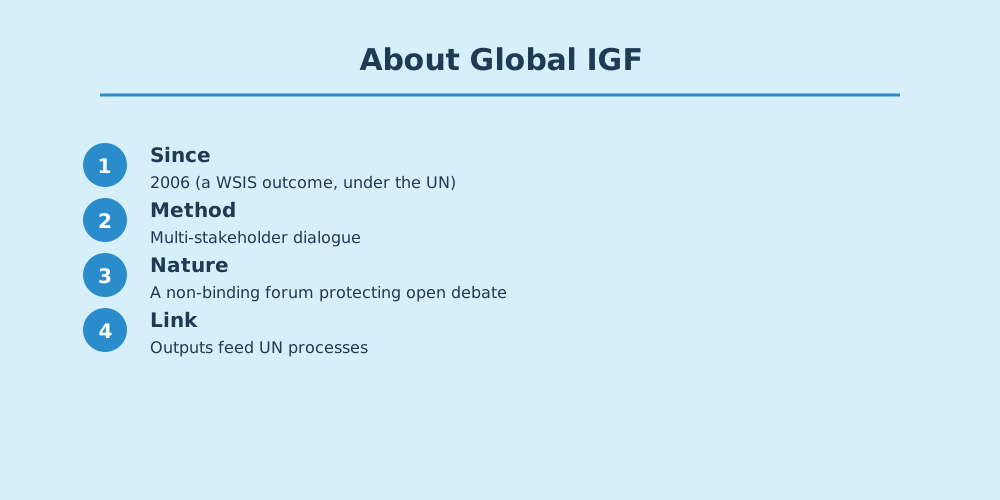
Global IGF has met annually under UN auspices since 2006 — the one global conference where governments, business, civil society, the technical community and youth debate internet governance as equals (the multistakeholder model).
Why It Matters to You
What was discussed here becomes the baseline for national digital policy, platform rules and AI regulation worldwide within a few years. The principles confirmed at the 2009 meeting are the foundation of the "next rules" for the phones, social platforms and AI services you use every day.
Sources & References
- The IGF 2009 Meeting — UN IGF Secretariat (accessed 2026-07-10)
- Chairman's Summary — IGF 2009 Sharm El Sheikh (PDF) — UN IGF Secretariat (accessed 2026-07-10)
- Internet Governance Forum — IGF IV, Sharm El Sheikh, Egypt 2009 — en (accessed 2026-07-10)
- Opening Address to the Internet Governance Forum (Sha Zukang, 15 November 2009) — UN DESA (accessed 2026-07-10)
- Opening Statement to the Stocktaking Session of the Internet Governance Forum (Sha Zukang, 18 November 2009) — UN DESA (accessed 2026-07-10)
- Main Session: Desirability of Continuing Global IGF Meetings (IGF 2009) — Elon University — Imagining the Internet (accessed 2026-07-10)
- Anti-censorship and surveillance group censored at the Internet forum in Egypt — APC (accessed 2026-07-10)
- Egypt to Apply for 1st Arabic Domain Name — AP (accessed 2026-07-10)
Quotes are translated or condensed from the records listed above. Bracketed numbers [n] refer to the source list.
Related links
- IGF official (NRI list): https://www.intgovforum.org/en/content/national-and-regional-igf-initiatives
- Japan IGF: https://japanigf.jp/
- Yuki Nakazawa's blog: https://nkzw.jp/category/igf/
Revision History
Rev. 1 — published 15 November 2009, 16:00 (Article published)
Rev. 2 — updated 10 July 2026, 14:28 (Fully revised into the in-depth edition: added the 3-line summary, minutes digest, short talk, source list and diagrams (all quotes verified against the listed sources))
— 中澤祐樹