


The 3-Line Summary
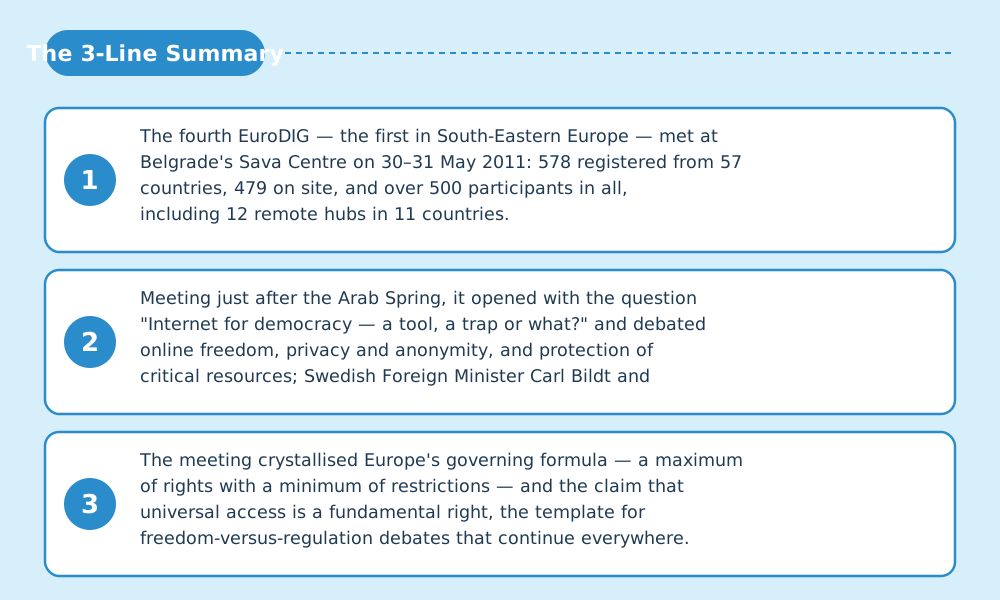
- The fourth EuroDIG — the first in South-Eastern Europe — met at Belgrade's Sava Centre on 30–31 May 2011: 578 registered from 57 countries, 479 on site, and over 500 participants in all, including 12 remote hubs in 11 countries.
- Meeting just after the Arab Spring, it opened with the question "Internet for democracy — a tool, a trap or what?" and debated online freedom, privacy and anonymity, and protection of critical resources; Swedish Foreign Minister Carl Bildt and Commission Vice-President Neelie Kroes sent video messages, and the Messages from Belgrade were adopted.
- The meeting crystallised Europe's governing formula — a maximum of rights with a minimum of restrictions — and the claim that universal access is a fundamental right, the template for freedom-versus-regulation debates that continue everywhere.
Welcome — this is the Japan IGF Support Organization. This in-depth report on EuroDIG 2011 in Belgrade draws on official outputs, session records and on-site reporting. In a hurry? The three lines above and the diagrams carry the gist.
Conference at a Glance (from official records)
| Item | Detail |
|---|---|
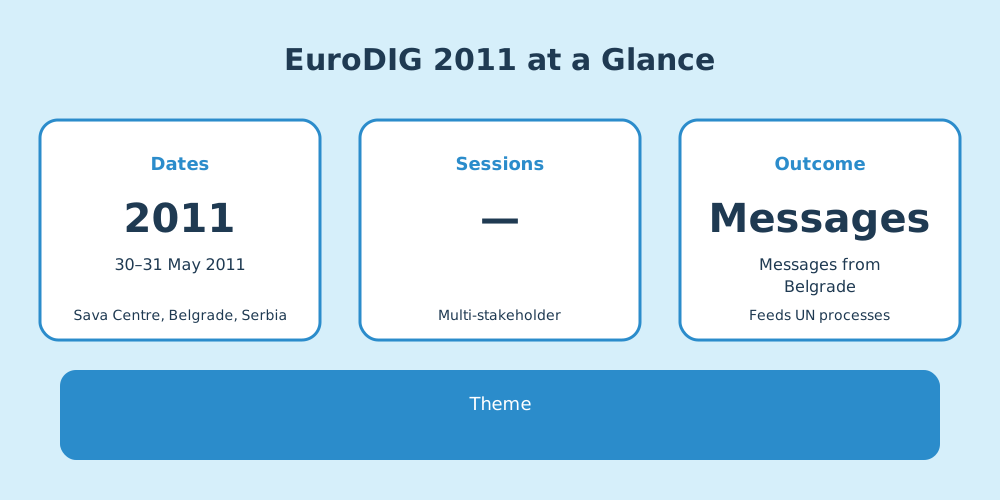
| Edition | 4th EuroDIG (first held in South-Eastern Europe) |
| Dates | 30–31 May 2011 |
| Venue | Sava Centre, Belgrade, Serbia |
| Theme | Regional governance themes |
| Registrations | 578 |
| Countries | 57 |
| Remote participants | 99 |
| Remote hubs | 12 remote hubs in 11 countries (Armenia, Bangladesh, Barbados, Belarus, Bosnia and Herzegovina, Colombia, France, Moldova, Spain, Sweden, Ukraine) |
| Attendees | 479 |
| Chair | Jasna Matić, State Secretary for Digital Agenda, Ministry of Culture, Media and Information Society of Serbia |
| Host | Hosted by the Digital Agenda Administration of the Republic of Serbia; organised by the Council of Europe, Swiss OFCOM, DiploFoundation and the EBU, with support from RNIDS, RATEL and others |
| Outcome | Messages from Belgrade |
(See the source list at the end of this article.)
Discussion Digest — from the Session Records
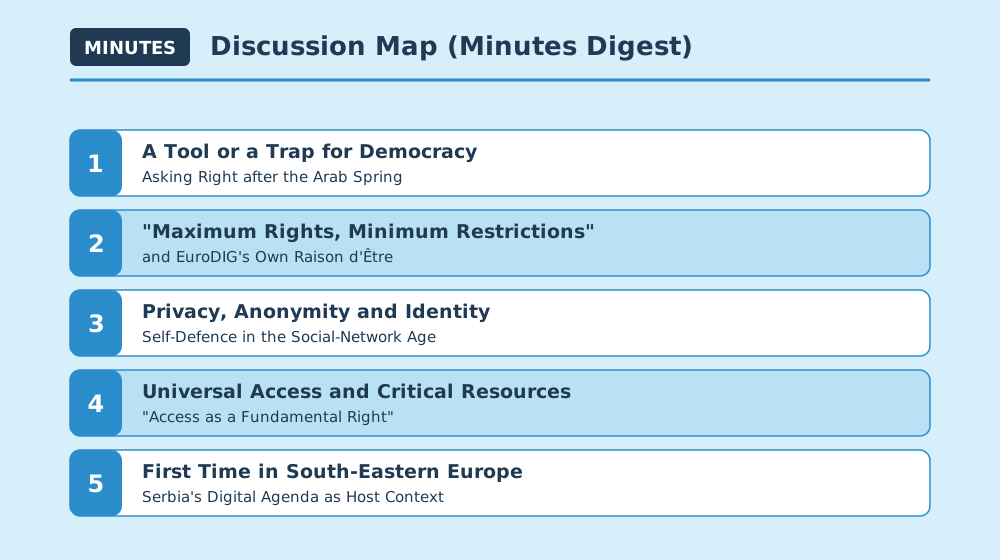
Key exchanges extracted from session records and transcripts.
1. A Tool or a Trap for Democracy — Asking Right after the Arab Spring
Sessions: Opening session: "Internet for democracy – a tool, a trap or what?" (30 May, 12:00–13:30)
"The Internet is under threat and freedom is under threat, and we in Europe have to stand up for the freedoms of the world and for the freedom of the Internet"
— Carl Bildt (Swedish Foreign Minister, video message) [2]
- Convened just after free communication had shown its force in the Arab countries, the session tackled head-on the internet's power to loosen authoritarian control [2]
- Blocking and filtering were declared incompatible with European standards and principles: a free society should retain a free internet [2]
- Co-moderated by Patrik Fältström (Cisco) and Yrjö Länsipuro (ISOC Finland), with Icelandic MP Birgitta Jónsdóttir, MEP Marietje Schaake and State Secretary Jasna Matić among the panellists [2]
2. "Maximum Rights, Minimum Restrictions" — and EuroDIG's Own Raison d'Être
Sessions: Opening session: "European and national priorities for Internet governance: Towards a pan-European agenda 2020" (30 May)
"The EuroDIG should not change its nature as a multi-stakeholder, nonbinding Forum, where the right questions can be asked. But we also must work together to raise its profile and impact"
— Neelie Kroes (Vice-President of the European Commission, Commissioner for the Digital Agenda, video message) [2]
- The ideal formula posited for internet governance was a maximum of rights with a minimum of restrictions — while candidly noting reality falls far short [2]
- Participants agreed the IGF and EuroDIG model was spreading to national and regional levels and already influencing decision-making [2]
- With the Paris E-G8 fresh in memory, the value of multistakeholder dialogue was weighed against powerful states and companies seeking greater influence over the net [2]
3. Privacy, Anonymity and Identity — Self-Defence in the Social-Network Age
Sessions: Plenary on privacy, anonymity and identity; Workshop 1: "The privacy standards that we want"
- Protecting privacy and identity amid expanding social networks ran through the whole meeting, with responsibility for user awareness shared among public authorities, industry and civil society [2][1]
- Biometric data processing was singled out as requiring enhanced personal-data safeguards [2][1]
- Anonymity was defended as protecting freedom of expression and identity development — particularly for young people — while safeguards against criminal misuse were also demanded [2][1]
4. Universal Access and Critical Resources — "Access as a Fundamental Right"
Sessions: Plenary on cyber security and related sessions
"Several European countries already offer their citizens a legal right to access broadband Internet. Social networking is becoming an essential part of people's rights to communicate and assembly"
— Maud de Boer-Buquicchio (Deputy Secretary General, Council of Europe) [2][1]
- Universal internet access should be treated as a fundamental right, with programmes to assist vulnerable and marginalised groups [2][1]
- Protecting critical resources requires procedures for fast, secure recovery after attack or failure, and identification of critical segments and threats [2][1]
- Trust and security were called fundamental to e-commerce, and law enforcement needs cybercrime-fighting tools that preserve the principle of openness [2][1]
5. First Time in South-Eastern Europe — Serbia's Digital Agenda as Host Context
Sessions: Opening sessions and the meeting as a whole, chaired by State Secretary Jasna Matić
- Hosted by Serbia's Digital Agenda Administration, the meeting showcased e-governance, net neutrality and end-user rights as national priorities, with IT literacy billed as a key Serbian competitive advantage [2][1]
- With 578 registrations and 479 on site it was the largest EuroDIG yet, and remote hubs reached beyond Europe to Bangladesh, Barbados and Colombia [2][1]
- The next EuroDIG was announced for Sweden in 2012, with sponsors including Telenor, Huawei, Microsoft, Google and ICANN [2][1]
Three-Minute Short Talk — Your Questions Answered
Q. What made this meeting distinctive?
A. Timing. Right after the Arab Spring showed the net could shake authoritarian rule, the meeting asked head-on whether the internet is a tool or a trap for democracy — and Sweden's Carl Bildt urged Europe to 'stand up for the freedom of the Internet'.
Q. What came out of it?
A. No binding decisions, but the Messages from Belgrade set out Europe's positions: universal access as a fundamental right, blocking as contrary to European principles, and 'a maximum of rights with a minimum of restrictions' as the governing ideal.
Q. Why should I care?
A. Whether access is a right, and how to balance online freedom against regulation, remain the central questions of platform and telecom policy everywhere — and this 500-person meeting is where Europe first framed them at scale.
What Is EuroDIG? (for first-time readers)
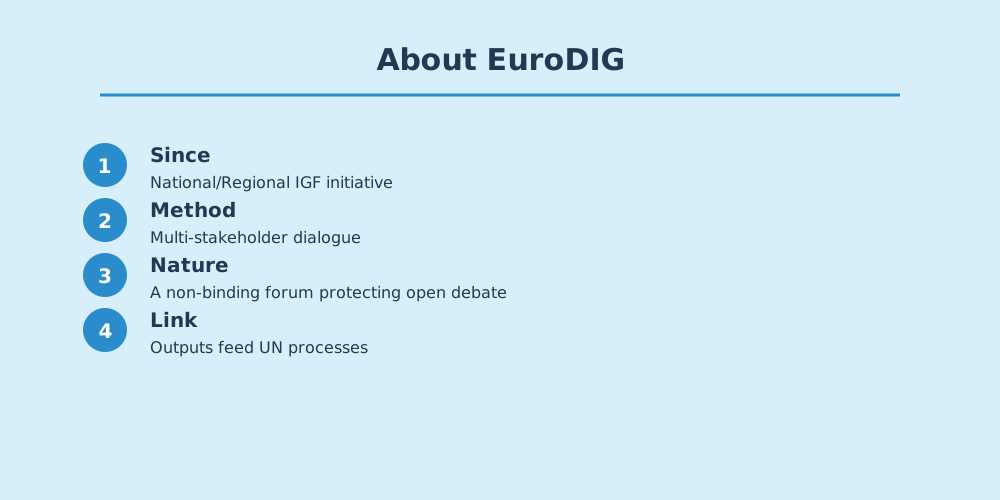
EuroDIG is a National or Regional IGF Initiative (NRI), aligning local internet governance discussion with global IGF principles.
Why It Matters to You
What was discussed here becomes the baseline for national digital policy, platform rules and AI regulation worldwide within a few years. The principles confirmed at the 2011 meeting are the foundation of the "next rules" for the phones, social platforms and AI services you use every day.
Sources & References
- EuroDIG 2011 — eurodigwiki.org (accessed 2026-07-10)
- Messages from Belgrade (PDF) — Council of Europe (accessed 2026-07-10)
- Programme overview 2011 — eurodigwiki.org (accessed 2026-07-10)
- European Dialogue on Internet Governance — en (accessed 2026-07-10)
- Hosting EuroDIG(歴代開催地一覧) — eurodig.org (accessed 2026-07-10)
Quotes are translated or condensed from the records listed above. Bracketed numbers [n] refer to the source list.
Related links
- IGF official (NRI list): https://www.intgovforum.org/en/content/national-and-regional-igf-initiatives
- Japan IGF: https://japanigf.jp/
- Yuki Nakazawa's blog: https://nkzw.jp/category/igf/
Revision History
Rev. 1 — published 30 May 2011, 09:00 (Article published)
Rev. 2 — updated 10 July 2026, 23:16 (Fully revised into the in-depth edition: added the 3-line summary, minutes digest, short talk, source list and diagrams (all quotes verified against the listed sources))
— 中澤祐樹

