


The 3-Line Summary
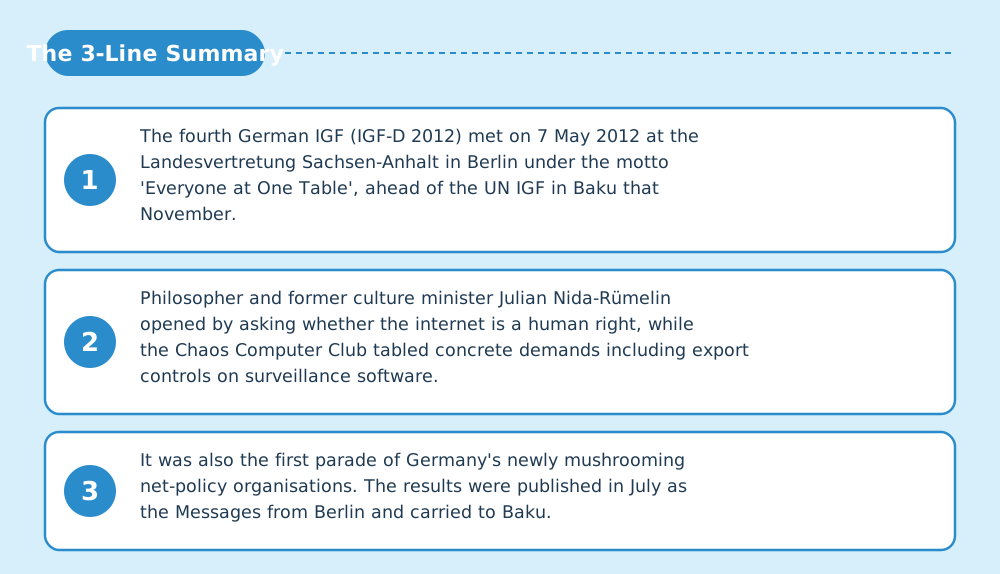
- The fourth German IGF (IGF-D 2012) met on 7 May 2012 at the Landesvertretung Sachsen-Anhalt in Berlin under the motto 'Everyone at One Table', ahead of the UN IGF in Baku that November.
- Philosopher and former culture minister Julian Nida-Rümelin opened by asking whether the internet is a human right, while the Chaos Computer Club tabled concrete demands including export controls on surveillance software.
- It was also the first parade of Germany's newly mushrooming net-policy organisations. The results were published in July as the Messages from Berlin and carried to Baku.
Welcome — this is the Japan IGF Support Organization. This in-depth report on IV. Internet Governance Forum Deutschland (IGF-D 2012) draws on official outputs, session records and on-site reporting. In a hurry? The three lines above and the diagrams carry the gist.
Conference at a Glance (from official records)
| Item | Detail |
|---|---|
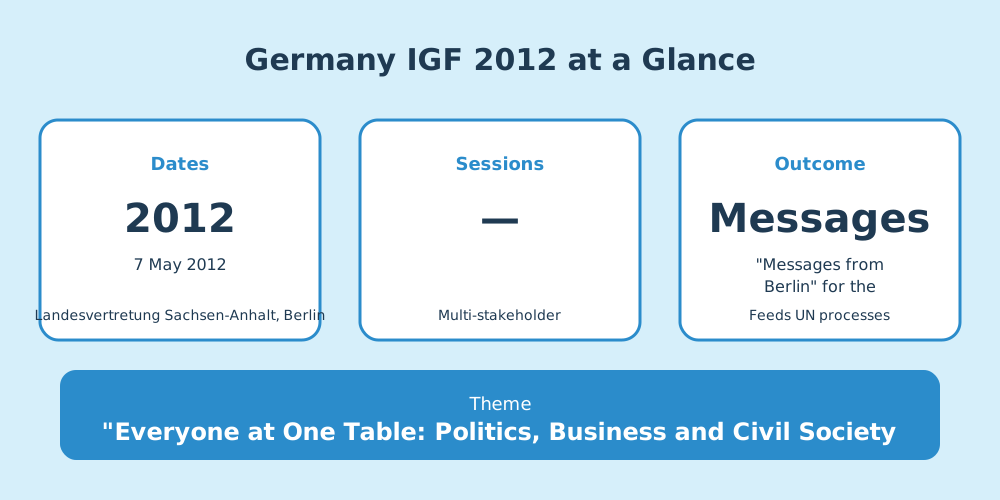
| Official name | IV. Internet Governance Forum Deutschland (IGF-D 2012) |
| Dates | 7 May 2012 |
| Venue | Landesvertretung Sachsen-Anhalt, Berlin |
| Theme | "Everyone at One Table: Politics, Business and Civil Society on the Future of the Internet" |
| Purpose | Germany's contribution to the 7th UN IGF in Baku, Azerbaijan (6–9 November 2012) |
| Host | DGVN (German UN Association), eco and ISOC.DE |
| Outcome | "Messages from Berlin" for the Baku IGF, published on 17 July 2012 |
(See the source list at the end of this article.)
Discussion Digest — from the Session Records
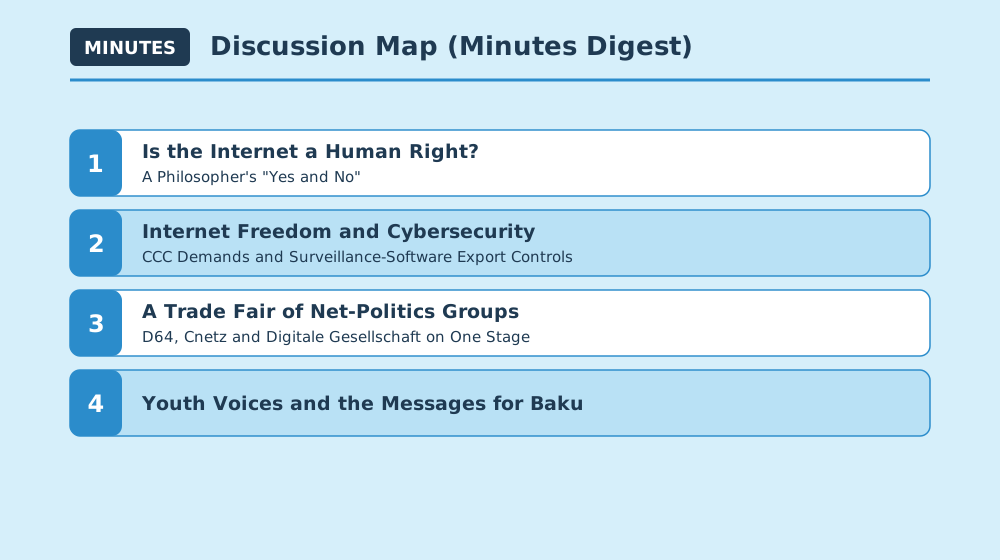
Key exchanges extracted from session records and transcripts.
1. Is the Internet a Human Right? — A Philosopher's "Yes and No"
Sessions: Keynote (10:00) by Julian Nida-Rümelin, former Minister of State for Culture
"You don't get human rights at a discount rate"
— Julian Nida-Rümelin (former Minister of State for Culture; professor of philosophy, LMU Munich) [2][3]
- His answer was a firm 'Jein' (yes-and-no): a technical system can hold no human right, but define the internet as the contemporary expression of a global civil society and a right to participate in that society can be claimed [2][3]
- Uncensored access, he argued, corresponds to the right to education in the Humboldtian tradition [2][3]
- He stressed the constitutive role of privacy for Western humanism — and warned against a video culture reminiscent of medieval lynch mobs [2][3]
2. Internet Freedom and Cybersecurity — CCC Demands and Surveillance-Software Export Controls
Sessions: Panel "Internet Freedom and Cyber Security: International Cooperation" (10:30–12:00, moderated by Ben Wagner)
"Encryption technologies can only help if they are carried through the network with equal rights — and carried at all"
— Peter Franck (deputy chair, Chaos Computer Club; computer forensics expert) [3][2][1]
"I am a fan of states keeping out of the network as far as possible"
— Jimmy Schulz (Member of the Bundestag, FDP) [3][2][1]
- The CCC demanded active support for encryption and anonymisation, alternative networks, and bans on data retention, cell-tower dragnets and state trojans — plus an export ban on 'lawful interception' software such as Gamma's FinFisher to undemocratic regimes [3][2][1]
- Martin Fleischer, the foreign office's cyber-foreign-policy coordinator, pointed to nuclear arms-control law as a possible model for export controls; MP Jimmy Schulz countered that 'inscrutable smartphones' were the bigger problem [3][2][1]
- Schulz also observed that nobody knows whether the hard- and software we use does only what it is supposed to — 'a bigger problem than export controls on surveillance technology' (official site record) [3][2][1]
3. A Trade Fair of Net-Politics Groups — D64, Cnetz and Digitale Gesellschaft on One Stage
Sessions: Panel "Organisations in German Net Politics: An Overview" (12:30–14:00, moderated by Malte Spitz)
"The internet is not a natural landscape. It is not something we found — people made it and decided it"
— Jan Mönikes (Board member, Internet Society German Chapter) [1][3][2]
- From the Google-funded Collaboratory to party-affiliated Cnetz (CDU) and D64 (SPD), civil-society group Digitale Gesellschaft, PolitCamp and the veteran ISOC.DE — Germany's proliferating net-politics organisations lined up on one stage for the first time [1][3][2]
- ISOC.DE's Mönikes warned against taking the internet's open standards for granted and criticised the self-referential nature of the German debate [1][3][2]
- The CDU's Peter Tauber injected realism: the promise of internet freedom is not shared by the majority — German history shows people want security, guaranteed by the state, online too [1][3][2]
- D64's Mathias Richel asked whether Baku should aim for an 'internet constitution' akin to the UN Charter — and the room split [1][3][2]
4. Youth Voices and the Messages for Baku
Sessions: "Now We're Talking!" youth session (15:00–16:30) and the closing Messages workshop (16:30–17:00, Mühlberg & Kleinwächter)
- A dedicated youth slot let young people from NGOs debate the future internet on equal terms, alongside an update on new TLDs and ICANN (GAC representative Schöttner, dotBerlin, nic.at) [1][2][3]
- The closing workshop distilled the day into the Messages from Berlin, published on 17 July 2012 and sent to the 7th UN IGF in Baku (6–9 November) [1][2][3]
- Heise's report title — 'Our Song for Baku', a nod to that year's Eurovision in the same city — captured the wry undertone of a UN IGF hosted by an authoritarian state [1][2][3]
Three-Minute Short Talk — Your Questions Answered
Q. What was the meeting for?
A. Germany's fourth national IGF, distilling domestic views into the 'Messages from Berlin' for the UN IGF in Baku that November — with politics, business and civil society 'at one table'.
Q. What stood out?
A. Philosopher Julian Nida-Rümelin's keynote answering 'Is the internet a human right?' with a firm yes-and-no, and the Chaos Computer Club's demand list, including export controls on surveillance software.
Q. Why does it still matter?
A. Export controls on spyware later became real policy in the Wassenaar Arrangement, and the 'right to participate' framing of internet access echoes in digital-inclusion debates worldwide.
What Is Germany IGF? (for first-time readers)
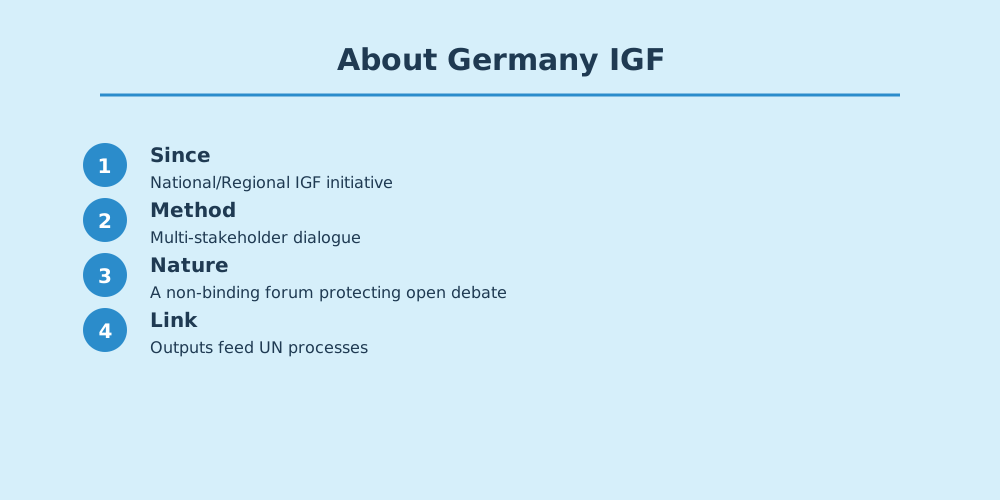
Germany IGF is a National or Regional IGF Initiative (NRI), aligning local internet governance discussion with global IGF principles.
Why It Matters to You
What was discussed here becomes the baseline for national digital policy, platform rules and AI regulation worldwide within a few years. The principles confirmed at the 2012 meeting are the foundation of the "next rules" for the phones, social platforms and AI services you use every day.
Sources & References
- IGF-D 2012 — IV. Internet Governance Forum Deutschland(公式Historieページ、全アジェンダ・主催団体) — IGF-D e.V.(2020年版公式サイト、Wayback Machine保存) (accessed 2026-07-11)
- Stimmen vom IGF-D 2012(2012-05-15)/Messages from Berlin für das UN IGF in Baku 2012(2012-07-17) — IGF-D(旧公式サイト igf-d.de ニュース、Wayback Machine保存) (accessed 2026-07-11)
- Internet Governance: Unser Lied für Baku(Detlef Borchers, 2012-05-08) — heise online (accessed 2026-07-11)
- Internet Governance Forum Deutschland(IGF-D設立経緯・Messages from Berlinの仕組み) — DiploFoundation (accessed 2026-07-11)
Quotes are translated or condensed from the records listed above. Bracketed numbers [n] refer to the source list.
Related links
- IGF official (NRI list): https://www.intgovforum.org/en/content/national-and-regional-igf-initiatives
- Japan IGF: https://japanigf.jp/
- Yuki Nakazawa's blog: https://nkzw.jp/category/igf/
Revision History
Rev. 1 — published 1 June 2012, 14:00 (Article published)
Rev. 2 — updated 16 July 2026, 20:09 (Fully revised into the in-depth edition: added the 3-line summary, minutes digest, short talk, source list and diagrams (all quotes verified against the listed sources))
— 中澤祐樹

