
The 3-Line Summary
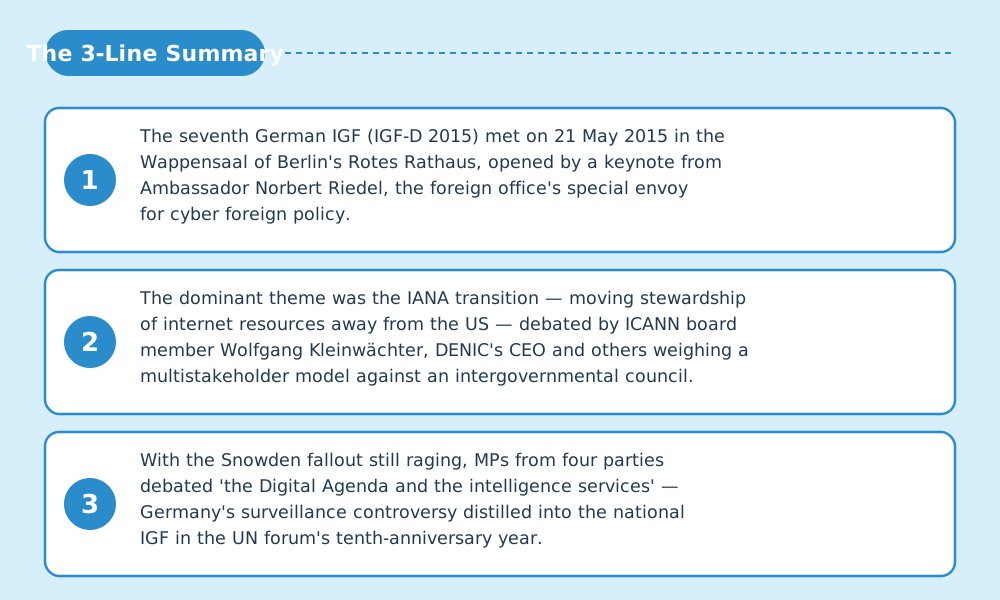
- The seventh German IGF (IGF-D 2015) met on 21 May 2015 in the Wappensaal of Berlin's Rotes Rathaus, opened by a keynote from Ambassador Norbert Riedel, the foreign office's special envoy for cyber foreign policy.
- The dominant theme was the IANA transition — moving stewardship of internet resources away from the US — debated by ICANN board member Wolfgang Kleinwächter, DENIC's CEO and others weighing a multistakeholder model against an intergovernmental council.
- With the Snowden fallout still raging, MPs from four parties debated 'the Digital Agenda and the intelligence services' — Germany's surveillance controversy distilled into the national IGF in the UN forum's tenth-anniversary year.
Welcome — this is the Japan IGF Support Organization. This in-depth report on VII. Internet Governance Forum Deutschland (IGF-D 2015) draws on official outputs, session records and on-site reporting. In a hurry? The three lines above and the diagrams carry the gist.
Conference at a Glance (from official records)
| Item | Detail |
|---|---|
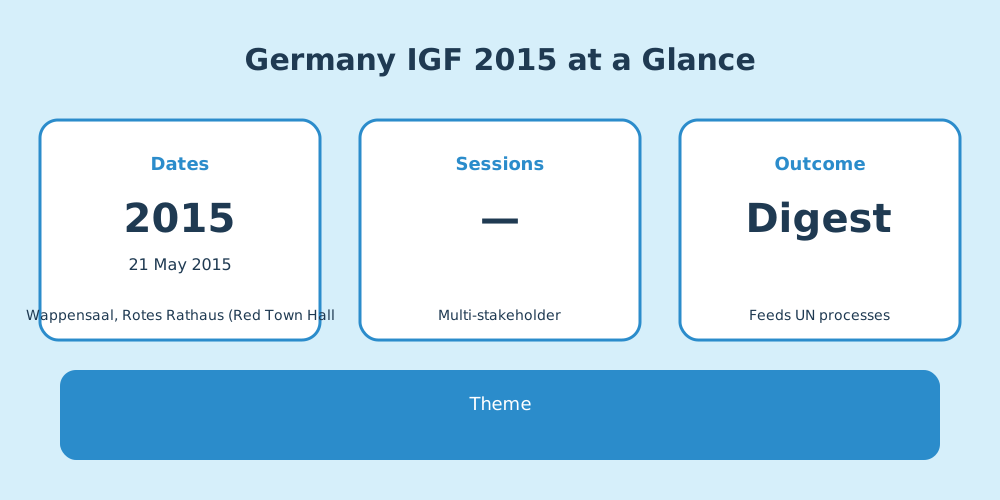
| Official name | VII. Internet Governance Forum Deutschland (IGF-D 2015) |
| Dates | 21 May 2015 |
| Venue | Wappensaal, Rotes Rathaus (Red Town Hall), Berlin |
| Theme | Regional governance themes |
| Purpose | Germany's national meeting in the year of the 10th UN IGF in João Pessoa, focused on the IANA transition and German cyber foreign policy |
| Host | Led by the DGVN (German UN Association), with Reporters Without Borders, eco and others co-organising |
(See the source list at the end of this article.)
Discussion Digest — from the Session Records
Key exchanges extracted from session records and transcripts.
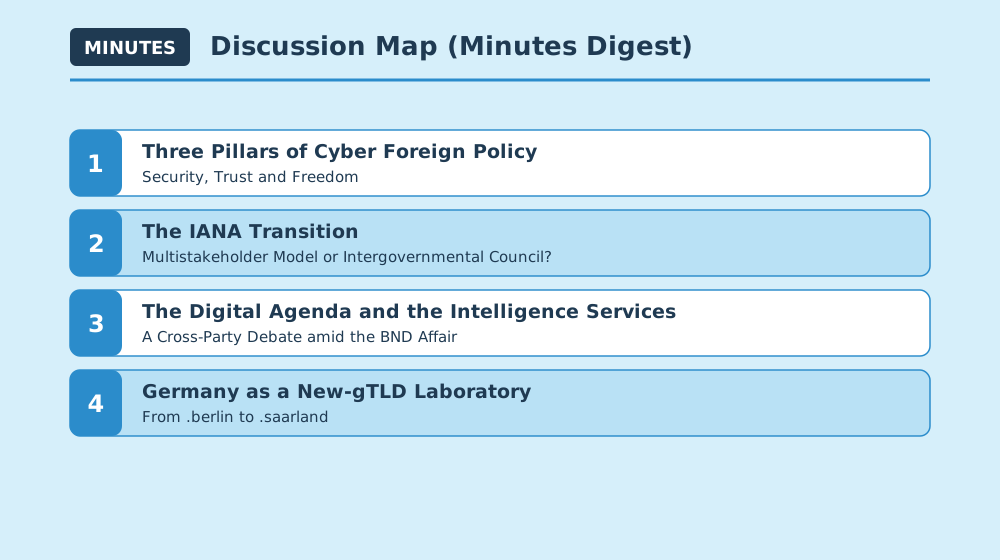
1. Three Pillars of Cyber Foreign Policy — Security, Trust and Freedom
Sessions: Keynote "Cyber Foreign Policy" (9:30) by Ambassador Norbert Riedel, the federal government's special envoy for cyber foreign policy
"The cyber domain is too complex to be managed by one person or one stakeholder alone"
— Norbert Riedel (Ambassador, Special Envoy for Cyber Foreign Policy, Federal Foreign Office) [3][1]
"Trust arrives on foot and leaves on horseback"
— Norbert Riedel (as above) [3][1]
- Riedel framed German cyber foreign policy around three strategic pillars — security, trust and freedom — aiming at 'a free, secure, decentralised and open internet' [3][1]
- He described UN-track work on norms of state behaviour (an 'international law of the net'), bilateral cyber consultations with China, the US, Russia and Brazil, and Germany's role in the 26-nation Freedom Online Coalition [3][1]
- Individuals, he stressed, hold the same rights online as offline — backing the creation of a UN special rapporteur on privacy (appointed June 2015) [3][1]
2. The IANA Transition — Multistakeholder Model or Intergovernmental Council?
Sessions: Lightning talk and interview Q&A (10:00–10:45, Prof. Wolfgang Kleinwächter) and panel "A New Government for the Net: the IANA Transition" (11:15–12:00, moderated by Monika Ermert)
- Prof. Kleinwächter, by then an ICANN board member, framed the question — multistakeholder participation model or intergovernmental council? — in a lightning talk followed by Q&A with the economics ministry's digital-policy chief Stefan Schnorr, ICANN senior advisor Tarek Kamel and ISOC trustee Hans-Peter Dittler [1][2]
- A second panel moderated by tech journalist Monika Ermert brought eco's Oliver Süme, Reporters Without Borders director Christian Mihr and DENIC CEO Jörg Schweiger to probe post-transition accountability and Germany's stake [1][2]
- With the US Commerce Department's original September 2015 deadline looming, press-freedom advocates, the .de registry, industry and government examined the transition's terms at one table [1][2]
3. The Digital Agenda and the Intelligence Services — A Cross-Party Debate amid the BND Affair
Sessions: Panel "Digital Agenda & Intelligence Services: Where Next for the Net?" (12:00–13:00, moderated by Lena Kampf)
- Heavyweights from four parties — Jarzombek (CDU), Klingbeil (SPD), Spitz (Greens) and Wawzyniak (Left) — debated how the government's Digital Agenda squares with intelligence practices [1][2]
- In spring 2015 the scandal over the BND's cooperation with the NSA in spying on European targets was rocking German politics, putting the tension between surveillance distrust and digital-policy ambition centre stage [1][2]
- Investigative journalist Lena Kampf moderated; rapporteurs fed each session into the closing wrap-up led by DGVN secretary-general Beate Wagner [1][2]
4. Germany as a New-gTLD Laboratory — From .berlin to .saarland
Sessions: Panel "New Domain Endings in the Digital Agenda" (14:00–15:00, moderated by Dirk Krischenowski)
- Chaired by Dirk Krischenowski of .berlin — the world's first city TLD — operators of .bayern/.nrw, .koeln/.cologne and .saarland joined eco to assess new gTLDs as regional digital strategy [1][2]
- New gTLDs, attacked at the first IGF-D in 2008 over the USD 185,000 application fee, now featured as working examples of regional branding — a measure of seven years' change [1][2]
- Later, Reporters Without Borders board member Matthias Spielkamp moderated a youth debate with blogger Michael Seemann, continuing the forum's youth track [1][2]
Three-Minute Short Talk — Your Questions Answered
Q. What kind of meeting was this?
A. Germany's seventh national IGF, held in Berlin's town hall: a keynote by the foreign office's cyber envoy, then a full day examining the IANA transition with government, industry and press-freedom groups.
Q. What was the central theme?
A. Who runs the 'new government of the net'. With the US preparing to hand over IANA stewardship, the debate weighed a multistakeholder handover against an intergovernmental council.
Q. Why should I care?
A. The IANA transition underpins every domain name on earth, and the 'security, trust, freedom' triad Riedel set out remains the template for democratic cyber diplomacy.
What Is Germany IGF? (for first-time readers)
Germany IGF is a National or Regional IGF Initiative (NRI), aligning local internet governance discussion with global IGF principles.
Why It Matters to You
What was discussed here becomes the baseline for national digital policy, platform rules and AI regulation worldwide within a few years. The principles confirmed at the 2015 meeting are the foundation of the "next rules" for the phones, social platforms and AI services you use every day.
Sources & References
- IGF-D 2015 — VII. Internet Governance Forum Deutschland(公式Historieページ、全アジェンダ) — IGF-D e.V.(2020年版公式サイト、Wayback Machine保存) (accessed 2026-07-11)
- Internet Governance Forum Deutschland tagt am 21. Mai 2015 in Berlin — iRights.info (accessed 2026-07-11)
- Cyber-Außenpolitik. Rede des Sonderbeauftragten für Cyber-Außenpolitik im Auswärtigen Amt, Norbert Riedel, beim Internet Governance Forum Deutschland(2015-05-21講演録) — ドイツ連邦外務省(Auswärtiges Amt) (accessed 2026-07-11)
- Internet Governance Forum Deutschland(IGF-D設立経緯・Messages from Berlinの仕組み) — DiploFoundation (accessed 2026-07-11)
Quotes are translated or condensed from the records listed above. Bracketed numbers [n] refer to the source list.
Related links
- IGF official (NRI list): https://www.intgovforum.org/en/content/national-and-regional-igf-initiatives
- Japan IGF: https://japanigf.jp/
- Yuki Nakazawa's blog: https://nkzw.jp/category/igf/
Revision History
Rev. 1 — published 26 June 2015, 14:00 (Article published)
Rev. 2 — updated 16 July 2026, 20:09 (Fully revised into the in-depth edition: added the 3-line summary, minutes digest, short talk, source list and diagrams (all quotes verified against the listed sources))
— 中澤祐樹