

The 3-Line Summary
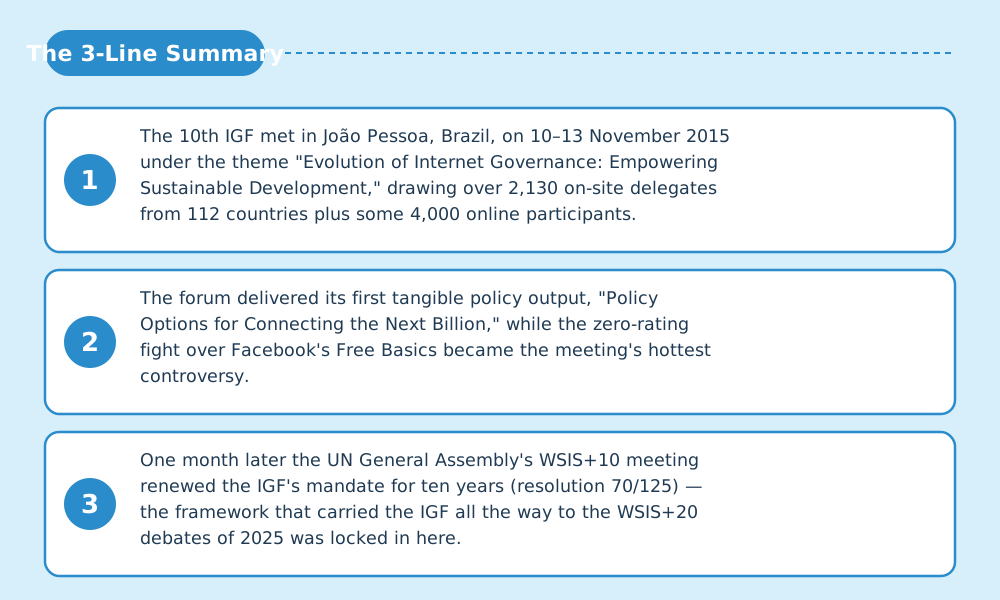
- The 10th IGF met in João Pessoa, Brazil, on 10–13 November 2015 under the theme "Evolution of Internet Governance: Empowering Sustainable Development," drawing over 2,130 on-site delegates from 112 countries plus some 4,000 online participants.
- The forum delivered its first tangible policy output, "Policy Options for Connecting the Next Billion," while the zero-rating fight over Facebook's Free Basics became the meeting's hottest controversy.
- One month later the UN General Assembly's WSIS+10 meeting renewed the IGF's mandate for ten years (resolution 70/125) — the framework that carried the IGF all the way to the WSIS+20 debates of 2025 was locked in here.
Welcome — this is the Japan IGF Support Organization. This in-depth report on Global IGF 2015 in João Pessoa draws on official outputs, session records and on-site reporting. In a hurry? The three lines above and the diagrams carry the gist.
Conference at a Glance (from official records)
| Item | Detail |
|---|---|
| Edition | 10th IGF; Brazil's second time hosting after Rio de Janeiro 2007 |
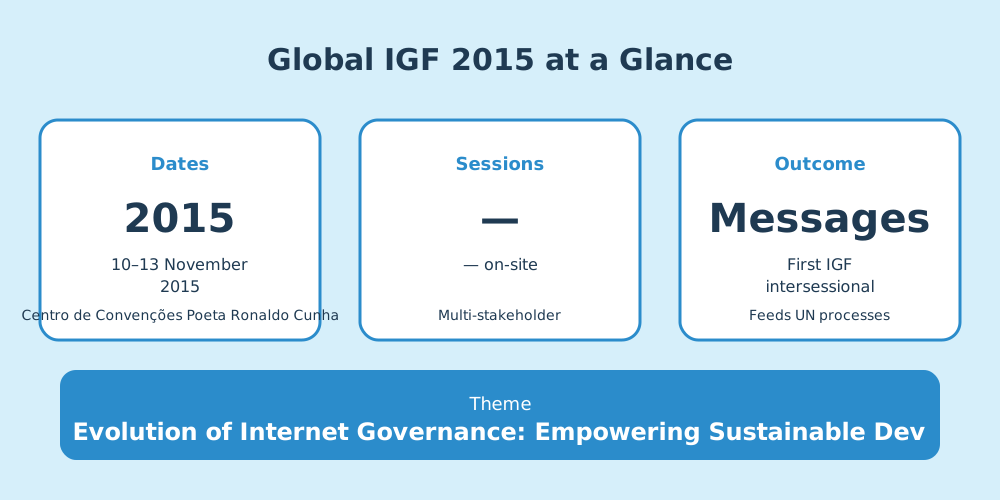
| Dates | 10–13 November 2015 |
| Venue | Centro de Convenções Poeta Ronaldo Cunha Lima, João Pessoa, Brazil |
| Theme | Evolution of Internet Governance: Empowering Sustainable Development |
| On-site participants | More than 2,130 on-site delegates from 112 countries (official proceedings) |
| Online participants | Some 4,000 online participants from 116 countries via roughly 50 remote hubs |
| Sessions | More than 150 sessions and 21 pre-events across eight sub-themes |
| Host | Government of Brazil (Ministry of Communications), CGI.br (Brazilian Internet Steering Committee) and the United Nations |
| Outcome | First IGF intersessional policy output, "Policy Options for Connecting the Next Billion"; the following month the UN General Assembly's WSIS+10 High-Level Meeting (resolution 70/125) renewed the IGF mandate for ten years |
(See the source list at the end of this article.)
Discussion Digest — from the Session Records
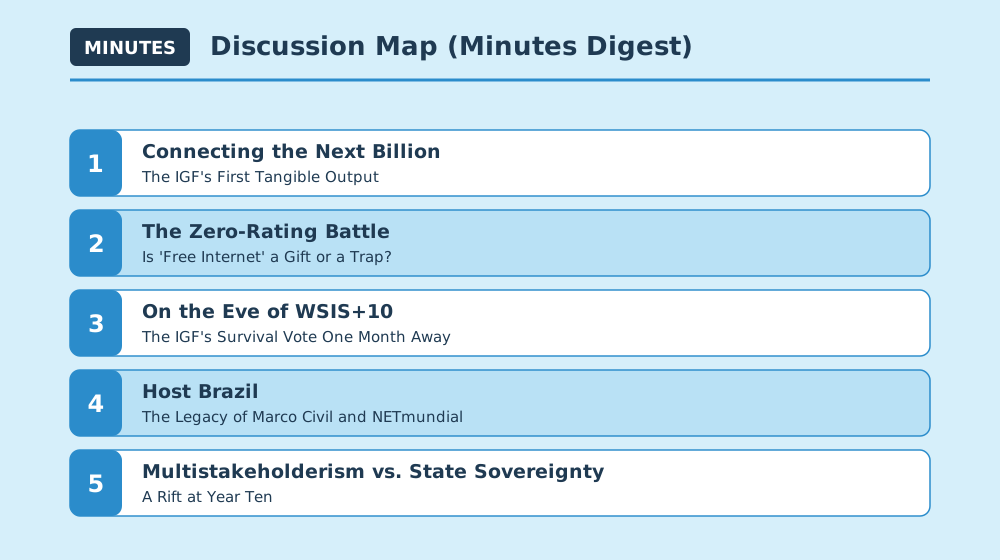
Key exchanges extracted from session records and transcripts.
1. Connecting the Next Billion — The IGF's First Tangible Output
Sessions: Main session "IGF intersessional work: Policy options and best practices for connecting the next billion"
- Answering a decade of criticism that the IGF 'talks but produces nothing,' the community compiled its first year-round intersessional output: policy options for bringing the next billion people online [8][5]
- A bottom-up document built on input from 15 national and regional IGFs and more than 80 stakeholder contributions, centred on infrastructure, usability, affordability and enabling environments [8][5]
- The finished compilation was forwarded to UN agencies for distribution to policymakers [8][5]
2. The Zero-Rating Battle — Is 'Free Internet' a Gift or a Trap?
Sessions: Opening session (10 November) plus WS156 "Zero-rating and neutrality policies in developing countries" (11 November) and WS79 "Zero Rating, Open Internet and Freedom of Expression" (13 November)
"Let's not sell donkeys, pretending they're horses."
— Joana Varon Ferraz (Founder Director, Coding Rights, Brazil) [4][6]
- Zero-rating — epitomised by Facebook's Free Basics — drew fierce civil-society resistance as a recipe for a two-tier internet split along North–South lines, making it the meeting's dominant controversy [4][6]
- Telecom operators pushed back, arguing free offerings are a realistic route to connecting developing countries and that traffic-management discrimination can be justified [4][6]
- Host Brazil's Marco Civil (the 2014 Internet Bill of Rights) enshrines net neutrality in law, sharpening questions about whether Free Basics could even be legal there [4][6]
3. On the Eve of WSIS+10 — The IGF's Survival Vote One Month Away
Sessions: WSIS+10 sessions and consultations
- The UN General Assembly's WSIS+10 High-Level Meeting was barely a month away (15–16 December), making renewal of the IGF's original ten-year mandate the question hanging over the whole event [5][2]
- Co-facilitators Ambassador Jānis Mažeiks (Latvia) and Ambassador Lana Zaki Nusseibeh (UAE) took stakeholder input on site and confirmed IGF consultations would feed into the WSIS+10 review [5][2]
- Resolution 70/125 in December extended the mandate by ten years — UN-level validation of a decade of the multistakeholder model [5][2]
4. Host Brazil — The Legacy of Marco Civil and NETmundial
Sessions: Opening ceremony (10 November, video message from President Dilma Rousseff)
"I am confident this meeting will allow us to deepen the major themes that concern us all for the development of the global internet."
— Dilma Rousseff (President of Brazil, video message; original in Portuguese) [7]
"The internet, in essence, is a space of openness and plurality."
— André Figueiredo (Minister of Communications, Brazil; original in Portuguese) [7]
- Post-Snowden, Brazil — architect of the NETmundial meeting (São Paulo 2014) and the Marco Civil — hosted its second IGF since Rio 2007 as the standard-bearer of multistakeholder governance [7]
- President Rousseff praised CGI.br's multi-participatory model and explicitly backed the IGF's continuation; 73 young people joined through the Youth@IGF programme [7]
5. Multistakeholderism vs. State Sovereignty — A Rift at Year Ten
Sessions: Opening session (10 November) and related sessions
"Enhanced cooperation involves more than just enabling governments to exercise or enhance their power."
— Ambassador Daniel Sepulveda (US State Department coordinator) [4][6]
- Tian Lin, head of the Chinese Foreign Ministry delegation, argued that clarifying sovereignty principles in internet governance would create the conditions for healthy international cooperation — a clear pitch for the state-led model [4][6]
- With WSIS+10 and the IANA stewardship transition looming, the founding rift between intergovernmentalism and multistakeholderism resurfaced at the ten-year mark [4][6]
Three-Minute Short Talk — Your Questions Answered
Q. So what did the conference actually decide?
A. The IGF doesn't 'decide' things — but this year was special. It produced its first policy output, 'Connecting the Next Billion,' sent it to the UN, and one month later the General Assembly renewed the IGF's own mandate for ten years.
Q. What was the most contentious topic?
A. Zero-rating. Is a free-but-limited internet like Facebook's Free Basics a gift to the poor or a second-class internet in disguise? One panellist put it memorably: 'Let's not sell donkeys, pretending they're horses.'
Q. Why should I care?
A. The ten-year mandate renewed here is what kept the IGF alive through to the WSIS+20 debates of 2025, and the zero-rating fight is the same argument behind every 'free data' plan and net-neutrality rule in force today.
What Is Global IGF? (for first-time readers)
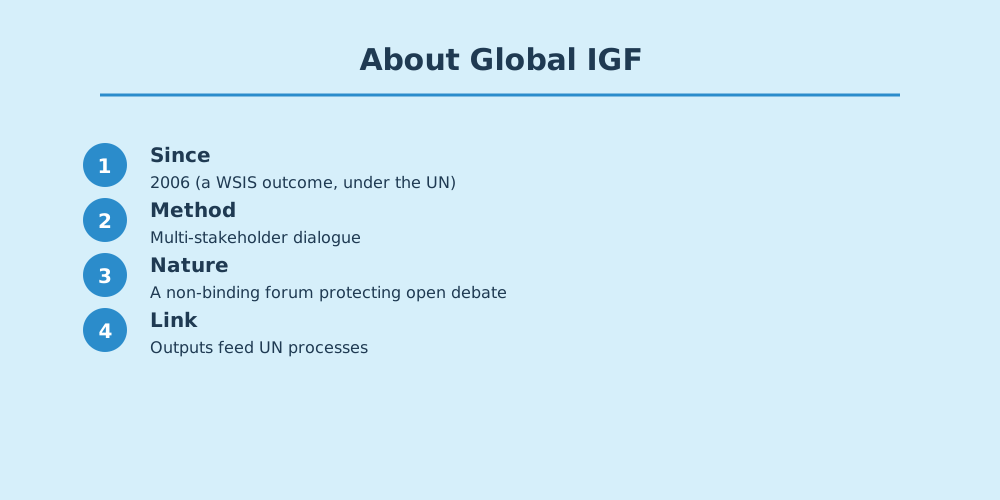
Global IGF has met annually under UN auspices since 2006 — the one global conference where governments, business, civil society, the technical community and youth debate internet governance as equals (the multistakeholder model).
Why It Matters to You
What was discussed here becomes the baseline for national digital policy, platform rules and AI regulation worldwide within a few years. The principles confirmed at the 2015 meeting are the foundation of the "next rules" for the phones, social platforms and AI services you use every day.
Sources & References
- IGF 2015 (archived official page) — UN IGF Secretariat (accessed 2026-07-10)
- The 10th Internet Governance Forum (IGF), 10-13 November 2015 — Report Part I (PDF) — UN Digital Library (accessed 2026-07-10)
- Internet Governance Forum (IGF) 2015 – Brazil — DiploFoundation (accessed 2026-07-10)
- IGF 2015 – Opening ceremony and opening session — DiploFoundation (accessed 2026-07-10)
- Internet forum enhances link between Internet, development — UN Sustainable Development blog (accessed 2026-07-10)
- 10th Internet Governance Forum Opens In Joao Pessoa, Brazil — Intellectual Property Watch (accessed 2026-07-10)
- IGF 2015 é oficialmente aberto em João Pessoa (開会式リリース) — CGI.br(ブラジル・インターネット運営委員会) (accessed 2026-07-10)
- Policy Options for Connecting the Next Billion — UN IGF Secretariat (accessed 2026-07-10)
Quotes are translated or condensed from the records listed above. Bracketed numbers [n] refer to the source list.
Related links
- IGF official (NRI list): https://www.intgovforum.org/en/content/national-and-regional-igf-initiatives
- Japan IGF: https://japanigf.jp/
- Yuki Nakazawa's blog: https://nkzw.jp/category/igf/
Revision History
Rev. 1 — published 10 November 2015, 21:00 (Article published)
Rev. 2 — updated 10 July 2026, 14:28 (Fully revised into the in-depth edition: added the 3-line summary, minutes digest, short talk, source list and diagrams (all quotes verified against the listed sources))
— 中澤祐樹

