

The 3-Line Summary
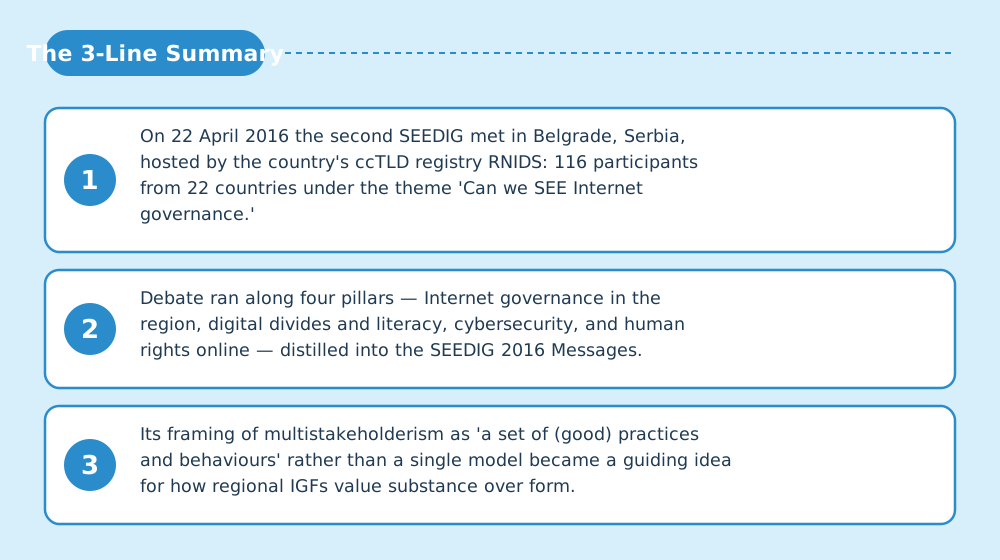
- On 22 April 2016 the second SEEDIG met in Belgrade, Serbia, hosted by the country's ccTLD registry RNIDS: 116 participants from 22 countries under the theme 'Can we SEE Internet governance.'
- Debate ran along four pillars — Internet governance in the region, digital divides and literacy, cybersecurity, and human rights online — distilled into the SEEDIG 2016 Messages.
- Its framing of multistakeholderism as 'a set of (good) practices and behaviours' rather than a single model became a guiding idea for how regional IGFs value substance over form.
Welcome — this is the Japan IGF Support Organization. This in-depth report on SEEDIG 2016 in Belgrade draws on official outputs, session records and on-site reporting. In a hurry? The three lines above and the diagrams carry the gist.
Conference at a Glance (from official records)
| Item | Detail |
|---|---|
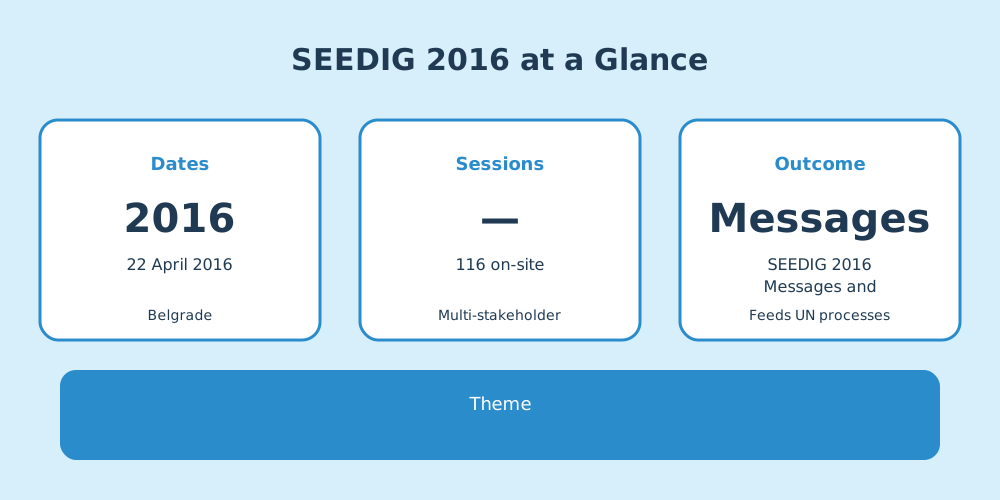
| Dates | 22 April 2016 |
| Venue | Belgrade, Serbia |
| Theme | Can we SEE Internet governance (The theme is a wordplay on SEE (South Eastern Europe) and 'see') |
| Participants | 116 (116 in-person participants from 22 countries; 91% from within SEE, 9% from beyond the region) |
| Host | Hosted by RNIDS (Serbian National Internet Domain Registry), with the Ministry of Trade, Tourism and Telecommunications and the Directorate for E-government as institutional partners |
| Outcome | SEEDIG 2016 Messages and annual report |
(See the source list at the end of this article.)
Discussion Digest — from the Session Records
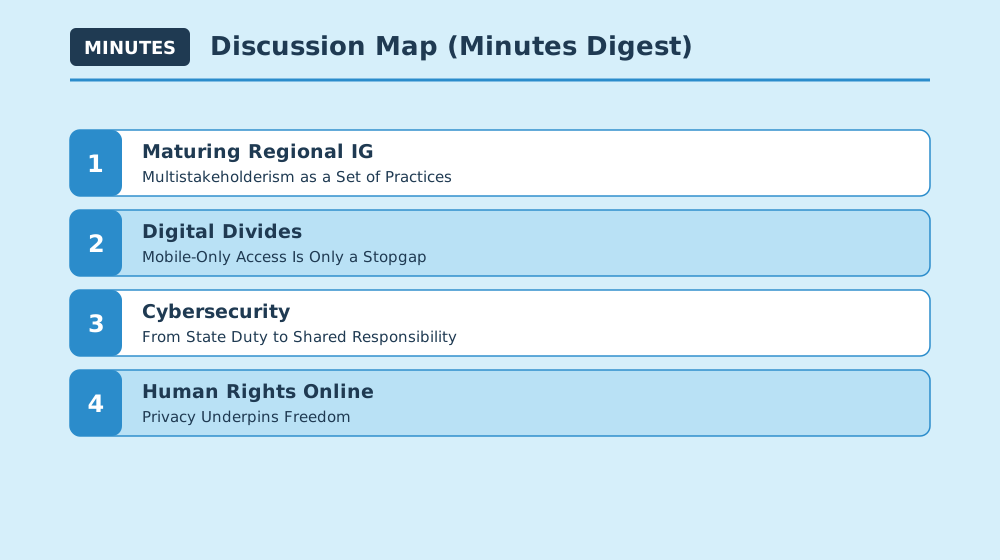
Key exchanges extracted from session records and transcripts.
1. Maturing Regional IG — Multistakeholderism as a Set of Practices
Sessions: Internet governance sessions (22 April)
- Internet governance evolves through dialogue and collaboration, with consensus as a fundamental principle [2]
- Multistakeholderism was framed as 'a set of (good) practices and behaviours' rather than a single model [2]
- Bottom-up layering — national to regional to global — strengthens global IG debates, and legitimacy flows from open, inclusive processes rather than perfect representativeness [2]
2. Digital Divides — Mobile-Only Access Is Only a Stopgap
Sessions: Session 2, 'Bridging digital divide(s) with a #SEEchange in digital literacy' (22 April, 11:30–13:00), with Megan Richards (European Commission), Jan Žorž (Internet Society), Vojislav Rodić (RNIDS) and Valentin Negoiță (APDETIC); moderated by Dušan Stojičević
- Deploying infrastructure alone is insufficient — education and local content development matter just as much [2][3]
- Mobile-only Internet access was called a temporary solution; fibre networks are needed, especially in rural areas [2][3]
- IPv6 adoption requires greater government and private-sector effort, while local-language digital literacy and IDNs were framed as keys to inclusion [2][3]
3. Cybersecurity — From State Duty to Shared Responsibility
Sessions: Cybersecurity sessions
- Stakeholders in the region lack harmonised cybersecurity definitions and clarity of roles [2]
- Responsibility is shifting from a state-only duty to a shared responsibility across all actors [2]
- Accountability of governments and security services was called a precondition for multistakeholder solutions, with human rights to be built into strategies 'by design' [2]
4. Human Rights Online — Privacy Underpins Freedom
Sessions: Human rights sessions
- Privacy was affirmed as the foundation that enables protections for freedom of expression and assembly [2]
- Access to information ensures equality online [2]
- Remedies for violations and a clearer allocation of responsibility between government and the private sector were flagged as open questions [2]
Three-Minute Short Talk — Your Questions Answered
Q. So what did the meeting decide?
A. SEEDIG doesn't decide — it's the regional forum where SEE governments, companies and civil society talk as equals. The takeaways were distilled into the SEEDIG 2016 Messages and circulated to national and international policy processes.
Q. What was the biggest issue?
A. How to connect the unconnected. Mobile-only access was called a stopgap; the real fix is fibre plus local-language content plus digital literacy.
Q. Why should I care?
A. The meeting's framing of multistakeholderism as a set of practices, not a fixed model, is a portable idea for anyone designing policy dialogues — well beyond the Balkans.
What Is SEEDIG? (for first-time readers)
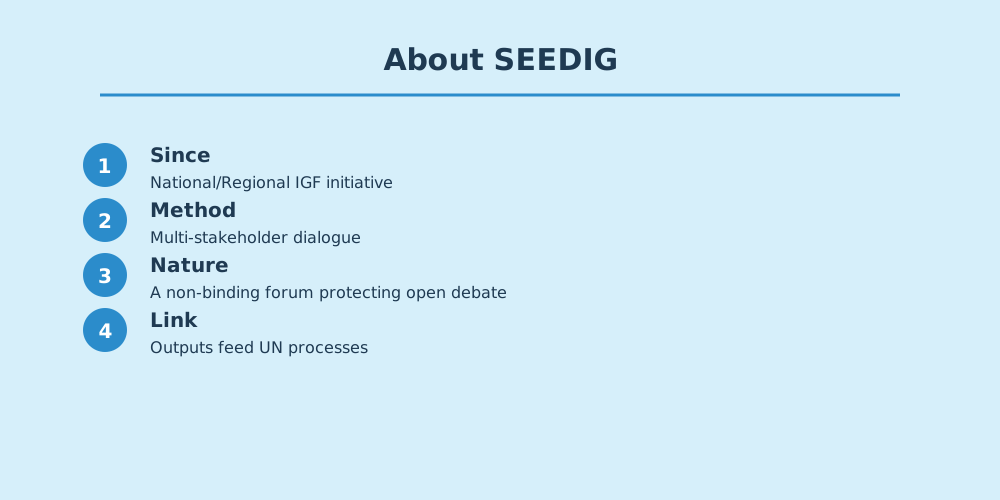
SEEDIG is a National or Regional IGF Initiative (NRI), aligning local internet governance discussion with global IGF principles.
Why It Matters to You
What was discussed here becomes the baseline for national digital policy, platform rules and AI regulation worldwide within a few years. The principles confirmed at the 2016 meeting are the foundation of the "next rules" for the phones, social platforms and AI services you use every day.
Sources & References
- SEEDIG 2016 meeting — SEEDIG(公式) (accessed 2026-07-11)
- Messages from SEEDIG 2016 — SEEDIG(公式) (accessed 2026-07-11)
- SEEDIG 2016: Session 2 — Bridging digital divide(s) with a #SEEchange in digital literacy — SEEDIG(公式) (accessed 2026-07-11)
- South Eastern European Dialogue on Internet Governance (SEEDIG) — APC (accessed 2026-07-11)
- South Eastern European Dialogue on Internet Governance — Wikipedia(英語版) (accessed 2026-07-11)
Quotes are translated or condensed from the records listed above. Bracketed numbers [n] refer to the source list.
Related links
- IGF official (NRI list): https://www.intgovforum.org/en/content/national-and-regional-igf-initiatives
- Japan IGF: https://japanigf.jp/
- Yuki Nakazawa's blog: https://nkzw.jp/category/igf/
Revision History
Rev. 1 — published 17 May 2016, 16:00 (Article published)
Rev. 2 — updated 11 July 2026, 02:14 (Fully revised into the in-depth edition: added the 3-line summary, minutes digest, short talk, source list and diagrams (all quotes verified against the listed sources))
— 中澤祐樹

