


The 3-Line Summary
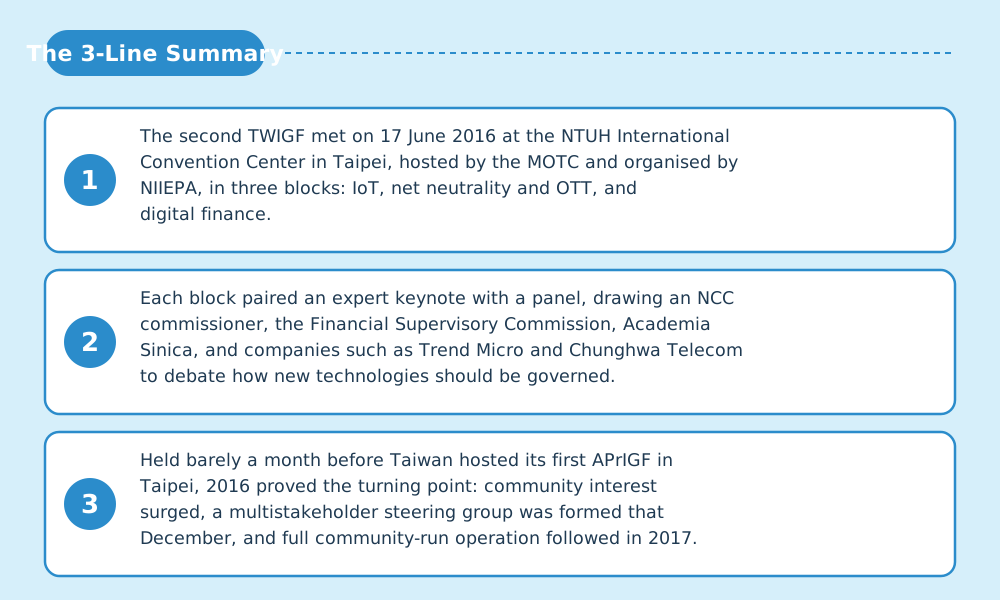
- The second TWIGF met on 17 June 2016 at the NTUH International Convention Center in Taipei, hosted by the MOTC and organised by NIIEPA, in three blocks: IoT, net neutrality and OTT, and digital finance.
- Each block paired an expert keynote with a panel, drawing an NCC commissioner, the Financial Supervisory Commission, Academia Sinica, and companies such as Trend Micro and Chunghwa Telecom to debate how new technologies should be governed.
- Held barely a month before Taiwan hosted its first APrIGF in Taipei, 2016 proved the turning point: community interest surged, a multistakeholder steering group was formed that December, and full community-run operation followed in 2017.
Welcome — this is the Japan IGF Support Organization. This in-depth report on Taiwan Internet Governance Forum 2016 (TWIGF 2016) draws on official outputs, session records and on-site reporting. In a hurry? The three lines above and the diagrams carry the gist.
Conference at a Glance (from official records)
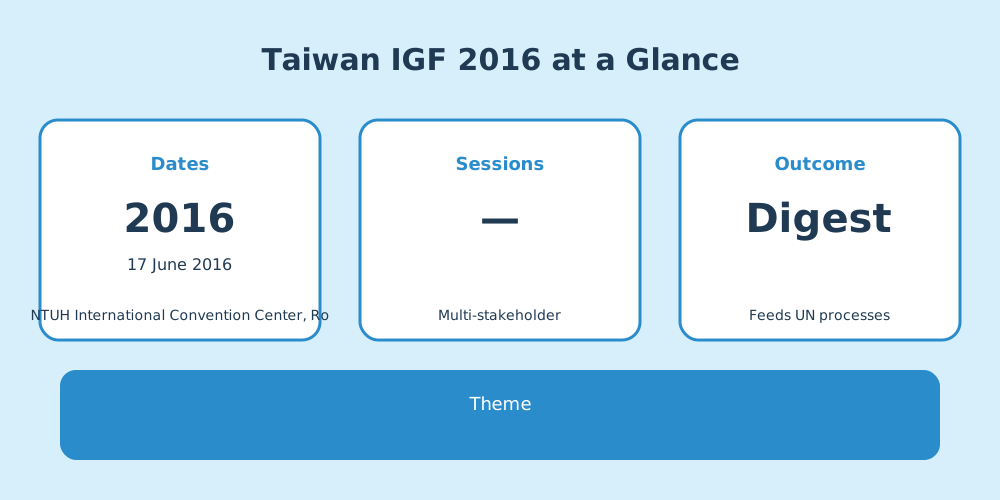
| Item | Detail |
|---|---|
| Official name | Taiwan Internet Governance Forum 2016 (TWIGF 2016) |
| Edition | 2nd edition |
| Dates | 17 June 2016 |
| Venue | NTUH International Convention Center, Room 401, Taipei |
| Theme | Regional governance themes |
| Host | Hosted by the Ministry of Transportation and Communications (MOTC); organised by the NII Enterprise Promotion Association (NIIEPA) |
(See the source list at the end of this article.)
Discussion Digest — from the Session Records
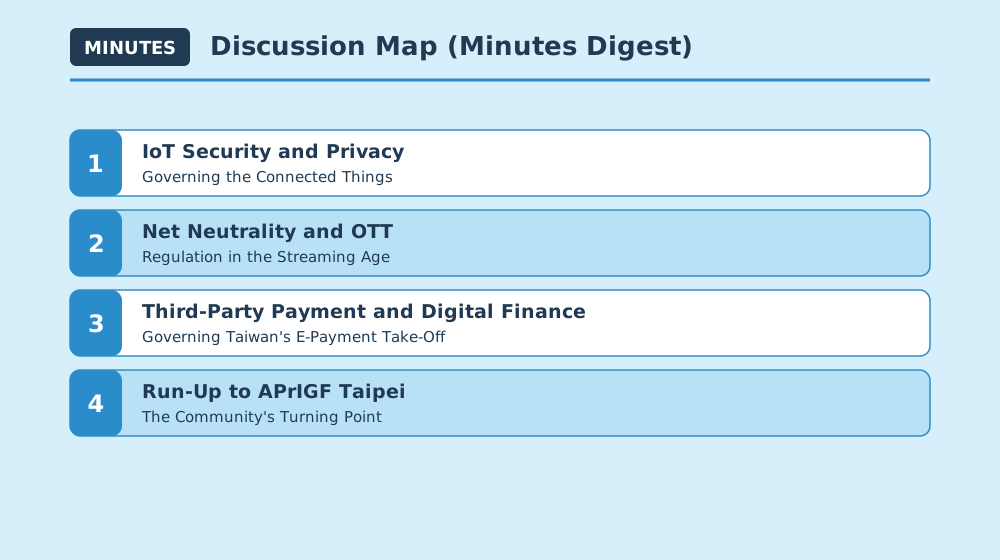
Key exchanges extracted from session records and transcripts.
1. IoT Security and Privacy — Governing the Connected Things
Sessions: Block 1: IoT security and privacy (keynote 10:20–10:40, panel 10:40–12:10)
- Kenny Huang (APNIC Executive Council) gave the keynote and moderated; panellists included Trend Micro, NCTU professor Ying-Dar Lin, Academia Sinica researcher Wen-Tsong Chiou and startup executives [1]
- At the dawn of mass IoT adoption, the session framed device vulnerabilities and sensor-data privacy as a single policy problem [1]
2. Net Neutrality and OTT — Regulation in the Streaming Age
Sessions: Block 2: Net neutrality and OTT management (keynote 13:30–13:50, panel 13:50–15:20)
- Nicole Chan — then head of the Science & Technology Law Institute, and NCC chairperson from the following year — keynoted and moderated, joined by NCC commissioner Yi-Ning Chen, Chunghwa Telecom, Taipei Tech's Ya-Chi Chiang and content businesses [1]
- With Netflix having entered Taiwan at the start of the year, the panel debated fair competition between carriers and OTT services with the regulator in the room [1]
3. Third-Party Payment and Digital Finance — Governing Taiwan's E-Payment Take-Off
Sessions: Block 3: Third-party payment and digital finance governance (keynote 15:40–16:00, panel 16:00–17:30)
- Luke Han, COO of Pi Mobile Wallet, keynoted and moderated, with a Financial Supervisory Commission official, CTBC Bank, and economists from Tamkang and National Taiwan University [1]
- As Taiwan's e-payment law took effect and services launched, the panel weighed fintech promotion against consumer protection and financial supervision [1]
4. Run-Up to APrIGF Taipei — The Community's Turning Point
Sessions: Overall forum (context)
- Barely a month later, on 27–29 July 2016, Taiwan hosted its first Asia Pacific Regional IGF (APrIGF) in Taipei [3][4]
- According to the GISWatch report, the enthusiasm generated by APrIGF Taipei led to the formal creation of TWIGF's multistakeholder steering group (MSG) in December 2016 [3][4]
- The shift from a government-commissioned event to a fully community-run forum, completed in 2017, was set in motion this year [3][4]
Three-Minute Short Talk — Your Questions Answered
Q. What stood out this year?
A. The keynote-plus-panel format in three blocks — IoT, net neutrality and OTT, and e-payments — all topics that were taking off in Taiwan that very year.
Q. Did it decide anything?
A. It is a dialogue, not a decision body, but getting the NCC and the Financial Supervisory Commission on stage with industry and academia was itself the point. And a month later Taiwan hosted APrIGF in Taipei, which supercharged the community.
Q. Why does it matter internationally?
A. OTT regulation and e-payment governance were live issues across Asia at the time, and APrIGF Taipei connected Taiwan's community with the wider region — the moment TWIGF stopped being a purely domestic exercise.
What Is Taiwan IGF? (for first-time readers)
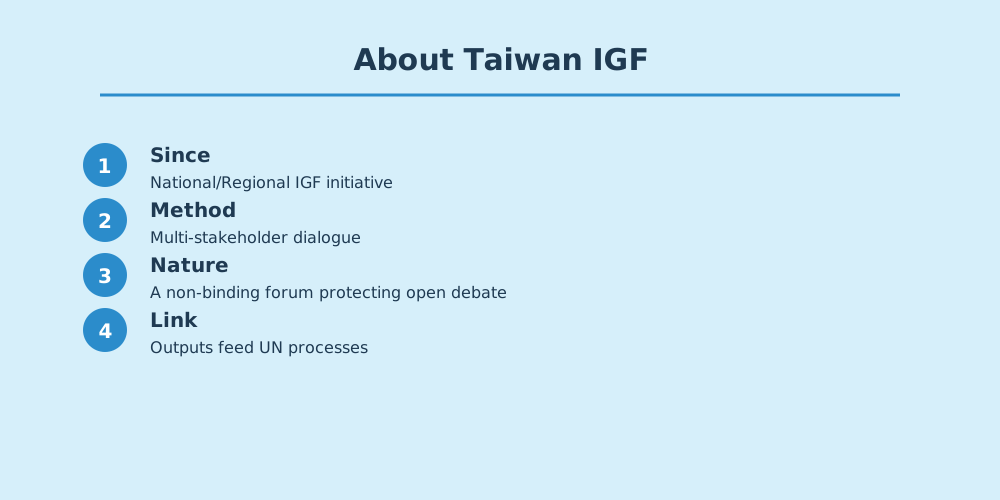
Taiwan IGF is a National or Regional IGF Initiative (NRI), aligning local internet governance discussion with global IGF principles.
Why It Matters to You
What was discussed here becomes the baseline for national digital policy, platform rules and AI regulation worldwide within a few years. The principles confirmed at the 2016 meeting are the foundation of the "next rules" for the phones, social platforms and AI services you use every day.
Sources & References
- 2016 臺灣網路治理論壇(大会公式サイト・議程/講者) — NII產業發展協進會(NIIEPA) (accessed 2026-07-11)
- 歷屆年會(TWIGF公式アーカイブ一覧) — 臺灣網路治理論壇(TWIGF) (accessed 2026-07-11)
- 關於TWIGF(組織沿革) — 臺灣網路治理論壇(TWIGF) (accessed 2026-07-11)
- Taiwan IGF (country report, GISWatch 2017 Special Issue) — APC (accessed 2026-07-11)
Quotes are translated or condensed from the records listed above. Bracketed numbers [n] refer to the source list.
Related links
- IGF official (NRI list): https://www.intgovforum.org/en/content/national-and-regional-igf-initiatives
- Japan IGF: https://japanigf.jp/
- Yuki Nakazawa's blog: https://nkzw.jp/category/igf/
Revision History
Rev. 1 — published 22 July 2016, 10:00 (Article published)
Rev. 2 — updated 16 July 2026, 20:09 (Fully revised into the in-depth edition: added the 3-line summary, minutes digest, short talk, source list and diagrams (all quotes verified against the listed sources))
— 中澤祐樹

