


The 3-Line Summary
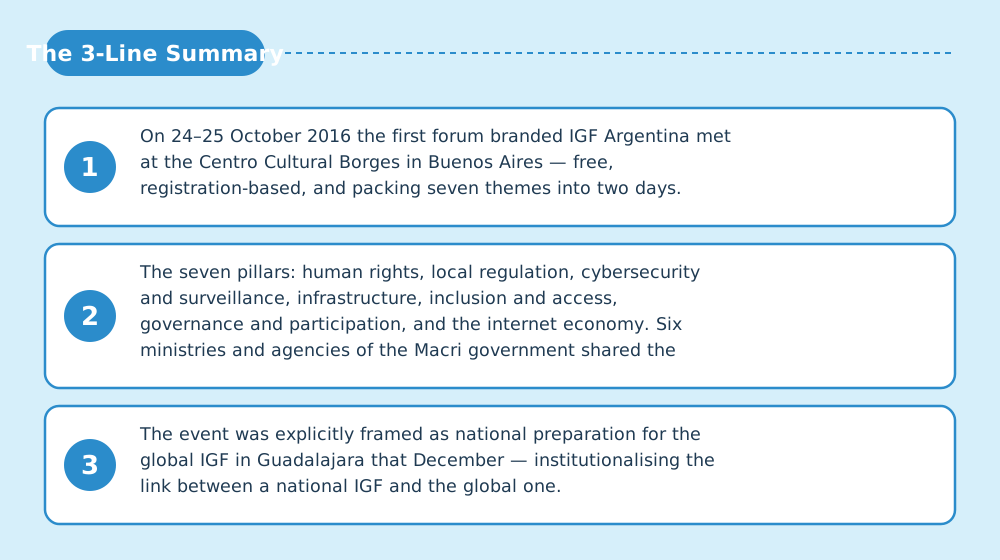
- On 24–25 October 2016 the first forum branded IGF Argentina met at the Centro Cultural Borges in Buenos Aires — free, registration-based, and packing seven themes into two days.
- The seven pillars: human rights, local regulation, cybersecurity and surveillance, infrastructure, inclusion and access, governance and participation, and the internet economy. Six ministries and agencies of the Macri government shared the public-policy panel.
- The event was explicitly framed as national preparation for the global IGF in Guadalajara that December — institutionalising the link between a national IGF and the global one.
Welcome — this is the Japan IGF Support Organization. This in-depth report on IGF Argentina 2016 — First Foro de Gobernanza de Internet Argentina draws on official outputs, session records and on-site reporting. In a hurry? The three lines above and the diagrams carry the gist.
Conference at a Glance (from official records)
| Item | Detail |
|---|---|
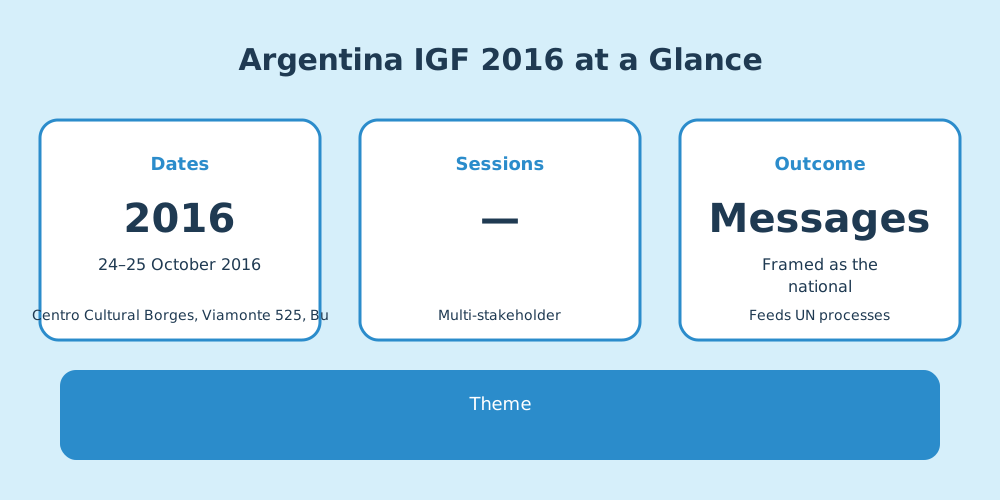
| Official name | IGF Argentina 2016 — First Foro de Gobernanza de Internet Argentina |
| Dates | 24–25 October 2016 |
| Venue | Centro Cultural Borges, Viamonte 525, Buenos Aires |
| Theme | Regional governance themes |
| Host | A Comité Multisectorial with representatives of government, the private sector, civil society, the technical community and academia, chosen by consensus within each sector |
| Outcome | Framed as the national preparatory process for the global IGF in Guadalajara that December; seven discussion themes were set through open consultation |
(See the source list at the end of this article.)
Discussion Digest — from the Session Records
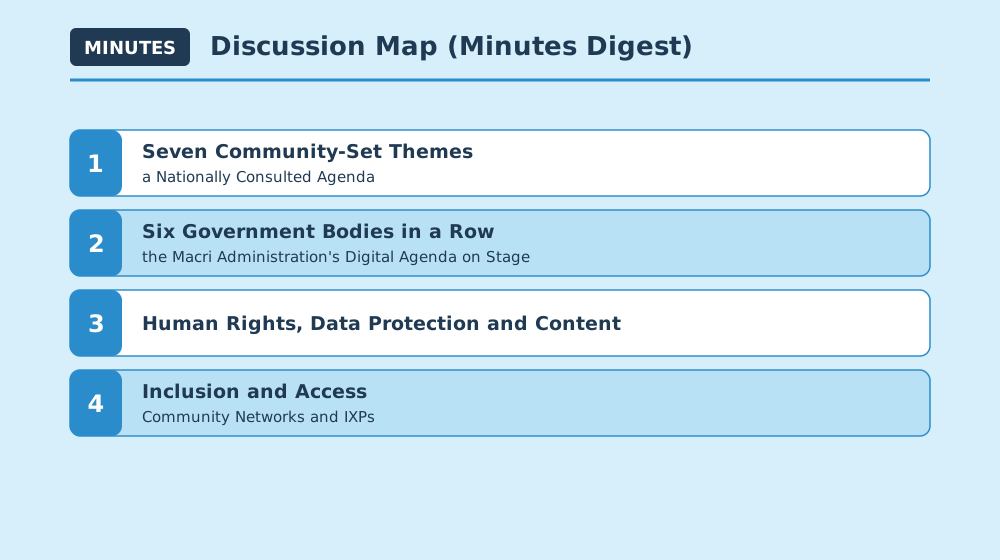
Key exchanges extracted from session records and transcripts.
1. Seven Community-Set Themes — a Nationally Consulted Agenda
Sessions: Overall programme (24–25 October, Auditorio Williams)
- Seven themes were set collaboratively: human rights online, local regulatory challenges, cybersecurity/surveillance/cybercrime, infrastructure, inclusion and access, governance and participation, and the internet economy [1][2]
- The multisector committee chose its members by consensus within each sector, an explicit design against capture by any one interest [1][2]
- Building on the 2015 Diálogo, the edition aimed to institutionalise the national ecosystem [1][2]
2. Six Government Bodies in a Row — the Macri Administration's Digital Agenda on Stage
Sessions: 'Public-sector initiatives on internet development and regulation' (24 October, from 2 pm)
- The Communications Ministry, regulator ENACOM, and the Modernisation, Production, Science and Foreign ministries presented the administration's digital policies side by side [3]
- The evening opening panel paired Communications undersecretary Héctor Huici with CABASE president Ariel Graizer and others across sectors [3]
- Less than a year after the change of government, the forum gave civil society and the technical community direct access to question the new administration's internet policy [3]
3. Human Rights, Data Protection and Content Removal
Sessions: 'Human rights online: free expression and privacy' (25 Oct, 11:15) and 'Data protection and content removal' (2 pm)
- Google's Eleonora Rabinovich, UBA's Molina Quiroga and Vladimir Chorny of Mexico's R3D debated free expression, big data and privacy, and the regulatory battles around them [3]
- Content and search-result removal — a live issue in Argentine case law — was moderated by civil-society groups ADC and CELE [3]
- The cybersecurity session brought in Horacio Azzolin of federal cybercrime unit UFECI on surveillance, vulnerabilities and regulation [3]
4. Inclusion and Access — Community Networks and IXPs
Sessions: 'Inclusion and internet access' (25 October, 4:30 pm)
- AlterMundi's Nicolás Echaniz (community networks), CABASE's Graizer and ASIET's Andrés Sastre discussed IXPs, self-provisioned connectivity and competition [3][1]
- 'Connecting the unconnected' carried over from the 2015 Diálogo, examined through both regulatory models and community self-provision [3][1]
- The closing session, with CETyS's Carolina Aguerre and Access Now's Javier Pallero among others, took stock of the multistakeholder model's consolidation [3][1]
Three-Minute Short Talk — Your Questions Answered
Q. What did it decide?
A. Nothing — by design. It was a dialogue across seven themes, explicitly framed as national preparation for the global IGF in Guadalajara that December.
Q. What stood out?
A. Six ministries and agencies on one panel: a full sweep of the new administration's digital policy, open to questioning from every other sector.
Q. Why should I care?
A. The 'national IGF feeds the global IGF' pattern and the open theme consultation are reusable designs for any country's internet governance community.
What Is Argentina IGF? (for first-time readers)
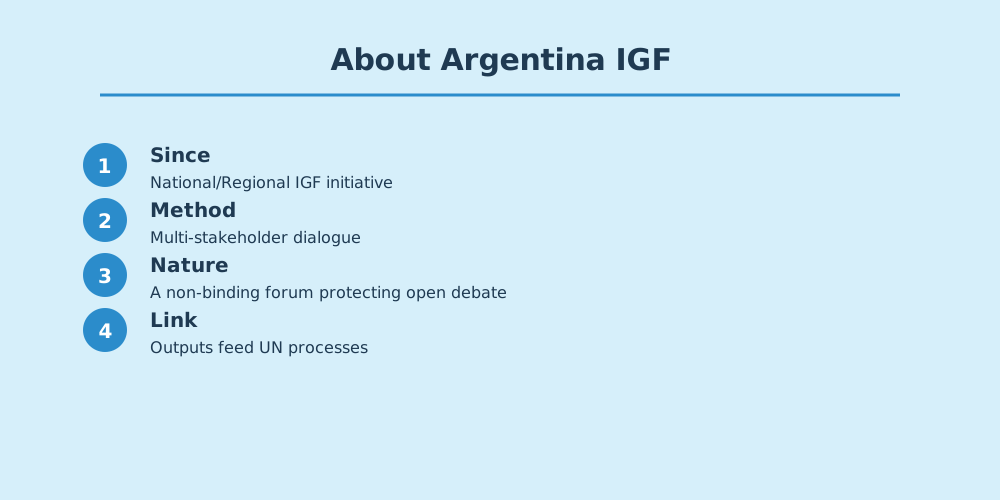
Argentina IGF is a National or Regional IGF Initiative (NRI), aligning local internet governance discussion with global IGF principles.
Why It Matters to You
What was discussed here becomes the baseline for national digital policy, platform rules and AI regulation worldwide within a few years. The principles confirmed at the 2016 meeting are the foundation of the "next rules" for the phones, social platforms and AI services you use every day.
Sources & References
- Primer Foro de Gobernanza de Internet en Argentina(第1回大会公式告知: 日付・会場・7テーマ・多部門委員会) — NIC Argentina (accessed 2026-07-23)
- Argentina celebrará su primer Foro de Gobernanza de Internet(グアダラハラIGFへの準備会合との位置づけ) — argentina.gob.ar (accessed 2026-07-23)
- IGF Argentina 2016(公式サイト: 2日間の詳細プログラムと登壇者名簿) — IGF Argentina 旧公式サイト(Wayback Machineアーカイブ) (accessed 2026-07-23)
- Iniciativas de gobernanza — 国別イニシアチブ一覧(アルゼンチンのFGI設立年の記録) — lacigf.org (accessed 2026-07-23)
Quotes are translated or condensed from the records listed above. Bracketed numbers [n] refer to the source list.
Related links
- IGF official (NRI list): https://www.intgovforum.org/en/content/national-and-regional-igf-initiatives
- Japan IGF: https://japanigf.jp/
- Yuki Nakazawa's blog: https://nkzw.jp/category/igf/
更新履歴
第1稿投稿 2026年8月8日 20時46分(記事コンテンツアップ)
— 中澤祐樹

