
The 3-Line Summary
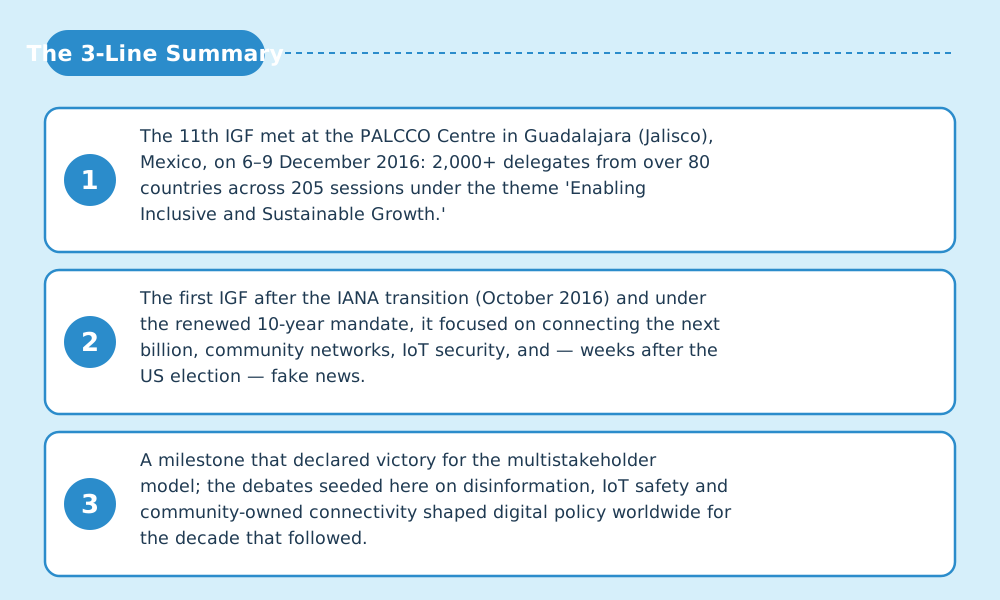
- The 11th IGF met at the PALCCO Centre in Guadalajara (Jalisco), Mexico, on 6–9 December 2016: 2,000+ delegates from over 80 countries across 205 sessions under the theme 'Enabling Inclusive and Sustainable Growth.'
- The first IGF after the IANA transition (October 2016) and under the renewed 10-year mandate, it focused on connecting the next billion, community networks, IoT security, and — weeks after the US election — fake news.
- A milestone that declared victory for the multistakeholder model; the debates seeded here on disinformation, IoT safety and community-owned connectivity shaped digital policy worldwide for the decade that followed.
Welcome — this is the Japan IGF Support Organization. This in-depth report on Global IGF 2016 in Guadalajara draws on official outputs, session records and on-site reporting. In a hurry? The three lines above and the diagrams carry the gist.
📍 Commonly the Guadalajara meeting; official branding read 'Jalisco, Mexico', with the venue at the PALCCO Centre in the Guadalajara metropolitan area
Conference at a Glance (from official records)
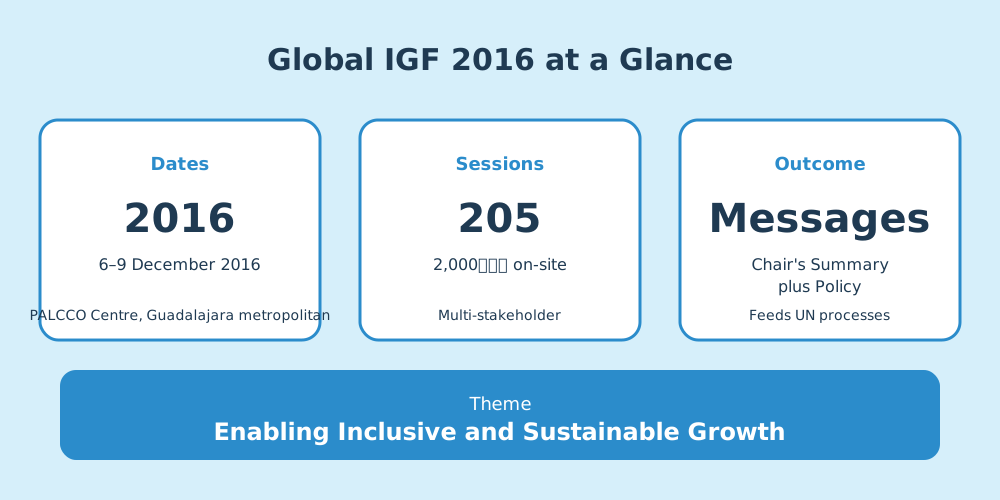
| Item | Detail |
|---|---|
| Dates | 6–9 December 2016 |
| Venue | PALCCO Centre, Guadalajara metropolitan area, Jalisco, Mexico |
| Theme | Enabling Inclusive and Sustainable Growth |
| On-site delegates | 2,000+ on-site delegates |
| Countries | 80+ countries represented |
| Sessions | 205 |
| Workshops | 96 |
| Dynamic Coalitions | 12 |
| Chair | Alejandra Lagunes, Coordinator of Mexico's National Digital Strategy (IGF 2016 Chair) |
| Host | Government of Mexico and the United Nations |
| Outcome | Chair's Summary plus Policy Options for Connecting and Enabling the Next Billion(s) Phase II, four Best Practice Forum outputs, and Dynamic Coalition papers |
| Milestone | 11th IGF; first under the 10-year mandate renewed at WSIS+10 (Dec 2015) and first after completion of the IANA stewardship transition (1 October 2016) |
(See the source list at the end of this article.)
Discussion Digest — from the Session Records
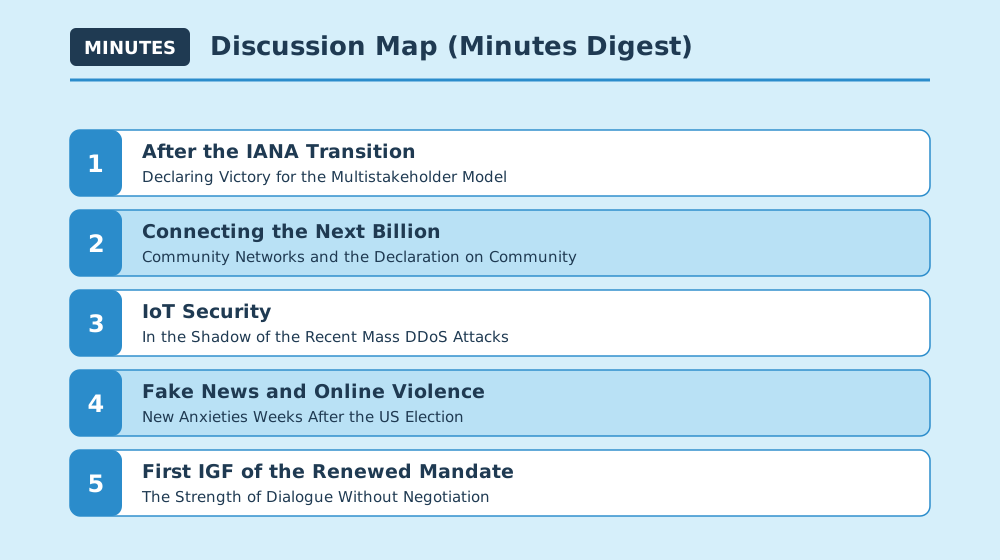
Key exchanges extracted from session records and transcripts.
1. After the IANA Transition — Declaring Victory for the Multistakeholder Model
Sessions: US NTIA remarks at the Opening Session (6 December); Day 0 ICANN session 'Reflections on the Evolution of the Multistakeholder Model in the Context of the IANA Stewardship Transition'
"The IANA transition is the most successful demonstration of the power of the multistakeholder model"
— Lawrence Strickling (Assistant Secretary, US NTIA) [1][5]
- The first IGF after the IANA stewardship transition was completed on 1 October 2016; NTIA's Lawrence Strickling, who oversaw it, urged the community to carry the momentum into applying the multistakeholder model elsewhere [1][5]
- Per the GIP final report, ICANN/IANA discussions shifted for the first time from controversy to implementation and accountability — the community's role and ICANN's ongoing accountability process took centre stage [1][5]
- With WSIS+10 and the IANA transition settled, the GIP report observed that 'there were no major elephants in the room this year' [1][5]
2. Connecting the Next Billion — Community Networks and the Declaration on Community Connectivity
Sessions: Dynamic Coalition on Community Connectivity (DC3); WS238 'Community Connectivity: Empowering the Unconnected' (8 December)
- With 53% of the world still offline, consensus formed that meaningful access goes beyond infrastructure to affordability, skills and local-language content [1][6][8]
- The notion that there should be no 'Internet for the poor' enjoyed widespread agreement, with zero-rating practices criticised [1][6][8]
- Community networks — infrastructure owned and democratically run by local communities — were championed by the new DC3, whose Declaration on Community Connectivity (the GIP report called it the 'Guadalajara Declaration') gathered feedback on site [1][6][8]
3. IoT Security — In the Shadow of the Recent Mass DDoS Attacks
Sessions: ICANN Open Forum (OF14) and IoT-related workshops
"While ICANN is not responsible for overall security of the Internet there is still a key role to be played in improving credibility and trust"
— Steve Crocker (Chair, ICANN Board) [4][1]
- Weeks after the October 2016 mass DDoS attacks powered by hijacked IoT devices, the GIP report noted 'the recent cyberattacks were evidently a cause for concern' — sessions debated industry and user responsibility for device security [4][1]
- Regulatory debate on the IoT remained embryonic; its development potential for the SDGs (disaster early warning, agriculture, traffic management) was stressed instead [4][1]
- The strong link between encryption and human rights, and between cybersecurity and human rights, was reiterated across sessions [4][1]
4. Fake News and Online Violence — New Anxieties Weeks After the US Election
Sessions: Workshops on fake news and intermediary liability; BPF on Gender and Access
- Right after the fake-news controversy of the November 2016 US election, IGF debate leaned toward user-side verification — greater social media literacy 'to understand that what we're reading is not the whole picture' — rather than platform regulation [1]
- Rising violence against women, including revenge pornography and doxxing, was treated as a headline issue; gender-based abuse was identified as a barrier keeping women offline, and the BPF on Gender and Access produced an output on it [1]
- With journalists and activists targeted to silence criticism and children falling victim to online sexual exploitation, the GIP report ranked online violence among the defining trends of this IGF [1]
5. First IGF of the Renewed Mandate — The Strength of Dialogue Without Negotiation
Sessions: Opening Ceremony (6 December); first-ever NRIs main session; Closing Ceremony (9 December)
"Clearly we need to build on our points of agreement and exchange of ideas so that we can make the most of all of the potential of the Internet"
— Alejandra Lagunes (IGF 2016 Chair; Coordinator of Mexico's National Digital Strategy) [1][6][7][3]
"But this is precisely the strength of the IGF – the absence of pressure to negotiate outcomes allows people to speak freely and also to think a bit outside the box, to do some brainstorming, and then go home and actually try to implement the ideas"
— Markus Kummer (Secretary, IGF Support Association) [1][6][7][3]
- The first meeting under the 10-year mandate renewed at WSIS+10 (December 2015); the first-ever main session on National and Regional IGF Initiatives (NRIs) began institutionalising the link between local voices and the global debate [1][6][7][3]
- A newcomers track, lightning talks and an unconference debuted as experiments, while Policy Options for Connecting the Next Billion(s) Phase II and four BPFs strengthened tangible outputs [1][6][7][3]
- Preparations for IGF 2017 in Geneva, Switzerland, began immediately after closing [1][6][7][3]
Three-Minute Short Talk — Your Questions Answered
Q. So what did the conference actually decide?
A. The IGF doesn't 'decide' — it's the UN's forum where governments, companies and civil society talk as equals. But 2016 was a milestone: the community collectively took stock of the completed IANA transition, the historic end of US government oversight of the internet's address book.
Q. What was the most contentious topic?
A. Unusually, very little. The big fights of previous years — the IANA transition and the IGF's own survival — were settled. Instead, fresh anxieties surfaced: fake news weeks after the US election, and online violence against women, from revenge porn to doxxing.
Q. Why should I care?
A. The fake-news debate that began here grew into today's fact-checking and media-literacy policies. And meeting just weeks after hijacked home routers and cameras powered record-breaking cyberattacks, this was where IoT security became a mainstream governance issue.
What Is Global IGF? (for first-time readers)
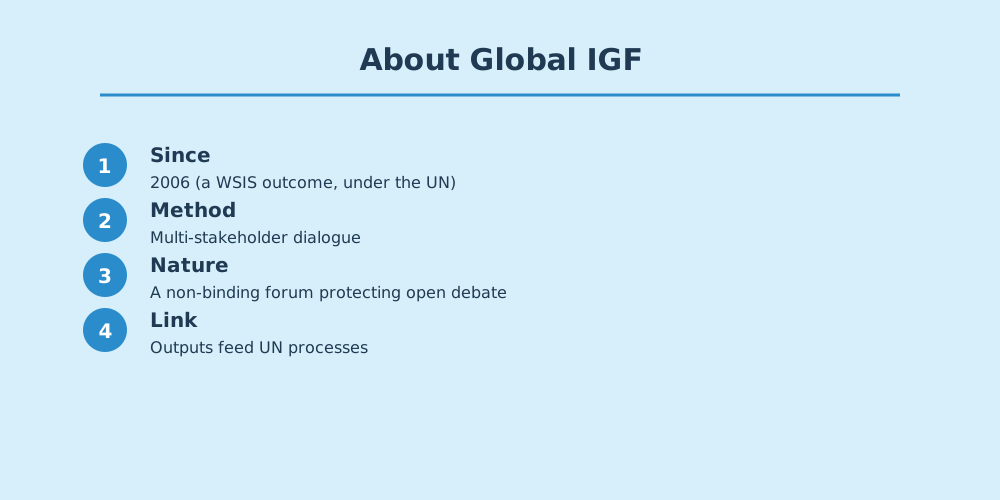
Global IGF has met annually under UN auspices since 2006 — the one global conference where governments, business, civil society, the technical community and youth debate internet governance as equals (the multistakeholder model).
Why It Matters to You
What was discussed here becomes the baseline for national digital policy, platform rules and AI regulation worldwide within a few years. The principles confirmed at the 2016 meeting are the foundation of the "next rules" for the phones, social platforms and AI services you use every day.
Sources & References
- Final Report from the 11th Internet Governance Forum (PDF) — dig.watch (accessed 2026-07-10)
- 11th Internet Governance Forum — event page & session reports — DiploFoundation (accessed 2026-07-10)
- Internet Governance Forum — IGF XI, Guadalajara 2016 — en (accessed 2026-07-10)
- IGF 2016 — Open Forum: ICANN (OF14) session report — DiploFoundation (accessed 2026-07-10)
- Remarks of Assistant Secretary Strickling at the Internet Governance Forum Opening Session 12/06/2016 — National Telecommunications and Information Administration (accessed 2026-07-10)
- Internet can play key role in achieving SDGs, officials say at IGF opening — UN DESA (accessed 2026-07-10)
- The 11th Internet Governance Forum (IGF), 6-9 December 2016, Jalisco, Mexico — Chair's Summary (PDF) — UN IGF Secretariat (accessed 2026-07-10)
- Declaration on Community Connectivity — DC3 (accessed 2026-07-10)
Quotes are translated or condensed from the records listed above. Bracketed numbers [n] refer to the source list.
Related links
- IGF official (NRI list): https://www.intgovforum.org/en/content/national-and-regional-igf-initiatives
- Japan IGF: https://japanigf.jp/
- Yuki Nakazawa's blog: https://nkzw.jp/category/igf/
Revision History
Rev. 1 — published 7 December 2016, 00:00 (Article published)
Rev. 2 — updated 10 July 2026, 14:28 (Fully revised into the in-depth edition: added the 3-line summary, minutes digest, short talk, source list and diagrams (all quotes verified against the listed sources))
— 中澤祐樹