


The 3-Line Summary
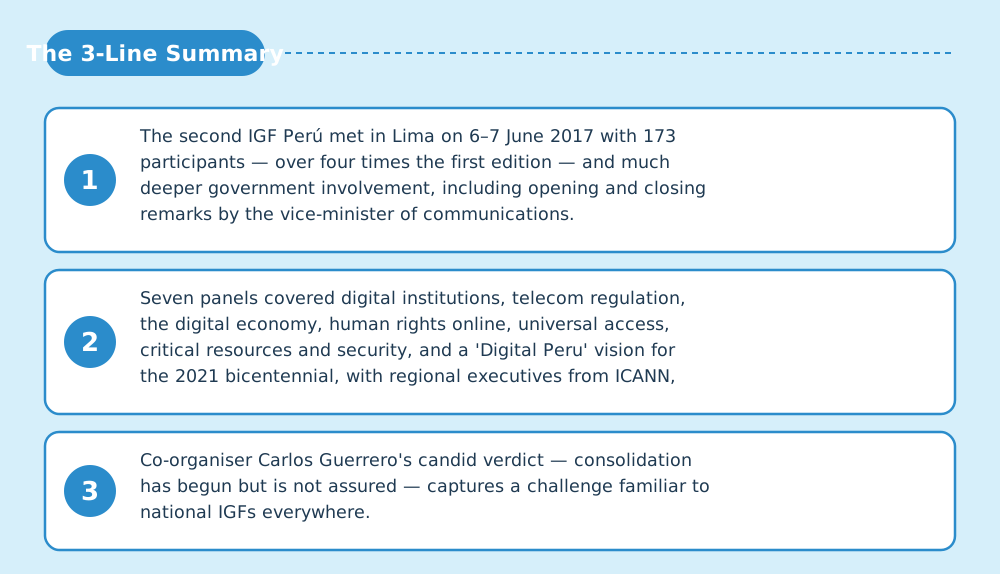
- The second IGF Perú met in Lima on 6–7 June 2017 with 173 participants — over four times the first edition — and much deeper government involvement, including opening and closing remarks by the vice-minister of communications.
- Seven panels covered digital institutions, telecom regulation, the digital economy, human rights online, universal access, critical resources and security, and a 'Digital Peru' vision for the 2021 bicentennial, with regional executives from ICANN, LACNIC and ISOC on stage.
- Co-organiser Carlos Guerrero's candid verdict — consolidation has begun but is not assured — captures a challenge familiar to national IGFs everywhere.
Welcome — this is the Japan IGF Support Organization. This in-depth report on IGF Perú 2017 (Second National IGF of Peru) draws on official outputs, session records and on-site reporting. In a hurry? The three lines above and the diagrams carry the gist.
📍 A free, two-day meeting in Lima; the venue building is not named in contemporary records
Conference at a Glance (from official records)
| Item | Detail |
|---|---|
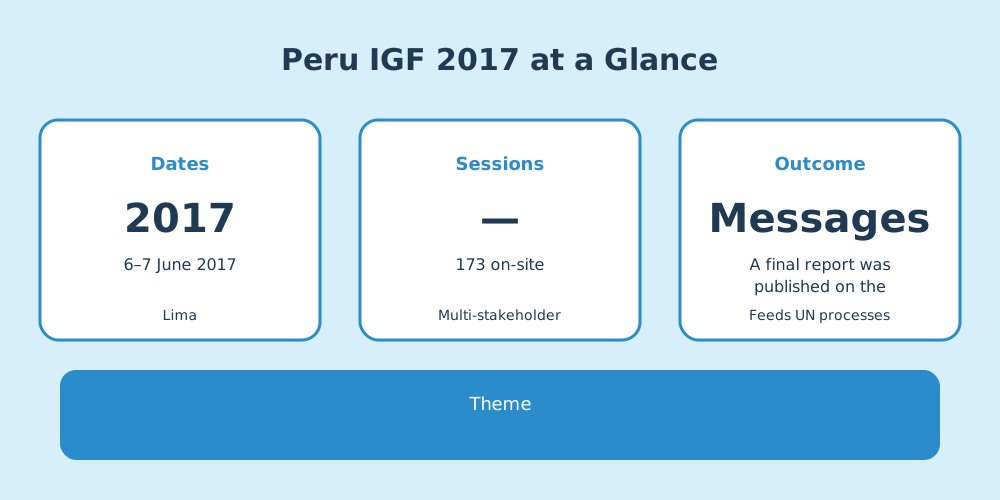
| Official name | IGF Perú 2017 (Second National IGF of Peru) |
| Dates | 6–7 June 2017 (The catalogue's 'around July 2017' is wrong: the official site, the UN-submitted report and the Servindi article all agree on 6–7 June 2017 (the 4 July Servindi piece is a post-event report)) |
| Venue | Lima, Peru |
| Theme | Regional governance themes |
| Participants | 173 (Breakdown: 21 government, 59 civil society, 52 private sector, 14 technical community, 27 academia; 68 women and 105 men (UN-submitted report)) |
| Host | Organising committee: Elaine Ford (Democracia Digital–D&D Internacional / ISOC Peru), Rolando Toledo (Red Científica Peruana), Carlos Huamán (DN Consultores) and Carlos Guerrero (Hiperderecho) |
| Outcome | A final report was published on the official site; attendance more than quadrupled (40 to 173) and the programme grew to seven panels |
(See the source list at the end of this article.)
Discussion Digest — from the Session Records
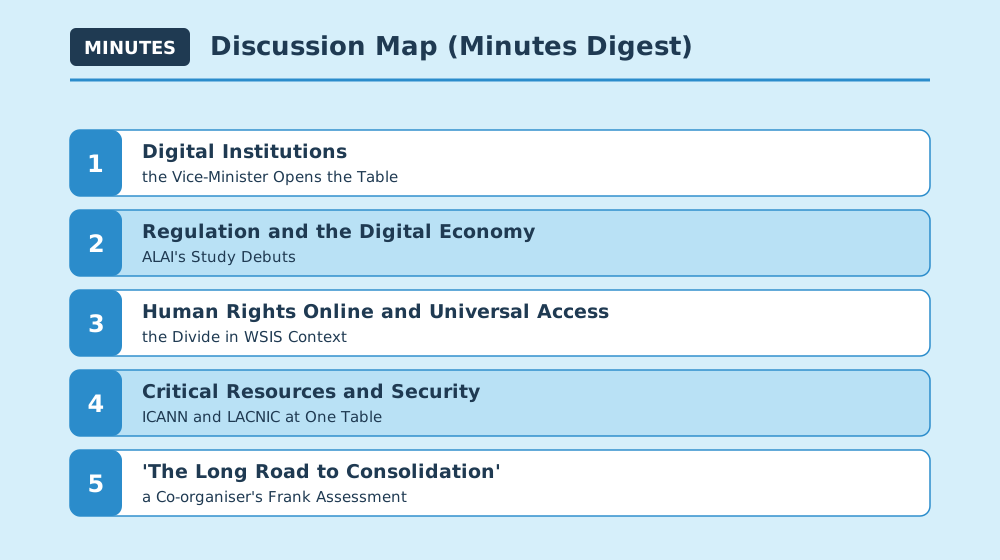
Key exchanges extracted from session records and transcripts.
1. Digital Institutions — the Vice-Minister Opens the Table
Sessions: Panel 1 'Institucionalidad digital' (6 June, 9:00–10:30)
- Vice-Minister of Communications Carlos Valdez and the PCM's digital-government secretariat joined the table — the executive-branch presence the first edition lacked [1][2]
- Elaine Ford (ISOC Peru), Raúl Solórzano (PUCP) and ICANN's Rodrigo de la Parra opened the event, and the vice-minister also delivered the closing remarks [1][2]
2. Regulation and the Digital Economy — ALAI's Study Debuts
Sessions: Panels 2 'Agenda regulatoria' and 3 'Estudio Economía Digital Perú' (6 June)
- Regulator OSIPTEL, Telefónica, Entel and satellite operator Gilat debated the regulatory agenda [1][2]
- ALAI presented a study on Peru's digital economy, with commentary from the Lima Chamber of Commerce, the Foreign Ministry, ICANN and Endeavor Perú [1][2]
3. Human Rights Online and Universal Access — the Divide in WSIS Context
Sessions: Panel 4 'Derechos humanos en línea' (6 June) and Panel 5 'Acceso Universal – WSIS' (7 June)
- Hiperderecho, Suma Ciudadana and OSIPTEL's Carmen Velarde (later head of RENIEC) discussed rights online [1][2]
- The universal-access panel brought together the Foreign Ministry, ONGAWA, ISOC's Raquel Gatto and Access Now's Verónica Arroyo, tying Peru's divide to the WSIS framework [1][2]
4. Critical Resources and Security — ICANN and LACNIC at One Table
Sessions: Panel 6 'Recursos críticos y seguridad de Internet' (7 June, 10:30–12:00)
- LACNIC's Oscar Robles, ICANN's Rodrigo de la Parra (with Ed Lewis joining remotely) and the RCP explained the governance of numbering resources and the DNS [1][2]
- Moderated by Google's Ana Lucía Lenis, the session gathered the regional registry and the national technical community — unusually strong technical content for a national IGF [1][2]
5. 'The Long Road to Consolidation' — a Co-organiser's Frank Assessment
Sessions: Post-event assessment (article by Carlos Guerrero, 4 July 2017)
"I believe this second edition has marked the start of a long consolidation process that may or may not succeed. Unlike Colombia, Argentina or Brazil, Peru has not yet articulated a permanent space for discussing internet governance (translated from Spanish)"
— Carlos Guerrero (Hiperderecho, co-organiser) [3]
- The organisers themselves published the growth figures: 40 to 173 attendees, 4 to 7 panels, 2 to 5 supporting institutions [3]
- Next challenges named: formalising multistakeholder decision-making, rotating leadership, and linking with CODESI, the government's information-society commission [3]
Three-Minute Short Talk — Your Questions Answered
Q. What changed from the first year?
A. Scale, mainly: attendance more than quadrupled to 173, and the vice-minister of communications, the PCM and regional executives of ICANN, LACNIC and ISOC all took part. Organising passed from a single NGO to a four-member committee.
Q. What did it decide?
A. Nothing binding, but the seven panels produced a final report submitted to the UN, plus a commissioned digital-economy study and an open exchange between the regulator and operators.
Q. Why should I care?
A. The organisers' dilemma — how to make multistakeholder dialogue permanent — is the same one national IGFs face everywhere, benchmarked candidly against Brazil and Colombia.
What Is Peru IGF? (for first-time readers)
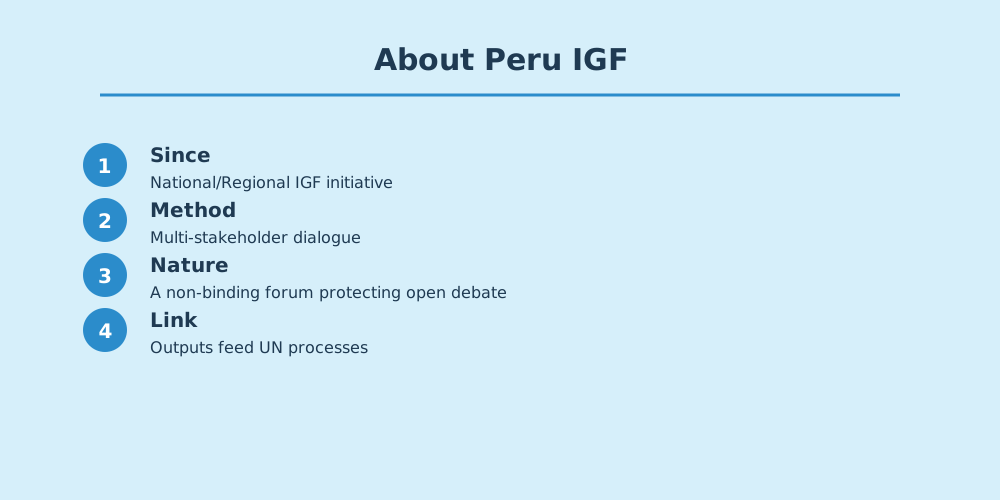
Peru IGF is a National or Regional IGF Initiative (NRI), aligning local internet governance discussion with global IGF principles.
Why It Matters to You
What was discussed here becomes the baseline for national digital policy, platform rules and AI regulation worldwide within a few years. The principles confirmed at the 2017 meeting are the foundation of the "next rules" for the phones, social platforms and AI services you use every day.
Sources & References
- 2017 National Internet Governance Forum of Peru – Final Summary Meeting Report(第2回最終報告書・UN提出) — intgovforum.org (accessed 2026-07-23)
- Edición 2017 – Foro de Gobernanza de Internet Perú(公式サイト・全7パネルの詳細プログラム、Wayback) — IGF Perú(gobernanzadeinternet.pe) (accessed 2026-07-23)
- Hacia la consolidación de la Gobernanza de Internet en Perú(共同主催者カルロス・ゲレロ氏の事後総括・2016/2017比較統計) — Servindi / Hiperderecho (accessed 2026-07-23)
- Peru IGF(NRI記録・年次報告書一覧) — intgovforum.org (accessed 2026-07-23)
Quotes are translated or condensed from the records listed above. Bracketed numbers [n] refer to the source list.
Related links
- IGF official (NRI list): https://www.intgovforum.org/en/content/national-and-regional-igf-initiatives
- Japan IGF: https://japanigf.jp/
- Yuki Nakazawa's blog: https://nkzw.jp/category/igf/
更新履歴
第1稿投稿 2026年8月6日 17時59分(記事コンテンツアップ)
— 中澤祐樹

