

The 3-Line Summary
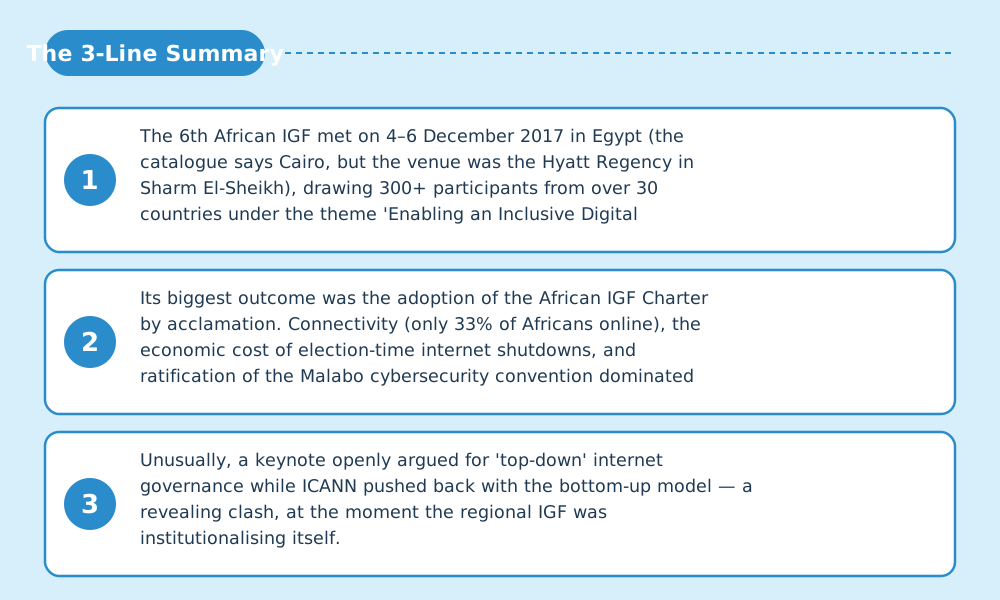
- The 6th African IGF met on 4–6 December 2017 in Egypt (the catalogue says Cairo, but the venue was the Hyatt Regency in Sharm El-Sheikh), drawing 300+ participants from over 30 countries under the theme 'Enabling an Inclusive Digital Transformation of Africa.'
- Its biggest outcome was the adoption of the African IGF Charter by acclamation. Connectivity (only 33% of Africans online), the economic cost of election-time internet shutdowns, and ratification of the Malabo cybersecurity convention dominated the agenda.
- Unusually, a keynote openly argued for 'top-down' internet governance while ICANN pushed back with the bottom-up model — a revealing clash, at the moment the regional IGF was institutionalising itself.
Welcome — this is the Japan IGF Support Organization. This in-depth report on AfIGF 2017 in Sharm El Sheikh draws on official outputs, session records and on-site reporting. In a hurry? The three lines above and the diagrams carry the gist.
📍 The catalogue lists this event as 'Cairo', but all sources confirm the 6th AfIGF (2017) met at the Hyatt Regency in Sharm El-Sheikh, Egypt. Cairo hosted the inaugural AfIGF in 2012, which may explain the mix-up (the country, Egypt, matches)
Conference at a Glance (from official records)
| Item | Detail |
|---|---|
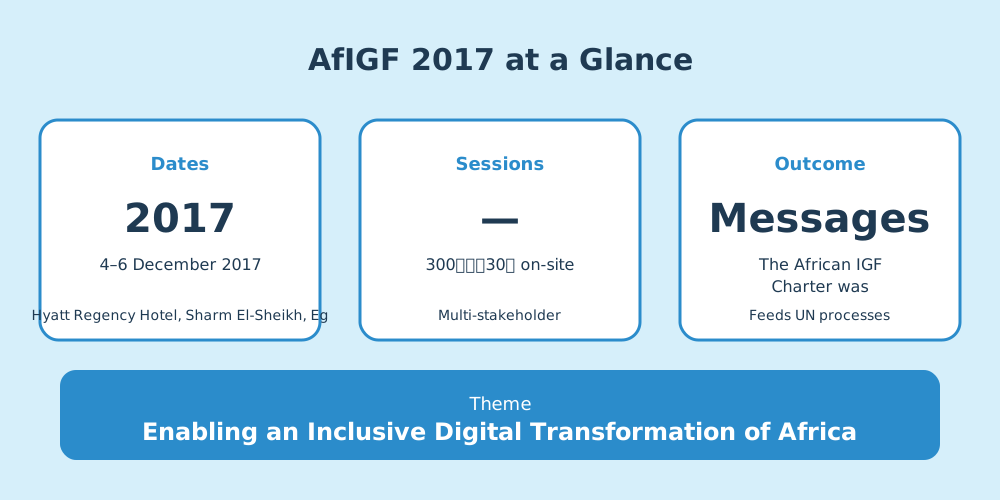
| Edition | 6th African Internet Governance Forum (AfIGF) |
| Dates | 4–6 December 2017 |
| Venue | Hyatt Regency Hotel, Sharm El-Sheikh, Egypt |
| Theme | Enabling an Inclusive Digital Transformation of Africa |
| Participants | Over 300 participants from more than 30 countries (official report) |
| Supporters | Technically and financially supported by AFRINIC, APC, dotAfrica, UNECA, Huawei, ICANN, IGFSA, ISOC and UNESCO |
| Host | Co-organised by the African Union Commission with Egypt's National Telecom Regulatory Authority (NTRA) and the NEPAD Coordination Agency |
| Outcome | The African IGF Charter was adopted by acclamation, to be implemented from the 7th AfIGF in Khartoum |
(See the source list at the end of this article.)
Discussion Digest — from the Session Records
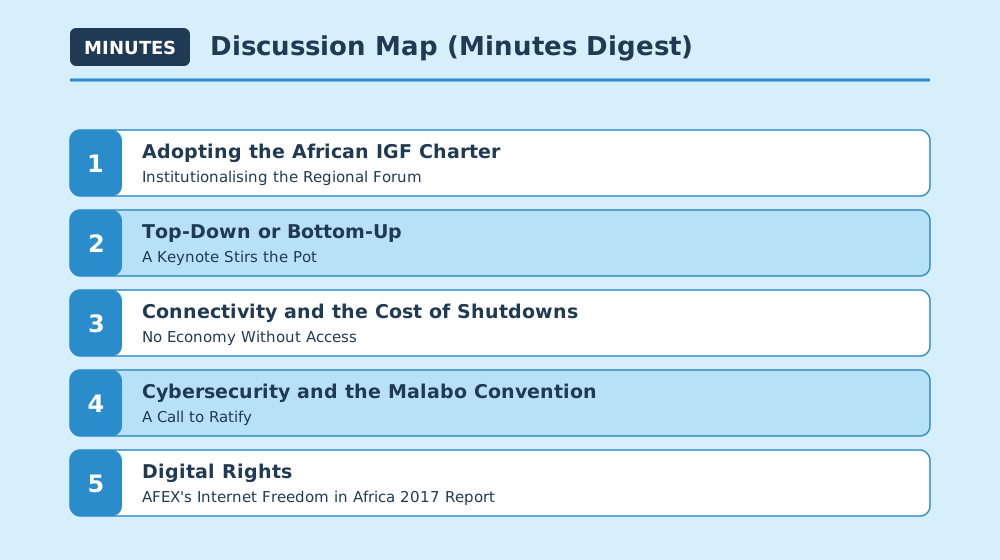
Key exchanges extracted from session records and transcripts.
1. Adopting the African IGF Charter — Institutionalising the Regional Forum
Sessions: Plenary Session 5, 'Review and Approval of the Draft African IGF Charter' (6 December, 9:00–10:30)
- Moderated by Mary Uduma (Nigeria), the draft was read out, discussed, and adopted by acclamation [1]
- The forum recommended publicising the Charter widely and implementing it from the 7th AfIGF in Khartoum in 2018 — the culmination of the online consultation launched after Durban 2016 [1]
2. Top-Down or Bottom-Up — A Keynote Stirs the Pot
Sessions: Keynote by Alexander Trigona, Special Envoy to the Prime Minister of Malta (4 December), and the High Level Discussion
- Trigona argued Africa should adopt the top-down approach of marine and outer-space accords, and negotiate new e-commerce rules at the WTO with a macro-level strategy [1]
- ICANN's Pierre Dandjinou countered that bottom-up consultation is what brings diverse stakeholder views on board, stressing ICANN's remit is limited to names and numbers, not content regulation [1]
3. Connectivity and the Cost of Shutdowns — No Economy Without Access
Sessions: Plenary Session 1, 'Promoting Digital Africa: Internet Economy' (5 December, 12:00–13:30) and others
"Making the Internet accessible, reliable and affordable to all African citizens is not a matter of choice but an obligation"
— Amani Abou-Zeid (AU Commissioner for Infrastructure and Energy, as recorded in the official report) [1]
- ISOC's Dawit Bekele noted only about one-third of Africans are connected and the internet contributes roughly 1.1% of GDP in most African countries — infrastructure is the precondition for an internet economy [1]
- The official report explicitly lists internet shutdowns during elections and unrest as damaging businesses and national economies, alongside high mobile-broadband costs and red tape [1]
- Commissioner Abou-Zeid cited 28% broadband access and studies showing a 10-point rise in penetration lifts economic growth by 2–3% [1]
4. Cybersecurity and the Malabo Convention — A Call to Ratify
Sessions: Plenary Session 3, 'Empowering Global Cooperation on Cybersecurity for Sustainable Development and Peace' (5 December, 16:30–18:00)
- Member states were urged to ratify the AU (Malabo) cybersecurity convention, framed as compatible with the Budapest Convention [1]
- The session called for law-enforcement capacity building (CERT tools, critical infrastructure protection, DNSSEC training) and cross-border cooperation against cybercrime [1]
- Session 4 added a data-sovereignty recommendation: data collected and processed in Africa should be kept in Africa so the continent controls its use [1]
5. Digital Rights — AFEX's Internet Freedom in Africa 2017 Report
Sessions: Parallel session (4 December, AFEX and civil-society partners)
- A report examining eight countries (including Ghana, Nigeria, Uganda and Zimbabwe) on shutdowns, high data costs and regulatory gaps was launched at the forum [3]
- It urged governments to repeal laws restricting online expression, and telecom operators to refuse unjustified shutdown orders and demand court orders before disclosing user data [3]
Three-Minute Short Talk — Your Questions Answered
Q. So what did the conference actually decide?
A. It's a dialogue forum, but this edition unusually adopted a founding document — the African IGF Charter — by acclamation, formalising how the regional forum is run from the next edition onwards.
Q. What was the most contentious topic?
A. How the internet should be governed at all. Malta's special envoy argued for a top-down, treaty-style approach like outer-space accords; ICANN pushed back with the bottom-up multistakeholder model — a rare head-on clash at an IGF.
Q. Why should I care?
A. The recommendation that 'data collected in Africa should stay in Africa' is an early form of the data-localisation debate that now shapes cross-border data rules — and compliance costs — worldwide.
What Is AfIGF? (for first-time readers)
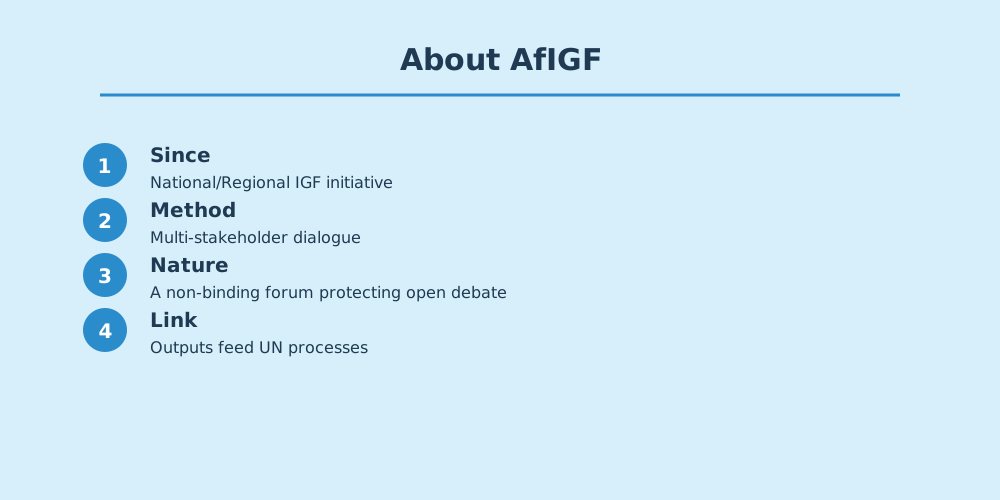
AfIGF is a National or Regional IGF Initiative (NRI), aligning local internet governance discussion with global IGF principles.
Why It Matters to You
What was discussed here becomes the baseline for national digital policy, platform rules and AI regulation worldwide within a few years. The principles confirmed at the 2017 meeting are the foundation of the "next rules" for the phones, social platforms and AI services you use every day.
Sources & References
- The African Internet Governance Forum – AfIGF 2017 Report (Sharm El-Sheikh) — アフリカIGF事務局(AUC) (accessed 2026-07-10)
- Sixth African Internet Governance Forum (AfIGF 2017) — news item — MCIT (accessed 2026-07-10)
- African governments urged to prioritise digital rights — IFEX (accessed 2026-07-10)
- African Internet Governance Forum — en (accessed 2026-07-10)
Quotes are translated or condensed from the records listed above. Bracketed numbers [n] refer to the source list.
Related links
- IGF official (NRI list): https://www.intgovforum.org/en/content/national-and-regional-igf-initiatives
- Japan IGF: https://japanigf.jp/
- Yuki Nakazawa's blog: https://nkzw.jp/category/igf/
Revision History
Rev. 1 — published 1 September 2017, 12:00 (Article published)
Rev. 2 — updated 10 July 2026, 23:16 (Fully revised into the in-depth edition: added the 3-line summary, minutes digest, short talk, source list and diagrams (all quotes verified against the listed sources))
— 中澤祐樹