

The 3-Line Summary
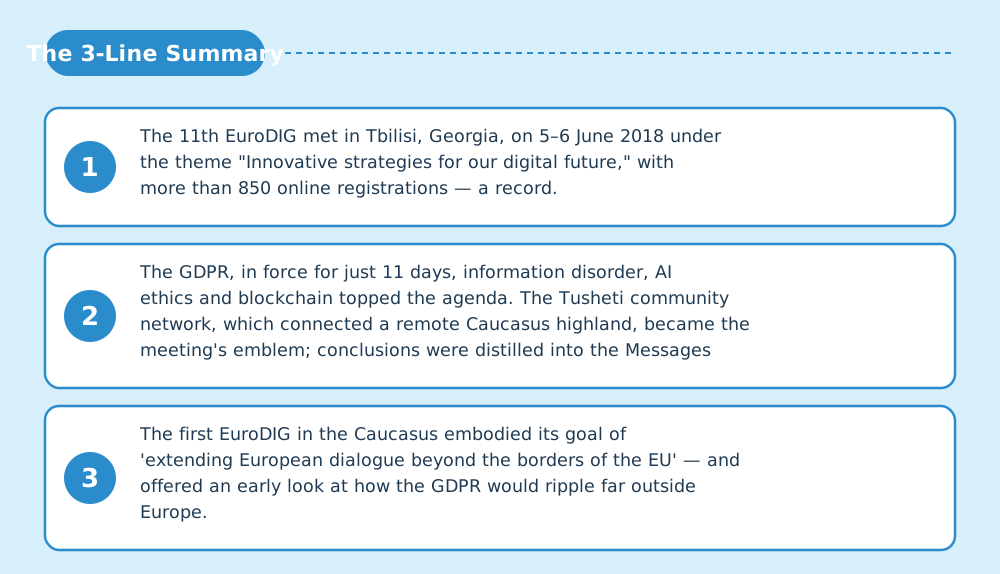
- The 11th EuroDIG met in Tbilisi, Georgia, on 5–6 June 2018 under the theme "Innovative strategies for our digital future," with more than 850 online registrations — a record.
- The GDPR, in force for just 11 days, information disorder, AI ethics and blockchain topped the agenda. The Tusheti community network, which connected a remote Caucasus highland, became the meeting's emblem; conclusions were distilled into the Messages from Tbilisi.
- The first EuroDIG in the Caucasus embodied its goal of 'extending European dialogue beyond the borders of the EU' — and offered an early look at how the GDPR would ripple far outside Europe.
Welcome — this is the Japan IGF Support Organization. This in-depth report on EuroDIG 2018 in Tbilisi draws on official outputs, session records and on-site reporting. In a hurry? The three lines above and the diagrams carry the gist.
Conference at a Glance (from official records)
| Item | Detail |
|---|---|
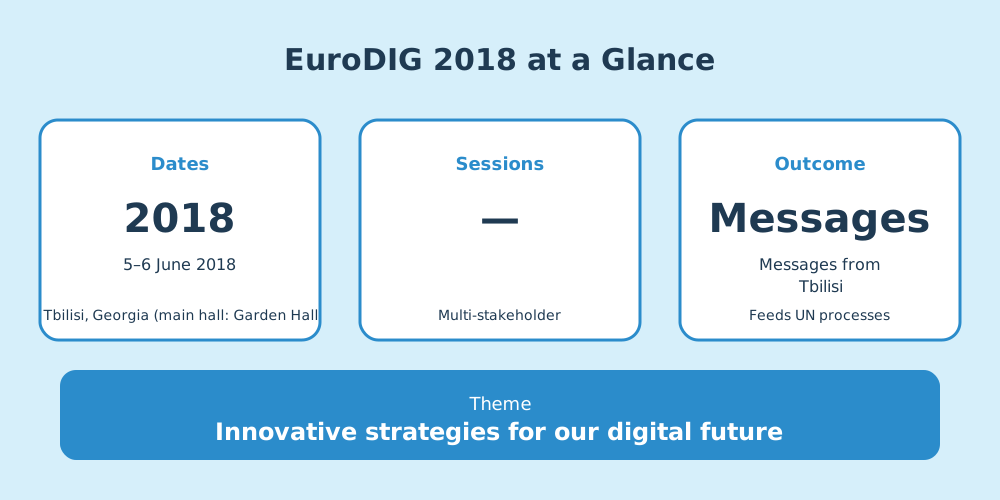
| Edition | 11th EuroDIG (the first held in the Caucasus) |
| Dates | 5–6 June 2018 |
| Venue | Tbilisi, Georgia (main hall: Garden Hall) |
| Theme | Innovative strategies for our digital future |
| Registrations | more than 850 online registrations (a record at the time) |
| Timing | Held 11 days after the GDPR took effect (25 May 2018) |
| Host | Hosted by the Ministry of Economy and Sustainable Development of Georgia, with the Small and Medium Telecom Operators' Association of Georgia and the Georgian National Communications Commission |
| Outcome | Messages from Tbilisi |
(See the source list at the end of this article.)
Discussion Digest — from the Session Records
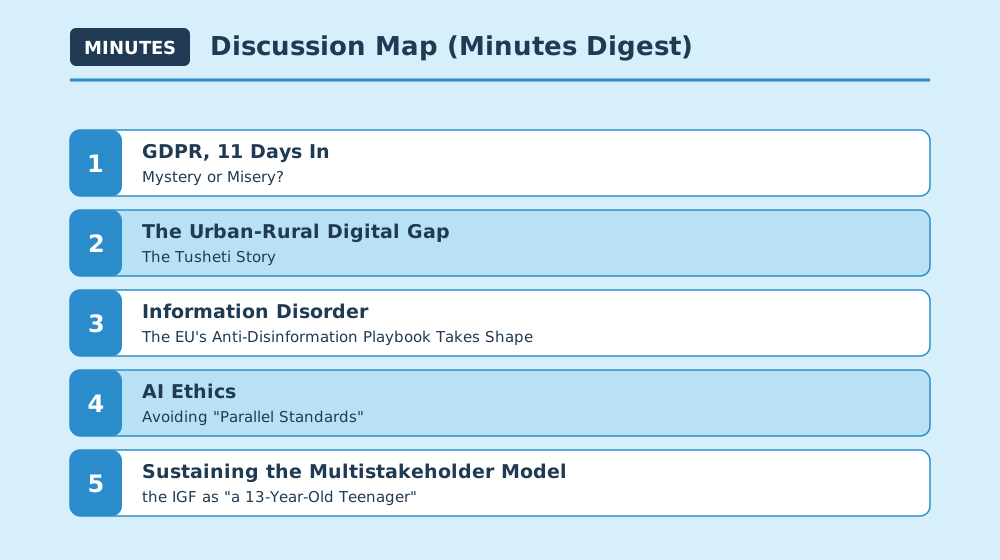
Key exchanges extracted from session records and transcripts.
1. GDPR, 11 Days In — Mystery or Misery?
Sessions: Educational session "Is GDPR still a mystery?" (EDU 1, 5 June) and the WHOIS debates
- Eleven days after entry into force, the session dissected the GDPR across eight sub-areas; one participant quipped that "'Is GDPR still a mystery?' should be called 'Is GDPR still a misery?'" — capturing the practical confusion [4][2]
- On access to WHOIS domain-registration data now redacted under the GDPR, participants agreed that "a federated access solution (accreditation system) seems like the most reasonable way forward" [4][2]
2. The Urban-Rural Digital Gap — The Tusheti Story
Sessions: Lightning talk on the Tusheti project and plenary "Bridging the urban-rural digital gap – a commercial or community effort?" (PL 1, 5 June, 11:30)
"Georgia stands in line with the leading European countries for the freedom of the net"
— Dimitry Kumsishvili (First Vice Prime Minister of Georgia, Minister of Economy and Sustainable Development) [1][6]
- Georgians shared how the Tusheti project, working with the Internet Society, connected a remote highland area of the Caucasus through a community network — the meeting's emblematic story [1][6]
- The plenary tackled the core question head-on: is rural connectivity a commercial or a community effort, and who serves the unprofitable last mile? [1][6]
3. Information Disorder — The EU's Anti-Disinformation Playbook Takes Shape
Sessions: Plenary "Information disorder: causes, risks and remedies" (PL 2, 5 June, 16:45) and flash "Tackling online disinformation: a European approach"
- The European Commission presented its approach — an EU-wide code of practice on disinformation and support for an independent network of fact-checkers; the Code launched that September and became a template for platform accountability [4][1]
- Global anxieties about 'fake news' and their impact on freedom of expression, human rights and democracy ran through the discussions [4][1]
4. AI Ethics — Avoiding "Parallel Standards"
Sessions: Keynote by Claudia Luciani (5 June, 16:30) and workshop "Artificial Intelligence, Ethics and the Future of Work" (WS 8, 6 June, 14:00)
"we need to avoid creating parallel standards, standards that would be issued from the industries and standards that could be issued from the international organisations."
— Claudia Luciani (Director of Democratic Governance and Anti-discrimination, Council of Europe) [5][2]
- Data concentration and algorithmic bias in elections, filter bubbles and voter micro-targeting were flagged as the next challenges beyond the GDPR [5][2]
- The AI-and-work workshop echoed the call to align, not multiply, ethical standards between industry and international organisations [5][2]
5. Sustaining the Multistakeholder Model — the IGF as "a 13-Year-Old Teenager"
Sessions: Keynotes by Yushi Torigoe (Deputy Director, ITU Telecommunication Development Bureau) and Lawrence Strickling (6 June, 9:00), and the session "Future of the IGF" (6 June, 17:15)
"This age is exciting, you are just about to find your identity, you are full of hope and sometimes doubts about the future. Many times teenagers are rebels. Let's look at the IGF movement with the mild eye of parents and help it to become a responsible adult that is able to make a change."
— Sandra Hoferichter (Secretary-General, EuroDIG) [1][2]
"a human centric Internet or an Internet of humans. It will have to be trustworthy, resilient, sustainable and inclusive"
— Mariya Gabriel (European Commissioner for Digital Economy and Society, video message) [1][2]
- Fifteen years after the first WSIS phase, the meeting took stock of the IGF and its national and regional offspring: Torigoe stressed cooperation towards the SDGs, while Strickling — who steered the IANA transition — urged active participation to keep the multistakeholder approach sustainable [1][2]
- Hoferichter's teenager metaphor for the 13-year-old IGF movement framed the debate over turning dialogue into change [1][2]
Three-Minute Short Talk — Your Questions Answered
Q. So what did the conference actually decide?
A. Nothing binding — EuroDIG is Europe's dialogue forum. The takeaways were distilled into the Messages from Tbilisi and carried to the global IGF in Paris that November.
Q. What was the most contentious topic?
A. The GDPR, in force for just 11 days. A session titled 'Is GDPR still a mystery?' prompted the quip that it should be renamed 'Is GDPR still a misery?' — the WHOIS data debate laid the confusion bare.
Q. Why should I care?
A. These early GDPR debates shaped how the regulation was applied worldwide, including adequacy arrangements with non-EU countries. And Tusheti's community network remains a model for connecting remote regions anywhere.
What Is EuroDIG? (for first-time readers)
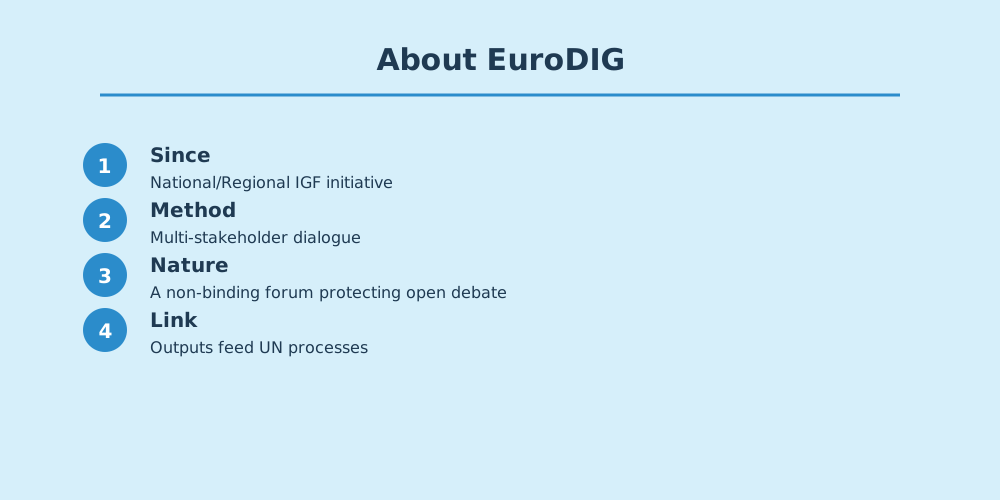
EuroDIG is a National or Regional IGF Initiative (NRI), aligning local internet governance discussion with global IGF principles.
Why It Matters to You
What was discussed here becomes the baseline for national digital policy, platform rules and AI regulation worldwide within a few years. The principles confirmed at the 2018 meeting are the foundation of the "next rules" for the phones, social platforms and AI services you use every day.
Sources & References
- Messages from Tbilisi (PDF) — EuroDIG Association (accessed 2026-07-10)
- EuroDIG 2018 — DiploFoundation (accessed 2026-07-10)
- EuroDIG 2018 — EuroDIG Wiki (accessed 2026-07-10)
- EuroDIG 2018 in Tbilisi: exploring new frontiers and looking into the (digital) future — CENTR(欧州ccTLDレジストリ協会) (accessed 2026-07-10)
- Keynotes 01 2018(クラウディア・ルチアーニ基調講演、書き起こし) — EuroDIG Wiki (accessed 2026-07-10)
- Welcome 2018(開会セッション、書き起こし) — EuroDIG Wiki (accessed 2026-07-10)
Quotes are translated or condensed from the records listed above. Bracketed numbers [n] refer to the source list.
Related links
- IGF official (NRI list): https://www.intgovforum.org/en/content/national-and-regional-igf-initiatives
- Japan IGF: https://japanigf.jp/
- Yuki Nakazawa's blog: https://nkzw.jp/category/igf/
Revision History
Rev. 1 — published 5 June 2018, 09:00 (Article published)
Rev. 2 — updated 10 July 2026, 23:16 (Fully revised into the in-depth edition: added the 3-line summary, minutes digest, short talk, source list and diagrams (all quotes verified against the listed sources))
— 中澤祐樹

